Tag: Gaia Spacecraft

  • Gaia leaves for retirement orbit

    Gaia leaves for retirement orbit

    From 25 July 2014 to 15 January 2025, the Gaia space observatory performed high-precision measurements of nearly two billion stars from its Lissajous orbit around the L2 Lagrange point, 1.5 million km from Earth.

    After 10.5 years of groundbreaking observations, Gaia’s cold gas supply for attitude control has been depleted. On 27 March 2025, Gaia will leave its Lissajous orbit and transition into a stable heliocentric orbit. Soon after, the spacecraft will be passivated, with its instruments and transmitters switched off.

    While Gaia will no longer collect new data, its scientific mission is far from over! The team continues working on Gaia Data Release 4 (expected 2026) and the final legacy catalogue (to be published not before the end of 2030), ensuring that Gaia’s discoveries will shape astronomy for decades to come.

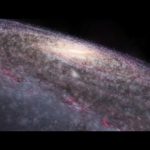
    This video visualises how Gaia leaves its Lissajous orbit and enters its final heliocentric orbit.

    This video was made with Gaia Sky (https://gaiasky.space) by Tiago Nogueira, Toni Sagristà, and Stefan Jordan.

    Text: Stefan Jordan, Tiago Nogueira, Tineke Roegiers

    The creators would like to thank Alessandro Masat and Ander Martinez from ESA for providing Gaia’s orbit and attitude data.

    Credit: ESA/Gaia/DPAC, CC BY-SA 3.0 IGO

    ★ Subscribe: http://bit.ly/ESAsubscribe and click twice on the bell button to receive our notifications.

    Check out our full video catalog: http://bit.ly/SpaceInVideos
    Follow us on Twitter: http://bit.ly/ESAonTwitter
    On Facebook: http://bit.ly/ESAonFacebook
    On Instagram: http://bit.ly/ESAonInstagram
    On LinkedIn: https://bit.ly/ESAonLinkedIn
    On Pinterest: https://bit.ly/ESAonPinterest
    On Flickr: http://bit.ly/ESAonFlickr

    We are Europe’s gateway to space. Our mission is to shape the development of Europe’s space capability and ensure that investment in space continues to deliver benefits to the citizens of Europe and the world. Check out https://www.esa.int/ to get up to speed on everything space related.

    Copyright information about our videos is available here: https://www.esa.int/ESA_Multimedia/Terms_and_Conditions

  • Have we detected the first medium-sized #BlackHole? 🤔 #shorts

    Have we detected the first medium-sized #BlackHole? 🤔 #shorts

    Our #Gaia spacecraft has captured a huge dark blob, 800 times more massive than our Sun which seems to be squeezed into a surprisingly small volume of space suggesting it could be an intermediate-mass black hole.

    Read more 👉 https://www.esa.int/ESA_Multimedia/Videos/2023/05/Has_Gaia_found_missing_link_in_black_hole_evolution/

    ★ Subscribe: http://bit.ly/ESAsubscribe and click twice on the bell button to receive our notifications.

    Check out our full video catalog: http://bit.ly/SpaceInVideos
    Follow us on Twitter: http://bit.ly/ESAonTwitter
    On Facebook: http://bit.ly/ESAonFacebook
    On Instagram: http://bit.ly/ESAonInstagram
    On LinkedIn: https://bit.ly/ESAonLinkedIn
    On Pinterest: https://bit.ly/ESAonPinterest
    On Flickr: http://bit.ly/ESAonFlickr

    We are Europe’s gateway to space. Our mission is to shape the development of Europe’s space capability and ensure that investment in space continues to deliver benefits to the citizens of Europe and the world. Check out https://www.esa.int/ to get up to speed on everything space related.

    Copyright information about our videos is available here: https://www.esa.int/ESA_Multimedia/Terms_and_Conditions
    #ESA
    #Gaia
    #Blackhole

  • Catching speeding stars

    Catching speeding stars

    This video reveals the evolution of stars in our Galaxy over the past million of years.

    It starts from the positions of stars in the sky 1 035 000 years ago, which were calculated using data from the Tycho-Gaia Astrometric Solution, or TGAS, one of the products of the first Gaia data release. The video follows the evolution of stellar positions until the present day, ending with a view of the sky as measured by Gaia between 2014 and 2015.

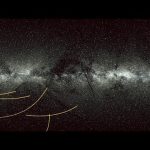
    Highlighted in yellow are the trajectories of six special stars: these are hypervelocity stars, moving through the Galaxy at several hundred of km/s. While it might not be apparent from the video, which shows the motions of stars as projected on the sky, they are moving through space much faster than the galactic average.

    Scientists spotted these speeding stars from the TGAS data set of two million stars with the help of an artificial neural network – software that mimics a human brain – and they are looking forward to finding many more in future Gaia data releases.

    These stars owe their high speeds to past interactions with the supermassive black hole that sits at the centre of the Milky Way and, with a mass of four million Suns, governs the orbits of stars in its vicinity. Having travelled great distances through the Galaxy, they provide crucial information about the gravitational field of the Milky Way from the centre to its outskirts.

    One of the six stars (labelled 1 at the end of the video) seems to be speeding so fast, at over 500 km/s, that it is no longer bound by the gravity of the Galaxy and will eventually leave. The other five stars are somewhat slower (over 400 km/s for the stars labelled 2, 3, 4 and 6, and 360 km/s for the star labelled 5) and are still bound to the Galaxy.

    These slightly slower stars are perhaps even more fascinating, as scientists are eager to learn what slowed them down – the invisible dark matter that is thought to pervade the Milky Way might also have played a role.

    The stars are plotted in Galactic coordinates and using a rectangular projection: in this, the plane of the Milky Way stands out as the horizontal band with greater density of stars. The stripes visible in the final frames reflect the way Gaia scans the sky and the preliminary nature of the first data release; these artefacts are gradually washed out in the video as stars move across the sky.

    Read more on our website:
    Artificial brain helps Gaia catch speeding stars –
    http://www.esa.int/Our_Activities/Space_Science/Gaia/Artificial_brain_helps_Gaia_catch_speeding_stars

    More about Gaia:
    http://sci.esa.int/gaia/

    Credit: ESA/Gaia/DPAC CC BY-SA 3.0 IGO: https://creativecommons.org/licenses/by-sa/3.0/igo/

  • The future of the Orion constellation

    The future of the Orion constellation

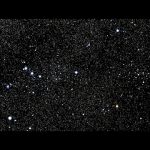
    This video reveals how our view of the Orion constellation will evolve over the next 450 000 years.

    Amid a myriad of drifting stars, the shape of Orion as defined by its brightest stars is slowly rearranged into a new pattern as time goes by.

    The portion of the sky depicted in the video measures 40 x 20º – as a comparison, the diameter of the full Moon in the sky is about half a degree.

    The video is based on data from ESA’s Gaia and Hipparcos satellites, as well as additional information from ground-based observations.

    A speeded-up version of the video is available here: http://sci.esa.int/gaia/59209

    Full story: The future of the Orion constellation http://www.esa.int/Our_Activities/Space_Science/Gaia/The_future_of_the_Orion_constellation

    The evolution of two million stellar positions on the entire sky is shown here: https://www.youtube.com/watch?v=87lgSRVUSxM

    Copyright: ESA/Gaia/DPAC CC BY-SA 3.0 IGO: https://creativecommons.org/licenses/by-sa/3.0/igo/

  • The motion of two million stars

    The motion of two million stars

    This video reveals the changing face of our Galaxy, tracing the motion of two million stars five million years into the future using data from the Tycho-Gaia Astrometric Solution, one of the products of the first Gaia data release. This provides a preview of the stellar motions that will be revealed in Gaia’s future data releases, which will enable scientists to investigate the formation history of our Galaxy.

    The stars are plotted in Galactic coordinates and using a rectangular projection: in this, the plane of the Milky Way stands out as the horizontal band with greater density of stars.

    The video starts from the positions of stars as measured by Gaia between 2014 and 2015, and shows how these positions are expected to evolve. The frames in the video are separated by 750 years, and the overall sequence covers five million years. The stripes visible in the early frames reflect the way Gaia scans the sky and the preliminary nature of the first data release; these artefacts are gradually washed out in the video as stars move across the sky.

    The shape of the Orion constellation can be spotted towards the right edge of the frame, just below the Galactic Plane, at the beginning of the video. As the sequence proceeds, the familiar shape of this constellation (and others) evolves into a new pattern. Two stellar clusters – groups of stars that were born together and consequently move together – can be seen towards the left edge of the frame: these are the alpha Persei (Per OB3) and Pleiades open clusters.

    More about this video:
    http://sci.esa.int/gaia/59004-two-million-stars-on-the-move/

    Credit: ESA/Gaia/DPAC CC BY-SA 3.0 IGO: https://creativecommons.org/licenses/by-sa/3.0/igo/

  • From the Solar System to the Hyades cluster

    From the Solar System to the Hyades cluster

    A virtual journey, from our Solar System through the Milky Way, based on data from the first release of ESA’s Gaia satellite.

    The journey starts by looking back at the Sun, surrounded by its eight planets. We then move away from the Sun and travel towards and around the Hyades star cluster, the closest open cluster to the Solar System, some 150 light-years away.

    The 3D positions of the stars shown in the animation are drawn from the Tycho-Gaia Astrometric Solution (TGAS), which combines information from Gaia’s first year of observations with the earlier Hipparcos and Tycho-2 Catalogues, both based on data from ESA’s Hipparcos mission.

    This new dataset contains positions on the sky, distances and proper motions of over two million stars. It is twice as precise and contains almost 20 times as many stars as the previous reference for astrometry, the Hipparcos Catalogue.

    The journey continues showing the full extent size of the stars contained in the Tycho-Gaia Astrometric Solution, all relatively near to the Sun, in the overall context of our Milky Way galaxy.

    The final Gaia catalogue will contain the most detailed 3D map ever made of the Galaxy, charting a billion stars – about 1% of the Milky Way’s stellar content – to unprecedented accuracy.

    For more information about Gaia, visit: http://www.esa.int/gaia

    Credit: ESA/Gaia/DPAC; Acknowledgement: S. Jordan & T. Sagristà Sellés (Zentrum für Astronomie der Universität Heidelberg)