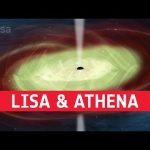
In this video, our scientists Paul McNamara and Matteo Guainazzi explain how we could combine the observing power of two of our future missions, LISA and Athena, to study these cosmic clashes and their mysterious aftermath for the first time.
LISA, the Laser Interferometer Space Antenna, will be the first space-borne observatory of gravitational waves – fluctuations in the fabric of spacetime produced by the acceleration of cosmic objects with very strong gravity fields, like pairs of merging black holes. Athena, the Advanced Telescope for High-ENergy Astrophysics, will be the largest X-ray observatory ever built, investigating some of the hottest and most energetic phenomena in the cosmos with unprecedented accuracy and depth. Currently in the study phase, both missions are scheduled for launch in the early 2030s.
Credits: Event Horizon Telescope Collaboration (black hole image); NASA, ESA and F. Summers, STScI (Hubble Ultra Deep Field flythrough and galaxy merger); Simulating eXtreme Spacetimes Project (gravitational waves and merging black holes); NASA’s Goddard Space Flight Centre (spiralling supermassive black holes); AEI/Milde Science Communication/exozet (LISA orbit sequence); ESA/Hubble, NASA, M. Kornmesser
★ Subscribe: http://bit.ly/ESAsubscribe and click twice on the bell button to receive our notifications.
We are Europe’s gateway to space. Our mission is to shape the development of Europe’s space capability and ensure that investment in space continues to deliver benefits to the citizens of Europe and the world. Check out http://www.esa.int/ESA to get up to speed on everything space related.
What if everything in the universe came to your doorstep…in a box?! What The Physics is BACK! Future episodes will explore the universe—but first, let’s unbox it.
Subscribe: http://youtube.com/whatthephysics?sub…
↓Want more info?↓
SCIENTIFIC NOTES:
Explosive young stars
* The average lifetime of a star is about 10 billion years, but the bigger the star, the shorter its life. One rare type of star, called a hypergiant, can be tens, hundreds, or even a thousand times the mass of our sun. These stars burn out and explode into supernovae in just a few million years. http://www.guide-to-the-universe.com/hypergiant-star.html
Black holes
* Black holes form from the collapse of a massive star at the end of its life, but this only happens in stars about three times as massive as the sun. http://burro.case.edu/Academics/Astr201/EndofSun.pdf
How big is the universe?
* Probably infinite. No one knows the size of the universe for sure, and we may never know, but the latest thinking is that it probably goes on forever. https://map.gsfc.nasa.gov/universe/uni_shape.html
Standard cosmological model
* According to the standard cosmological model, the universe started with a big bang, underwent rapid inflation within the first fraction of a second, and continues to expand, driven by a vacuum energy called dark energy. All of the structure we see in the universe has come from interactions between dark energy and dark matter (which accounts for about 85% of the universe’s matter). This model describes and predicts many phenomena in the universe but is not perfect. https://physics.aps.org/articles/v8/108
False vacuum model
* The false vacuum model is a real, albeit unlikely theory. All the fundamental forces of nature have corresponding fields (e.g., gravitational fields, magnetic fields, etc.), and we generally believe that the universe is at rest in a global minimum of the potentials of those fields. But if we are instead at rest in a local minimum, or a “false vacuum,” the universe could potentially be nudged, catastrophically, into a lower minimum.
Recycling stars into life
* Before the first stars, the universe was all hydrogen and helium. All heavier elements, including the building blocks of life, were forged in stars.
Dark matter and dark energy
* Only 5% of the universe is made up of matter we can see. The “missing mass” later dubbed dark matter was first noticed in the 1930s; dark energy was discovered in the 1990s. In both cases, their existence was inferred by their effect on objects they interact with. However, they are still not directly observable, so nobody knows yet what they are made of.
Leftover light from the Big Bang
* The theory of the Big Bang predicted the existence of cool radiation pervading the universe, left over from its beginning. In an accidental discovery, two New Jersey scientists discovered the cosmic microwave background, a nearly uniform bath of radiation throughout the universe at a temperature of about 3 Kelvin, or -454 degrees Fahrenheit.
Gravitational waves
* Albert Einstein predicted the existence of gravitational waves in his theory of general relativity in 1916. According to his theory, the acceleration of massive objects, like black holes, should send ripples through space-time at the speed of light. A century after his prediction, two merging black holes sent a ripple through space-time that was detected on Earth as a signal that stretched the 4-kilometer arms of a detector by less than 1/1,000 the width of a proton.
Cosmic dust
* Cosmic dust is cast off from stars at the end of their lives and hovers in galaxies as clouds. These clouds of dust absorb ultraviolet and visible light, obscuring much of what lies behind them. This makes it notoriously difficult to study things like the dusty center of our galaxy.
The observable universe
* The universe is 13.8 billion years old. Since the distance we can observe is limited by the time it takes light to travel to Earth, we can only ever observe a fraction of the universe: an expanding sphere around us that is now about 46 billion years in radius. However, the universe is much larger than what we can observe.
CREDITS:
Host, Writer, Producer: Greg Kestin
Animation & Compositing: Danielle Gustitus
Contributing Writers: Lissy Herman, HCSUCS
Filming, Writing, & Editing Contributions from:
Samia Bouzid and David Goodliffe
Creation of Sad Star Image: Drew Ganon
Special thanks:
Julia Cort
Lauren Aguirre
Ari Daniel
Anna Rothschild
Allison Eck
Fernando Becerra
And the entire NOVA team
The LISA Pathfinder mission ends on 18 July 2017 after a successful demonstration of the technology needed to detect gravitational waves in space. These vibrations in spacetime, first predicted by Einstein over a hundred years ago, are produced by huge astronomical events – such as two black holes colliding – and will allow scientists to open new windows into our universe.
The success of the LISA Pathfinder mission has paved the way for the newly selected LISA mission which, when built and launched, will detect gravitational waves from objects up to a million times larger than our Sun.
The film features interview soundbites from Dr Paul McNamara, LISA Pathfinder Project Scientist, at the European Space Agency’s European Technology and Science facility (ESTEC) in The Netherlands.
Launched in December 2015, LISA Pathfinder travelled to its operational orbit, 1.5 million km from earth towards the Sun, where it started its scientific mission on 1 March.
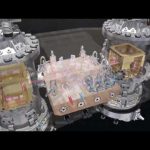
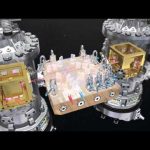
At the core of the spacecraft, two identical gold-platinum cubes, are being held in the most precise free-fall ever produced in space.
Placing the test masses in a motion subject only to gravity is the challenging condition needed to build and operate a future space mission to observe gravitational waves. Predicted by Albert Einstein a century ago, gravitational waves are fluctuations in the fabric of space-time, which were recently detected directly for the first time by the Laser Interferometer Gravitational-Wave Observatory.
Over the first two months of scientific operations, the LISA Pathfinder team has performed a number of experiments on the test masses to prove the feasibility of gravitational wave observation from space.
These results are explained in this video with interviews of Paul McNamara, LISA Pathfinder Project scientist, ESA and two LISA Pathfinder Principal investigators : Rita DOLES, University of Trento and Martin Hewitson, University of Hannover.
During his Feb. 9 State of NASA speech at Langley Research Center in Hampton, Va, Administrator Charles Bolden characterized President Obama’s $19 billion Fiscal Year 2017 budget proposal for NASA as a vote of confidence and an indication of the agency’s strength. Bolden noted that the investments in the FY2017 budget proposal will empower NASA to continue to work with partners both in and out of government to develop the technologies that drive exploration – to build an even stronger future in which NASA continues reaching for new heights for the benefit of all humankind. Also, Space station one-year crew update, Increased land water slows sea level rise, Gravitational waves detected, and more!
ESA’s LISA Pathfinder mission is a technology demonstrator that will pave the way for future spaceborne gravitational-wave observatories. It will operate about 1.5 million km from Earth towards the Sun, orbiting the first Sun–Earth ‘Lagrangian point’, L1.
The animation of the spacecraft build-up begins with two freely falling test masses. Between them lies the central component of LISA Pathfinder’s payload: the 20 x 20 cm optical bench interferometer. A set of 22 mirrors and beam-splitters directs laser beams across the bench. There are two beams: one reflects off the two free-falling test masses while the other is confined to the bench. By comparing the length of the different paths covered by the beams, it is possible to monitor changes accurately in distance and orientation between the two test masses.
A box surrounds the two masses without touching them, shielding them from outside influence and constantly applying tiny adjustments to its position. This internal payload is housed in a central cylinder, isolating the test masses from the other components of the science payload and spacecraft.
The solar array provides power to the instrumentation and acts as a thermal shield. Microthrusters control the spacecraft to keep the master test mass centred in its housing, opposing the force of the solar radiation pressure – the main source of ‘noise’ – impinging on the solar array.
Although LISA Pathfinder is not aimed at the detection of gravitational waves themselves, it will prove the innovative technologies needed to do so. It will demonstrate that the two independent masses can be monitored as they free-fall through space, reducing external and internal disturbances to the point where the relative test mass positions would be more stable than the expected change caused by a passing gravitational wave, equal to much less than the size of an atom.