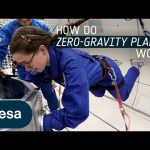
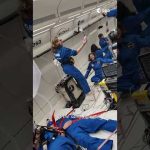
Ever wondered how astronauts prepare for the weightlessness of space? In Bordeaux, France, our astronauts train for microgravity using parabolic flights! These special flights create brief periods of zero gravity, mimicking the conditions of space.
By performing a series of steep climbs and descents, the plane allows astronauts to experience intense 2G forces before entering a 22-second weightless phase! This crucial training helps future astronauts adapt to moving, working, and even jumping in zero gravity.
Join us as we follow Rosemary Coogan, Sławosz Uznański-Wiśniewski, and John McFall on their parabolic flight training.
Credits: ESA – European Space Agency Footage: ESA/Novaspace
★ Subscribe: http://bit.ly/ESAsubscribe and click twice on the bell button to receive our notifications.
We are Europe’s gateway to space. Our mission is to shape the development of Europe’s space capability and ensure that investment in space continues to deliver benefits to the citizens of Europe and the world. Check out https://www.esa.int/ to get up to speed on everything space related.
We know how microgravity impacts the brain thanks to astronauts on the ISS, but what about life on the Moon or Mars? Future explorers will also face hypoxia—low oxygen levels—which could affect their brain function and decision-making.
A team of students is tackling this challenge by conducting zero-gravity flight experiments to study how the brain responds to both microgravity and hypoxia. Their research could help improve astronaut safety for future lunar and Martian missions, ensuring they can explore safely beyond their spacecraft.
Could this be a key step in preparing humans for deep space exploration? Let us know your thoughts in the comments!
📹 ESA – European Space Agency 📸 ESA – European Space Agency
NASA spacecraft deliver stunning visual imagery of the cosmos, but we can also experience that data by turning it into sound. Kim Arcand at the Chandra X-Ray Observatory has helped develop many different sonifications including from galaxies, black holes, nebulae and more. Kim chats with NASA’s Chief Scientist Jim Green about her process of choosing instruments to represent different kinds of light, and plays a few examples of these cosmic sounds. Kim developed these sonifications in collaboration with astrophysicist Matt Russo and musician Andrew Santaguida, both of the SYSTEM Sound project. Check out the full series of sonifications at chandra.si.edu/sound and listen to the rest of this Gravity Assist podcast episode at nasa.gov/gravityassist.
Listen to the full episode of this podcast and subscribe at: https://www.nasa.gov/gravityassist
For decades, moons of the outer solar system have proven fascinating subjects for scientists interested in the search for life. Forty years ago this year, NASA’s Voyager 1 spacecraft flew by Saturn’s moon Titan and took the first close images, revealing a thick orange-colored atmosphere that is the most Earth-like in the solar system. NASA’s Cassini probe then dropped off a lander at Titan called Huygens in 2004, and studied Titan in detail during its 13 years at Saturn. Now, NASA is preparing to launch the rotorcraft mission Dragonfly to Titan in the 2020s. But Titan is just one interesting moon. The European Space Agency’s upcoming JUpiter ICy moons Explorer (JUICE) mission will study Ganymede, Europa, and another moon of Jupiter called Callisto. Meanwhile, NASA’s Europa Clipper mission will provide complementary observations of Europa.
If astrobiologists find life beyond Earth in the solar system, it will most likely be in the form of tiny organisms called microbes – nothing that would talk to us. But the galaxy is a big place; the universe even bigger. Somewhere out there, life may have evolved to become as smart, or even much smarter, than us. And the next step in that ladder may be “post-biological,” argues Susan Schneider, the Baruch S. Blumberg NASA/Library of Congress Chair in Astrobiology, Exploration, and Scientific Innovation. Advanced life may be entirely based on microchips and silicon, using the tools of artificial intelligence instead of brains. Listen to the full episode of “Gravity Assist” at nasa.gov/gravityassist.
Producer Credit: Sonnet Apple & Elizabeth Landau
Music Credit: Universal Production Music
Here at ESA, the European Space Agency, space is our business. It’s a place we explore, heading outwards while also looking back, to improve life on our own blue planet. Why go out there? Because space is useful and valuable; because it’s the place we all live. That’s why ESA does what we do: because Earth is only the start. Here’s what you need to know about the stuff that surrounds us.
★ Subscribe: http://bit.ly/ESAsubscribe and click twice on the bell button to receive our notifications.
We are Europe’s gateway to space. Our mission is to shape the development of Europe’s space capability and ensure that investment in space continues to deliver benefits to the citizens of Europe and the world. Check out http://www.esa.int/ESA to get up to speed on everything space related.
Astrobiologists study ancient lakes on Earth in order to help us search for life in our solar system and beyond. Subscribe to our “Gravity Assist” podcast for this episode and more: www.nasa.gov/gravityassist
As the Perseverance Rover flies toward Jezero Crater on Mars, which once hosted water, astrobiologists are interested in places on Earth that are similar to the rover landing site. Kennda Lynch, scientist at the Lunar and Planetary Institute in Houston, Texas, has been doing fieldwork in an ancient lake location in Utah called the Pilot Valley Playa. In this episode of Gravity Assist, she describes her recent discoveries and why she’s excited about Perseverance. She also explains how all life forms create waste products, even bacteria, that could leave tracers or “biosignatures” for scientists to detect. By looking at how microbes survive in extreme environments on Earth, scientists can explore the bigger question of how life could sustain itself on other planetary bodies like Mars and Jupiter’s moon Europa.
Image Credits:
NASA
Vox/ YouTube Original -“Glad You Asked”
Brocken Inaglory/Wikimedia Commons
Alexander Gerst/Wikimedia Commons
Paul Hermans/Wikimedia Commons
Is there life beyond Earth? How did life get started on Earth anyway? This season of NASA’s Gravity Assist podcast is about the origins of life on Earth and the search for life elsewhere. Subscribe at https://www.nasa.gov/gravityassist. See all NASA podcasts: www.nasa.gov/podcasts
Hosted by NASA’s Chief Scientist Jim Green, each episode features a conversation with a scientist who has researched some aspect of these questions. We’ll talk about the search for life on Mars, what kind of life might survive on Saturn’s moon Titan, and much more.
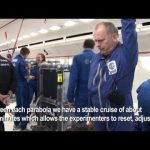
ESA’s parabolic flight project coordinator Neil Melville explains why 40 researchers working on 12 technologically-advanced experiments are put in an aircraft that flies at maximum thrust in repeated 50° angles at the limits of the Novespace aircraft’s design.
Parabolic flights offer sessions of 20 seconds of zero gravity giving a total of 10 minutes of weightlessness each flight. The advantage of parabolic flights over other platforms for experimentation in altered gravity is that researchers can join the flight and interact with their experiment – fine tuning hardware, running tests on human subjects or changing parameters on the fly. The experiments are carefully chosen for potential benefits, safety and uniqueness.
Neil highlights some of the experiments on ESA’s 72nd campaign that covered disciplines as diverse as astronomy, cooling techniques, metallurgy, weather and human physiology.
The Progra2 experiment is creating clouds of matter and recording how light is scattered by micrometre-sized particles. The carbon-based dust is chosen to resemble the clouds found in our Solar System such as around asteroids and comets. Knowing how light is scattered by these particles in microgravity will help interpret observations made from telescopes and increase our understanding the Universe.
An experiment from the Université Libre de Bruxelles in Belgium is looking at healing wounds with bio-mimetic materials by submitting them to mechanical stresses typical in weightlessness. The knowledge acquired will pave the way for the development of biophysical models and a have a direct impact on the industrial market of wearable electronics.
The VIP-GRAN team is looking into how particles behave in reduced gravity to understand the underlying physics in detail. On this flight they investigated the jamming of particles as they flow through small openings. This can be an annoyance on Earth when salt gets stuck in the shaker for example, but the phenomenon is influenced by gravity and the researchers want to know more. This was the ninth flight for the VIP-GRAN team and who are working towards having a version of their experiment fly on the International Space Station with even more weightless time.
Air Zero-G exterior footage courtesy of Airborne Films and Novespace.
★ Subscribe: http://bit.ly/ESAsubscribe and click twice on the bell button to receive our notifications.
We are Europe’s gateway to space. Our mission is to shape the development of Europe’s space capability and ensure that investment in space continues to deliver benefits to the citizens of Europe and the world. Check out http://www.esa.int/ESA to get up to speed on everything space related.
NASA’s Chief Scientist, Jim Green, talks with some of the world’s top lunar experts.
Listen: https://www.nasa.gov/gravity-assist Subscribe: https://go.nasa.gov/30Hfpd1
What’s so special about our Moon? This season of Gravity Assist dives into the Moon’s history and mysteries, as well as NASA’s plans to send astronauts there by 2024. New episodes on Thursdays.
To support Kurzgesagt and learn more about Brilliant, go to https://www.brilliant.org/nutshell and sign up for free. The first 688 people that go to that link will get 20% off the annual Premium subscription.
Are wormholes real or are they just magic disguised as physics and maths? And if they are real how do they work and where can we find them?
🐦🐧🐤 PATREON BIRD ARMY 🐤🐧🐦
▀▀▀▀▀▀▀▀▀▀▀▀▀▀▀▀▀▀▀▀▀▀▀▀▀▀
Many Thanks to our wonderful Patreons from http://kgs.link/patreon who support us every month and made this video possible:
Big Skapinsky, Liam Wenzel, Juan Gonzalez, Grigory Sarnitsky, Brandon Cleary, Amanda Hutchings, Siddharth Amarsee, Maciamo Hay, Nick T., Gabriel Correa, Matthew McAteer, Javier Silva Calvo, javier canella, Gergely Szakács, Pernox, Alana leonhardy, Tommi Moilanen, David DiGiovanni, Jack Bernstein, Jonas Steen Nielsen, Thomas Pyke, Gizem Ozdemir, ShiroiYami, Alice Bater, Ennio Sialiti, Alexander Evans, Eric Chan, Peter Noort, Adrian Haslinger, Tomasz Różalski, Miro Cibula, Lyle Jeff, Sunil Pai, Aurélien Delaux, Piotr Pałek, Øyvind Helland, Khloudalahbaby, Nicola Larosa, Dave, Montant, Eli V, ryan oberfield, Iain Garioch, Janina Lamøy, Saurischian, Zachary Osman, Cody Douglas, Can Berk Güder, Jason Lin, Eric Lugo, Emil Hjort, Luuk Perdaems, Brandon Carraway, Zack Methven, dava, Gauthier Muguerza, Tim Andreev, Robin Gielings, Mihai Anei, Pranab Kumar Mishra, jeong-min, An, Nerijana, jongre1512, Mike Levy, David W., Jakob Stams, Linda Yancey, Leo White, John, Justin Boh, Thot, Matthew Dyet, Andrei Stefan, Patrick McKelvy, Kervan Govender, Rajiv Cruz, Peter Duncan, Ramsey Elbasheer, Zhuang Miao, Brayden Sola, frikinside, Yasmeen Mawlawi, Loic Rebillard, Nicholas Miller, Philipp Bergamin, K. Gustavo Carlos, Albin, Connor Wilson, Talal Al-Khaldi, NURO, Durham Goode, Christopher Hadley, Sean Holland, iulian constantin, Pumpk!nH34D, Douwe de Jong, Jens Baumann, Vladislav Aleynikov, Joshua Olson, Andrew Boggs, William Wu, Andrew Mckinley, Eric Burnett, Benjamin Bromberg, Barry Costa, Philippe Ryll, Barbieri Davide, Claire Baldauf, Ondrej Debreceni, Benjamin Sairanen, Elija Peterson, Eki Hassa, Ryan K. Allen, Ville Vuorela, Reinhold Dunkl, Gloria Hope, Matti Hanberg, Moritz Roell, Marco Schmidt, Trey, Jiesi Ren, Maurice Simmons, Simon Sardeson-Coe, Sam Day, Orphansmith, Noah T Blanchard, Gerald Balla, Yannick van Andel, Khaled I. Johari
What if the Earth were swallowed by a black hole? Would humanity’s legacy be gone forever? Or could you somehow get back that information from behind the event horizon?
There are three possible answers to this question…but they all break physics as we know it!
Have you ever wondered what it would be like to fall into a black hole? Take a 360° adventure to find out!
SUBSCRIBE: http://youtube.com/whatthephysics?sub
Is String Theory the final solution for all of physic’s questions or an overhyped dead end?
This video was realised with the help of Dr. Alessandro Sfondrini and it was funded by SNSF under Agora Grant n. 171622 and through the NCCR SwissMAP: The Mathematics of Physics.
🐦🐧🐤 PATREON BIRD ARMY 🐤🐧🐦
▀▀▀▀▀▀▀▀▀▀▀▀▀▀▀▀▀▀▀▀▀▀▀▀▀▀
Many Thanks to our wonderful Patreons from http://kgs.link/patreon who support us every month and made this video possible:
Flavio Storino, Alice Balcon, Hari Krishnan, Warren Wiscombe, Sara Zeglin, Asiryan Alexander, maarten sprengers, William Northern, Kerem Mimaroglu, Yana Kultysheva, Josh, Keaton Anderson, Croconaw, Peter Steinberger, Jonathan Diamond, Troy McConaghy, Paddy, Darko Sperac, Peter Burkhalter, Chris Amaris, Tyler Lovell, John Ruble, Chase Henson, Arpita Singh, Edward C.P., Andreas Edlund, Ryan Bubinski, Paul Greyson, Jerry Ding, Austin Sundquist, Daniel Link, Tim Johnson, kayleigh dreste, Johan Sjöblom, Max Stuart, Mush Rain, Andor Baranyi, Eduardas Afanasjevas, Bill Clem, Jake Smith, Stephen Woerner, Jeff Sorensen, Christopher Damsgaard, Eduardo AV, Michael Gawenka, Florian Hoedt, Lucas Nyman, Nathanael Baker, Martin Wierzyk, Mauricio Streb, Karl, Rameet Chawla, Joachim Andersen, Avinash, Erik Golden, Glenn Stoltz, Elliott Nelson, Andrew Averett, Ben Wei
What if everything in the universe came to your doorstep…in a box?! What The Physics is BACK! Future episodes will explore the universe—but first, let’s unbox it.
Subscribe: http://youtube.com/whatthephysics?sub…
↓Want more info?↓
SCIENTIFIC NOTES:
Explosive young stars
* The average lifetime of a star is about 10 billion years, but the bigger the star, the shorter its life. One rare type of star, called a hypergiant, can be tens, hundreds, or even a thousand times the mass of our sun. These stars burn out and explode into supernovae in just a few million years. http://www.guide-to-the-universe.com/hypergiant-star.html
Black holes
* Black holes form from the collapse of a massive star at the end of its life, but this only happens in stars about three times as massive as the sun. http://burro.case.edu/Academics/Astr201/EndofSun.pdf
How big is the universe?
* Probably infinite. No one knows the size of the universe for sure, and we may never know, but the latest thinking is that it probably goes on forever. https://map.gsfc.nasa.gov/universe/uni_shape.html
Standard cosmological model
* According to the standard cosmological model, the universe started with a big bang, underwent rapid inflation within the first fraction of a second, and continues to expand, driven by a vacuum energy called dark energy. All of the structure we see in the universe has come from interactions between dark energy and dark matter (which accounts for about 85% of the universe’s matter). This model describes and predicts many phenomena in the universe but is not perfect. https://physics.aps.org/articles/v8/108
False vacuum model
* The false vacuum model is a real, albeit unlikely theory. All the fundamental forces of nature have corresponding fields (e.g., gravitational fields, magnetic fields, etc.), and we generally believe that the universe is at rest in a global minimum of the potentials of those fields. But if we are instead at rest in a local minimum, or a “false vacuum,” the universe could potentially be nudged, catastrophically, into a lower minimum.
Recycling stars into life
* Before the first stars, the universe was all hydrogen and helium. All heavier elements, including the building blocks of life, were forged in stars.
Dark matter and dark energy
* Only 5% of the universe is made up of matter we can see. The “missing mass” later dubbed dark matter was first noticed in the 1930s; dark energy was discovered in the 1990s. In both cases, their existence was inferred by their effect on objects they interact with. However, they are still not directly observable, so nobody knows yet what they are made of.
Leftover light from the Big Bang
* The theory of the Big Bang predicted the existence of cool radiation pervading the universe, left over from its beginning. In an accidental discovery, two New Jersey scientists discovered the cosmic microwave background, a nearly uniform bath of radiation throughout the universe at a temperature of about 3 Kelvin, or -454 degrees Fahrenheit.
Gravitational waves
* Albert Einstein predicted the existence of gravitational waves in his theory of general relativity in 1916. According to his theory, the acceleration of massive objects, like black holes, should send ripples through space-time at the speed of light. A century after his prediction, two merging black holes sent a ripple through space-time that was detected on Earth as a signal that stretched the 4-kilometer arms of a detector by less than 1/1,000 the width of a proton.
Cosmic dust
* Cosmic dust is cast off from stars at the end of their lives and hovers in galaxies as clouds. These clouds of dust absorb ultraviolet and visible light, obscuring much of what lies behind them. This makes it notoriously difficult to study things like the dusty center of our galaxy.
The observable universe
* The universe is 13.8 billion years old. Since the distance we can observe is limited by the time it takes light to travel to Earth, we can only ever observe a fraction of the universe: an expanding sphere around us that is now about 46 billion years in radius. However, the universe is much larger than what we can observe.
CREDITS:
Host, Writer, Producer: Greg Kestin
Animation & Compositing: Danielle Gustitus
Contributing Writers: Lissy Herman, HCSUCS
Filming, Writing, & Editing Contributions from:
Samia Bouzid and David Goodliffe
Creation of Sad Star Image: Drew Ganon
Special thanks:
Julia Cort
Lauren Aguirre
Ari Daniel
Anna Rothschild
Allison Eck
Fernando Becerra
And the entire NOVA team
Does gravity change the color of light all around you? Einstein thought so. Did this ingenious experiment proved him right?
Subscribe: http://youtube.com/whatthephysics?sub…
↓Want more info?↓
Special thanks:
Tyler Howe
Ari Daniel
Paul Horowitz
Sara Tewksbury
Seeta Joseph
Karishma Desai
Lauren Aguirre
Kristine Allington
Allison Eck
Lauren Miller
Stuart McNeil
How does an astronaut return to Earth from the International Space Station? What does it feel like to re-enter the atmosphere? How does the Soyuz capsule function? Watch and find out. This video is based on an actual lesson delivered to the ESA astronaut class of 2009 (also known as the #Shenanigans09) during their ESA Basic Training. It features interviews with astronauts who have flown on the Soyuz and dramatic footage of actual landings.
Produced by the ESA Human Spaceflight and Operations (HSO) Astronaut Training Division, Cologne, Germany, in collaboration with the HSO Strategic Planning and Outreach Office, Noordwijk, The Netherlands, with special support from Roskosmos.
Content Design: Stephane Ghiste, Dmitriy Churkin, Raffaele Castellano, Matthew Day (HSO-UT)
Animation & Video Editing: Raffaele Castellano (HSO-UT), HSO-K
Project Coordination: Matthew Day, Stephane Ghiste, Dmitriy Churkin (HSO-UT)
Special thanks to:
Martin Schweiger (Orbiter software: http://orbit/medphys.ucl.ac.uk/)
Nikita Vtyurin, Andrew Thielmann (Orbiter Soyuz model)
Lionel Ferra (HSO-UT)
Oleg Polovnikov (HSO-UT)
Frank De Winne (HSO-A)
Paolo Nespoli (HSO-A)
Antonio Rodenas Bosque (HSO-UT)
NASA
ROSCOSMOS
S.P. Korolev Rocket and Space Corporation Energia
Aerospace Search and Rescue Service of the Russian Federation
Parachute footage: Cambridge University Spaceflight
Surfer footage: copyright Red Bull Media House
Footage from inside Soyuz capsule courtesy of RSC Energia has limited rights:
a) These data are submitted with Limited Rights under Agreement among the Government of Canada, Governments of Member States of the European Space Agency, the Government of Japan, the Government of the Russian Federation and the Government of the United States of America concerning co-operation on the civil International Space Station.
These data may be used by the receiving co-operating agency and its contractors and subcontractors, provided that such data shall be used, duplicated or disclosed only for the following purposes, which are related to the Cooperating Agency Space Station Program for ISS:
1) Use for ESA astronaut training
2) Use for educational purposes
These data shall not be used by persons or entities other than the receiving Cooperating Agency, its contractors or subcontractors, or for any other purposes, without the prior written permission of the furnishing partner state, acting through its cooperating agency.
b) This notice shall be marked on any reproduction of these data in whole or part.
Captions available in English, French, German, Italian, Russian, Romanian (with thanks to Alexa Mirel) and Spanish. Click on the CC button to switch between languages.
Everyone knows that water can’t flow uphill. Not so fast… When a small amount of Polyox (polyethylene oxide) is mixed with water, it dissolves, forming a thick, slippery, gooey, mucous-like gel. Oh, the visual imagery! When the gel is poured back and forth between two beakers, the gel mysteriously siphons from the higher held beaker to the lower one. Maybe water can flow uphill. You have to play with the stuff to believe it.
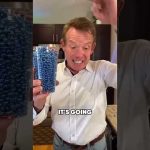
All it takes is a slight tug and the long string of beads literally pull itself out of the container and onto the floor. Best of all, fifty feet of beads empty from the container in under five seconds! How does it work?
Help Keep PTSOS Going, Click Here: https://www.gofundme.com/ptsos
Dan Burns explains his space-time warping demo at a PTSOS workshop at Los Gatos High School, on March 10, 2012. Thanks to Shannon Range from the Gravity Probe B program for creating the original demonstration which he shared with Dan in 2004.
Information on how to make your own Spacetime Simulator can be found here: https://youtu.be/2JOf1ub9US0
Water in rivers, in a glass, or falling from clouds obeys gravity. It’s going to fall towards the ground because of the physical pull of the earth. But, what if we told you that you could turn a glass of water completely upside down and the water wouldn’t fall to the floor? That’s what happens in the Anti-Gravity Water demonstration. It’s a simple experiment that dramatically demonstrates the amazing physical properties of water.
Steve Spangler is a celebrity teacher, science toy designer, speaker, author and an Emmy award-winning television personality. Spangler is probably best known for his Mentos and Diet Coke geyser experiment that went viral in. Spangler is the founder of www.SteveSpanglerScience.com, a Denver-based company specializing in the creation of science toys, classroom science demonstrations, teacher resources and home for Spangler’s popular science experiment archive and video collection. Spangler is a frequent guest on the Ellen DeGeneres Show and Denver 9 News where he takes classroom science experiments to the extreme. For teachers, parents or DIY Science ideas – check out other sources of learning:
Check out http://www.stevespanglerscience.com/experiment/falling-ring-catch-sick-science to learn more about this experiment and to see other cool science experiments. Is it possible to catch a falling ring with a loop of string? Sure it is! It’s going to take a bit of experimentation and trial and error, but you’ll get the hang of it in no time! You’ll see how motion and force can sometimes create unexpected results.
The launch of space shuttle Endeavour on STS-134 has been rescheduled for May 16th. Launch is scheduled for 8:56 a.m. Eastern. Also, NASA’s Gravity Probe B mission confirms two aspects of Albert Einstein’s theory of general relativity. Plus, two Mercury explorers honored; Young innovators recognized; ISS honored; NextGen Day; rotocraft research; FIRST finals; and HQ Cyber Café.
NASA’s Gravity Probe B (GP-B) spacecraft has confirmed two key predictions derived from Albert Einstein’s general theory of relativity. Launched in 2004, GP-B was designed to test Einstein using four ultra-precise gyroscopes to measure the hypothesized geodetic effect, which is the warping of space and time around a gravitational body, and frame-dragging, which is the amount a spinning object pulls space and time with it as it rotates. (News briefing held May 4, 2011 at NASA Headquarters in Washington.)
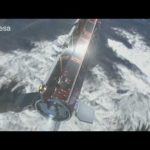
Launched on 17 March 2009, ESA’s Gravity field and steady-state Ocean Circulation Explorer (GOCE) is bringing about a whole new level of understanding of one of Earth’s most fundamental forces of nature: the gravity field. Dubbed the ‘Formula 1’ of satellites, GOCE is mapping Earth’s gravity field in unprecedented detail.
This has given rise to a unique model of the ‘geoid’, which is the surface of an hypothetical global ocean in the absence of tides and currents, shaped only by gravity. It is a crucial reference for measuring ocean circulation and sea-level change, which are affected by climate change.
The colours in the image represent deviations in height ( -100 m to + 100 m) from an ideal geoid. The blue colours represent low values and the reds/yellows represent high values.
Frank De Winne is answering a few questions on the ISS submitted by the pupils of Class 7M from the Christian Morgenstern School in Hersching (Germany):
Question: – Jerome (13): How do you feel in orbit after 2 months? – Karina (13): How much time do you spend working outside the ISS? – Tamara: Do you have any real free time in the ISS, and how can you spend this time? How often do you contact your family? – Antoine (13): Have you ever felt scared in orbit? Has there ever been a moment that you wished to be back on Earth? – Regina (14): Has anything strange happened on the ISS that none of your colleagues have been able to explain? – Flavu: Which kind of education and qualification do you need for this kind of work?
Operated for ESA by the French company Novespace, the Zero-G aircraft flies parabolic arcs so that its passengers and cargo experience periods of freefalling weightlessness.
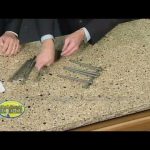
Check out this and other cool science experiments at http://www.stevespanglerscience.com/experiments/ The object of the challenge is to balance all of the nails on the head of a single nail. All of the nails have to be balanced at the same time and cannot touch anything but the top of the nail that is stuck in the base. Are you up to the challenge?
About Steve Spangler Science…
Steve Spangler is a celebrity teacher, science toy designer, speaker, author and an Emmy award-winning television personality. Spangler is probably best known for his Mentos and Diet Coke geyser experiment that went viral in 2005 and prompted more than 1,000 related YouTube videos. Spangler is the founder of www.SteveSpanglerScience.com, a Denver-based company specializing in the creation of science toys, classroom science demonstrations, teacher resources and home for Spangler’s popular science experiment archive and video collection. Spangler is a frequent guest on the Ellen DeGeneres Show where he takes classroom science experiments to the extreme. Check out his pool filled with 2,500 boxes of cornstarch!
On the education side, Spangler started his career as a science teacher in the Cherry Creek School district for 12 years. Today, Steve travels extensively training teachers in ways to make learning more engaging and fun. His hands-on science boot camps and summer institutes for teachers inspire and teach teachers how to prepare a new generation for an ever-changing work force. Over the last 15 years, he has also made more than 500 television appearances as an authority on hands-on science and inquiry-based learning.
On the business side, Spangler is the founder and CEO of Steve Spangler Science, a Denver-based company specializing in the creation of educational toys and kits and hands-on science training services for teachers. The companys unique business strategies and viral creations have been featured in the Wall Street Journal, Inc. Magazine, Wired and TIME Magazine where online readers voted Steve Spangler #18 in the Top 100 Most Influential People of the Year for 2006 (what were they thinking?). You’ll find more than 140 Spangler created products available online at SteveSpanglerScience.com and distributed to toy stores and mass-market retailers worldwide.
Spangler joined NBC affiliate 9News in 2001 as the science education specialist. His weekly experiments and science segments are designed to teach viewers creative ways to make learning fun. His now famous Mentos Geyser experiment, turning 2-liter bottles of soda into erupting fountains, became an Internet sensation in September 2005 when thousands of people started posting their own Mentos explosions on YouTube.com.
As founder of SteveSpanglerScience.com, Spangler and his design team have developed more than 140 educational toys and science-related products featured by mass-market retailers like Target, Wal-Mart, Toys R’ Us, Discovery Channel Stores and over 1,400 independent specialty toy stores. His educational science catalog and on-line business offers more than a thousand science toys and unique learning resources. Recently, Spangler has been featured in the Wall Street Journal, Inc. Magazine, WIRED, the History Channel, Food Network and TIME Magazine where on-line readers voted Steve Spangler #18 in the Top 100 Most Influential People of the Year for 2006.
His recent appearances on the Ellen DeGeneres Show have taught viewers how to blow up their food, shock their friends, create mountains of foam, play on a bed of nails, vanish in a cloud of smoke and how to turn 2,500 boxes of cornstarch and a garden hose into a swimming pool of fun.
To achieve its crucial scientific objectives, ESA’s ‘Gravity field and steady-state Ocean Circulation Explorer’, or GOCE, satellite must orbit as low as possible, in order to sense minute variations in the Earth’s gravitational field – at the edge of space and the limits of the atmosphere at only 268 km!