Tag: Hipparcos

  • The future of the Orion constellation

    The future of the Orion constellation

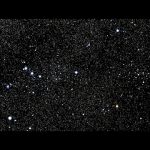
    This video reveals how our view of the Orion constellation will evolve over the next 450 000 years.

    Amid a myriad of drifting stars, the shape of Orion as defined by its brightest stars is slowly rearranged into a new pattern as time goes by.

    The portion of the sky depicted in the video measures 40 x 20º – as a comparison, the diameter of the full Moon in the sky is about half a degree.

    The video is based on data from ESA’s Gaia and Hipparcos satellites, as well as additional information from ground-based observations.

    A speeded-up version of the video is available here: http://sci.esa.int/gaia/59209

    Full story: The future of the Orion constellation http://www.esa.int/Our_Activities/Space_Science/Gaia/The_future_of_the_Orion_constellation

    The evolution of two million stellar positions on the entire sky is shown here: https://www.youtube.com/watch?v=87lgSRVUSxM

    Copyright: ESA/Gaia/DPAC CC BY-SA 3.0 IGO: https://creativecommons.org/licenses/by-sa/3.0/igo/

  • From the Solar System to the Hyades cluster

    From the Solar System to the Hyades cluster

    A virtual journey, from our Solar System through the Milky Way, based on data from the first release of ESA’s Gaia satellite.

    The journey starts by looking back at the Sun, surrounded by its eight planets. We then move away from the Sun and travel towards and around the Hyades star cluster, the closest open cluster to the Solar System, some 150 light-years away.

    The 3D positions of the stars shown in the animation are drawn from the Tycho-Gaia Astrometric Solution (TGAS), which combines information from Gaia’s first year of observations with the earlier Hipparcos and Tycho-2 Catalogues, both based on data from ESA’s Hipparcos mission.

    This new dataset contains positions on the sky, distances and proper motions of over two million stars. It is twice as precise and contains almost 20 times as many stars as the previous reference for astrometry, the Hipparcos Catalogue.

    The journey continues showing the full extent size of the stars contained in the Tycho-Gaia Astrometric Solution, all relatively near to the Sun, in the overall context of our Milky Way galaxy.

    The final Gaia catalogue will contain the most detailed 3D map ever made of the Galaxy, charting a billion stars – about 1% of the Milky Way’s stellar content – to unprecedented accuracy.

    For more information about Gaia, visit: http://www.esa.int/gaia

    Credit: ESA/Gaia/DPAC; Acknowledgement: S. Jordan & T. Sagristà Sellés (Zentrum für Astronomie der Universität Heidelberg)

  • Guide to our Galaxy

    Guide to our Galaxy

    This virtual journey shows the different components that make up our home galaxy, the Milky Way, which contains about a hundred billion stars.

    It starts at the black hole at the centre of the Milky Way and with the stars that orbit around it, before zooming out through the central Galactic Bulge, which hosts about ten billion stars.

    The journey continues through a younger population of stars in the stellar disc, home to most of the Milky Way’s stars, and which is embedded in a slightly larger gaseous disc. Stars in the disc are arranged in a spiral arm pattern and orbit the centre of the Galaxy.

    The discs and bulge are embedded in the stellar halo, a spherical structure that consists of a large number of globular clusters — the oldest population of stars in the Galaxy — as well as many isolated stars. An even larger halo of invisible dark matter is inferred by its gravitational effect on the motions of stars in the Galaxy.

    Looking at a face-on view of the Galaxy we see the position of our Sun, located at a distance of about 26 000 light-years from the Galactic Centre.

    Finally, the extent of the stellar survey conducted by ESA’s Hipparcos mission is shown, which surveyed more than 100 000 stars up to 300 light-years away from the Sun. In comparison, ESA’s Gaia survey will study one billion stars out to 30 000 light-years away.