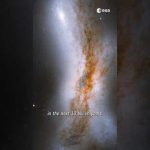
For years, astronomers believed the Milky Way and Andromeda were on a direct collision course in about 4.5 billion years. But new research using data from our Gaia mission and Hubble Space Telescope suggests the story isn’t so simple.
After running 100 000 simulations with the most precise data available, scientists now say there’s only a 50% chance the two galaxies will collide in the next 10 billion years.
The Large Magellanic Cloud, one of our satellite galaxies, could be tugging the Milky Way just enough to steer it away from Andromeda. Instead of crashing, the two galaxies might simply orbit each other in a slow cosmic dance.
So the fate of the Milky Way remains uncertain. And with the Sun expected to make Earth uninhabitable in about a billion years, a galaxy collision is low on our list of concerns.
📹 European Space Agency (ESA) 📸 NASA, ESA, STScI, Till Sawala (University of Helsinki), DSS, J. DePasquale (STScI)
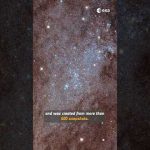
Witness the breathtaking beauty of our cosmic neighbor—the Andromeda galaxy—located 2.5 million light-years away. This spiral disk galaxy appears elliptical from Earth due to its tilted orientation. In this panoramic view, young blue stars shimmer along the galaxy’s outer rim, while older yellowish stars cluster toward the bright central hub, resembling the yolk of a cosmic fried egg. 🍳💫
This vibrant portrait is the result of over 10 years of observations and more than 600 snapshots captured by the Hubble Space Telescope. Altogether, it reveals the mesmerizing glow of 200 million stars scattered across the galaxy’s immense 200,000-light-year-wide disk. As the camera zooms into the central region, a dense sea of ancient stars comes into view. Panning across the galaxy’s expanse, we see intricate patterns of dark dust clouds weaving through space, while vibrant blue star clusters stand out along the edges, signaling regions of ongoing star formation. 🌌✨
Prepare to be amazed as we explore one of the largest and most detailed galactic images ever captured—offering a glimpse into the heart of a distant galaxy, yet eerily similar to our own Milky Way.
📸 NASA, ESA, B. Williams (University of Washington), G. Bacon (STScI) 🎶 Rain Clouds – Beautiful Visions
Did you know the Large Magellanic Cloud, one of our galaxy’s closest neighbors, survived a dramatic collision with the Milky Way’s gaseous halo? Despite losing most of its gas, the Large Magellanic Cloud is still forming new stars—a testament to its resilience! Thanks to Hubble Space Telescope, astronomers measured the Large Magellanic Cloud’s halo for the first time, revealing incredible insights about galaxy interactions.
📹 ESA – European Space Agency 📸 NASA, ESA, R. Crawford
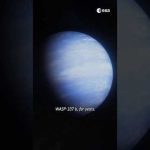
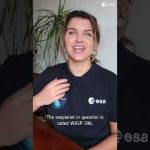
Data collected using the NASA/ESA/CSA James Webb Space Telescope, combined with earlier observations from the NASA/ESA Hubble Space Telescope, show surprisingly little methane (CH4) in the atmosphere of WASP-107 b, indicating that the interior of the planet must be significantly hotter and the core much more massive than previously estimated.
📹 ESA – European Space Agency 📸 NASA, ESA, CSA, R. Crawford
This video takes the viewer on a journey to the 34th anniversary image of the launch of the legendary NASA/ESA Hubble Space Telescope: the Little Dumbbell Nebula (also known as Messier 76, M76, or NGC 650/651). The object is located 3400 light-years away in the northern circumpolar constellation Perseus. The photogenic nebula is a favourite target of amateur astronomers.
Credit: NASA, ESA, STScI, A. Pagan (STScI) Acknowledgment: D. Crowson, A. Fujii, Digitized Sky Survey.
At present it’s as though the distance ladder observed by Hubble and Webb has firmly set an anchor point on one shoreline of a river, and the afterglow of the Big Bang observed by our Planck mission from the beginning of the Universe is set firmly on the other side. How the Universe’s expansion was changing in the billions of years between these two endpoints has yet to be directly observed.
📹 ESA – European Space Agency 📸 NASA, ESA, CSA, Space Telescope Science Inst., A. Riess (JHU/STScI)
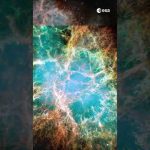
The first image shown in this video is the 2005 Hubble optical wavelength image of the Crab Nebula. This is followed by a new image of the object from the James Webb Space Telescope’s NIRCam (Near-Infrared Camera) and MIRI (Mid-Infrared Instrument) instruments that has revealed new details in infrared light.
In Webb’s infrared observation, a crisp, cage-like structure of fluffy red-orange filaments and knots of dust surround the object’s central area. However, some aspects of the inner workings of the Crab Nebula become more prominent and increase in detail in infrared light. In particular, Webb highlights what is known as synchrotron emission, seen here with a milky smoke-like appearance throughout the majority of the Crab Nebula’s interior.
Credit: NASA, ESA, CSA, STScI, T. Temim (Princeton University), N. Bartmann (ESA/Webb), A. Loll/J. Hester (Arizona State University) Music: Stellardrone – The Night Sky in Motion
This image was captured by NIRCam, Webb’s primary near-infrared camera, and contains the lensing galaxy cluster SDSS J1226+2149. It lies at a distance of around 6.3 billion light-years from Earth, in the constellation Coma Berenices. By combining Webb’s sensitivity with the magnifying effect of gravitational lensing, astronomers were able to use this gravitational lens to explore the earliest stages of star formation in distant galaxies. To do so, they relied on earlier studies by the NASA/ESA Hubble Space Telescope, which provided the ‘prescription’ for this gravitational lens.
Credit: ESA/Webb, NASA & CSA, J. Rigby Music: Stellardrone – Twilight
Astronomers are celebrating the NASA/ESA Hubble Space Telescope’s 33rd launch anniversary with an ethereal photo of a nearby star-forming region, NGC 1333. The nebula is in the Perseus molecular cloud, and is located approximately 960 light-years away.
This video takes the viewer on a journey through space to NGC 1333.
Credit: NASA, ESA, STScI, KPNO/NOIRLab/NSF/AURA, N. Bartmann (ESA/Hubble), E. Slawik, N. Risinger, T.A. Rector (University of Alaska Anchorage), H. Schweiker (NOIRLab), M. Zamani (ESA/Hubble)
We are Europe’s gateway to space. Our mission is to shape the development of Europe’s space capability and ensure that investment in space continues to deliver benefits to the citizens of Europe and the world. Check out https://www.esa.int/ to get up to speed on everything space related.
These are termed “tidal disruption events.” But the wording belies the complex, raw violence of a black hole encounter. There is a balance between the black hole’s gravity pulling in star stuff, and radiation blowing material out. In other words, black holes are messy eaters. Astronomers are using Hubble to find out the details of what happens when a wayward star plunges into the gravitational abyss.
We are Europe’s gateway to space. Our mission is to shape the development of Europe’s space capability and ensure that investment in space continues to deliver benefits to the citizens of Europe and the world. Check out https://www.esa.int/ to get up to speed on everything space related.
Three different moments in a far-off supernova explosion were captured in a single snapshot by the NASA/ESA Hubble Space Telescope. The progenitor star exploded more than 11 billion years ago, when the Universe was less than a fifth of its current age of 13.8 billion years.
📹 @EuropeanSpaceAgency
📸 @NASA, ESA, STScI, Wenlei Chen (UMN), Patrick Kelly (UMN), Hubble Frontier Fields
★ Subscribe: http://bit.ly/ESAsubscribe and click twice on the bell button to receive our notifications.
We are Europe’s gateway to space. Our mission is to shape the development of Europe’s space capability and ensure that investment in space continues to deliver benefits to the citizens of Europe and the world. Check out https://www.esa.int/ to get up to speed on everything space related.
While Webb and other space telescopes, including the NASA/ESA Hubble Space Telescope, have previously revealed isolated ingredients of this heated planet’s atmosphere, the new readings provide a full menu of atoms, molecules, and even signs of active chemistry and clouds. The latest data also give a hint of how these clouds might look up close: broken up rather than as a single, uniform blanket over the planet.
📹 @EuropeanSpaceAgency
📸 @NASA, ESA, @canadianspaceagency , J. Olmsted (STS)
★ Subscribe: http://bit.ly/ESAsubscribe and click twice on the bell button to receive our notifications.
We are Europe’s gateway to space. Our mission is to shape the development of Europe’s space capability and ensure that investment in space continues to deliver benefits to the citizens of Europe and the world. Check out https://www.esa.int/ to get up to speed on everything space related.
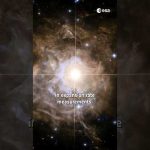
The first clue came when the star mysteriously darkened in late 2019. An immense cloud of obscuring dust formed from the ejected surface as it cooled. Astronomers have now pieced together a scenario for the upheaval. And the star is still slowly recovering; the photosphere is rebuilding itself. And the interior is reverberating like a bell that has been hit with a sledgehammer, disrupting the star’s normal cycle. This doesn’t mean the monster star is going to explode any time soon, but the late-life convulsions may continue to amaze astronomers.
We are Europe’s gateway to space. Our mission is to shape the development of Europe’s space capability and ensure that investment in space continues to deliver benefits to the citizens of Europe and the world. Check out https://www.esa.int/ to get up to speed on everything space related.
These spectacular images feature the spiral galaxy IC 5332, taken by the @NASA/ESA Hubble Space Telescope and the NASA/ESA/ @Canadian Space Agency James Webb Space Telescope. The images display the powerful capabilities that both world-leading space telescopes provide, especially when combining their data.
We are Europe’s gateway to space. Our mission is to shape the development of Europe’s space capability and ensure that investment in space continues to deliver benefits to the citizens of Europe and the world. Check out https://www.esa.int/ to get up to speed on everything space related.
The Small Magellanic Cloud has a simpler chemical composition than the Milky Way, making it similar to the galaxies found in the younger Universe, when heavier elements were more scarce. Because of this, the stars in the Small Magellanic Cloud burn hotter and so run out of their fuel faster than in our Milky Way. Though a proxy for the early universe, at 200 000 light-years away the Small Magellanic Cloud is also one of our closest galactic neighbours.
We are Europe’s gateway to space. Our mission is to shape the development of Europe’s space capability and ensure that investment in space continues to deliver benefits to the citizens of Europe and the world. Check out https://www.esa.int/ to get up to speed on everything space related.
New images of the spectacular Phantom Galaxy, M74, showcase the power of space observatories working together in multiple wavelengths. In this case, data from the @NASA / ESA / @canadianspaceagency James Webb Space Telescope and the NASA/ESA Hubble Space Telescope compliment each other to provide a comprehensive view of the galaxy.
We are Europe’s gateway to space. Our mission is to shape the development of Europe’s space capability and ensure that investment in space continues to deliver benefits to the citizens of Europe and the world. Check out https://www.esa.int/ to get up to speed on everything space related.
Each year, the NASA/ESA Hubble Space Telescope dedicates a small portion of its precious observing time to taking a special anniversary image, showcasing particularly beautiful and meaningful objects. These images continue to challenge scientists with exciting new surprises and to enthral the public with ever more evocative observations.
To celebrate Hubble’s 30th anniversary, let’s look back at the beauty and science behind each of the anniversary images unveiled as of 2005. In this video, we will also feature the very special 2020 Hubble Space Telescope 30th anniversary image.
Credit:
Directed by: Bethany Downer
Visual design and editing: Martin Kornmesser
Written by: Bethany Downer
Narration: Sara Mendes da Costa
Images & VIdeos: NASA, ESA, M.Kornmesser, L. Calçada, ESO, NAOJ, G. Bacon, L. Frattare, Z. Levay and F. Summers (STScI/AURA), D. Lennon and E. Sabbi (ESA/STScI), J. Anderson, S.E. de Mink, R. van der Marel, T. Sohn, and N. Walborn (STScI), L. Bedin (INAF, Padua), C. Evans (STFC), H. Sana (Amsterdam), N. Langer (Bonn), P. Crowther (Sheffield), A. Herrero (IAC, Tenerife), N. Bastian (USM, Munich), and E. Bressert (ESO), the Hubble Heritage Team, T. Davis, L. Frattare, Z. Levay, (Viz 3D team, STScI), J. Anderson (STScI), the Hubble Heritage Team (STScI/AURA), A. Nota (ESA/STScI), and the Westerlund 2 Science Team, Eckhard Slawik (e.slawik@gmx.net).
Music: Johan B. Monell (www.johanmonell.com
Web and technical support: Raquel Yumi Shida
Executive producer: Mariya Lyubenova
★ Subscribe: http://bit.ly/ESAsubscribe and click twice on the bell button to receive our notifications.
We are Europe’s gateway to space. Our mission is to shape the development of Europe’s space capability and ensure that investment in space continues to deliver benefits to the citizens of Europe and the world. Check out http://www.esa.int/ESA to get up to speed on everything space related.
On 24 April 1990 the NASA/ESA Hubble Space Telescope was sent into orbit aboard the space shuttle Discovery, the first space telescope of its kind. It offered a new view of the Universe and has, for 30 years, reached and surpassed all expectations, beaming back data and images that have changed scientists’ understanding of the Universe and the public’s perception of it. Hubble’s discoveries have revolutionised nearly all areas of current astronomical research, from planetary science to cosmology, and its pictures are unmistakably out of this world.
This video revisits some of Hubble’s biggest science discoveries throughout its three decades of operation to celebrate the telescope’s 30th anniversary.
Credit:
Directed by: Bethany Downer
Visual design and editing: Martin Kornmesser
Written by: Bethany Downer
Narration: Sara Mendes da Costa
Images & Videos: NASA, ESA, M.Kornmesser, L. Calçada, ESO, G. Bacon (STScI), theHubble Heritage Team (STScI/AURA)-ESA/Hubble Collaboration, and H. Bond (STScI and Pennsylvania State University), A. Feild (STScI), and A. Riess (STScI/JHU), D. Jewitt (UCLA), F. Summers, Z. Levay, J. DePasquale, L. Hustak, L. Frattare, M. Robberto (STScI), R. Hurt (Caltech/IPAC) Acknowledgement: R. Gendler, spaceengine.org.
Music: Johan B. Monell (www.johanmonell.com)
Web and technical support: Raquel Yumi Shida
Executive producer: Mariya Lyubenova
★ Subscribe: http://bit.ly/ESAsubscribe and click twice on the bell button to receive our notifications.
We are Europe’s gateway to space. Our mission is to shape the development of Europe’s space capability and ensure that investment in space continues to deliver benefits to the citizens of Europe and the world. Check out http://www.esa.int/ESA to get up to speed on everything space related.
This month marks the 30th anniversary of the international Hubble Space Telescope.
Launched on 24 April 1990, and deployed from the Space Shuttle Discovery cargo bay a day later (25 April 1990), the telescope has given us a new perspective on the Universe.
The joint NASA/ESA mission has shown us distant galaxies and spectacular nebulae. It has revealed supermassive black holes and planets in distant solar systems; and has proved that the Universe is not only expanding, the expansion is accelerating.
Hubble’s mission has also been eventful. When it was first launched, a defect in the mirror meant it sent back blurry images. Since then, five servicing missions have enabled the telescope to be improved and upgraded. Today, it is still going strong.
We are Europe’s gateway to space. Our mission is to shape the development of Europe’s space capability and ensure that investment in space continues to deliver benefits to the citizens of Europe and the world. Check out http://www.esa.int/ESA to get up to speed on everything space related.
Building the future of quiet supersonic flight, science and supplies delivered to the space station, and uncovering the farthest star ever seen – a few of the stories to tell you about, This Week at NASA!
This video is available for download from NASA’s Image and Video Library: https://images.nasa.gov/details-Lowering%20the%20Boom%20of%20Supersonic%20Flight%20on%20This%20Week%20@NASA%20%E2%80%93%20April%206,%202018.html
During a NASA science briefing on April 13, representatives from the agency discussed new results about ocean worlds in our solar system based on data gathered by NASA’s Cassini spacecraft and the Hubble Space Telescope.
The two veteran missions are providing tantalizing new details about icy, ocean-bearing moons of Jupiter and Saturn, further enhancing the scientific interest of these and other “ocean worlds” in our solar system and beyond.
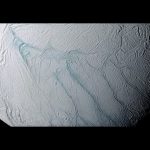
New research from Cassini indicates that hydrogen gas, which could potentially provide a chemical energy source for life, is pouring into the ocean of Saturn’s icy moon Enceladus from hydrothermal vents in the seafloor. The Cassini spacecraft detected the hydrogen in the plume of gas and icy material spraying from Enceladus during its deepest dive through the plume on Oct. 28, 2015.This means that ocean microbes — if any exist there — could use the hydrogen to produce energy
NASA’s Hubble Space Telescope saw a probable plume of material erupting from the moon’s surface on 2016, at the same location where Hubble saw evidence of a plume in 2014. These images bolster evidence that the Europa plumes could be a real phenomenon, flaring up intermittently in the same region on the moon’s surface.
Both Cassini and Hubble investigations are laying the groundwork for NASA’s Europa Clipper mission, which is being planned for launch in the 2020s.
On April 24, 1990, NASA’s Hubble Space Telescope rode to space aboard space shuttle Discovery – on a mission to do just that – discover. The results over the past 25 years have been nothing short of remarkable.
The storied and historic journey into the cosmos that Hubble’s eyes have taken us on, has led to groundbreaking discoveries, captivated imaginations and given humans a better understanding of our place in the universe. NASA celebrated Hubble’s Silver anniversary with a variety of events including the unveiling of the official Hubble 25th anniversary image at the Newseum in Washington and a gala at the Smithsonian’s National Air and Space Museum, during which many of the astronauts, scientists, engineers, technicians, educators, and others who have contributed to Hubble’s success were honored. Also, NASA celebrates Earth Day, 3-D printed copper engine part and more!
In its quarter-century in orbit, the Hubble Space Telescope has transformed the way we understand the Universe, helped us find our place among the stars, and paved the way to incredible advancements in science and technology. The Hubble story is a human story. Hubble overcame much adversity early on in its mission and demonstrated the great heights NASA is capable of achieving against all odds. Much of that is thanks to the “Hubble Heroes”, including scientists, engineers, and the brave astronauts who flew five Space Shuttle missions to service Hubble.
Join NASA Television in celebrating the 25th anniversary of the Hubble Space Telescope in orbit April 24, 2015.
This stunning movie shows the Eagle Nebula from the iconic 1995 Hubble image of the Pillars of Creation through to the latest multi-wavelength composite.