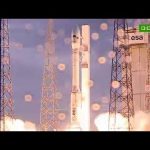
ESA’s new Vega-C rocket lifted off for its inaugural flight VV21 at 15:13 CEST/13:13 UTC/10:13 local time from Europe’s Spaceport in French Guiana. With new first and second stages and an uprated fourth stage, Vega-C increases performance to about 2.3 t in a reference 700 km polar orbit, from the 1.5 t capability of its predecessor, Vega. For flight VV21, Vega-C’s payload is LARES-2, a scientific mission of @AsiTVit and six research CubeSats from France, Italy and Slovenia.
We are Europe’s gateway to space. Our mission is to shape the development of Europe’s space capability and ensure that investment in space continues to deliver benefits to the citizens of Europe and the world. Check out https://www.esa.int/ to get up to speed on everything space related.
ESA’s new Vega-C rocket lifted off for its inaugural flight VV21 at 15:13 CEST/13:13 UTC/10:13 local time from Europe’s Spaceport in French Guiana. With new first and second stages and an uprated fourth stage, Vega-C increases performance to about 2.3 t in a reference 700 km polar orbit, from the 1.5 t capability of its predecessor, Vega. For flight VV21, Vega-C’s payload is LARES-2, a scientific mission of the Italian space agency ASI and six research CubeSats from France, Italy and Slovenia.
We are Europe’s gateway to space. Our mission is to shape the development of Europe’s space capability and ensure that investment in space continues to deliver benefits to the citizens of Europe and the world. Check out https://www.esa.int/ to get up to speed on everything space related.
This animated preview of flight VV21 illustrates gantry rollout and liftoff from Europe’s Spaceport in French Guiana, stage and fairing separations, and deployment of the Italian Space Agency’s LARES-2 scientific payload and six research CubeSats. Vega-C represents a dramatic capability boost compared to its predecessor, Vega, which has flown since 2012. With new first and second stages and an uprated fourth stage, Vega-C increases performance from Vega’s 1.5 t to about 2.2 t in a reference 700 km polar orbit and handles larger payloads.
We are Europe’s gateway to space. Our mission is to shape the development of Europe’s space capability and ensure that investment in space continues to deliver benefits to the citizens of Europe and the world. Check out https://www.esa.int/ to get up to speed on everything space related.
Multiple small satellites will be launched at once on the Vega VV16 mission from Europe’s Spaceport in Kourou, French Guiana. This flight will demonstrate the modular SSMS dispenser resting on its upper stage intended to bring routine affordable launch opportunities for light satellites from 0.2 kg CubeSats up to 400 kg minisatellites.
Until now the smallest classes of satellites – all the way down to tiny CubeSats, built from 10 cm modular boxes – have typically ‘piggybacked’ to orbit. They have to make use of any spare capacity as a single large satellite is launched, meaning their overall launch opportunities are limited.
The new Vega Small Spacecraft Mission Service switches this into a ‘rideshare’ model, with multiple small satellites being flown together, splitting the launch cost.
SAB Aeropsace in the Czech Republic and Bercella in Italy designed and manufactured this modular dispenser for ESA’s Vega prime contractor Avio. The component structures are made of very low-density aluminium ‘sandwich’ panels protected by carbon fibre reinforced polymer skins. This makes it very lightweight and rigid.
The SSMS comprises two main sections, the hexagonal lower section can hold six nanosatellites or up to a dozen CubeSat deployers while the upper section section is used for microsatellites, minisatellites and small satellites. The lower section can also be used independently, coupled with a larger satellite replacing the top section.
The hexagonal module, a central column, towers, a supporting platform and a set of standard satellite interface spacers are assembled to suit each mission and combination of satellites. For this flight, a configuration called Flexi-3 weighing just 330 kg is being used.
This demonstration flight aims to prove the technical and financial viability of the rideshare service. ESA has collaborated with the European Union, which has partly funded this mission within the Horizon 2020 programme. This is part of the Contribution Agreement between ESA and the EU on space technology activities signed on 16 April 2019.
The animation shows the separation of the ESAIL mission which is a joint ESA LuxSpace project to extend the monitoring of maritime traffic beyond existing land-based tracking of Automatic Identification Systems (AIS) through the means of an array of microsatellites: SAT-AIS.
★ Subscribe: http://bit.ly/ESAsubscribe and click twice on the bell button to receive our notifications.
We are Europe’s gateway to space. Our mission is to shape the development of Europe’s space capability and ensure that investment in space continues to deliver benefits to the citizens of Europe and the world. Check out http://www.esa.int/ESA to get up to speed on everything space related.
Video of full-size models of the Curiosity Mars rover and Orion, the multi-purpose capsule that will take our astronauts farther into space than ever, as they appeared in the Washington, D.C. parade on Jan. 21. Accompanying the vehicles were members of the Curiosity team from NASA’s Jet Propulsion Laboratory, and current and former astronauts Alvin Drew, Serena Aunon, Kate Rubins, Mike Massimino, Lee Morin and Kjell Lindgren, as well as Leland Melvin, NASA’s associate administrator for Education, and John Grunsfeld, NASA’s associate administrator for Science.
Vega, le nouveau lanceur de l’ESA, est désormais prêt pour son entrée en exploitation aux côtés d’Ariane-5 et de Soyouz, après le succès de son vol de qualification, effectué ce matin depuis le port spatial de l’Europe à Kourou (Guyane française).
Avec Vega, qui vient compléter la famille des lanceurs disponibles à Kourou, l’Europe est désormais à même de répondre à toute la gamme des besoins de lancement, que ce soit pour mettre sur orbite des petits satellites scientifiques et d’observation de la Terre ou pour entreprendre des missions de vaste envergure comme l’envoi de véhicules ESA de ravitaillement à destination de la Station spatiale internationale (ISS).
Vega a décollé pour la première fois à 10h00 GMT (11h00 heure de Paris, 7h00 heure locale) de son nouveau pas de tir, et son vol de qualification s’est parfaitement déroulé.