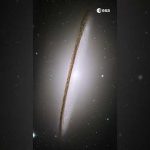
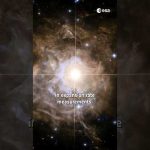
This video takes the viewer on a journey through space to the Sombrero Galaxy, also known as Messier 104 (M104).
The NASA/ESA/CSA James Webb Space Telescope recently imaged the Sombrero galaxy with its MIRI (Mid-InfraRed Instrument), resolving the clumpy nature of the dust along the galaxy’s outer ring.
The mid-infrared light highlights the gas and dust that are a feature of the star formation taking place among the Sombrero galaxy’s outer disc. The rings of the Sombrero galaxy produce less than one solar mass of stars per year, in comparison to the Milky Way’s roughly two solar masses a year. It’s not a particular hotbed of star formation.
The Sombrero galaxy is around 30 million light-years from Earth in the constellation Virgo.
📹 European Space Agency (ESA) 📸 NASA, ESA, CSA, STScI, ESO/IDA/Danish 1.5 m, DSS 2, The Hubble Heritage Team (STScI/AURA), N. Bartmann (ESA/Webb), R. Gendler and J.-E. Ovaldsen, E. Slawik, N. Risinger & M. Zamani (ESA/Webb)
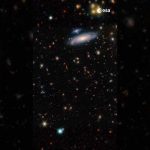
This video takes you on a breathtaking zoom-in journey to the spiral galaxy LEDA 2046648, located over a billion light-years away in the constellation Hercules. Captured by the NASA/ESA/CSA James Webb Space Telescope’s NIRCam instrument, this image reveals a stunning array of distant galaxies and bright stars, crowned with Webb’s signature six-pointed diffraction spikes.
Webb’s mission is to explore the universe’s earliest galaxies, unveiling their formation, evolution, and chemical composition through its powerful infrared vision. This observation was part of the telescope’s calibration process, ensuring its instruments were fine-tuned for groundbreaking discoveries. As the camera zooms in, witness the incredible detail Webb can capture, showcasing the vast and intricate tapestry of the cosmos.
Credit: ESA/Webb, NASA & CSA, A. Martel, Dark Energy Survey/DOE/FNAL/NOIRLab/NSF/AURA, DSS, E. Slawik, N. Risinger, D. de Martin, N. Bartmann, M. Zamani
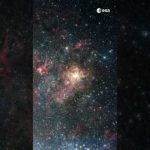
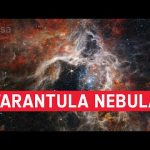
This video takes the viewer on a journey that zooms through space to reveal the Tarantula Nebula.
Thousands of never-before-seen young stars are spotted in the stellar nursery called 30 Doradus, captured by the NASA/ESA/CSA James Webb Space Telescope. It is nicknamed the Tarantula Nebula for the appearance of its dusty filaments in previous telescope images, the nebula has long been a favourite for astronomers studying star formation. In addition to young stars, Webb reveals distant background galaxies, as well as the detailed structure and composition of the nebula’s gas and dust.
Credit: NASA, ESA, CSA, STScI, ESO, E. Slawik, N. Risinger, D. De Martin, D. Lennon, E. Sabbi, N. Bartmann, M. Zamani Music: tonelabs – Happy Hubble
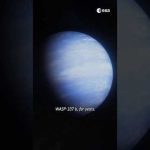
Data collected using the NASA/ESA/CSA James Webb Space Telescope, combined with earlier observations from the NASA/ESA Hubble Space Telescope, show surprisingly little methane (CH4) in the atmosphere of WASP-107 b, indicating that the interior of the planet must be significantly hotter and the core much more massive than previously estimated.
📹 ESA – European Space Agency 📸 NASA, ESA, CSA, R. Crawford
At present it’s as though the distance ladder observed by Hubble and Webb has firmly set an anchor point on one shoreline of a river, and the afterglow of the Big Bang observed by our Planck mission from the beginning of the Universe is set firmly on the other side. How the Universe’s expansion was changing in the billions of years between these two endpoints has yet to be directly observed.
📹 ESA – European Space Agency 📸 NASA, ESA, CSA, Space Telescope Science Inst., A. Riess (JHU/STScI)
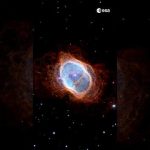
This video zooms through space to reveal Webb’s Near-Infrared Camera (NIRCam) image of the Southern Ring Nebula.
The bright star at the centre of NGC 3132, while prominent when viewed by the NASA/ESA/CSA James Webb Telescope in near-infrared light, plays a supporting role in sculpting the surrounding nebula. A second star, barely visible at lower left along one of the bright star’s diffraction spikes, is the nebula’s source. It has ejected at least eight layers of gas and dust over thousands of years.
Data from Webb’s Near-Infrared Camera (NIRCam) were used to make this extremely detailed image. It is teeming with scientific information — and research will begin following its release.
Credit: NASA, ESA, CSA, STScI, and the Webb ERO Production Team Music: Tonelabs – Happy Hubble
Astronomers estimate 50 000 sources of near-infrared light are represented in this image from the NASA/ESA/CSA James Webb Space Telescope. Their light has travelled through various distances to reach the telescope’s detectors, representing the vastness of space in a single image. A foreground star in our own galaxy, to the right of the image centre, displays Webb’s distinctive diffraction spikes. Bright white sources surrounded by a hazy glow are the galaxies of Pandora’s Cluster, a conglomeration of already-massive clusters of galaxies coming together to form a mega cluster. The concentration of mass is so great that the fabric of spacetime is warped by gravity, creating a natural, super-magnifying glass called a ‘gravitational lens’ that astronomers can use to see very distant sources of light beyond the cluster that would otherwise be undetectable, even to Webb.
Credit: ESA/Webb, NASA & CSA, P. Kelly, Dark Energy NASA, ESA, CSA, I. Labbe (Swinburne University of Technology), R. Bezanson (University of Pittsburgh), A. Pagan (STScI). Dark Energy Survey/DOE/FNAL/NOIRLab/NSF/AURA, DSS, N. Bartmann, E. Slawik, N. Risinger, D. de Martin, M. Zamani Music: Tonelabs – The Red North
This video from the NASA/ESA/CSA James Webb Space Telescope takes the viewer on a journey through space to the location of the massive galaxy cluster RX J2129. Due to Gravitational lensing, this observation contains three different images of the same supernova-hosting galaxy. Gravitational lensing occurs when a massive celestial body causes a sufficient curvature of spacetime to bend the path of light travelling past or through it, almost like a vast lens. In this case, the lens is the galaxy cluster RX J2129, located around 3.2 billion light-years from Earth in the constellation Aquarius.
Credit: ESA/Webb, NASA & CSA, P. Kelly, Dark Energy Survey/DOE/FNAL/NOIRLab/NSF/AURA, DSS, N. Bartmann (ESA/Webb), E. Slawik, N. Risinger, D. de Martin (ESA/Webb), M. Zamani (ESA/Webb) Music: Tonelabs – The Red North
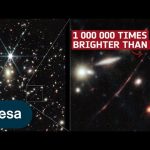
Embark on a cosmic journey with ESA as we explore the universe through the lens of ‘One Million’. From the scorching temperatures of the Sun’s corona to the cosmic gaze of the NASA/ESA/CSA James Webb Space Telescope — discover the astronomical wonders that surround us. 🚀
🎉 Join our space community in celebrating a momentous occasion — 1 MILLION subscribers on YouTube! 🌟 Thank you for your enthusiasm and support. ✨
★ Subscribe: http://bit.ly/ESAsubscribe and click twice on the bell button to receive our notifications.
We are Europe’s gateway to space. Our mission is to shape the development of Europe’s space capability and ensure that investment in space continues to deliver benefits to the citizens of Europe and the world. Check out https://www.esa.int/ to get up to speed on everything space related.
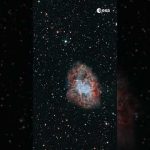
This video takes the viewer on a cosmic journey to the Crab Nebula.
The new image of the object revealed at the end from NASA/ESA/CSA James Webb Space Telescope was captured by the NIRCam (Near-Infrared Camera) and MIRI (Mid-Infrared Instrument) instruments to reveal new details in infrared light.
Credit: ESA/Webb, NASA, CSA, STScI, KPNO/NOIRLab, ESO, Digitized Sky Survey 2, N. Bartmann (ESA/Webb), N. Risinger, D. De Martin (ESA/Hubble), M. Zamani (ESA/Webb)
Music: Tonelabs – The Red North
This image was captured by NIRCam, Webb’s primary near-infrared camera, and contains the lensing galaxy cluster SDSS J1226+2149. It lies at a distance of around 6.3 billion light-years from Earth, in the constellation Coma Berenices. By combining Webb’s sensitivity with the magnifying effect of gravitational lensing, astronomers were able to use this gravitational lens to explore the earliest stages of star formation in distant galaxies. To do so, they relied on earlier studies by the NASA/ESA Hubble Space Telescope, which provided the ‘prescription’ for this gravitational lens.
Credit: ESA/Webb, NASA & CSA, J. Rigby Music: Stellardrone – Twilight
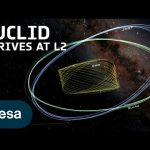
In the month after its launch on 1 July, Euclid has travelled 1.5 million kilometres from Earth towards the Sun-Earth Lagrange point L2, meaning it has ‘arrived’ at its destination orbit.
This animation showcases the orbits of Euclid (green), the James Webb Space Telescope (blue), and the Gaia mission (yellow) around this unique position in space. The positions of the spacecraft in this animation don’t correspond to their current positions in space.
Located about 1.5 million kilometres from Earth in the opposite direction from the Sun, L2 is about four times further away than our Moon. Several other space missions like Webb and Gaia also orbit L2 as it offers the perfect vantage point to study the Universe.
At L2, the spacecraft can keep the Sun, Earth and Moon behind them at all times, so they don’t interfere with observations, while at the same time getting a clear view of deep space and pointing an antenna back to Earth to remain in close communication.
Euclid and Webb’s halo orbit around L2 is big. In terms of distance, the ‘radius’ of Euclid’s orbit varies from about 400 000 kilometres at its closest to the centre, and up to 800 000 kilometres at its furthest. By the time Euclid has completed one full revolution around L2, the Moon will have circled the Earth six times. Gaia orbits L2 in a Lissajous orbit, with a maximum distance of around 350 000 km from its centre.
The region around L2 is big and even though the orbits of these spacecraft seem to cross in the animation, in reality there is plenty of space and a collision can be easily avoided. For example, Webb and Gaia are between 400 000 and 1 100 000 km apart, depending on where they are in their respective orbits.
Video credit: ESA/Gaia/DPAC; CC BY-SA 3.0 IGO
★ Subscribe: http://bit.ly/ESAsubscribe and click twice on the bell button to receive our notifications.
We are Europe’s gateway to space. Our mission is to shape the development of Europe’s space capability and ensure that investment in space continues to deliver benefits to the citizens of Europe and the world. Check out https://www.esa.int/ to get up to speed on everything space related.
Scientists are on a quest to understand how water, the foundation of life as we know it, reaches distant planets. The PDS 70 system, with its inner and outer discs hosting gas-giant planets, holds intriguing clues. Recently, MIRI, part of the James Webb Space Telescope, detected water vapor in the inner disc at distances less than 160 million km from the star – a zone where rocky, Earth-like planets may be taking shape!
This discovery is groundbreaking, as it delves into the region where terrestrial planets typically form. The PDS 70 star is relatively old, yet it surprisingly harbors water vapor, offering the raw materials needed for rocky world construction. But where did the water come from? Could it be forming in place or transported from the outer disc?
The PDS 70 system’s secrets await further exploration, and Webb’s NIRCam and NIRSpec instruments will soon dive deeper into this fascinating cosmic phenomenon. As we unlock the mysteries of water in space, we inch closer to understanding the origins of life beyond our own planet.
📹 ESA – European Space Agency
★ Subscribe: http://bit.ly/ESAsubscribe and click twice on the bell button to receive our notifications.
We are Europe’s gateway to space. Our mission is to shape the development of Europe’s space capability and ensure that investment in space continues to deliver benefits to the citizens of Europe and the world. Check out https://www.esa.int/ to get up to speed on everything space related.
We are Europe’s gateway to space. Our mission is to shape the development of Europe’s space capability and ensure that investment in space continues to deliver benefits to the citizens of Europe and the world. Check out https://www.esa.int/ to get up to speed on everything space related.
The @NASA/@EuropeanSpaceAgency/@canadianspaceagency James Webb Space Telescope has enabled astronomers get one step closer to the answer by allowing them to detect water vapour around a comet in the main asteroid belt for the first time.
We are Europe’s gateway to space. Our mission is to shape the development of Europe’s space capability and ensure that investment in space continues to deliver benefits to the citizens of Europe and the world. Check out https://www.esa.int/ to get up to speed on everything space related.
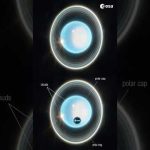
The NASA/ESA/CSA James Webb Space Telescope has taken a stunning image of the Solar System’s other ice giant, the planet Uranus. The new image features dramatic rings as well as bright features in the planet’s atmosphere. The new Webb data of Uranus offer exquisite sensitivity, revealing the faintest dusty rings.
The seventh planet from the Sun, Uranus is strange: it rotates on its side, at a nearly 90-degree angle from the plane of its orbit. This causes unusual seasons since the planet’s poles experience 42 years of constant sunlight and 42 years of complete darkness (Uranus takes 84 years to orbit the Sun). Currently, it is late spring at the northern pole, which is on the right side of this image; Uranus’s northern summer will be in 2028.
Credit: NASA, ESA, CSA, STScI, J. DePasquale (STScI), N. Bartmann Music: Stellardrone – The Belt of Orion
★ Subscribe: http://bit.ly/ESAsubscribe and click twice on the bell button to receive our notifications.
We are Europe’s gateway to space. Our mission is to shape the development of Europe’s space capability and ensure that investment in space continues to deliver benefits to the citizens of Europe and the world. Check out https://www.esa.int/ to get up to speed on everything space related.
This video zooms in towards the protostar L152 to reveal the object as seen by the NASA/ESA/CSA James Webb Space Telescope, embedded within a cloud of material that is feeding its growth. Material ejected from the star has cleared out cavities above and below it, whose boundaries glow orange and blue in this infrared view. The upper central region displays bubble-like shapes due to stellar ‘burps,’ or sporadic ejections. Webb also detects filaments made of molecular hydrogen that has been shocked by past stellar ejections. Intriguingly, the edges of the cavities at upper left and lower right appear straight, while the boundaries at upper right and lower left are curved. The region at lower right appears blue, as there’s less dust between it and Webb than the orange regions above it.
Credit: ESA/Webb, NASA, CSA, unWISE/JPL-Caltech/D. Lang (Perimeter Institute), E. Slawik, N. Risinger, N. Bartmann, M. Zamani Music: Tonelabs – The Red North (www.tonelabs.com)
★ Subscribe: http://bit.ly/ESAsubscribe and click twice on the bell button to receive our notifications.
We are Europe’s gateway to space. Our mission is to shape the development of Europe’s space capability and ensure that investment in space continues to deliver benefits to the citizens of Europe and the world. Check out https://www.esa.int/ to get up to speed on everything space related.
This image takes the viewer to space to finish at Webb’s view of the galaxy merger II ZW 96.
This pair of galaxies is roughly 500 million light-years from Earth and lies in the constellation Delphinus, close to the celestial equator. As well as the wild swirl of the merging galaxies, a menagerie of background galaxies are dotted throughout the image. Learn more about the object here.
Credit: ESA/Webb, NASA, CSA, L. Armus, A. Evans, SDSS, E. Slawik, N. Risinger, M. Zamani (ESA/Webb), N. Bartmann (ESA/Webb) Music: Tonelabs – The Red North
★ Subscribe: http://bit.ly/ESAsubscribe and click twice on the bell button to receive our notifications.
We are Europe’s gateway to space. Our mission is to shape the development of Europe’s space capability and ensure that investment in space continues to deliver benefits to the citizens of Europe and the world. Check out https://www.esa.int/ to get up to speed on everything space related.
This video takes the viewer on a journey to NGC 346, one of the most dynamic star-forming regions in nearby galaxies, as seen by the NASA/ESA/CSA James Webb Space Telescope.
NCG 346 is located in the Small Magellanic Cloud (SMC), a dwarf galaxy close to our Milky Way.
Credit: ESA/Webb, NASA, CSA, ESO, ESA/Hubble, Digitized Sky Survey 2, A. Nota, N. Bartmann, M. Zamani Music: Music for the Zoom: Tonelabs – The Red North
★ Subscribe: http://bit.ly/ESAsubscribe and click twice on the bell button to receive our notifications.
We are Europe’s gateway to space. Our mission is to shape the development of Europe’s space capability and ensure that investment in space continues to deliver benefits to the citizens of Europe and the world. Check out https://www.esa.int/ to get up to speed on everything space related.
Researchers have confirmed the presence of an exoplanet, a planet that orbits another star, using James Webb Space Telescope for the first time. Formally classified as LHS 475 b, the planet is almost exactly the same size as our own, clocking in at 99% of Earth’s diameter.
Among all operating telescopes, only Webb is capable of characterising the atmospheres of Earth-sized exoplanets. The team attempted to assess what is in the planet’s atmosphere by analysing its transmission spectrum. Although the data show that this is an Earth-sized terrestrial planet, they do not yet know if it has an atmosphere.
Webb also revealed that the planet is a few hundred degrees warmer than Earth, so if clouds are detected it may lead the researchers to conclude that the planet is more like Venus, which has a carbon dioxide atmosphere and is perpetually shrouded in thick cloud.
📹 @EuropeanSpaceAgency 🖥️ @NASA , ESA, @canadianspaceagency , L. Hustak
★ Subscribe: http://bit.ly/ESAsubscribe and click twice on the bell button to receive our notifications.
We are Europe’s gateway to space. Our mission is to shape the development of Europe’s space capability and ensure that investment in space continues to deliver benefits to the citizens of Europe and the world. Check out https://www.esa.int/ to get up to speed on everything space related.
While Webb and other space telescopes, including the NASA/ESA Hubble Space Telescope, have previously revealed isolated ingredients of this heated planet’s atmosphere, the new readings provide a full menu of atoms, molecules, and even signs of active chemistry and clouds. The latest data also give a hint of how these clouds might look up close: broken up rather than as a single, uniform blanket over the planet.
📹 @EuropeanSpaceAgency
📸 @NASA, ESA, @canadianspaceagency , J. Olmsted (STS)
★ Subscribe: http://bit.ly/ESAsubscribe and click twice on the bell button to receive our notifications.
We are Europe’s gateway to space. Our mission is to shape the development of Europe’s space capability and ensure that investment in space continues to deliver benefits to the citizens of Europe and the world. Check out https://www.esa.int/ to get up to speed on everything space related.
Most striking about Webb’s new image is the crisp view of the planet’s dynamic rings — some of which haven’t been seen at all, let alone with this clarity, since the Voyager 2 flyby in 1989. In addition to several bright narrow rings, the Webb images clearly show Neptune’s fainter dust bands. Webb’s extremely stable and precise image quality also permits these very faint rings to be detected so close to Neptune.
We are Europe’s gateway to space. Our mission is to shape the development of Europe’s space capability and ensure that investment in space continues to deliver benefits to the citizens of Europe and the world. Check out https://www.esa.int/ to get up to speed on everything space related.
Thousands of never-before-seen young stars are spotted in a stellar nursery called 30 Doradus, captured by the @NASA/ESA/@Canadian Space Agency James Webb Space Telescope. Nicknamed the Tarantula Nebula for the appearance of its dusty filaments in previous telescope images, the nebula has long been a favourite for astronomers studying star formation. In addition to young stars, Webb reveals distant background galaxies, as well as the detailed structure and composition of the nebula’s gas and dust.
We are Europe’s gateway to space. Our mission is to shape the development of Europe’s space capability and ensure that investment in space continues to deliver benefits to the citizens of Europe and the world. Check out https://www.esa.int/ to get up to speed on everything space related.
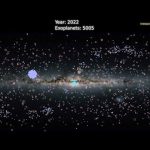
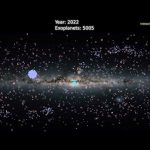
On March 21, 2022, the number of known exoplanets passed 5,000 according to the NASA Exoplanet Archive. This 360-degree animation and sonification tracks humanity’s discovery of the planets beyond our solar system over time. Turning NASA data into sounds allows users to hear the pace of discovery with additional information conveyed by the notes themselves.
As each exoplanet is discovered, a circle appears at its position in the sky. The size of the circle indicates the relative size of the planet’s orbit and the color indicates which planet detection method was used to discover it. The music is created by playing a note for each newly discovered world. The pitch of the note indicates the relative orbital period of the planet. Planets that take a longer time to orbit their stars are heard as lower notes, while planets that orbit more quickly are heard as higher notes.
Please note: Not all browsers support viewing 360 videos. YouTube supports their playback on computers using Chrome, Firefox, MS Edge, and Opera browsers. For the best experience on a mobile device, play this video in the YouTube app.
Credit: NASA/JPL-Caltech/M. Russo, A. Santaguida (SYSTEM Sounds)
On March 21, 2022, the number of known exoplanets passed 5,000 according to the NASA Exoplanet Archive. This animation and sonification tracks humanity’s discovery of the planets beyond our solar system over time. Turning NASA data into sounds allows users to hear the pace of discovery, with additional information conveyed by the notes themselves.
As each exoplanet is discovered, a circle appears at its position in the sky. The size of the circle indicates the relative size of the planet’s orbit and the color indicates which planet detection method was used to discover it. The music is created by playing a note for each newly discovered world. The pitch of the note indicates the relative orbital period of the planet. Planets that take a longer time to orbit their stars are heard as lower notes, while planets that orbit more quickly are heard as higher notes.
Credit: NASA/JPL-Caltech/M. Russo, A. Santaguida (SYSTEM Sounds)
How long would it take us to reach our closest neighbour? How do astronomers know so much about the universe? Why is astronomy important for society? In this Meet the Experts episode, ESA research fellow Tereza Jerabkova discusses our place in the universe and takes us on a journey through space.
We are Europe’s gateway to space. Our mission is to shape the development of Europe’s space capability and ensure that investment in space continues to deliver benefits to the citizens of Europe and the world. Check out https://www.esa.int/ to get up to speed on everything space related.
Are you curious to know how a telescope works? Join ESA astronomer Giovanna Giardino as she gives an insight into the inner workings of the world’s largest telescope in space, the extraordinary James Webb Space Telescope.
We are Europe’s gateway to space. Our mission is to shape the development of Europe’s space capability and ensure that investment in space continues to deliver benefits to the citizens of Europe and the world. Check out https://www.esa.int/ to get up to speed on everything space related.
How did the universe go from a dark and cold place after the Big Bang, to the mesmerizing cosmos we see today? In this episode of Meet the Experts, ESA research fellow Rachana Bhatawdekar takes us on a tour of the early universe, to discover how the very first stars and galaxies were born after the Big Bang.
We are Europe’s gateway to space. Our mission is to shape the development of Europe’s space capability and ensure that investment in space continues to deliver benefits to the citizens of Europe and the world. Check out https://www.esa.int/ to get up to speed on everything space related.
The James Webb Space Telescope lifted off on an Ariane 5 rocket from Europe’s Spaceport in French Guiana, at 13:20 CET on 25 December 2021 on its exciting mission to unlock the secrets of the Universe.
This timelapse shows highlights of the launch campaign from the arrival of Webb in French Guiana through to liftoff.
Every launch requires meticulous planning and preparation. For Webb, this process began about 15 years ago. Webb arrived from California on board the MN Colibri which sailed the Panama Canal to Pariacabo harbour in French Guiana. The shallow Kourou river was specially dredged to ensure a clear passage and the vessel followed high tide to safely reach port on 12 October 2021.
Though the telescope weighs only six tonnes, it was more than 10.5 m high and almost 4.5 m wide when folded. At Europe’s Spaceport it was unpacked inside a dedicated spacecraft preparation facility fitted with walls of air filters to protect the telescope from contamination during preparations for launch.
After its arrival in the final assembly building, Webb was lifted slowly about 40 m high and then carefully manoeuvred on top of Ariane 5 – one of the most delicate operations during the entire launch campaign. A ‘shower curtain’ about 12 m high and 8 m in diameter was installed in between two platforms, to create a closed-off space around Webb to avoid any contamination.
On the day of encapsulation, the fairing was lowered over the observatory and locked in place for liftoff. A laser guiding system assisted this particularly delicate operation for a perfect fit inside Ariane 5’s fairing.
Ariane 5 with Webb was rolled out from the final assembly building to the launch pad on 22 December. On 25 December, Ariane 5 performed the flawless launch of this once in a generation mission. Ariane 5’s highly precise launch meant that Webb saved its own fuel which can be used to significantly extend its expected lifetime of 10 years.
Webb is the largest, most powerful telescope ever launched into space. As part of an international collaboration agreement, ESA has provided the telescope’s launch service using the Ariane 5 launch vehicle. Working with partners, ESA was responsible for the development and qualification of Ariane 5 adaptations for the Webb mission and for the procurement of the launch service by @arianespace. ESA has also provided the workhorse spectrograph NIRSpec and 50% of the mid-infrared instrument MIRI, in collaboration with the University of Arizona. Webb is an international partnership between @NASA, ESA and the @Canadian Space Agency.
We are Europe’s gateway to space. Our mission is to shape the development of Europe’s space capability and ensure that investment in space continues to deliver benefits to the citizens of Europe and the world. Check out https://www.esa.int/ to get up to speed on everything space related.
As always, a new year brings new and exciting missions and launches for ESA. In science the world looks forward to the first image releases of the recently launched James Webb Space Telescope and the third data release for Gaia, both teaching us more about our galaxy and Universe. ESA’s new Mars rover will be launched with the ExoMars mission, and we will also see the maiden flights of Vega-C, Ariane 6 and the Artemis I flight. Astronaut Samantha Cristoforetti will return to the ISS for her second mission and a new class of astronauts will be presented to the world. After the groundwork has been laid in 2021 a new Ministerial Council Meeting will gather to look at the future of ESA, and the need for ESA and Europe to accelerate space and integrated space technology into the fabric of our lives.
★ Subscribe: http://bit.ly/ESAsubscribe and click twice on the bell button to receive our notifications.
We are Europe’s gateway to space. Our mission is to shape the development of Europe’s space capability and ensure that investment in space continues to deliver benefits to the citizens of Europe and the world. Check out https://www.esa.int/ to get up to speed on everything space related.
This real-time video shows the separation of the James Webb Space Telescope from the Ariane 5 launch vehicle and the subsequent solar array deployment.
Webb’s launch on an ESA-provided Ariane 5 rocket was performed by @arianespace on behalf of ESA from Europe’s Spaceport in French Guiana, at 12:20:07 GMT (13:20:07 CET) on 25 December 2021.
Webb separation from the Ariane 5 occurred at 12:47:14 GMT (13:47:14 CET) with solar array deployment starting 69 seconds later.
Thanks to Ariane 5’s highly precise launch trajectory Webb’s solar array was able to deploy soon after separation from the Ariane 5, capturing sunlight to power the observatory.
This video shows the view from Ariane 5’s upper stage, taken by a camera manufactured by Irish company Réaltra Space Systems Engineering.
Webb is the next great space science observatory following Hubble, designed to answer outstanding questions about the Universe and to make breakthrough discoveries in all fields of astronomy. Webb will see farther into our origins: from the formation of stars and planets, to the birth of the first galaxies in the early Universe. Webb is an international partnership between @NASA, ESA and the @Canadian Space Agency.
We are Europe’s gateway to space. Our mission is to shape the development of Europe’s space capability and ensure that investment in space continues to deliver benefits to the citizens of Europe and the world. Check out https://www.esa.int/ to get up to speed on everything space related.
Highlights of the launch campaign for the James Webb Space Telescope, from its arrival at Europe’s Spaceport in Kourou, French Guiana, weeks of launch preparations, to launch on board an Ariane 5, and separation of the spacecraft and solar panel deployment.
Now in space and on its way to L2, Webb will undergo a complex unfolding sequence. In the months after, the instruments will be turned on and their capabilities tested. After half a year in space, Webb will start its routine science observations.
Webb will see farther into our origins: from the Universe’s first galaxies, to the birth of stars and planets, to exoplanets with the potential for life, and our own Solar System.
We are Europe’s gateway to space. Our mission is to shape the development of Europe’s space capability and ensure that investment in space continues to deliver benefits to the citizens of Europe and the world. Check out https://www.esa.int/ to get up to speed on everything space related.
The Copernicus Sentinel-2 takes us over Kourou – home to Europe’s Spaceport in French Guiana, where the James Webb Space Telescope is being prepared for its upcoming launch – in this edition of the Earth from Space programme.
We are Europe’s gateway to space. Our mission is to shape the development of Europe’s space capability and ensure that investment in space continues to deliver benefits to the citizens of Europe and the world. Check out https://www.esa.int/ to get up to speed on everything space related.
The world’s next generation cosmic observatory, the James Webb Space Telescope, is due for launch on an Ariane 5 from Europe’s Spaceport in French Guiana in late December.
Developed and constructed over more than 30 years, Webb is a remarkable feat of engineering and technology – with the largest astronomical mirror ever flown in space, sophisticated new scientific instruments, and a sunshield the size of a tennis court.
Webb is an international partnership between @NASA, ESA and the @Canadian Space Agency and will reveal the Universe in a whole new light. Optimised for infrared wavelengths, its detectors will be able to look back to shortly after the very dawn of time, revealing the formation of the first galaxies, as well as study stars and planets in our own Milky Way.
We are Europe’s gateway to space. Our mission is to shape the development of Europe’s space capability and ensure that investment in space continues to deliver benefits to the citizens of Europe and the world. Check out https://www.esa.int/ to get up to speed on everything space related.
The James Webb Space Telescope, configured for flight, was moved from the cleanroom to the payload preparation facility for fuelling at Europe’s Spaceport in French Guiana on 11–12 November 2021.
Webb will be loaded with propellants before being mounted on top of the rocket and then encapsulated by the Ariane 5 fairing.
Webb will be the largest, most powerful telescope ever launched into space. As part of an international collaboration agreement, ESA is providing the telescope’s launch service using the Ariane 5 launch vehicle. Working with partners, ESA was responsible for the development and qualification of Ariane 5 adaptations for the Webb mission and for the procurement of the launch service by Arianespace.
Webb is an international partnership between @NASA , ESA and the @Canadian Space Agency.
We are Europe’s gateway to space. Our mission is to shape the development of Europe’s space capability and ensure that investment in space continues to deliver benefits to the citizens of Europe and the world. Check out https://www.esa.int/ to get up to speed on everything space related.
The James Webb Space Telescope, a once in a generation space mission, arrived safely at Pariacabo harbour in French Guiana on 12 October 2021, ahead of its launch on an Ariane 5 rocket from Europe’s Spaceport.
Webb was packed in a 30 m long container with additional equipment. It arrived from California on board the MN Colibri which sailed the Panama Canal to French Guiana on a 16-day voyage. The shallow Kourou river was specially dredged to ensure a clear passage and the vessel followed high tide to safely reach port.
The MN Colibri, like its sister vessel the MN Toucan, were built to ship Ariane 5 rocket parts from Europe to French Guiana. They were specifically designed to carry a complete set of Ariane 5 parts across the Atlantic, while having a low enough draft to enable them to follow a route along the shallow Kourou river to the Pariacabo harbour.
Webb will be the largest, most powerful telescope ever launched into space. As part of an international collaboration agreement, ESA is providing the telescope’s launch service using the Ariane 5 launch vehicle. Working with partners, ESA was responsible for the development and qualification of Ariane 5 adaptations for the Webb mission and for the procurement of the launch service by @arianespace.
Webb is an international partnership between @NASA, ESA and the @Canadian Space Agency.
We are Europe’s gateway to space. Our mission is to shape the development of Europe’s space capability and ensure that investment in space continues to deliver benefits to the citizens of Europe and the world. Check out https://www.esa.int/ to get up to speed on everything space related.
James Webb Space Telescope – the largest, most powerful telescope to be sent into space is getting ready for launch in autumn 2021!
Watch the replay of the media presentation and Q&A with representatives from Webb’s partners ESA, @NASA and the @Canadian Space Agency, as well as ESA’s partner @arianespace, to hear more about it and its upcoming launch. Following in the footsteps of the Hubble Space Telescope as the next great space science observatory, the International James Webb Space Telescope is designed to help answer outstanding questions about the Universe and make breakthrough discoveries in all fields of astronomy.
We are Europe’s gateway to space. Our mission is to shape the development of Europe’s space capability and ensure that investment in space continues to deliver benefits to the citizens of Europe and the world. Check out https://www.esa.int/ to get up to speed on everything space related.
The European Space Agency – or ESA – has been a major player in the commercial launch space for decades with their Ariane series of rockets. But they also have been racking up some impressive interplanetary missions, their latest one being the BepiColumbo mission to Mercury.
Here we break down the ESA, talk about some of their biggest victories, and where they want to go in the future.
NASA Administrator Jim Bridenstine recently sat down with Nobel Prize winner John Mather and the agency’s Associate Administrator for Science, Thomas Zurbuchen for a conversation about NASA’s James Webb Space Telescope. They talked about the challenges of building the world’s premier space telescope and why it’s all worth it. Webb is the first telescope of its kind, an unprecedented feat of engineering, and is at the very leading edge of technological innovation and development. Webb will find the first galaxies that formed in the early universe and peer through dusty clouds to see stars forming planetary systems.
This video is available for download from NASA’s Image and Video Library: https://images.nasa.gov/details-NASA%20Administrator%20Bridenstine%20Talks%20Webb%20Science%20with%20Nobel%20Laureate.html