Tag: Juice

  • Timelapse of Juice’s lunar-Earth flyby

    Timelapse of Juice’s lunar-Earth flyby

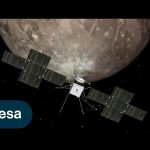
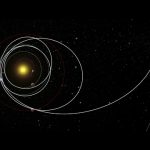
    On 19–20 August 2024, Juice successfully completed a world-first lunar-Earth flyby, with flight controllers guiding the spacecraft first past the Moon, then past Earth. The gravity of the two changed Juice’s speed and direction, sending it on a shortcut to Jupiter via Venus.

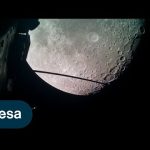
    The closest approach to the Moon was at 23:15 CEST on 19 August, deflecting Juice towards a closest approach to Earth just over 24 hours later at 23:56 CEST on 20 August. In the hours before and after both close approaches, Juice’s two monitoring cameras captured photos, giving us a unique ‘Juice eye view’ of our home planet.

    Juice’s two monitoring cameras provide 1024 x 1024 pixel snapshots that can be processed in colour. Their main purpose is to monitor the spacecraft’s various booms and antennas, especially during the challenging period after launch. The photos they captured of the Moon and Earth during the lunar-Earth flyby are a bonus.

    The piece of music that accompanies the images is called 11,2 km/s. It was composed by Gautier Acher back in 2015, and selected as the official theme music for ESA’s Estrack ground station network to mark its 40th anniversary (more information). The music is available under a CC BY-NC-SA licence.

    Juice rerouted to Venus in world’s first lunar-Earth flyby: https://www.esa.int/Science_Exploration/Space_Science/Juice/Juice_rerouted_to_Venus_in_world_s_first_lunar-Earth_flyby

    Juice’s lunar-Earth flyby: all you need to know: https://www.esa.int/Science_Exploration/Space_Science/Juice/Juice_s_lunar-Earth_flyby_all_you_need_to_know

    Processing notes: The Juice monitoring cameras provide 1024 x 1024 pixel images. Upscaling software was used to convert the images into 2160 x 2160 pixel images, which match the 3480 x2160 pixel resolution of the 4K movie format.

    Credits: ESA – European Space Agency
    Acknowledgements: Simeon Schmauß & Mark McCaughrean

    ★ Subscribe: http://bit.ly/ESAsubscribe and click twice on the bell button to receive our notifications.

    Check out our full video catalog: http://bit.ly/SpaceInVideos
    Follow us on Twitter: http://bit.ly/ESAonTwitter
    On Facebook: http://bit.ly/ESAonFacebook
    On Instagram: http://bit.ly/ESAonInstagram
    On LinkedIn: https://bit.ly/ESAonLinkedIn
    On Pinterest: https://bit.ly/ESAonPinterest
    On Flickr: http://bit.ly/ESAonFlickr

    We are Europe’s gateway to space. Our mission is to shape the development of Europe’s space capability and ensure that investment in space continues to deliver benefits to the citizens of Europe and the world. Check out https://www.esa.int/ to get up to speed on everything space related.

    Copyright information about our videos is available here: https://www.esa.int/ESA_Multimedia/Terms_and_Conditions

    #ESA #Juice #Timelapse
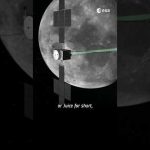
  • Juice rerouted to Venus in world’s first lunar-Earth flyby 🧃 #shorts

    Juice rerouted to Venus in world’s first lunar-Earth flyby 🧃 #shorts

    Our Juice spacecraft returned to Earth to complete the world’s first Lunar-Earth gravity assist.

    Flight controllers guided the spacecraft past the Moon and then the Earth, ‘braking’ the spacecraft.

    This manoeuvre may seem counterintuitive but will allow Juice to take a shortcut via Venus on its way to Jupiter.

    📹 ESA – European Space Agency
    🖥️ ESA

  • Juice: Live from the Moon + Q&A with the team

    Juice: Live from the Moon + Q&A with the team

    Join us for Juice’s flyby of the Moon. We’ll be sharing images as soon as we can after Juice sends them down to Earth. Be among the first people in the world to see these images, and ask your questions about the mission and its lunar-Earth flyby to our panel of Juice team members.

    The images will be captured using Juice’s two ‘monitoring cameras’, designed to watch the unfolding of Juice’s solar panels, antennas and booms in space in the weeks after the spacecraft launched into space in April 2023. The cameras have successfully completed their task. But we thought… what will we see if we point them at the Moon?

    We don’t know how the images will look. It’s the first time the cameras will point at a big bright object in space. And we’re sharing them publicly before we’ve had a chance to process them at all.

    Let’s see what happens!

    Read more: https://www.esa.int/Science_Exploration/Space_Science/Juice/Juice_s_lunar-Earth_flyby_all_you_need_to_know

    ★ Subscribe: http://bit.ly/ESAsubscribe and click twice on the bell button to receive our notifications.

    Check out our full video catalog: http://bit.ly/SpaceInVideos
    Follow us on Twitter: http://bit.ly/ESAonTwitter
    On Facebook: http://bit.ly/ESAonFacebook
    On Instagram: http://bit.ly/ESAonInstagram
    On LinkedIn: https://bit.ly/ESAonLinkedIn
    On Pinterest: https://bit.ly/ESAonPinterest
    On Flickr: http://bit.ly/ESAonFlickr

    We are Europe’s gateway to space. Our mission is to shape the development of Europe’s space capability and ensure that investment in space continues to deliver benefits to the citizens of Europe and the world. Check out https://www.esa.int/ to get up to speed on everything space related.

    Copyright information about our videos is available here: https://www.esa.int/ESA_Multimedia/Terms_and_Conditions

    #ESA #Juice #Moon

  • Why Juice is coming back to Earth

    Why Juice is coming back to Earth

    ESA’s Jupiter Icy Moons Explorer (Juice) returns to Earth on 19–20 August 2024, to complete the world’s first Lunar-Earth gravity assist. Flight controllers will guide the spacecraft past the Moon and then Earth itself, ‘braking’ the spacecraft. This manoeuvre may seem counterintuitive but will allow Juice to take a shortcut via Venus on it’s way to Jupiter.

    Juice has already travelled more than 1000 million km to the giant planet but it still has a long way to go even though Jupiter is on average ‘just’ 800 million km away from Earth. Join us as we explain why Juice’s journey to Jupiter is taking sooo long.

    Read more: https://www.esa.int/Science_Exploration/Space_Science/Juice/Juice_s_lunar-Earth_flyby_all_you_need_to_know

    Read more: https://www.esa.int/Enabling_Support/Operations/Juice_why_s_it_taking_sooo_long

    Credits: ESA – European Space Agency

    —————————————————

    Chapters:
    00:00 Introduction
    00:59 Why is the journey so long?
    05:15 What is a flyby?
    06:10 Lunar-Earth gravity assist
    08:05 Conclusion

    ★ Subscribe: http://bit.ly/ESAsubscribe and click twice on the bell button to receive our notifications.

    Check out our full video catalog: http://bit.ly/SpaceInVideos
    Follow us on Twitter: http://bit.ly/ESAonTwitter
    On Facebook: http://bit.ly/ESAonFacebook
    On Instagram: http://bit.ly/ESAonInstagram
    On LinkedIn: https://bit.ly/ESAonLinkedIn
    On Pinterest: https://bit.ly/ESAonPinterest
    On Flickr: http://bit.ly/ESAonFlickr

    We are Europe’s gateway to space. Our mission is to shape the development of Europe’s space capability and ensure that investment in space continues to deliver benefits to the citizens of Europe and the world. Check out https://www.esa.int/ to get up to speed on everything space related.

    Copyright information about our videos is available here: https://www.esa.int/ESA_Multimedia/Terms_and_Conditions

    #ESA #Juice #Jupiter

  • 2023: ESA’s year in space

    2023: ESA’s year in space

    2023’s highlight was the highly anticipated launch of Juice, Europe’s Jupiter Icy Moon Explorer. The Juice spacecraft was placed on course to Jupiter on the second-to-last Ariane 5 launch vehicle in April. After an eight-year journey, Juice will begin observing the giant gas planet and its three large ocean-bearing moons – Ganymede, Calisto and Europa.

    The Euclid space telescope was launched in July with the aim of unravelling the enigmas of ‘dark matter’ and ‘dark energy’. Euclid’s first images were released in November, revealing razor-sharp astronomical images with detail never before seen by a telescope across such a large patch of the sky.

    After almost five years in space, ESA’s Aeolus wind mission was retired. This trailblazing mission was tasked with observing wind patterns from space thereby improving weather forecasts and climate models.. Aeolus data and technology will have an important role to play in the accuracy of future weather forecasting. On 28 July, it burned up in an assisted re-entry – the first assisted re-entry by a mission which was not designed to do so.

    As space debris becomes an increasingly serious issue, ESA is determined to search for solutions. Together with its commercial and institutional partners, ESA has developed the ‘Zero Debris Charter’, launched this year. By signing the Charter, space entities worldwide can register their intent to work together towards the sustainable use of Earth’s orbital environment.

    Earlier in in 2023, MTG-I1, the first of the Meteosat Third Generation missions, sent back its first images. The satellite was launched in 2022 and carries two instruments: a flexible combined imager and a lighting imager. Both instruments performed beyond expectation and a stunning combined image from both was revealed.

    Earth observation is key to keeping our planet and the population as a whole, safe. Today, monitoring earthquakes, forest fires or flooding from space already helps to coordinate rescue response but the data can also be used to better understand phenomena such as climate change and support the IPCC climate reports.

    Last year, NASA’s Dart mission impacted on a small moonlet of the asteroid Didymos, changing its course. We’ll soon be launching ESA’s Hera spacecraft to collect data on the aftermath of this collision. The Hera spacecraft was integrated and underwent testing this year in ESA ESTEC’s test centre in the Netherlands.

    2023 also saw the first hardware tests for the second generation of Galileo satellites but even more importantly the Galileo High Accuracy Service was launched in January. This new service delivers centimetre accuracy from space further cementing Galileo’s reputation as the most accurate satellite navigation system in the world.

    ★ Subscribe: http://bit.ly/ESAsubscribe and click twice on the bell button to receive our notifications.

    Check out our full video catalog: http://bit.ly/SpaceInVideos
    Follow us on Twitter: http://bit.ly/ESAonTwitter
    On Facebook: http://bit.ly/ESAonFacebook
    On Instagram: http://bit.ly/ESAonInstagram
    On LinkedIn: https://bit.ly/ESAonLinkedIn
    On Pinterest: https://bit.ly/ESAonPinterest
    On Flickr: http://bit.ly/ESAonFlickr

    We are Europe’s gateway to space. Our mission is to shape the development of Europe’s space capability and ensure that investment in space continues to deliver benefits to the citizens of Europe and the world. Check out https://www.esa.int/ to get up to speed on everything space related.

    Copyright information about our videos is available here: https://www.esa.int/ESA_Multimedia/Terms_and_Conditions

    #ESA #2023 #Highlights

  • Juice is coming home! 🛰️🌎🌚 #shorts

    Juice is coming home! 🛰️🌎🌚 #shorts

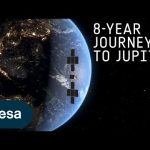
    On 17 November 2023, our Juice spacecraft carried out one of the largest and most important manoeuvres in its eight-year journey to Jupiter.

    Why does it take so long? Well, the short answer is that its less to do with the distance between Earth and Jupiter and more to do with fighting the Sun’s massive gravitational pull as you venture to the outer Solar System.

    If spacecraft like Juice had to carry all the fuel needed to battle the Sun’s gravity alone, they’d be nothing more than colossal tanks. Instead, they use ‘gravity-assist’ tricks – they swing by planets to receive a boost on the way.

    Using its main engine, Juice changed its orbit around the Sun to put itself on the correct trajectory for next summer’s Earth-Moon double gravity assist – the first of its kind.

    The manoeuvre lasted 43 minutes and burned almost 10% of the spacecraft’s entire fuel reserve. It’s the first part of a two-part manoeuvre that could mark the final time that Juice’s main engine is used until its arrival in the Jupiter system in 2031.

    📹 ESA – European Space Agency

    #ESA
    #JuiceMission
    #Jupiter

  • Juice Balloon Prank

    Juice Balloon Prank

    © 2020 Steve Spangler Inc. All Rights Reserved | SteveSpangler.com

  • Juice flies Ariane 5 | Preparation to liftoff timelapse

    Juice flies Ariane 5 | Preparation to liftoff timelapse

    Timelapse of the integration and launch of Juice.

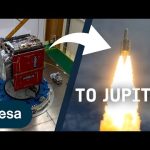
    ESA’s latest interplanetary mission, Juice, lifted off on an Ariane 5 rocket from Europe’s Spaceport in French 09:14 local time/14:14CEST on 14 April 2023 to begin its eight-year journey to Jupiter, where it will study in detail the gas giant planet’s three large ocean-bearing moons: Ganymede, Callisto and Europa.

    Juice – Jupiter Icy Moons Explorer – is humankind’s next bold mission to the outer Solar System. This ambitious mission will characterise Ganymede, Callisto and Europa with a powerful suite of remote sensing, geophysical and in situ instruments to discover more about these compelling destinations as potential habitats for past or present life. Juice will monitor Jupiter’s complex magnetic, radiation and plasma environment in depth and its interplay with the moons, studying the Jupiter system as an archetype for gas giant systems across the Universe.

    Following launch, Juice will embark on an eight-year journey to Jupiter, arriving in July 2031 with the aid of momentum and direction gained from four gravity-assist fly-bys of the Earth-Moon system, Venus and, twice, Earth.

    Flight VA260 is the final Ariane 5 flight to carry an ESA mission to space.

    “Correction:” 03:45 Audio: Hubrid

    ★ Subscribe: http://bit.ly/ESAsubscribe and click twice on the bell button to receive our notifications.

    Check out our full video catalog: http://bit.ly/SpaceInVideos
    Follow us on Twitter: http://bit.ly/ESAonTwitter
    On Facebook: http://bit.ly/ESAonFacebook
    On Instagram: http://bit.ly/ESAonInstagram
    On LinkedIn: https://bit.ly/ESAonLinkedIn
    On Pinterest: https://bit.ly/ESAonPinterest
    On Flickr: http://bit.ly/ESAonFlickr

    We are Europe’s gateway to space. Our mission is to shape the development of Europe’s space capability and ensure that investment in space continues to deliver benefits to the citizens of Europe and the world. Check out https://www.esa.int/ to get up to speed on everything space related.

    Copyright information about our videos is available here: https://www.esa.int/ESA_Multimedia/Terms_and_Conditions

    #ESA
    #Jupiter
    #JuiceMission

  • Juice liftoff

    Juice liftoff

    Ariane 5 for flight VA260 carrying ESA’s Juice mission is seen here fully integrated and ready for rollout for its planned 13 April 2023 launch from Europe’s Spaceport in French Guiana.

    Juice – JUpiter ICy Moons Explorer – is humankind’s next bold mission to the outer Solar System. After an eight-year journey to Jupiter, it will make detailed observations of the gas giant and its three large ocean-bearing moons: Ganymede, Callisto and Europa. This ambitious mission will characterise these moons with a powerful suite of remote sensing, geophysical and in situ instruments to discover more about these compelling destinations as potential habitats for past or present life. Juice will monitor Jupiter’s complex magnetic, radiation and plasma environment in depth and its interplay with the moons, studying the Jupiter system as an archetype for gas giant systems across the Universe.

    Find out more about Juice in ESA’s launch kit: https://esamultimedia.esa.int/docs/science/Juice-LaunchKit.pdf

    ★ Subscribe: http://bit.ly/ESAsubscribe and click twice on the bell button to receive our notifications.

    Check out our full video catalog: http://bit.ly/SpaceInVideos
    Follow us on Twitter: http://bit.ly/ESAonTwitter
    On Facebook: http://bit.ly/ESAonFacebook
    On Instagram: http://bit.ly/ESAonInstagram
    On LinkedIn: https://bit.ly/ESAonLinkedIn
    On Pinterest: https://bit.ly/ESAonPinterest
    On Flickr: http://bit.ly/ESAonFlickr

    We are Europe’s gateway to space. Our mission is to shape the development of Europe’s space capability and ensure that investment in space continues to deliver benefits to the citizens of Europe and the world. Check out https://www.esa.int/ to get up to speed on everything space related.

    Copyright information about our videos is available here: https://www.esa.int/ESA_Multimedia/Terms_and_Conditions

    #ESA
    #Jupiter
    #JuiceMission

  • Juice launch to Jupiter

    Juice launch to Jupiter

    We’re going to Jupiter – and three of its moons! The Juice spacecraft is now securely fastened to an Ariane 5 rocket and ready for launch. Juice, for Jupiter Icy Moons Explorer, will explore Jupiter’s complex environment in depth after an eight-year journey.

    – Liftoff: 29:45
    – Juice launch separation: 57:40
    – Acquisition of signal: 1:20:45
    – Solar Array deployment: 1:48:30

    ★ Subscribe: http://bit.ly/ESAsubscribe and click twice on the bell button to receive our notifications.

    Check out our full video catalog: http://bit.ly/SpaceInVideos
    Follow us on Twitter: http://bit.ly/ESAonTwitter
    On Facebook: http://bit.ly/ESAonFacebook
    On Instagram: http://bit.ly/ESAonInstagram
    On LinkedIn: https://bit.ly/ESAonLinkedIn
    On Pinterest: https://bit.ly/ESAonPinterest
    On Flickr: http://bit.ly/ESAonFlickr

    We are Europe’s gateway to space. Our mission is to shape the development of Europe’s space capability and ensure that investment in space continues to deliver benefits to the citizens of Europe and the world. Check out https://www.esa.int/ to get up to speed on everything space related.

    Copyright information about our videos is available here: https://www.esa.int/ESA_Multimedia/Terms_and_Conditions

    #ESA
    #Jupiter
    #JuiceMission

  • Two different worlds 🔵 ⚫️ #shorts

    Two different worlds 🔵 ⚫️ #shorts

    Juice will complete two flybys of Europa in July 2032, approaching the moon at a closest approach of 400 km. During these close encounters, Juice will explore the geology, surface, subsurface, activity and environment of the moon, which appears to have a young, active, colourful and distinctively marked surface.

    The mission will characterise the composition and chemistry of Europa’s surface, hunting for substances that are essential to support life and determining the source of the moon’s material. Europa may vent water vapour to space via ‘plumes’ and geysers; Juice will search for pockets of water in the moon’s shallow subsurface using unprecedented ice-penetrating radar, and reveal locations where the transfer of material between subsurface, surface and space may be especially intense.

    Juice will complete its first flyby of Callisto in June 2032; the spacecraft will complete a total of 21 flybys of this moon from 2032–2034 (both to explore the moon and to adjust the energy and orientation of Juice’s orbit), coming as close as 200 km from Callisto at nearest approach.

    Callisto is also the least geologically evolved Galilean satellite, and therefore offers a unique glimpse into the environment around early Jupiter. As the moon does not seem to have evolved much over time, it stands to reveal unique information about how it initially formed, and about the origin of the wider Jupiter system.

    📹 @EuropeanSpaceAgency

    ★ Subscribe: http://bit.ly/ESAsubscribe and click twice on the bell button to receive our notifications.

    Check out our full video catalog: http://bit.ly/SpaceInVideos
    Follow us on Twitter: http://bit.ly/ESAonTwitter
    On Facebook: http://bit.ly/ESAonFacebook
    On Instagram: http://bit.ly/ESAonInstagram
    On LinkedIn: https://bit.ly/ESAonLinkedIn
    On Pinterest: https://bit.ly/ESAonPinterest
    On Flickr: http://bit.ly/ESAonFlickr

    We are Europe’s gateway to space. Our mission is to shape the development of Europe’s space capability and ensure that investment in space continues to deliver benefits to the citizens of Europe and the world. Check out https://www.esa.int/ to get up to speed on everything space related.

    Copyright information about our videos is available here: https://www.esa.int/ESA_Multimedia/Terms_and_Conditions

    #ESA
    #Jupiter
    #JuiceMission

  • Could life exists on a frozen icy world? 🥶 #shorts

    Could life exists on a frozen icy world? 🥶 #shorts

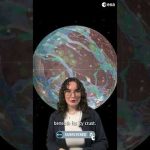
    Ganymede is the primary scientific target of the Jupiter Icy Moons Explorer, Juice, mission. With a diameter of about 5260 km, larger than that of Pluto and Mercury, Ganymede tops the Solar-System moons’ size chart. It is the seventh moon from the gas giant (and the third among the Galilean satellites) and orbits Jupiter at a distance of more than 1 million kilometres. Researchers believe there is tidal heating on Ganymede, although to a much smaller degree than on Io and Europa. This heat could drive some tectonic activity and provide one of the necessary conditions for life to emerge: a source of energy.

    This high-resolution mapping of the surface can help constrain the moon’s composition and mineralogy, and assess how habitable Ganymede could be by searching for biosignatures. Observations at various wavelengths will allow astronomers to study non-water-ice material to determine the distribution of biologically essential elements—such as carbon or oxygen—and other important elements—such as magnesium and iron—on the planetary body. The mission will also shed light on the origin and evolution of the materials on the surface by exploring which substances form at Ganymede and which are brought in from the plasma environment around the moon.

    To study Ganymede in detail, Juice will enter orbit around it, becoming the first spacecraft to orbit a moon in the outer Solar System. The dedicated orbital tour is expected to last about eight months and will be the final stage of the mission.

    📹 @EuropeanSpaceAgency

    ★ Subscribe: http://bit.ly/ESAsubscribe and click twice on the bell button to receive our notifications.

    Check out our full video catalog: http://bit.ly/SpaceInVideos
    Follow us on Twitter: http://bit.ly/ESAonTwitter
    On Facebook: http://bit.ly/ESAonFacebook
    On Instagram: http://bit.ly/ESAonInstagram
    On LinkedIn: https://bit.ly/ESAonLinkedIn
    On Pinterest: https://bit.ly/ESAonPinterest
    On Flickr: http://bit.ly/ESAonFlickr

    We are Europe’s gateway to space. Our mission is to shape the development of Europe’s space capability and ensure that investment in space continues to deliver benefits to the citizens of Europe and the world. Check out https://www.esa.int/ to get up to speed on everything space related.

    Copyright information about our videos is available here: https://www.esa.int/ESA_Multimedia/Terms_and_Conditions

    #ESA
    #JuiceMission
    #Jupiter

  • I want to break free… 🎶 #shorts

    I want to break free… 🎶 #shorts

    When a spacecraft launches on a mission to another planet it must first break free of the Earth’s gravitational field. Once it has done that, it enters interplanetary space, where the dominant force is the gravitational field of the Sun.

    The spacecraft begins to follow a curving orbit, around the Sun, which is similar to the orbit of a comet. When this orbit brings it close to its target destination the spacecraft must fire a retrorocket to slow down and allow itself to be captured by the gravitational field of its target. The smaller the target, the more the spacecraft must slow down.

    Sometimes passing a planet can result in the spacecraft being accelerated, even without the spacecraft firing any of its thrusters. This is known as the ‘slingshot’ effect. Such ‘gravity assist’ manoeuvres are now a standard part of spaceflight and are used by almost all our interplanetary missions. They take advantage of the fact that the gravitational attraction of the planets can be used to change the trajectory and speed of a spacecraft.

    The amount by which the spacecraft speeds up or slows down is determined by whether it is passing behind or in front of the planet as the planet follows its orbit. When the spacecraft leaves the influence of the planet, it follows an orbit on a different course than before.

    📹 @EuropeanSpaceAgency

    ★ Subscribe: http://bit.ly/ESAsubscribe and click twice on the bell button to receive our notifications.

    Check out our full video catalog: http://bit.ly/SpaceInVideos
    Follow us on Twitter: http://bit.ly/ESAonTwitter
    On Facebook: http://bit.ly/ESAonFacebook
    On Instagram: http://bit.ly/ESAonInstagram
    On LinkedIn: https://bit.ly/ESAonLinkedIn
    On Pinterest: https://bit.ly/ESAonPinterest
    On Flickr: http://bit.ly/ESAonFlickr

    We are Europe’s gateway to space. Our mission is to shape the development of Europe’s space capability and ensure that investment in space continues to deliver benefits to the citizens of Europe and the world. Check out https://www.esa.int/ to get up to speed on everything space related.

    Copyright information about our videos is available here: https://www.esa.int/ESA_Multimedia/Terms_and_Conditions

    #ESA
    #Jupiter
    #JuiceMission

  • Time to explore Jupiter with some JUICE!🧃 #shorts

    Time to explore Jupiter with some JUICE!🧃 #shorts

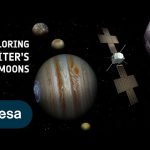
    Our Jupiter Icy Moons Explorer, Juice, will make detailed observations of the giant gas planet and its three large ocean-bearing moons – Ganymede, Callisto and Europa – with a suite of remote sensing, geophysical and in situ instruments. The mission will characterise these moons as both planetary objects and possible habitats, explore Jupiter’s complex environment in depth, and study the wider Jupiter system as an archetype for gas giants across the Universe.

    Juliet will be taking us to Jupiter and its moons in the coming weeks. So stay tuned for more!

    📹 @europeanspaceagency

    ★ Subscribe: http://bit.ly/ESAsubscribe and click twice on the bell button to receive our notifications.

    Check out our full video catalog: http://bit.ly/SpaceInVideos
    Follow us on Twitter: http://bit.ly/ESAonTwitter
    On Facebook: http://bit.ly/ESAonFacebook
    On Instagram: http://bit.ly/ESAonInstagram
    On LinkedIn: https://bit.ly/ESAonLinkedIn
    On Pinterest: https://bit.ly/ESAonPinterest
    On Flickr: http://bit.ly/ESAonFlickr

    We are Europe’s gateway to space. Our mission is to shape the development of Europe’s space capability and ensure that investment in space continues to deliver benefits to the citizens of Europe and the world. Check out https://www.esa.int/ to get up to speed on everything space related.

    Copyright information about our videos is available here: https://www.esa.int/ESA_Multimedia/Terms_and_Conditions

    #ESA
    #Juice
    #Jupiter

  • Juice one step closer to launch

    Juice one step closer to launch

    After many years of study, development, building and testing, ESA’s Jupiter Icy Moons Explorer, Juice, has finally arrived at Europe’s Spaceport in Kourou, French Guiana. At the end of 2022 the spacecraft underwent its final thermal vacuum test at an Airbus Defence and Space facility in Toulouse, as well as its final software verification tests, whereby it was controlled from the ESOC mission control centre in Darmstadt, Germany.

    Soon, an Ariane 5 will lift Juice into orbit and send it on its journey to explore the largest planet in our Solar System and its three icy moons, Europa, Callisto and in particular Ganymede. By exploring and studying the Jovian system, the mission neatly fullfills its role in ESA’s Cosmic Vision programme, teaching us about our Universe and the origins of life.

    Stay tuned: www.esa.int/juice

    ★ Subscribe: http://bit.ly/ESAsubscribe and click twice on the bell button to receive our notifications.

    Check out our full video catalog: http://bit.ly/SpaceInVideos
    Follow us on Twitter: http://bit.ly/ESAonTwitter
    On Facebook: http://bit.ly/ESAonFacebook
    On Instagram: http://bit.ly/ESAonInstagram
    On LinkedIn: https://bit.ly/ESAonLinkedIn
    On Pinterest: https://bit.ly/ESAonPinterest
    On Flickr: http://bit.ly/ESAonFlickr

    We are Europe’s gateway to space. Our mission is to shape the development of Europe’s space capability and ensure that investment in space continues to deliver benefits to the citizens of Europe and the world. Check out https://www.esa.int/ to get up to speed on everything space related.

    Copyright information about our videos is available here: https://www.esa.int/ESA_Multimedia/Terms_and_Conditions

    #ESA
    #Juice
    #Jupiter

  • Juice’s odyssey of exploration

    Juice’s odyssey of exploration

    A grand odyssey of exploration is about to begin. Humankind’s next bold mission to the outer Solar System, ESA’s Jupiter Icy Moons Explorer, Juice, is poised to explore giant planet Jupiter and its largest moons. These intriguing worlds have piqued our curiosity ever since Galileo first raised his telescope to the planet and discovered its four largest moons: Io, Europa, Ganymede and Callisto, three of which are thought to harbour underground oceans.

    Early space probes visiting the Jovian system have raised more questions than answers. But thanks to Juice, many of those answers are now within reach. ESA is launching the spacecraft in April 2023 on an eight-year journey to the distant planet.

    To uncover the hidden secrets of these mysterious worlds, Juice is equipped with the most powerful science instruments ever sent to the outer Solar System. The spacecraft will face many dangers along the way: radiation, extreme temperatures, and the vast gravitational pull of Jupiter, all while operating hundreds of millions of kilometres from Earth. But in the safe hands of ESA’s operators to guide it safely through these challenges, the dangers will be worth it for the science that Juice is destined to uncover.

    The countdown to this new era of Jupiter system exploration has begun. Stay tuned: www.esa.int/juice

    Credit: Produced by ESA/ATG medialab

    ★ Subscribe: http://bit.ly/ESAsubscribe and click twice on the bell button to receive our notifications.

    Check out our full video catalog: http://bit.ly/SpaceInVideos
    Follow us on Twitter: http://bit.ly/ESAonTwitter
    On Facebook: http://bit.ly/ESAonFacebook
    On Instagram: http://bit.ly/ESAonInstagram
    On LinkedIn: https://bit.ly/ESAonLinkedIn
    On Pinterest: https://bit.ly/ESAonPinterest
    On Flickr: http://bit.ly/ESAonFlickr

    We are Europe’s gateway to space. Our mission is to shape the development of Europe’s space capability and ensure that investment in space continues to deliver benefits to the citizens of Europe and the world. Check out https://www.esa.int/ to get up to speed on everything space related.

    Copyright information about our videos is available here: https://www.esa.int/ESA_Multimedia/Terms_and_Conditions

    #ESA
    #Juice
    #Jupiter

  • ESA Preview 2023

    ESA Preview 2023

    At the start of 2023 the European Space Agency ESA is happily looking forward to another year filled with a host of thrilling new missions, cutting edge science and the continued effort to guarantee independent access to space for Europe. We will see the first images of the first Meteosat Third Generation satellite, the launch of the Jupiter Icy Moons Explorer, and of Euclid and another Sentinel-1 satellite launch. It will also be the year of Ariane 6 which will make its inaugural flight and the first Dane in space, Andreas Mogensen will return to the ISS as the new astronaut-candidates commence their training. Near the end of the year the second Space Summit will further cement ESA’s ambitions for Space in Europe.

    ★ Subscribe: http://bit.ly/ESAsubscribe and click twice on the bell button to receive our notifications.

    Check out our full video catalog: http://bit.ly/SpaceInVideos
    Follow us on Twitter: http://bit.ly/ESAonTwitter
    On Facebook: http://bit.ly/ESAonFacebook
    On Instagram: http://bit.ly/ESAonInstagram
    On LinkedIn: https://bit.ly/ESAonLinkedIn
    On Pinterest: https://bit.ly/ESAonPinterest
    On Flickr: http://bit.ly/ESAonFlickr

    We are Europe’s gateway to space. Our mission is to shape the development of Europe’s space capability and ensure that investment in space continues to deliver benefits to the citizens of Europe and the world. Check out https://www.esa.int/ to get up to speed on everything space related.

    Copyright information about our videos is available here: https://www.esa.int/ESA_Multimedia/Terms_and_Conditions

    #ESA
    #2023
    #Space

  • The secrets of Jupiter

    The secrets of Jupiter

    Discover the top five mysteries that ESA’s Jupiter Icy Moons Explorer (Juice) mission will solve. Jupiter, its magnetic environment, and its moons form one of the most intriguing systems in the Solar System. Juice, planned for launch in 2023 and arrival at Jupiter in 2031, will reveal more about this fascinating planet and its natural satellites.

    More about Juice: https://www.esa.int/Science_Exploration/Space_Science/Juice/

    ★ Subscribe: http://bit.ly/ESAsubscribe and click twice on the bell button to receive our notifications.

    Check out our full video catalog: http://bit.ly/SpaceInVideos
    Follow us on Twitter: http://bit.ly/ESAonTwitter
    On Facebook: http://bit.ly/ESAonFacebook
    On Instagram: http://bit.ly/ESAonInstagram
    On LinkedIn: https://bit.ly/ESAonLinkedIn
    On Pinterest: https://bit.ly/ESAonPinterest
    On Flickr: http://bit.ly/ESAonFlickr

    We are Europe’s gateway to space. Our mission is to shape the development of Europe’s space capability and ensure that investment in space continues to deliver benefits to the citizens of Europe and the world. Check out https://www.esa.int/ to get up to speed on everything space related.

    Copyright information about our videos is available here: https://www.esa.int/ESA_Multimedia/Terms_and_Conditions

  • Juice fully integrated

    Juice fully integrated

    ESA’s Juice mission has entered its final phase of development, with the spacecraft moving to an @Airbus Defence and Space facility in Toulouse, France, for the next round of testing. The spacecraft has been fully integrated, and these tests will be done in full flight configuration, as Juice is scheduled for launch from Europe’s Spaceport in Kourou, French Guiana, in April 2023.

    The Juice mission is a perfect example of collaboration between several national space agencies and European industry. Its objective is to explore the gas giant Jupiter, its environment, and three of its moons: Europa, Callisto and Ganymede. By studying this planetary system, ESA hopes to learn more about the icy worlds around Jupiter and the origins and possibility of life in our Universe

    Learn more about Juice: https://bit.ly/JuiceESAScience

    ★ Subscribe: http://bit.ly/ESAsubscribe and click twice on the bell button to receive our notifications.

    Check out our full video catalog: http://bit.ly/SpaceInVideos
    Follow us on Twitter: http://bit.ly/ESAonTwitter
    On Facebook: http://bit.ly/ESAonFacebook
    On Instagram: http://bit.ly/ESAonInstagram
    On Flickr: http://bit.ly/ESAonFlickr

    We are Europe’s gateway to space. Our mission is to shape the development of Europe’s space capability and ensure that investment in space continues to deliver benefits to the citizens of Europe and the world. Check out https://www.esa.int/ to get up to speed on everything space related.

    Copyright information about our videos is available here: https://www.esa.int/ESA_Multimedia/Terms_and_Conditions

    #ESA
    #Jupiter
    #JuiceMission

  • Juice’s journey and Jupiter system tour

    Juice’s journey and Jupiter system tour

    ESA’s Jupiter Icy Moons Explorer, Juice, is set to embark on an eight-year cruise to Jupiter starting April 2023. The mission will investigate the emergence of habitable worlds around gas giants and the Jupiter system as an archetype for the numerous giant planets now known to orbit other stars.

    This animation depicts Juice’s journey to Jupiter and highlights from its foreseen tour of the giant planet and its large ocean-bearing moons. It depicts Juice’s journey from leaving Earth’s surface in a launch window 5–25 April 2023 and performing multiple gravity assist flybys in the inner Solar System, to arrival at Jupiter (July 2031), flybys of the Jovian moons Europa, Callisto and Ganymede, orbital insertion at Ganymede (December 2034), and eventual impact on this moon’s surface (late 2035).

    An Ariane 5 will lift Juice into space from Europe’s Spaceport in Kourou. A series of gravity assist flybys of Earth, the Earth-Moon system and Venus will set the spacecraft on course for its July 2031 arrival at Jupiter. These flybys are shown here in order – Earth-Moon (August 2024), Venus (August 2025), Earth (September 2026, January 2029) – interspersed by Juice’s continuing orbits around the Sun. Juice’s flyby of the Earth-Moon system, known as a Lunar-Earth gravity assist (LEGA), is a world first: by performing this manoeuvre – a gravity assist flyby of the Moon followed just 1.5 days later by one of Earth – Juice will save a significant amount of propellant on its journey.

    Juice will start its science mission about six months prior to entering orbit around Jupiter, making observations as it approaches its destination. Once in the Jovian system, a gravity assist flyby of Jupiter’s largest moon Ganymede – also the largest moon in the Solar System – will help Juice enter orbit around Jupiter, where the spacecraft will spend four years observing the gas giant and three of its moons: Ganymede, Callisto and Europa.

    Juice will make two flybys of Europa (July 2032), which has strong evidence for an ocean of liquid water under its icy shell. Juice will look at the moon’s active zones, its surface composition and geology, search for pockets of liquid water under the surface, and study the plasma environment around Europa, also exploring the moon’s tiny atmosphere and hunting for plumes of water vapour (as have been previously detected erupting to space).

    A sequence of Callisto flybys will be used to study this ancient, cratered world that may too harbour a subsurface ocean, also changing the angle of Juice’s orbit with respect to Jupiter’s equator, making it possible to explore Jupiter’s higher latitudes (2032–2034).

    A sequence of Ganymede and Callisto flybys will adjust Juice’s orbit – properly orienting it while minimising the amount of propellant expended – so that it can enter orbit around Ganymede in December 2034, making it the first spacecraft to orbit another planet’s moon. Juice’s initial elliptical orbit will be followed by a 5000 km-altitude circular orbit, and later a 500 km-altitude circular orbit.

    Ganymede is the only moon in the Solar System to have a magnetosphere. Juice will investigate this phenomenon and the moon’s internal magnetic field, and explore how its plasma environment interacts with that of Jupiter. Juice will also study Ganymede’s atmosphere, surface, subsurface, interior and internal ocean, investigating the moon as not only a planetary object but also a possible habitat.

    Over time, Juice’s orbit around Ganymede will naturally decay due to lack of propellant, and it will make a grazing impact onto the surface (late 2035).

    The Juice launch itself will be a historical milestone for more reasons than one. It will be the final launch for Ariane 5, ending the launcher’s nearly three-decade run as one of the world’s most successful heavy-lift rockets. Its duties are being taken over by Ariane 6.

    Learn more about Juice: https://bit.ly/JuiceESAScience

    Credit: ESA/Lightcurve Films/R. Andres

    ★ Subscribe: http://bit.ly/ESAsubscribe and click twice on the bell button to receive our notifications.

    Check out our full video catalog: http://bit.ly/SpaceInVideos
    Follow us on Twitter: http://bit.ly/ESAonTwitter
    On Facebook: http://bit.ly/ESAonFacebook
    On Instagram: http://bit.ly/ESAonInstagram
    On Flickr: http://bit.ly/ESAonFlickr

    We are Europe’s gateway to space. Our mission is to shape the development of Europe’s space capability and ensure that investment in space continues to deliver benefits to the citizens of Europe and the world. Check out https://www.esa.int/ to get up to speed on everything space related.

    Copyright information about our videos is available here: https://www.esa.int/ESA_Multimedia/Terms_and_Conditions

    #ESA
    #Jupiter
    #JuiceMission

  • Juice takes the heat

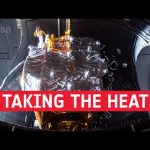
    Juice takes the heat

    ESA’s Jupiter Icy moons Explorer, Juice, has successfully completed rigorous thermal tests simulating the extreme coldness of space and the warmth of the Sun at ESA’s test centre ESTEC, in The Netherlands.

    The spacecraft underwent a month of round-the-clock testing and monitoring in the Large Space Simulator, which recreates the vacuum of space and is able to simulate both hot and cold space environments. The spacecraft was subjected to temperatures ranging from 250 degrees to minus 180 degrees Celsius, showing that it can survive its journey in space.

    Juice will launch in 2022 to our Solar System’s largest planet. It will spend over four years studying Jupiter’s atmosphere, magnetosphere and its icy moons Europa, Callisto and Ganymede, investigating whether the moons’ subsurface oceans are habitable for life.

    Learn more about Juice: https://bit.ly/JuiceESAScience

    ★ Subscribe: http://bit.ly/ESAsubscribe and click twice on the bell button to receive our notifications.

    Check out our full video catalog: http://bit.ly/SpaceInVideos
    Follow us on Twitter: http://bit.ly/ESAonTwitter
    On Facebook: http://bit.ly/ESAonFacebook
    On Instagram: http://bit.ly/ESAonInstagram
    On Flickr: http://bit.ly/ESAonFlickr

    We are Europe’s gateway to space. Our mission is to shape the development of Europe’s space capability and ensure that investment in space continues to deliver benefits to the citizens of Europe and the world. Check out https://www.esa.int/ to get up to speed on everything space related.

    Copyright information about our videos is available here: https://www.esa.int/ESA_Multimedia/Terms_and_Conditions

    #ESA
    #JuiceMission
    #InTheCleanRoom

  • The making of Juice

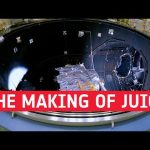
    The making of Juice

    The ESA Jupiter Icy Moons Explorer (Juice) team has been working very hard to prepare the spacecraft for the first test in the one-year long environmental test campaign. This is the so-called Thermal Balance Thermal Vacuum (TBTV) test.

    Juice is in the Large Space Simulator (LSS), a unique facility in Europe (run by the European Test Center, at ESA/ESTEC in the Netherlands) that can simulate the vacuum and cold and hot temperature conditions in space, and also the Sun itself!

    The TBTV started on 17 June with the closure of the LSS and the “pumping-down”, meaning the removal of air within the chamber to a pressure level of 10nbar (1/100 000 000th of the outside air pressure). This is the closest Juice will come to space conditions while on Earth. It will undergo 24/7 testing, ending on 16 July 2021.

    In this episode this process is followed and several team members comment on the different moments.

    Produced for ESA by Lightcurve Films.
    GoPro footage by ESA.
    Original music by William Zeitler.

    ★ Subscribe: http://bit.ly/ESAsubscribe and click twice on the bell button to receive our notifications.

    Check out our full video catalog: http://bit.ly/SpaceInVideos
    Follow us on Twitter: http://bit.ly/ESAonTwitter
    On Facebook: http://bit.ly/ESAonFacebook
    On Instagram: http://bit.ly/ESAonInstagram
    On Flickr: http://bit.ly/ESAonFlickr

    We are Europe’s gateway to space. Our mission is to shape the development of Europe’s space capability and ensure that investment in space continues to deliver benefits to the citizens of Europe and the world. Check out https://www.esa.int/ to get up to speed on everything space related.

    Copyright information about our videos is available here: https://www.esa.int/ESA_Multimedia/Terms_and_Conditions

    #ESA
    #JuiceMission
    #InTheCleanRoom

  • Ultra-cool test of Jupiter instrument

    Ultra-cool test of Jupiter instrument

    An instrument destined for Jupiter orbit undergoes eight days of cryogenic radio-frequency testing using a new test facility at ESA’s ESTEC technical centre in the Netherlands. The Submillimetre Wave Instrument of ESA’s Juice mission will survey the churning atmosphere of Jupiter and the scanty atmospheres of its Galilean moons.

    Testing took place in ESA’s custom-built Low-temperature Near-field Terahertz chamber, or Lorentz. The first chamber of its kind, the 2.8-m diameter Lorentz chamber can perform high-frequency radio-frequency testing in realistic space conditions, combining space-quality vacuum with ultra-low temperatures.

    ★ Subscribe: http://bit.ly/ESAsubscribe and click twice on the bell button to receive our notifications.

    Check out our full video catalog: http://bit.ly/SpaceInVideos
    Follow us on Twitter: http://bit.ly/ESAonTwitter
    On Facebook: http://bit.ly/ESAonFacebook
    On Instagram: http://bit.ly/ESAonInstagram
    On Flickr: http://bit.ly/ESAonFlickr

    We are Europe’s gateway to space. Our mission is to shape the development of Europe’s space capability and ensure that investment in space continues to deliver benefits to the citizens of Europe and the world. Check out https://www.esa.int/ to get up to speed on everything space related.

    Copyright information about our videos is available here: https://www.esa.int/ESA_Multimedia/Terms_and_Conditions

    #ESA
    #JuiceMission
    #InTheCleanRoom

  • Gravity Assist: Why Icy Moons are So Juicy, with Athena Coustenis

    Gravity Assist: Why Icy Moons are So Juicy, with Athena Coustenis

    Listen to the full episode of this podcast and subscribe at: https://www.nasa.gov/gravityassist
    For decades, moons of the outer solar system have proven fascinating subjects for scientists interested in the search for life. Forty years ago this year, NASA’s Voyager 1 spacecraft flew by Saturn’s moon Titan and took the first close images, revealing a thick orange-colored atmosphere that is the most Earth-like in the solar system. NASA’s Cassini probe then dropped off a lander at Titan called Huygens in 2004, and studied Titan in detail during its 13 years at Saturn. Now, NASA is preparing to launch the rotorcraft mission Dragonfly to Titan in the 2020s. But Titan is just one interesting moon. The European Space Agency’s upcoming JUpiter ICy moons Explorer (JUICE) mission will study Ganymede, Europa, and another moon of Jupiter called Callisto. Meanwhile, NASA’s Europa Clipper mission will provide complementary observations of Europa.

  • Juice’s Jovian odyssey

    Juice’s Jovian odyssey

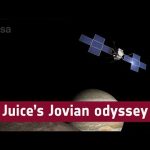
    Juice, ESA’s Jupiter Icy Moons Explorer, is set to embark on a seven-year cruise to Jupiter starting May 2022. The mission will investigate the emergence of habitable worlds around gas giants and the Jupiter system as an archetype for the numerous giant planets now known to orbit other stars.

    This animation depicts the journey to Jupiter and the highlights from its foreseen tour of the giant planet and its large ocean-bearing moons.

    An Ariane 5 will lift Juice into space from Europe’s Spaceport in Kourou. A series of gravity-assist flybys at Earth (3), Venus (1) and Mars (1) will set the spacecraft on course for its October 2029 rendezvous in the Jovian system.

    It is expected that a number of instruments will be activated during the gravity assists (indicated by the different coloured beams scanning across the planets) and measurements will be taken for calibration and to check the health of the instruments. The visualisations of the Earth flybys show the closest approaches over the planet according to current planning – over the South Pacific Ocean, Argentina and Peru, respectively. Throughout the animation, the instrument beam colours correspond to example observations by JANUS (green), MAJIS (red), UVS (purple), Gala (Blue) and RIME (grey), which are cameras, spectrometers, laser altimeter and radar.

    During the Venus flyby, limited observations can be made because the spacecraft will be oriented to protect it from the heat of the Sun experienced in the inner Solar System. The Mars flyby will see Juice fly over the planet’s south pole to make scientific observations.

    Juice will start its science mission about six months prior to arriving in orbit around the gas giant, making observations as it approaches its destination. Once in the Jovian system, a gravity-assist flyby of Jupiter’s largest moon Ganymede – the largest moon in the Solar System – helps Juice enter orbit around the gas giant 7.5 hours later.

    While in Jupiter orbit, the spacecraft will study the Jovian system as an archetype for gas giants, making observations of its atmosphere, the magnetosphere, its rings and satellites.

    During the tour, Juice will make two flybys of Europa, which has strong evidence for an ocean of liquid water under its icy shell. Juice will look at the moon’s active zones, its surface composition and geology, search for pockets of liquid water under the surface and study the plasma environment around Europa.

    A sequence of Callisto flybys will not only be used to study this ancient, cratered world that may too harbor a subsurface ocean, but it will change the angle of Juice’s orbit with respect to Jupiter’s equator, making it possible to investigate the polar regions and environment at higher latitudes.

    During the tour there will also be unique periods to observe events such as moon transits. The example in this animation shows Europa and Io passing in front of Jupiter on 27 January 2032. This type of event is rare, with less than 10 expected to occur during Juice’s tour of the Jovian system.

    A sequence of Ganymede and Callisto flybys will adjust the orbit of Juice to enable it to enter orbit around Ganymede, marking it the first spacecraft to orbit another planet’s moon (aside from our own). The elliptical orbit will be followed by a 5000 km altitude cicular orbit, and later a 500 km circular orbit.

    Ganymede is unique in the Solar System in that it is the only moon to have a magnetosphere. Juice will investigate this phenomenon and the moon’s internal magnetic field, and the interaction of its plasma environment with that of Jupiter. Juice will also study the moon’s atmosphere, surface, subsurface, interior and its internal ocean, investigating the moon as a planetary object and possible habitat.

    Over time the 500 km orbit will naturally decay – eventually there will not be enough propellant to maintain it – and it will make a grazing impact on the surface. The animation concludes with an example of what the approach to impact could look like.

    ★ Subscribe: http://bit.ly/ESAsubscribe and click twice on the bell button to receive our notifications.

    Check out our full video catalog: http://bit.ly/SpaceInVideos
    Follow ESA on Twitter: http://bit.ly/ESAonTwitter
    On Facebook: http://bit.ly/ESAonFacebook
    On Instagram: http://bit.ly/ESAonInstagram
    On Flickr: http://bit.ly/ESAonFlickr

    ESA is Europe’s gateway to space. Our mission is to shape the development of Europe’s space capability and ensure that investment in space continues to deliver benefits to the citizens of Europe and the world. Check out http://www.esa.int/ESA to get up to speed on everything space related.

    Copyright information about our videos is available here: http://www.esa.int/spaceinvideos/Terms_and_Conditions

    #JUICE
    #Jupiter
    #SolarSystem

  • ESA Euronews: Van-e élet a Marson?

    ESA Euronews: Van-e élet a Marson?

    A dél-spanyolországi Rio Tinto nevű hely gyakorlatilag a Mars a Földön. Ha itt van élet, vajon lehet a vörös bolygón is?

  • ESA Euronews: Se há vida na Terra, porque não em Marte?

    ESA Euronews: Se há vida na Terra, porque não em Marte?

    A Euronews esteve em Huelva, onde conheceu o Rio Tinto, cujas margens e sedimentos se parecem em todos os aspetos aos do Planeta Vermelho.
    Um grupo de cientistas procura sinais de vida noutros planetas do nosso sistema solar. E fazem-no com a recolha de amostras dos lugares mais inesperados.

  • ESA Euronews: Mars on Earth

    ESA Euronews: Mars on Earth

    The Rio Tinto river snakes through the Spanish countryside for 100 kilometres, a dark, blood-red stain of acid water and rusty-looking rocks that scientists love to study. Both ESA and NASA experts regularly spend weeks in the Rio Tinto, examining the life underground, and using it as a test bed to look for life on Mars.

    This video is also available in the following languages:
    German: https://youtu.be/K2D8T5i_Myk
    French: https://youtu.be/7cynIaX5O0I
    Italian: https://youtu.be/LOYgvHSR84g
    Spanish: https://youtu.be/YI9Prr0ZVrw
    Portuguese: https://youtu.be/VSDmRn-rRTE
    Greek: https://youtu.be/7KW2SJc2Yjo
    Hungarian: https://youtu.be/M0c6Ev63acs

  • Juice’s journey to Jupiter

    Juice’s journey to Jupiter

    This animation shows the proposed trajectory of ESA’s Jupiter Icy Moons Explore (Juice) mission to Jupiter.

    Based on a launch in June 2022, the spacecraft will make a series of gravity-assist flybys at Earth (May 2023, September 2024 and November 2026), Venus (October 2023) and Mars (February 2025) before arriving in the Jupiter system in October 2029.

    The animation ends at the Jupiter orbit insertion point, but the planned 3.5 year mission will see Juice not only orbit Jupiter, but also make dedicated flybys of the moons Europa, Callisto and Ganymede, before orbiting the largest moon, Ganymede.

    More about Juice:
    http://sci.esa.int/juice/

  • Space science: everything starts here

    Space science: everything starts here

    How did it all begin? What are the origins of our planet? To understand our place in the Universe we need to explore space. Find out how we’re doing this with ESA’s incredible fleet of space science missions to study our Sun and chart the stars around us, probe the dark matter and dark energy of the Universe, and tour various planets, moons and other small bodies in our Solar System.

  • ESA Euronews: Φως στα μυστικά του Δία

    ESA Euronews: Φως στα μυστικά του Δία

    Καλώς ήλθατε στο νέο επεισόδιο του Space. Προσπαθήστε να φανταστείτε ένα ηλιακό μοντέλο στο οποίο κάποιοι πλανήτες θα έχουν κάτω από την επιφάνεια περισσότερο νερό από ότι υπάρχει στη γη.

    Αυτός είναι ο επόμενος στόχος της Ευρωπαϊκής Υπηρεσίας Διαστήματος. Θα επανέλθουμε στο θέμα, αφού πρώτα μάθουμε κάποια διαστημικά νέα.

  • Dry Ice Bubbling Acid – Sick Science! #006

    Dry Ice Bubbling Acid – Sick Science! #006

    For more dry ice cool science experiments, check out http://www.stevespanglerscience.com/experiments/ To learn how to make the cabbage juice, take a look at the video response.

    Want more experiments like this? Check out http://www.stevespanglerscience.com/product/naked-eggs-and-flying-potatoes

    Sick Science™ is a trademark of Steve Spangler, inc.

    © 2010 Steve Spangler Science all rights reserved

  • Spooky Halloween Beverage – Sick Science! #004

    Spooky Halloween Beverage – Sick Science! #004

    Share your ideas for creating the ultimate halloween party by leaving a comment below. Check out http://www.stevespanglerscience.com/halloween-parties.html for party ideas. With just a little dry ice and apple juice, you can create a spooky beverage for you halloween party.

    Want more experiments like this? Check out http://www.stevespanglerscience.com/product/fire-bubbles-exploding-toothpaste-book

    Sick Science™ is a trademark of Steve Spangler, inc.

    © 2010 Steve Spangler Science all rights reserved

  • Dry Ice Recipes – Cool Halloween Science

    Dry Ice Recipes – Cool Halloween Science

    Halloween is the perfect time for oozing, bubbling, eye-catching science! If you love to perform science demonstrations, Halloween is a wonderful excuse to fill the cooler with dry ice and get ready for a day filled with “ooze” and ahhhs! Great Halloween Science!

    About Steve Spangler…

    Steve Spangler is a celebrity teacher, science toy designer, speaker, author and an Emmy award-winning television personality. Spangler is probably best known for his Mentos and Diet Coke geyser experiment that went viral in. Spangler is the founder of www.SteveSpanglerScience.com, a Denver-based company specializing in the creation of science toys, classroom science demonstrations, teacher resources and home for Spangler’s popular science experiment archive and video collection. Spangler is a frequent guest on the Ellen DeGeneres Show and Denver 9 News where he takes classroom science experiments to the extreme. For teachers, parents or DIY Science ideas – check out other sources of learning:

    Join the Science Club and check out other cool science experiments at – http://www.SteveSpanglerScience.com

    Sign up to receive a FREE Experiment of the Week- http://www.stevespanglerscience.com/experiment-of-the-week

    Attend a Spangler Hands-on Science Workshop for Teachers – http://www.stevespanglerscience.com/training

    Watch Steve on Local and National Media Appearances on YouTube at: https://www.youtube.com/user/SpanglerScienceTV