A commercial lander touches down on the Moon, discussing the science on the space station, and preparing for the next space station crew rotation mission … a few of the stories to tell you about – This Week at NASA!
Link to download this video: https://images.nasa.gov/details/NHQ_2024_0223_A%20Commercial%20Lander%20Touches%20Down%20on%20the%20Moon%20on%20This%20Week%20@NASA%20%E2%80%93%20February%2023,%202024
Video Producer: Andre Valentine Video Editor: Andre Valentine Narrator: Emanuel Cooper Music: Universal Production Music Credit: NASA
Scientists and engineers on the ExoMars project had their hearts in their mouths as the ExoMars mission reached the red planet, with the Schiaparelli probe going missing in action at the end of its descent just as the TGO mothership swept into a perfectly timed orbit.
The rollercoaster ride of arrival at Mars is the first installment in this ambitious Russian and European project that aims for the first time to directly search for signs of life on Mars.
The plight of Schiaparelli remains unclear. It is certainly on the Martian surface, but may well have hit the red dust much harder then engineers had planned, and nothing has been heard from it since.
Data relayed during the lander’s descent shows the initial high-speed entry to the Martian atmosphere went well, with the heatshield slowing the craft and the parachute deploying. However once the back heat shield and parachute were ejected the flow of events did not go to plan.
Visualisation of the ExoMars Schiaparelli module entering and descending through the atmosphere to land on Mars. The animation follows a simulated timeline of the module, starting when it enters the atmosphere at an altitude of 121 km at 14:42 GMT. In six minutes it will use a heatshield, parachute and thrusters to brake from 21 000 km/h to a near standstill 2 m above the surface, where a crushable structure on its underside will absorb the final shock.
The key operational milestones are highlighted in the animation at the predicted times at which they have been calculated to occur. However, the actual times may vary depending on the atmospheric conditions on the day, the final path through the atmosphere and the speed at which the module descends.
The times indicated in the animation are onboard spacecraft times at Mars. The one-way signal travel time on 19 October is just under 10 minutes, meaning that signals relayed by spacecraft at Mars are received on Earth about 10 minutes after the event itself has happened on the Red Planet.
Both Schiaparelli and the Mars scenery in this animation are computer-generated.
Visualisation of the ExoMars Schiaparelli module entering and descending through the martian atmosphere to land on Mars.
Schiaparelli will enter the atmosphere at about 21 000 km/h and in less than six minutes it will use a heatshield, a parachute and thrusters to slow its descent before touching down in the Meridiani Planum region close to the equator, absorbing the final contact with a crushable structure.
The entire process will take less than six minutes: the animation has been sped up.
Schiaparelli is set to separate from the Trace Gas Orbiter on 16 October, after a seven-month cruise together through space, and will enter the atmosphere on 19 October at 14:42 GMT.
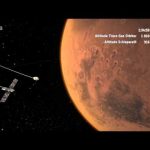
The paths of the ExoMars 2016 Trace Gas Orbiter (TGO) and the Schiaparelli entry, descent and landing demonstrator module arriving at Mars on 19 October (right and left, respectively). The counter begins at the start of a critical engine burn that TGO must conduct in order to enter Mars orbit. The altitude above Mars is also indicated, showing the arrival of Schiaparelli on the surface and the subsequent trajectory of TGO. The orbiter’s initial 4-day orbit will be about 250 x 100 000 km. Starting in December 2016, the spacecraft will perform a series of aerobraking manoeuvres to steadily lower it into a circular, 400 km orbit (not shown here).
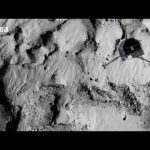
Highlights from coverage of ESA’s Rosetta mission soft-landing its Philae probe on a comet, the first time in history that such an extraordinary feat has been achieved. Including the presentation of the first ROLIS image sent back by Philae as the lander descended to the surface of the comet.
After a tense wait during the seven-hour descent to the surface of Comet 67P/Churyumov–Gerasimenko, the signal confirming the successful touchdown arrived on Earth at 16:03 GMT (17:03 CET).
Scene inside Mission Control as the team regained contact with Rosetta as expected after separation, and with Philae that is descending onto the surface of Comet 67P/C-G.
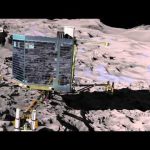
Rosetta’s deployment of Philae to land on Comet 67P/Churyumov–Gerasimenko.
The animation begins with Philae still on Rosetta, which will come to within about 22.5 km of the centre of the nucleus to release the lander on 12 November 2014.
The animation then shows Philae being ejected by Rosetta and deploying its own three legs, and follows the lander’s descent until it reaches the target site on the comet about seven hours later.
The animation is speeded up, but the comet rotation is true: in the time it takes for Philae to descend, the nucleus has rotated by more than 180º (the comet’s rotation period is 12.4 hours).
The final steps of Philae’s descent towards the comet are shown as seen by a hypothetical observer close to the landing site on the comet.
Finally, the animation shows Philae landing on the comet.
Because of the comet’s extremely low gravity, landing gear will absorb the small forces of landing while ice screws in the probe’s feet and a harpoon system will lock the probe to the surface. At the same time a thruster on top of the lander will push it down to counteract the impulse of the harpoon imparted in the opposite direction. Once it is anchored to the comet, the lander will begin its primary science mission, based on its 64-hour initial battery lifetime. The animation shows a number of the science instruments in action on the surface.
Acknowledgement: The background image of the sequence showing Philae closing in on the landing site was taken by Rosetta’s OSIRIS narrow-angle camera (ESA/Rosetta/MPS for OSIRIS Team MPS/UPD/LAM/IAA/SSO/INTA/UPM/DASP/IDA) on 14 September 2014 from a distance of about 30 km.
Philae was provided by a consortium led by DLR, MPS, CNES and ASI.
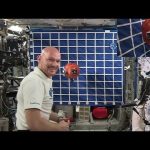
ESA astronaut Alexander Gerst performs a demonstration of how ESA’s Rosetta mission will attempt to put a lander, called ‘Philae’ on the surface of comet 67P/Churyumov–Gerasimenko.
Alexander narrates the story of the Rosetta mission and performs a demonstration that visualises the difficulties of landing on an object that has little gravitational pull. Using the weightless environment of the Space Station, Alexander attempts to land ‘Philae’ (an ear plug) onto the surface of the ‘comet’ (an inactive SPHERES robot) with increasing levels of difficulty: a rotating comet that is not moving to one that is both rotating and moving.
This video is one of the six experiments and demonstrations in the Flying Classroom, Alexander will use small items to demonstrate several principles of physics in microgravity to students aged 10–17 years.
The Rosetta mission’s lander, Philae, will be deployed on 12 November at 08:35 GMT/09:35 CET from a distance of 22.5 km from the centre of the comet. It will land about seven hours later, with confirmation expected to arrive at Earth at around 16:00 GMT/17:00 CET.
Rosetta will release its Philae lander when approximately 22 kilometres from the centre of the comet. A signal confirming the separation will arrive at ground stations on Earth 28 minutes and 20 seconds later while the lander’s descent to the surface will take seven hours. On the way down, Philae will take a series of images and onboard instruments will sample the dust, gas and plasma close to the comet’s surface and measure any magnetic field.
Philae’s three lander legs will absorb the momentum of impact and use it to drive an ice screw in each foot into the surface. At the same time two harpoons will fire to lock the probe onto the surface and a small thruster on top will counteract the impulse. Once anchored to the nucleus, Philae will begin its primary science mission, based on its initial battery lifetime of 64 hours.
The SESAME experiment – which contains three instruments – includes one called CASSE, located in the lander’s feet. Harald KRUEGER, Principal Investigator of Rosetta’s SESAME experiment, explains how CASSE will use acoustic waves to determine properties of the comet’s soil.
Within hours of landing, we also hope to see the first ever images of a comet from its surface.
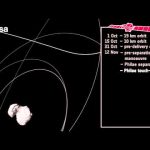
Animation showing Rosetta’s orbit in the lead up to, during and after lander separation.
The animation begins on 1 October 2014, when Rosetta is orbiting about 19 km from Comet 67P/Churyumov–Gerasimenko (all distances refer to the comet’s centre). The animation shows the transition to the close 10 km orbit by mid-October, and then the steps taken to move onto the pre-separation trajectory.
On the day of landing, 12 November, Rosetta makes a further manoeuvre 2–3 hours before separation to move to 22.5 km from the comet centre to deploy the lander, Philae. While Philae descends to the surface over a period of seven hours, Rosetta makes another manoeuvre to maintain visibility with the lander. A series of ‘relay phase’ manoeuvres then move Rosetta out to a distance of about 50 km, before moving first to a 30 km orbit and later to an orbit at about 20 km by early December.
The speed of the animation slows during the separation and lander phase to better highlight these events. The comet shape and rate of rotation is real – the comet rotates with a period of about 12.4 hours.
Lunar Lander mission, from launch to landing and exploring the Moon.
Lunar Lander is a robotic explorer that will demonstrate key European technologies and conduct science experiments.
The mission is a forerunner to future human and robotic exploration of the Moon and Mars. It will establish European expertise to allow strong international partnerships in exploration.