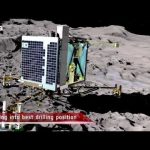
Watch Intuitive Machines’ Nova-C lunar lander, Athena, touch down on the Moon. Athena will land at Mons Mouton, a lunar plateau near the Moon’s South Pole, delivering NASA science and technology to the Moon’s surface. Landing is slated for no earlier than 12:30 p.m. EST (1730 UTC).
The NASA tech aboard the lander will demonstrate resource utilization on the Moon by measuring the possible presence of volatiles or gases from lunar soil and give future spacecraft a permanent reference point on the lunar surface.
This is Intuitive Machines’ second Moon landing as part of NASA’s Commercial Lunar Payload Services (CLPS) initiative. To learn more about CLPS, visit https://go.nasa.gov/3RFR0A5.
NASA science is set to land on the Moon aboard Odysseus, Intuitive Machines’ uncrewed autonomous lander. Touchdown is now targeted for 6:24 p.m. EST (2324 UTC) Thursday, Feb. 22, 2024. The NASA payloads aboard the lander aim to help us learn more about terrain and communications near the lunar South Pole.
For more information about our Commercial Lunar Payload Services initiative, visit: https://go.nasa.gov/3RFR0A5
19 years ago, on 25 December 2004, ESA’s Huygens probe was released from the Cassini spacecraft. Huygens continued on to Titan, Saturn’s largest and most interesting moon, descending via parachute and touching-down at 11:30 UTC, 14 January 2005. The descent phase lasted around 2 hours, 27 minutes, with a further 1 hour and 10 minutes of operation on the surface.
This video has been accelerated to 200% speed, showing the descent from an altitude of 62 km at 9:41 UTC to the touchdown.
What’s it like landing on Mars? Tough! But every time we land, we learn more.
When our Perseverance Mars rover descended toward the Red Planet, it was decked out with temperature and pressure sensors that collected critical data about entry and landing conditions. NASA engineer Alex Scammell tells us more.
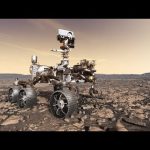
On February 18, 2021, the Perseverance Mars Rover will touch down on the Red Planet. The rover will seek signs of ancient life and collect samples of rock and regolith (broken rock and soil) for possible return to Earth.
Similar in size to a car, Perseverance is the heaviest rover we’ve ever sent to the surface of Mars, carrying a variety of out-of-this-world experiments that will help prepare us for future human exploration.
Producer/Editor: Lacey Young Music: Universal Production Music
L’astronauta dell’ESA Luca Parmitano è tornato dalla sua seconda missione di lunga durata sulla Stazione Spaziale Internazionale chiamata ‘Beyond’, il 6 febbraio 2020. In questa intervista al Centro astronauti dell’ESA di Colonia in Germania, condivide alcune delle sue esperienze e dei suoi sentimenti dopo 201 giorni in orbita.
Questa intervista è stata condotta nella tarda notte in cui Luca è atterrato a Colonia, ed è la prima intervista completa con lui in Europa da quando è atterrato in Kazakistan alle 09:12 GMT (10:12 CET) giovedì 6 febbraio.
Tra i momenti salienti della missione Beyond di Luca ci sono: diventare il terzo europeo e il primo italiano al comando della Stazione Spaziale, condurre tre delle quattro complesse passeggiate spaziali, ottenere il record europeo per la maggior parte del tempo trascorso durante le passeggiate spaziali, controllare a distanza un rover che raccoglie rocce nei Paesi Bassi, condurre oltre 50 esperimenti europei e 200 internazionali e condividere le sue esperienze attraverso immagini e collegamenti video.
Una delle cose principali che Luca ha evidenziato nel corso della sua missione è stata la fragilità del nostro pianeta e la necessità di agire ora per le generazioni a venire.
We are Europe’s gateway to space. Our mission is to shape the development of Europe’s space capability and ensure that investment in space continues to deliver benefits to the citizens of Europe and the world. Check out http://www.esa.int/ESA to get up to speed on everything space related.
On July 20, 1969, humans walked on another world for the first time in history, achieving the goal that President John F. Kennedy had set in 1961, before Americans had even orbited the Earth. After a landing that included dodging a lunar crater and boulder field just before touchdown, Apollo 11 astronauts Neil Armstrong and Buzz Aldrin explored the area around their lunar landing site for more than two hours.
When the lunar module landed at 4:17 p.m EDT, only 30 seconds of fuel remained. Armstrong radioed “Houston, Tranquility Base here. The Eagle has landed.” Mission control erupted in celebration as the tension breaks, and a controller tells the crew “You got a bunch of guys about to turn blue, we’re breathing again.”
A landing site is selected for our next Mars rover, our InSight mission is in the home stretch of its journey to the Red Planet, and a week of celebration on the space station … a few of the stories to tell you about – This Week at NASA!
This video is available for download from NASA’s Image and Video Library: https://images.nasa.gov/details-NHQ_2018_1123_Landing%20Site%20Selected%20for%20Mars%202020%20Mission%20on%20This%20Week%20@NASA%20%E2%80%93%20November%2023,%202018.html
Highlights from ESA astronaut Thomas Pesquet’s return to Earth at the end of his six-month Proxima mission to the International Space Station on 2 June 2017.
After farewells and hatch closure, Thomas and his Expedition 50/51 crewmate and Soyuz commander Oleg Novitsky undocked from the International Space Station at 12:47 CEST (10:47 GMT). Just a few hours later their spacecraft reentered Earth’s atmosphere, landing in the Kazakh Steppe at 16:10 CEST (14:10 GMT). Thomas and Oleg were helped out of the Soyuz by a recovery crew and, after medical checks, they were flown to Karaganda airport where they received the traditional welcoming ceremony. Thomas then flew directly from Karaganda to Cologne, in Germany, home to the European Astronaut Centre, to start post-flight testing.
Thomas and Oleg spent 196 days in space. Thomas took part in more than 60 experiments during his Proxima mission. His experiments are helping to understand the human brain, ocean currents and radiation in space, how atoms behave and tested new spacecraft materials. Other highlights included his two spacewalks to improve and maintain the Space Station.
Scientists and engineers on the ExoMars project had their hearts in their mouths as the ExoMars mission reached the red planet, with the Schiaparelli probe going missing in action at the end of its descent just as the TGO mothership swept into a perfectly timed orbit.
The rollercoaster ride of arrival at Mars is the first installment in this ambitious Russian and European project that aims for the first time to directly search for signs of life on Mars.
The plight of Schiaparelli remains unclear. It is certainly on the Martian surface, but may well have hit the red dust much harder then engineers had planned, and nothing has been heard from it since.
Data relayed during the lander’s descent shows the initial high-speed entry to the Martian atmosphere went well, with the heatshield slowing the craft and the parachute deploying. However once the back heat shield and parachute were ejected the flow of events did not go to plan.
Visualisation of the ExoMars Schiaparelli module entering and descending through the atmosphere to land on Mars. The animation follows a simulated timeline of the module, starting when it enters the atmosphere at an altitude of 121 km at 14:42 GMT. In six minutes it will use a heatshield, parachute and thrusters to brake from 21 000 km/h to a near standstill 2 m above the surface, where a crushable structure on its underside will absorb the final shock.
The key operational milestones are highlighted in the animation at the predicted times at which they have been calculated to occur. However, the actual times may vary depending on the atmospheric conditions on the day, the final path through the atmosphere and the speed at which the module descends.
The times indicated in the animation are onboard spacecraft times at Mars. The one-way signal travel time on 19 October is just under 10 minutes, meaning that signals relayed by spacecraft at Mars are received on Earth about 10 minutes after the event itself has happened on the Red Planet.
Both Schiaparelli and the Mars scenery in this animation are computer-generated.
On 16 October, seven months and 500 million km after launching from Baikonur in Kazakhstan, the joint European and Russian ExoMars 2016 mission reaches a crucial phase.
The Trace Gas Orbiter will release its Schiaparelli lander for a three day coast and a six minute descent to the Martian surface.The lander, which was designed to demonstrate technologies for entry, descent and landing on Mars, is heading for the Meridiani Planum. This is an area that is currently being studied by NASA’s Opportunity rover and Europe’s Mars Express orbiter.
On 19 October, the Schiaparelli lander will be activated a few hours before reaching the Martian atmosphere, when it will be travelling at some 21 000 km/h. The front heatshield – covered with 90 insulating tiles – will be subjected to temperatures of up to 1500 degrees Celsius.
This video covers the separation, descent and landing procedures, as well as the orbiter’s critical burn to avoid crashing on the surface of Mars.
Visualisation of the ExoMars Schiaparelli module entering and descending through the martian atmosphere to land on Mars.
Schiaparelli will enter the atmosphere at about 21 000 km/h and in less than six minutes it will use a heatshield, a parachute and thrusters to slow its descent before touching down in the Meridiani Planum region close to the equator, absorbing the final contact with a crushable structure.
The entire process will take less than six minutes: the animation has been sped up.
Schiaparelli is set to separate from the Trace Gas Orbiter on 16 October, after a seven-month cruise together through space, and will enter the atmosphere on 19 October at 14:42 GMT.
Inside the main control room at ESA’s operation centre as the Rosetta spacecraft sends its last signal from Comet 67P/Churyumov–Gerasimenko, confirming the end of the spacecraft’s 12.5 year journey in space.
On the last day of her incredible mission, Rosetta slowly descends to the surface of Comet 67P/Churyumov-Gerasimenko. After having sent her extraordinary data back home, she is ready to join Philae for a well deserved rest on the comet. But is there one last surprise in store?
On the last day of her incredible mission, Rosetta slowly descends to the surface of Comet 67P/Churyumov-Gerasimenko. After having sent her extraordinary data back home, she is ready to join Philae for a well deserved rest on the comet. But is there one last surprise in store?
On the last day of her incredible mission, Rosetta slowly descends to the surface of Comet 67P/Churyumov-Gerasimenko. After having sent her extraordinary data back home, she is ready to join Philae for a well deserved rest on the comet. But is there one last surprise in store?
On the last day of her incredible mission, Rosetta slowly descends to the surface of Comet 67P/Churyumov-Gerasimenko. After having sent her extraordinary data back home, she is ready to join Philae for a well deserved rest on the comet. But is there one last surprise in store?
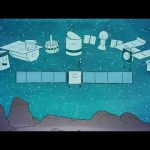
Rosetta revisits the exciting scientific discoveries she made during her time at Comet 67P/Churyumov-Gerasimenko, including the successful search to find Philae. Finally, she starts preparing to descend to the comet for the end of her extraordinary mission.
Animation visualising Rosetta’s descent to Comet 67P/Churyumov–Gerasimenko on 30 September 2016. The sequence is speeded up to show the relative motion of Rosetta and the rotating comet below.
Rosetta will target a smooth region close to several large pits measuring more than 100 m across and 60 m deep, on the small lobe of the comet.
The impact time is predicted as 11:20 GMT +/- 20 minutes on 30 September.
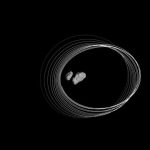
Animation of Rosetta’s trajectory over the last two months of its mission at Comet 67P/Churyumov–Gerasimenko.
The animation begins in early August, when the spacecraft started flying elliptical orbits that brought it progressively closer to the comet at its closest approach.
On 24 September 2016, Rosetta will leave its current close, flyover orbits and transfer into the start of a 16 x 23 km orbit that will be used to prepare and line up for the final descent.
On the evening of 29 September (20:50 GMT) Rosetta will manoeuvre onto a collision course with the comet, beginning the descent from an altitude of 19 km. The spacecraft will fall freely, without further manoeuvres, collecting scientific data during the descent.
The trajectory shown here was created from real data provided over the last month, but may not necessarily follow the exact comet distance because of natural deviations from the comet’s gravity and outgassing.
Animation of Rosetta’s final trajectory in the last 10 days of its mission at Comet 67P/Churyumov–Gerasimenko.
On 24 September 2016, Rosetta will leave a close flyover orbit and transfer into the start of a 16 x 23 km orbit that will be used to prepare and line up for the final descent. In the evening of 29 September (20:50 GMT) Rosetta will manoeuvre onto a collision course with the comet, beginning the descent from an altitude of 19 km. The spacecraft will fall freely, without further manoeuvres, collecting scientific data during the descent.
The trajectory shown in this animation is created from real data provided in the last month, but may not necessarily follow the exact distance/time details because of natural deviations in the trajectory associated with the comet’s gravity and outgassing.
This interview with ESA astronaut Tim Peake was recorded in Cologne, Germany, one day after his return from a six-month stay on the International Space Station.
Tim Peake, NASA astronaut Tim Kopra and commander Yuri Malenchenko landed in the steppe of Kazakhstan on Saturday, 18 June in their Soyuz TMA-19M spacecraft at 09:15 GMT. The trio spent 186 days on the International Space Station.
The landing brings Tim Peake’s Principia mission to an end but the research continues. Tim is the eighth ESA astronaut to complete a long-duration mission in space. He was the third after Alexander Gerst and Andreas Mogensen to fly directly to ESA’s astronaut home base in Cologne, Germany, for medical checks and for researchers to collect more data on how Tim’s body and mind have adapted to living in space.
ESA astronaut Tim Peake, NASA astronaut Tim Kopra and commander Yuri Malenchenko landed in the steppe of Kazakhstan on Saturday, 18 June in their Soyuz TMA-19M spacecraft. The trio spent 186 days on the International Space Station. The landing brings Tim Peake’s Principia mission to an end but the research continues. Tim is the eighth ESA astronaut to complete a long-duration mission in space. He is the third after Alexander Gerst and Andreas Mogensen to fly directly to ESA’s astronaut home base in Cologne, Germany, for medical checks and for researchers to collect more data on how Tim’s body and mind have adapted to living in space.
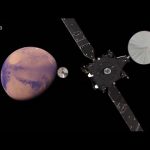
The paths of the ExoMars 2016 Trace Gas Orbiter (TGO) and the Schiaparelli entry, descent and landing demonstrator module arriving at Mars on 19 October (right and left, respectively). The counter begins at the start of a critical engine burn that TGO must conduct in order to enter Mars orbit. The altitude above Mars is also indicated, showing the arrival of Schiaparelli on the surface and the subsequent trajectory of TGO. The orbiter’s initial 4-day orbit will be about 250 x 100 000 km. Starting in December 2016, the spacecraft will perform a series of aerobraking manoeuvres to steadily lower it into a circular, 400 km orbit (not shown here).
ESA astronaut Samantha Cristoforetti, NASA astronaut Terry Virts and Russian commander Anton Shkaplerov landed in the Kazakh steppe after a three-hour ride in their Soyuz spacecraft 11 June 2015.
Shortly after landing the crew were welcomed back to Earth in a traditional Kazakh ceremony held for all astronauts who return from space on a Soyuz spacecraft.
ESA astronaut Samantha Cristoforetti, NASA astronaut Terry Virts and Russian commander Anton Shkaplerov landed in the Kazakh steppe after a three-hour ride in their Soyuz spacecraft 11 June 2015. They left the International Space Station at 10:20 GMT at the end of their six-month stay on the research complex.
Soyuz TMA-15M braked from the Station’s cruising speed of almost 28 800 km/h and entered the atmosphere six hours later. The small descent module separated as planned and parachutes deployed to slow the vehicle down even more.
The module fired retrorockets moments before landing and springs in the moulded seats reduced the impact of hitting the steppe at 13:44 GMT. Teams were on hand within minutes to help them out.
Celebrating the landing of Rosetta’s Philae lander on 67P/Churyumov–Gerasimenko at ESA’s technical heart. Along with the main Rosetta landing event taking place at ESA’s ESOC control centre, many other events took place all across Europe. More than a quarter of a century in the making, the Rosetta comet-chaser had been designed, planned and finally tested at ESTEC – ESA’s largest establishment, based in Noordwijk, the Netherlands – in advance of its 2004 launch.
More than 450 external guests, media representatives and Agency personnel gathered together at SpaceExpo, ESTEC’s visitor centre, to follow the nail-biting Philae landing during the afternoon and evening of Wednesday 12 November 2014. ESTEC Director Franco Ongaro presided over the gathering, which was also attended by ESA astronaut André Kuipers, Rob van Hassel of Airbus Defence and Space Netherlands – who detailed the Dutch contributions to Rosetta – as well as comet expert Inge Loes ten Kate from Utrecht University.
Highlights from coverage of ESA’s Rosetta mission soft-landing its Philae probe on a comet, the first time in history that such an extraordinary feat has been achieved.
After a tense wait during the seven-hour descent to the surface of Comet 67P/Churyumov–Gerasimenko, the signal confirming the successful touchdown arrived on Earth at 16:03 GMT (17:03 CET).
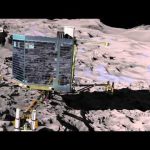
Rosetta’s deployment of Philae to land on Comet 67P/Churyumov–Gerasimenko.
The animation begins with Philae still on Rosetta, which will come to within about 22.5 km of the centre of the nucleus to release the lander on 12 November 2014.
The animation then shows Philae being ejected by Rosetta and deploying its own three legs, and follows the lander’s descent until it reaches the target site on the comet about seven hours later.
The animation is speeded up, but the comet rotation is true: in the time it takes for Philae to descend, the nucleus has rotated by more than 180º (the comet’s rotation period is 12.4 hours).
The final steps of Philae’s descent towards the comet are shown as seen by a hypothetical observer close to the landing site on the comet.
Finally, the animation shows Philae landing on the comet.
Because of the comet’s extremely low gravity, landing gear will absorb the small forces of landing while ice screws in the probe’s feet and a harpoon system will lock the probe to the surface. At the same time a thruster on top of the lander will push it down to counteract the impulse of the harpoon imparted in the opposite direction. Once it is anchored to the comet, the lander will begin its primary science mission, based on its 64-hour initial battery lifetime. The animation shows a number of the science instruments in action on the surface.
Acknowledgement: The background image of the sequence showing Philae closing in on the landing site was taken by Rosetta’s OSIRIS narrow-angle camera (ESA/Rosetta/MPS for OSIRIS Team MPS/UPD/LAM/IAA/SSO/INTA/UPM/DASP/IDA) on 14 September 2014 from a distance of about 30 km.
Philae was provided by a consortium led by DLR, MPS, CNES and ASI.
Media and interested members of the public joined Rosetta mission experts online on Friday, 7 November for a briefing ahead of the historic comet landing on 12 November.
Programme:
Introduction: Emily Baldwin, ESA space science editor
Overview of media events: Jocelyne Landeau-Constantin, Head of ESOC communication office
Science from Rosetta so far: Matt Taylor, ESA Rosetta project scientist
Spacecraft status and operations timeline: Andrea Accomazzo, ESA Rosetta flight director
Key messages: Fred Jansen, ESA Rosetta mission manager
Q&A: all
The final steps of Philae’s descent towards Comet 67P/Churyumov–Gerasimenko on 12 November 2014, as seen by a hypothetical observer close to the landing site on the comet.
The background image was taken by Rosetta’s OSIRIS narrow-angle camera on 14 September 2014 from a distance of about 30 km.
Philae was provided by a consortium led by DLR, MPS, CNES and ASI.
Credit: ESA/ATG medialab; background image: ESA/Rosetta/MPS for OSIRIS Team MPS/UPD/LAM/IAA/SSO/INTA/UPM/DASP/IDA
Rosetta will release its Philae lander when approximately 22 kilometres from the centre of the comet. A signal confirming the separation will arrive at ground stations on Earth 28 minutes and 20 seconds later while the lander’s descent to the surface will take seven hours. On the way down, Philae will take a series of images and onboard instruments will sample the dust, gas and plasma close to the comet’s surface and measure any magnetic field.
Philae’s three lander legs will absorb the momentum of impact and use it to drive an ice screw in each foot into the surface. At the same time two harpoons will fire to lock the probe onto the surface and a small thruster on top will counteract the impulse. Once anchored to the nucleus, Philae will begin its primary science mission, based on its initial battery lifetime of 64 hours.
The SESAME experiment – which contains three instruments – includes one called CASSE, located in the lander’s feet. Harald KRUEGER, Principal Investigator of Rosetta’s SESAME experiment, explains how CASSE will use acoustic waves to determine properties of the comet’s soil.
Within hours of landing, we also hope to see the first ever images of a comet from its surface.
Annotated version of the Philae’s mission at comet 67P animation.
The animation begins with the deployment of Philae from Rosetta at comet 67P/Churyumov–Gerasimenko in November 2014. It will take several hours for it to reach the surface. Because of the comet’s extremely low gravity, landing gear will absorb the small forces of landing while ice screws in the probe’s feet and a harpoon system will lock the probe to the surface. At the same time a thruster on top of the lander will push it down to counteract the impulse of the harpoon imparted in the opposite direction.
Once it is anchored to the comet, the lander will begin its primary science mission, based on its 64-hour initial battery lifetime. The animation shows a number of the science instruments in action on the surface.
Rosetta’s Philae lander is provided by a consortium led by DLR, MPS, CNES and ASI.
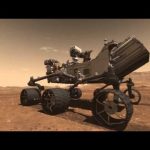
NASA’s most advanced Mars rover Curiosity has landed on the Red Planet. The one-ton rover, hanging by ropes from a rocket backpack, touched down onto Mars Sunday to end a 36-week flight and begin a two-year investigation.
The Mars Science Laboratory (MSL) spacecraft that carried Curiosity succeeded in every step of the most complex landing ever attempted on Mars, including the final severing of the bridle cords and flyaway maneuver of the rocket backpack.
The Mars Science Laboratory, the hardest mission ever attempted in planetary robotic exploration is about to prove its mettle with the landing of its Curiosity rover on the Red Planet. Live coverage begins at 11:30 p.m. Eastern on NASA TV.
On 1 July 2012, ESA astronaut André Kuipers, NASA astronaut Don Pettit and Russian Cosmonaut Oleg Kononenko returned to Earth in their Soyuz capsule. It marks the end of PromISSe, the fourth ESA long-duration mission aboard the International Space Station.
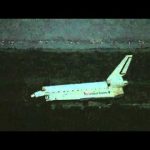
After more than 30 years, the space shuttle era has come to a close. Space shuttle Atlantis and the STS-135 crew landed safely on runway 15 at 5:57 a.m. EDT at Kennedy Space Center’s Shuttle Landing Facility in Florida, ending a 13-day journey of more than five million miles. It was the final and 133rd landing in shuttle history. The STS-135 crew consisted of Commander Chris Ferguson, Pilot Doug Hurley, Mission Specialists Sandra Magnus and Rex Walheim.
This 11-minute animation depicts key events of NASA’s Mars Science Laboratory mission, which will launch in late 2011 and land a rover, Curiosity, on Mars in August 2012. A shorter 4-minute version of this animation, with narration, is also available on our youtube page.