Tag: launches

  • Ariane 6 launches MetOp-SG-A1 and Sentinel-5

    Ariane 6 launches MetOp-SG-A1 and Sentinel-5

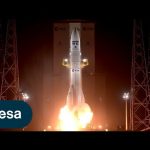
    Europe’s first MetOp Second Generation, MetOp-SG-A1, weather satellite – which hosts the Copernicus Sentinel-5 mission – has launched aboard an Ariane 6 rocket from Europe’s Spaceport in French Guiana. The rocket lifted off on 13 August at 02:37 CEST (12 August 21:37 Kourou time).

    MetOp-SG-A1 is the first in a series of three successive pairs of satellites. The mission as a whole not only ensures the continued delivery of global observations from polar orbit for weather forecasting and climate analysis for more than 20 years, but also offers enhanced accuracy and resolution compared to the original MetOp mission – along with new measurement capabilities to expand its scientific reach.

    This new weather satellite also carries the Copernicus Sentinel-5 mission to deliver daily global data on air pollutants and atmospheric trace gases as well as aerosols and ultraviolet radiation.

    Credit: ESA/CNES/Arianespace

    Access the video on the ESA video library: https://www.esa.int/ESA_Multimedia/Videos/2025/08/MetOp-SG-A1_and_Sentinel-5_launch_on_Ariane_6

    ★ Subscribe: http://bit.ly/ESAsubscribe and click twice on the bell button to receive our notifications.

    Check out our full video catalog: http://bit.ly/SpaceInVideos
    Follow us on Twitter: http://bit.ly/ESAonTwitter
    On Facebook: http://bit.ly/ESAonFacebook
    On Instagram: http://bit.ly/ESAonInstagram
    On LinkedIn: https://bit.ly/ESAonLinkedIn
    On Pinterest: https://bit.ly/ESAonPinterest
    On Flickr: http://bit.ly/ESAonFlickr

    We are Europe’s gateway to space. Our mission is to shape the development of Europe’s space capability and ensure that investment in space continues to deliver benefits to the citizens of Europe and the world. Check out https://www.esa.int/ to get up to speed on everything space related.

    Copyright information about our videos is available here: https://www.esa.int/ESA_Multimedia/Terms_and_Conditions
  • Axiom Mission 4 Launches to the International Space Station

    Axiom Mission 4 Launches to the International Space Station

    Axiom Mission 4, set to lift off at 2:31 a.m. EDT (0631 UTC) on Wednesday, June 25, is Axiom’s fourth private astronaut mission to the International Space Station. Ax-4 is launching from NASA’s Kennedy Space Center aboard SpaceX’s Dragon spacecraft.

    During their two-week stay aboard the orbiting laboratory, the crew of Ax-4 will engage in science, outreach, and commercial activities.

    Peggy Whitson, former NASA astronaut and director of human spaceflight at Axiom Space, will command the mission, while ISRO (Indian Space Research Organisation) astronaut Shubhanshu Shukla will serve as pilot. The two mission specialists are ESA (European Space Agency) project astronaut Sławosz Uznański-Wiśniewski of Poland and Tibor Kapu of Hungary. This mission will send the first ISRO astronaut to the station as part of a joint effort between NASA and the Indian space agency. Ax-4 will also carry the first astronauts from Poland and Hungary to stay aboard the space station.

    Launch coverage is led by Axiom Space, with support from NASA and SpaceX; NASA’s primary mission responsibilities begin during Dragon’s approach to the International Space Station, the start of Ax-4 integrated operations. Learn more about NASA’s role in Ax-4 and how we’re working with our industry partners to open low Earth orbit to more people, more science, and more opportunities: https://go.nasa.gov/4mRkpGj

    Song: ‘Apache’ by Kevin Graham
    Content ID: WXGBDH0A08QGK9CG

    Song: ‘Majestic Skies’ by Strength To Last
    Content ID: VINOM8MWVMC8LB7X

  • Sentinel-1C launches on Vega-C

    Sentinel-1C launches on Vega-C

    The third Copernicus Sentinel-1 satellite, Sentinel-1C, has launched aboard a Vega-C rocket, flight VV25, from Europe’s Spaceport in French Guiana. The rocket lifted off on 5 December 2024 at 22:20 CET (18:20 local time).

    Sentinel-1C extends the legacy of its predecessors, delivering high-resolution radar imagery to monitor Earth’s changing environment, supporting a diverse range of applications and advance scientific research. Additionally, Sentinel-1C introduces new capabilities for detecting and monitoring maritime traffic.

    The launch also marks Vega-C’s ‘return to flight’, a key step in restoring Europe’s independent access to space. Vega-C is the evolution of the Vega family of rockets and delivers increased performance, greater payload volume and improved competitiveness.

    Credits: Arianespace

    ★ Subscribe: http://bit.ly/ESAsubscribe and click twice on the bell button to receive our notifications.

    Check out our full video catalog: http://bit.ly/SpaceInVideos
    Follow us on Twitter: http://bit.ly/ESAonTwitter
    On Facebook: http://bit.ly/ESAonFacebook
    On Instagram: http://bit.ly/ESAonInstagram
    On LinkedIn: https://bit.ly/ESAonLinkedIn
    On Pinterest: https://bit.ly/ESAonPinterest
    On Flickr: http://bit.ly/ESAonFlickr

    We are Europe’s gateway to space. Our mission is to shape the development of Europe’s space capability and ensure that investment in space continues to deliver benefits to the citizens of Europe and the world. Check out https://www.esa.int/ to get up to speed on everything space related.

    Copyright information about our videos is available here: https://www.esa.int/ESA_Multimedia/Terms_and_Conditions

    #ESA #Sentinel-1 C #Rocket

  • A New Crew Launches to the Space Station on This Week @NASA – March 8, 2024

    A New Crew Launches to the Space Station on This Week @NASA – March 8, 2024

    A new crew launches to the space station, graduating a new class of Artemis astronauts, and a group of tiny lunar-roving robots are ready to roll … a few of the stories to tell you about – This Week at NASA!

    Link to download this video:
    https://images.nasa.gov/details/A%20New%20Crew%20Launches%20to%20the%20Space%20Station%20on%20This%20Week%20@NASA%20%E2%80%93%20March%208,%202024

    Video Producer: Andre Valentine
    Video Editor: Andre Valentine
    Narrator: Emanuel Cooper
    Music: Universal Production Music
    Credit: NASA

  • Axiom Mission 3 Launches to the International Space Station (Official NASA Broadcast)

    Axiom Mission 3 Launches to the International Space Station (Official NASA Broadcast)

    Axiom Mission 3, set to lift off at 4:49 p.m. EST (2149 UTC) on Thursday, Jan. 18, is Axiom’s third private astronaut mission to the International Space Station. Ax-3 is launching from NASA’s Kennedy Space Center aboard SpaceX’s Dragon Freedom spacecraft.

    During their two-week stay aboard the orbiting laboratory, the crew of Ax-3—commander Michael López-Alegría, pilot Walter Villadei of Italy, mission specialist Alper Gezeravcı of Turkey, and ESA (European Space Agency) project astronaut Marcus Wandt of Sweden—will engage in technology demonstrations, student outreach, and experiments ranging from medical research to materials science.

    Launch coverage is led by Axiom Space, with support from NASA and SpaceX; NASA’s primary mission responsibilities begin during Freedom’s approach to the International Space Station, the start of Ax-3 integrated operations. Learn more about NASA’s role in Ax-3 and how we’re working with our industry partners to open low Earth orbit to more people, more science, and more opportunities: https://go.nasa.gov/3Se0bsN

    Stream highlights:
    2:10 — Meet the Ax-3 Crew
    30:04 — Ax-3 Crew Training
    34:14 — Ax-3 Science & Research
    48:42 — Interview with NASA Administrator Bill Nelson
    1:03:48 — Liftoff!
    1:16:04 — Dragon flies free

    #Ax3 #NASA #SpaceStation

  • 2024: a year of launches

    2024: a year of launches

    As 2024 kicks into gear, we invite you to look ahead with ESA and see what awaits us in the coming 12 months.

    After Ariane 5’s retirement in 2023, Europe’s new and versatile heavy-duty launcher Ariane 6 will continue the Ariane legacy of excellence and reliability. After years of development and construction, Ariane 6 will be ready for its first flight from Europe’s Spaceport in Kourou.

    In 2024, we’ll see a return-to-flight for Vega-C. Vega-C will continue to provide Europe with its own affordable lightweight launcher. Together both projects guarantee Europe’s independent access to space.

    We also continue to collaborate internationally with NASA on the Artemis lunar programme. This Spring, another European Service Module, ESM-3, for the third Artemis mission will be shipped to the United States for mating with its Orion capsule.

    In 2024, Proba-3 will be launched, the first precision formation-flying mission. The Coronagraph and Occulter spacecraft will fly together forming a 144 m coronagraph studying the Sun’s corona closer to the solar rim than ever before.

    At the beginning of the year, the first scientific data gathered by our latest space telescope, Euclid, will be revealed. Euclid was designed to explore the composition and evolution of dark matter and dark energy.

    Another exciting mission that will launch later in 2024 is the Hera mission. This mission will fly to the binary asteroid system of Dimorphos and Didymos to observe the aftermath of the impact made by NASA’s Dart mission.

    In Earth observation, there are several satellites ready to be launched: the ESA/JAXA mission EarthCARE mission, the Arctic Weather Satellite mission and the European Union’s Copernicus Sentinel-1C and Sentinel-2C satellites.

    2024 will bring new developments as well for Galileo: two more first-generation satellites are to be launched in April, followed by two more later in the year. These will expand the constellation and help guarantee Galileo’s optimal performance. Meanwhile, the first hardware deliveries will take place for the second-generation Galileo satellites.

    The five career astronauts from the 2022 astronaut class will finish their basic training this year and then be ready for mission assignments.

    For Swedish project astronaut Marcus Wandt, there is no such wait. In January, he will be launched to the Space Station as a mission specialist on the Axiom-3 commercial mission – just time to catch up in space with his Danish colleague, ESA astronaut Andreas Mogensen, who is scheduled to return to Earth after a six-month stay on the Space Station in February.

    Credits: ESA – European Space Agency

    ★ Subscribe: http://bit.ly/ESAsubscribe and click twice on the bell button to receive our notifications.

    Check out our full video catalog: http://bit.ly/SpaceInVideos
    Follow us on Twitter: http://bit.ly/ESAonTwitter
    On Facebook: http://bit.ly/ESAonFacebook
    On Instagram: http://bit.ly/ESAonInstagram
    On LinkedIn: https://bit.ly/ESAonLinkedIn
    On Pinterest: https://bit.ly/ESAonPinterest
    On Flickr: http://bit.ly/ESAonFlickr

    We are Europe’s gateway to space. Our mission is to shape the development of Europe’s space capability and ensure that investment in space continues to deliver benefits to the citizens of Europe and the world. Check out https://www.esa.int/ to get up to speed on everything space related.

    Copyright information about our videos is available here: https://www.esa.int/ESA_Multimedia/Terms_and_Conditions
    #ESA #EuropeanSpaceAgency #2024

  • Psyche Launches to a Metal Asteroid (Official NASA Broadcast)

    Psyche Launches to a Metal Asteroid (Official NASA Broadcast)

    Watch the Psyche spacecraft launch from NASA’s Kennedy Space Center in Florida on a SpaceX Falcon Heavy rocket. Targeted to launch on Oct. 12, 2023, at 10:16 a.m. EDT. The mission to Psyche will take us on a journey to a metal-rich asteroid.

    During this mission we will be researching the largest metallic object in the solar system, how planets form and testing high-speed laser communications with Deep Space Optical Communications (DSOC) technology.

    For more information about Psyche, visit: https://www.jpl.nasa.gov/missions/psyche

    Credit: NASA

    #NASA #Asteroid #Psyche #MissionToPsyche

  • Axiom Mission 2 Launches to the International Space Station (Official NASA Broadcast)

    Axiom Mission 2 Launches to the International Space Station (Official NASA Broadcast)

    Axiom Mission 2, set to lift off at 5:37 p.m. EDT (2137 UTC) on Sunday, May 21, is the second all-private astronaut mission to the International Space Station. Ax-2 is launching from NASA’s Kennedy Space Center aboard SpaceX’s Dragon Freedom spacecraft—it’s the same capsule that carried NASA’s SpaceX Crew-4 astronauts to the station in 2022.

    During their scheduled eight-day stay aboard the orbiting laboratory, the crew of Ax-2—commander Peggy Whitson, pilot John Shoffner, and mission specialists Ali Alqarni and Rayyanah Barnawi—will engage in technology demonstrations, student outreach, and scientific experiments ranging from cancer treatments to weather research.

    Today’s launch coverage is led by Axiom Space, with support from NASA and SpaceX; NASA’s primary mission responsibilities begin during Freedom’s approach to the International Space Station, the start of Ax-2 integrated operations. Learn more about NASA’s role in Ax-2 and how we’re working with our industry partners to open low-Earth orbit to more people, more science, and more commercial opportunities: https://go.nasa.gov/3O54kO1

    Thumbnail credit: NASA/Joel Kowsky
    Music Credit : “Change by Nu Alkemi$t”
    Content ID : JWRDVGU4E26SNWIX

    Song: Created by Design by Cody Martin
    Content ID : 8WTFQBQNPL7LNDHO

    #Ax2 #NASA #SpaceStation

  • Artemis I Launches to the Moon (Official NASA Recap)

    Artemis I Launches to the Moon (Official NASA Recap)

    NASA’s Artemis I mission lifted off on Nov. 16, 2022, from Kennedy Space Center’s Launch Complex 39B. This video includes highlights from the event.

    With 8.8 million pounds of thrust, the Space Launch System (SLS), is NASA’s most powerful rocket. It will send the uncrewed Orion spacecraft beyond the Moon, 280,000 miles from Earth, farther than any human-rated spacecraft has ever flown.

    After 26 days and a total distance of over a million miles, Orion will return home faster and hotter than any spacecraft has before.

    The primary goals for Artemis I are to demonstrate Orion’s systems in a spaceflight environment and ensure a safe re-entry, descent, splashdown, and recovery prior to the first flight with crew on Artemis II.

    The first in a series of increasingly complex missions, Artemis I will demonstrate our commitment and capability to build a long-term human presence at the Moon for decades to come.

    Learn more at: https://www.nasa.gov/specials/artemis-i/

    Download Link:
    https://images.nasa.gov/details-Artemis%20I%20Launches%20to%20the%20Moon%20(Official%20NASA%20Recap)

    Video Producer: Sonnet Apple
    Music: Universal Production Music
    Credit: NASA

  • A New Crew Launches to the Space Station on This Week @NASA – October 7, 2022

    A New Crew Launches to the Space Station on This Week @NASA – October 7, 2022

    Launching a new crew to the space station, the plan moving forward for Artemis I, and Webb’s new look at a pair of galaxies … a few of the stories to tell you about – This Week at NASA!

    Download Link:
    https://images.nasa.gov/details-Onward%20and%20Upward!%20New%20Crew%20Launches%20to%20the%20Space%20Station%20on%20This%20Week%20@NASA%20–%20October%207,%202022

    Producer: Andre Valentine
    Editor: Lacey Young
    Music: Universal Production Music
    Credit: NASA

  • NASA’s SpaceX Crew-5 Mission Launches to the Space Station (Official NASA Broadcast)

    NASA’s SpaceX Crew-5 Mission Launches to the Space Station (Official NASA Broadcast)

    Our #Crew5 mission to the International Space Station is targeted for liftoff at noon EDT (1600 UTC) Wednesday, Oct. 5, 2022, from Launch Complex 39A at NASA’s Kennedy Space Center in Florida.

    NASA astronauts Nicole Mann and Josh Cassada, as well as JAXA (Japan Aerospace Exploration Agency) astronaut Koichi Wakata and Roscosmos cosmonaut Anna Kikina, will launch aboard their Dragon Endurance spacecraft atop a SpaceX Falcon 9 rocket. For the latest updates: https://blogs.nasa.gov/commercialcrew/

    Find crew bios and more information about the science launching with Crew-5 at https://go.nasa.gov/3SNgdr2

    Credit: NASA

  • A New Crew Launches to the Space Station on This Week @NASA – April 29, 2022

    A New Crew Launches to the Space Station on This Week @NASA – April 29, 2022

    A new crew launches to the space station, another crew wraps up an historic mission to the station, and more time to explore for some planetary science missions … a few of the stories to tell you about – This Week at NASA!

  • Axiom Mission 1 Launches to the Space Station (Official NASA Stream)

    Axiom Mission 1 Launches to the Space Station (Official NASA Stream)

    Axiom Mission 1 (or Ax-1), set to lift off at 11:17 a.m. EDT (15:17 UTC) April 8, is the first all-private astronaut mission to the International Space Station. Ax-1 is launching from NASA’s Kennedy Space Center aboard SpaceX’s Crew Dragon Endeavour capsule.

    During their eight-day stay aboard the orbiting laboratory, crew members Larry Connor, Michael López-Alegría, Mark Pathy, and Eytan Stibbe will engage in technology demonstrations and scientific experiments ranging from robotics to data modeling for future cancer research.

    Today’s launch coverage is led by Axiom Space, with support from NASA and SpaceX; NASA’s primary mission responsibilities begin during Endeavour’s approach to the International Space Station, the start of Ax-1 integrated operations. Learn more about NASA’s role in Ax-1 and how we’re working with our industry partners to open low-Earth orbit to more people, more science, and more commercial opportunities: https://go.nasa.gov/3ubIqhP

    https://www.nasa.gov/axiom-1

    #Ax1 #NASA #SpaceStation

  • Our Crew-3 Mission Launches to the Space Station on This Week @NASA – November 12, 2021

    Our Crew-3 Mission Launches to the Space Station on This Week @NASA – November 12, 2021

    Our Crew-3 mission launches to the space station, Crew-2 makes a splash at the end of its record-setting mission, and a big honor for our deputy administrator … a few of the stories to tell you about – This Week at NASA!

    Producer/Writer: Andre Valentine
    Editor: Shane Apple
    Music: Universal Production Music

    Download Link:
    https://images.nasa.gov/details-Our%20Crew-3%20Mission%20Launches%20to%20the%20Space%20Station%20on%20This%20Week%20@NASA%20–%20November%2012,%202021

  • A New Earth-Observing Mission Launches to Space on This Week @NASA – October 1, 2021

    A New Earth-Observing Mission Launches to Space on This Week @NASA – October 1, 2021

    A new Earth-observing mission launches to space, a move to make room aboard the space station, and some valuable space station science returns to Earth … a few of the stories to tell you about – This Week at NASA!

    Download Link: https://images.nasa.gov/details-A%20New%20Earth-Observing%20Mission%20Launches%20to%20Space%20on%20This%20Week%20@NASA%20%E2%80%93%20October%201,%202021

    Video Credits:
    Producer/Writer: Andre Valentine
    Editor: Amy Leniart

  • Luca Parmitano launches the 2019-20 European Astro Pi Challenge

    Luca Parmitano launches the 2019-20 European Astro Pi Challenge

    ESA astronaut Luca Parmitano is this year’s ambassador of the European Astro Pi Challenge. In this video, he welcomes students to the challenge and gives an overview of the project.

    Learn more about Astro Pi: http://bit.ly/AstroPiESA

    ★ Subscribe: http://bit.ly/ESAsubscribe and click twice on the bell button to receive our notifications.

    Check out our full video catalog: http://bit.ly/SpaceInVideos
    Follow us on Twitter: http://bit.ly/ESAonTwitter
    On Facebook: http://bit.ly/ESAonFacebook
    On Instagram: http://bit.ly/ESAonInstagram
    On Flickr: http://bit.ly/ESAonFlickr

    We are Europe’s gateway to space. Our mission is to shape the development of Europe’s space capability and ensure that investment in space continues to deliver benefits to the citizens of Europe and the world. Check out http://www.esa.int/ESA to get up to speed on everything space related.

    Copyright information about our videos is available here: http://www.esa.int/spaceinvideos/Terms_and_Conditions
    #ESA
    #Education
    #AstroPi

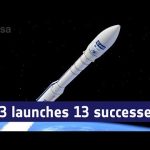
  • Vega: 13 launches 13 successes

    Vega: 13 launches 13 successes

    Europe’s Vega launch vehicle operating from Europe’s Spaceport in Kourou, French Guiana, has a flawless record.

    Vega serves a wide range of missions and payload configurations, responding to different market opportunities. It is the ideal launcher for most scientific and Earth observation missions, benchmarked to loft 1500 kg into a 700 km-altitude circular orbit at 90° inclination.

    Based on this success a more powerful #Vega, Vega-C, now in development is set to launch in mid-2019 offering greater performance at no additional cost.

    Vega-C shares technology with Europe’s other new launcher Ariane 6. The P120C solid fuel motor will be used as the first stage for Vega-C and two or four will be used as strap-on boosters for Ariane 6.

    ★ Subscribe: http://bit.ly/ESAsubscribe

    Check out our full video catalog: http://bit.ly/SpaceInVideos
    Follow ESA on Twitter: http://bit.ly/ESAonTwitter
    On Facebook: http://bit.ly/ESAonFacebook
    On Instagram: http://bit.ly/ESAonInstagram
    On Flickr: http://bit.ly/ESAonFlickr

    ESA is Europe’s gateway to space. Our mission is to shape the development of Europe’s space capability and ensure that investment in space continues to deliver benefits to the citizens of Europe and the world. Check out http://www.esa.int/ESA to get up to speed on everything space related.

    Copyright information about our videos is available here: http://www.esa.int/spaceinvideos/Terms_and_Conditions
  • NASA Launches NOAA Weather Satellite to Improve Forecasts

    NASA Launches NOAA Weather Satellite to Improve Forecasts

    Early on the morning of Saturday, Nov. 18, NASA successfully launched for the National Oceanic and Atmospheric Administration (NOAA) the first in a series of four advanced polar-orbiting satellites, equipped with next-generation technology and designed to improve the accuracy of U.S. weather forecasts out to seven days. The Joint Polar Satellite System-1 (JPSS-1) lifted off on a United Launch Alliance Delta II rocket from Vandenberg Air Force Base on California’s central coast. JPSS-1 data will improve weather forecasting and help agencies involved with post-storm recovery by visualizing storm damage and the geographic extent of power outages.

    This video is available for download from NASA’s Image and Video Library: https://images.nasa.gov/details-NHQ_2017_1118_NASA%20Launches%20NOAA%20Weather%20Satellite%20to%20Improve%20Forecasts.html

  • NASA Launches Parachute Test Platform from Wallops

    NASA Launches Parachute Test Platform from Wallops

    NASA tested a parachute platform during the flight of a Terrier-Black Brant IX suborbital sounding rocket on Oct. 4, from the agency’s Wallops Flight Facility in Virginia. The rocket carried the Advanced Supersonic Parachute Inflation Research Experiment (ASPIRE) from NASA’s Jet Propulsion Laboratory in Pasadena, Calif. The mission will evaluate the performance of the ASPIRE payload, which is designed to test parachute systems in a low-density, supersonic environment.

    This video is available for download from NASA’s Image and Video Library: https://images.nasa.gov/#/details-NHQ_2017_1004_NASA%20Launches%20Parachute%20Test%20Platform%20from%20Wallops.html

  • New Crew Launches to the Space Station on This Week @NASA – July 28, 2017

    New Crew Launches to the Space Station on This Week @NASA – July 28, 2017

    Acting Administrator Robert Lightfoot was in Kazakhstan on July 28 to observe the launch to the International Space Station of our astronaut Randy Bresnik with his crewmates – Sergey Ryazanskiy of Roscosmos, and Paolo Nespoli of the European Space Agency. The trio is scheduled to spend more than four months on the station working on hundreds of science and technology experiments. Also, New 4K Footage of Spacewalk, NASA Technologies Showcased at AirVenture Event, Preparing to Chase the Total Solar Eclipse from the Sky, and Another Successful RS-25 Engine Test!

  • NASA Launches Satellite Constellation for Hurricane Tracking Mission

    NASA Launches Satellite Constellation for Hurricane Tracking Mission

    NASA successfully launched eight small satellites that will provide scientists with advanced technology to see inside tropical storms and hurricanes like never before. Called the Cyclone Global Navigation Satellite System (CYGNSS), the constellation of eight microsatellite observatories launched Dec. 12 aboard an Orbital ATK air-launched Pegasus XL launch vehicle from Cape Canaveral Air Force Station in Florida. The rocket was dropped and launched from Orbital’s Stargazer L-1011 aircraft over the Atlantic Ocean off the coast of central Florida.

  • Expedition 50/51 Launches to Space Station on This Week @NASA – November 18, 2016

    Expedition 50/51 Launches to Space Station on This Week @NASA – November 18, 2016

    The Expedition 50/51 crew, including NASA astronaut Peggy Whitson, launched aboard a Soyuz spacecraft from the Baikonur Cosmodrome in Kazakhstan Nov. 17 eastern time, to begin a two-day flight to the International Space Station. Whitson, Oleg Novitskiy of the Russian space agency Roscosmos and Thomas Pesquet of ESA (European Space Agency) are scheduled to join Expedition 50 commander Shane Kimbrough of NASA and Roscosmos cosmonauts Sergey Ryzhikov and Andrey Borisenko, who all have been aboard the orbiting laboratory since October. Whitson will assume command of the station in February – making her the first woman to command the space station twice. Whitson and her Expedition 50 crewmates are scheduled to return to Earth next spring. Also, Supermoon Shines Bright, Newman Participates in Operation IceBridge, and Advanced Weather Satellite Mission Previewed!

  • Orbital ATK Launches to ISS from NASA’s Wallops Flight Facility

    Orbital ATK Launches to ISS from NASA’s Wallops Flight Facility

    On Oct. 17, Orbital ATK launched its Cygnus cargo spacecraft atop an Antares rocket to the International Space Station. The spacecraft launched from the Mid-Atlantic Regional Spaceport at NASA’s Wallops Flight Facility in Virginia. This is the sixth cargo mission to the International Space Station for Orbital ATK.

  • NASA Launches Go Ultra-High Definition

    NASA Launches Go Ultra-High Definition

    NASA Television’s newest offering, NASA TV UHD, brings ultra-high definition video to a new level with the kind of imagery only the world’s leader in space exploration could provide.

    Using an array of six 4K+ cameras, Harmonic documented the Dec. 6 launch of Orbital ATK’s commercial resupply mission to the International Space Station from Cape Canaveral Air Force Station in Florida. Capturing footage at Ultra High Definition with high frame rate and in high dynamic range (HDR) options.

    The company then post-produced the footage into a program showcasing the entire launch process for airing on NASA TV UHD.

    For more info: http://go.nasa.gov/1lyUGlY

  • New crew launches to ISS on This Week @NASA – November 28, 2014

    New crew launches to ISS on This Week @NASA – November 28, 2014

    NASA’s Terry Virts and Expedition 42/43 crewmates, Anton Shkaplerov of the Russian Federal Space Agency and the European Space Agency’s Samantha Cristoforetti, launched Nov. 23 at 4:01 p.m. Eastern Standard Time, from Baikonur, Kazakhstan. Almost six hours later, their Soyuz spacecraft docked to the International Space Station – where they joined Expedition 42 Commander Barry Wilmore of NASA, and Flight Engineers Alexander Samokutyaev and Elena Serova of Roscosmos – returning the station crew to its full complement of six people. Also, First 3-D printed object in space, Orion flight test update, New airborne Earth Science missions and Happy Thanksgiving from space!

  • NASA Launches Radiation Belt Storm Probes Mission

    NASA Launches Radiation Belt Storm Probes Mission

    NASA’s Radiation Belt Storm Probes (RBSP), the first twin-spacecraft mission designed to explore our planet’s radiation belts, launched into the predawn skies at 4:05a.m. EDT Thursday from Cape Canaveral Air Force Station, Fla.

    The two satellites, each weighing just less than 1,500 pounds, comprise the first dual-spacecraft mission specifically created to investigate this hazardous regions of near-Earth space, known as the radiation belts. These two belts, named for their discoverer, James Van Allen, encircle the planet and are filled with highly charged particles. The belts are affected by solar storms and coronal mass ejections and sometimes swell dramatically. When this occurs, they can pose dangers to communications, GPS satellites and human spaceflight.

    The hardy RBSP satellites will spend the next 2 years looping through every part of both Van Allen belts. By having two spacecraft in different regions of the belts at the same time, scientists finally will be able to gather data from within the belts themselves, learning how they change over space and time. Designers fortified RBSP with special protective plating and rugged electronics to operate and survive within this punishing region of space that other spacecraft avoid. In addition, a space weather broadcast will transmit selected data from those instruments around the clock, giving researchers a check on current conditions near Earth.

  • Mars Rover Launches on This Week @NASA

    Mars Rover Launches on This Week @NASA

    The NASA Mars Science Laboratory launched from the Cape Canaveral Air Force Station in Florida, beginning its journey to the Red Planet. When it arrives at Gale Crater next August, Curiosity rover’s ten instruments will investigate whether that area of Mars could ever have sustained microbial life. Also, ISS spinoff; Bolden on tour: lander test; best of the feds; money saver; high-flying feast, and more.

  • NASA’s GRAIL Spacecraft Launches on Lunar Mission

    NASA’s GRAIL Spacecraft Launches on Lunar Mission

    NASA’s GRAIL spacecraft launched to the moon aboard a United Launch Alliance Delta II rocket on Sept. 10, 2011, from Cape Canaveral Air Force Station, Fla.

    GRAIL’s primary science objectives are to determine the structure of the lunar interior, from crust to core, and to advance understanding of the thermal evolution of the moon.

  • Juno Mission Launches to Jupiter

    Juno Mission Launches to Jupiter

    NASA’s Juno spacecraft is on its way to Jupiter after being launched aboard an Atlas V rocket from the Cape Canaveral Air Force Station, Florida on August 5 at 11:25 a.m. Eastern. The solar-powered spacecraft will arrive at Jupiter in July 2016 and orbit its poles 33 times to find out more about the gas giant’s interior, atmosphere and aurora. Scientists believe Jupiter holds the key to better understanding the origins of our solar system.

  • NASA Details Future Science Missions & Launches

    NASA Details Future Science Missions & Launches

    Chief scientist Waleed Abdalati is among the panelists who talk and answer questions about upcoming NASA science missions.