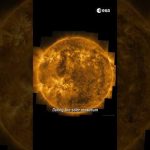
Join us on a unique video tour of the Sun’s mesmerising surface. Thanks to its innovative instrumentation and a ‘daring’ trajectory passing close to the Sun, ESA’s Solar Orbiter spacecraft has obtained the highest-resolution full views of the Sun’s surface to date.
Watching the Sun in visible light, Solar Orbiter reveals a grainy surface and dark sunspots. On the same day, the spacecraft mapped the Sun’s magnetic field, tracked how fast and in which direction scorching hot material on the surface is moving, and snapped a hypnotising image in ultraviolet light of the Sun’s upper atmosphere, the corona. All taken on the same day, the four new images shown in this video let us peel away the Sun’s many layers.
The images were taken when Solar Orbiter was less than 74 million kilometres from the Sun; being so close meant each high-resolution image only covers a small portion of the Sun. To obtain the full-disc views showcased in the video, 25 images were stitched together like a mosaic. The Sun has a diameter of around 8000 pixels in the full mosaics, revealing an extraordinary amount of detail.
Credit: ESA – European Space Agency Acknowledgements: Sun images: ESA & NASA/Solar Orbiter/PHI and EUI Teams; Solar Orbiter spacecraft animation: ESA/ATG medialab; Voiceover: Juliet Hannay
★ Subscribe: http://bit.ly/ESAsubscribe and click twice on the bell button to receive our notifications.
We are Europe’s gateway to space. Our mission is to shape the development of Europe’s space capability and ensure that investment in space continues to deliver benefits to the citizens of Europe and the world. Check out https://www.esa.int/ to get up to speed on everything space related.
Did you know, the Northern lights or Aurora Borealis are created when the mythical Finnish ‘Firefox’ runs so quickly across the snow that its tail causes sparks to fly into the night sky? At least, that’s one of the stories that has been told in Finland about this beautiful phenomenon. Another that we love comes from the Sámi people of Finnish Lapland (among others), who describe them as plumes of water ejected by whales.
Today’s scientific explanation for the origin of the Aurora wasn’t thought up until the 20th Century, by the Norwegian scientist Kristian Birkeland. Charged particles, electrons and protons, are constantly emitted by the Sun, making up the solar wind. This wind slams into Earth’s ionosphere – sometimes sped up to vast speeds by solar storms – and the charged particles are deflected towards the poles by the magnetosphere.
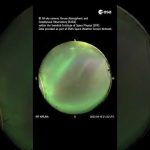
Molecules in our atmosphere then absorb energy from these charged particles from the Sun, and re-release it in their own unique set of colours. Oxygen produces green, but at high altitudes can create red, nitrogen creates blues, and colours can overlap creating purple. Waves, twists and streams are caused by variations in Earth’s magnetic fields. This striking video shows the Aurora over Kiruna, the northernmost city in Sweden. It’s composed of images taken by the Kiruna all-sky camera every minute for about ten hours over 18-19 September 2023.
The all-sky auroral camera is operated by the Kiruna Atmospheric and Geophysical Observatory (KAGO) within the Swedish Institute of Space Physics (IRF), and data from here is provided as part of ESA’s network of space weather services within the Agency’s Space Safety Programme. A sequence of multiple coronal mass ejections – large, sudden ejections of plasma and magnetic field from the Sun – recently struck Earth, and we are still recovering from the passage of the last of them. The fastest was travelling at around 700 km/s, which is considered a small event.
Solar storms are causing an increase in geomagnetic activity; temporary disturbances in Earth’s magnetosphere, which has led to increased light shows at Earth’s poles.
Credits: All-sky camera, Kiruna Atmospheric and Geophysical Observatory (KAGO) within the Swedish Institute of Space Physics (IRF). Data provided as part of ESA’s Space Weather Service Network.
Earth’s magnetic field protects life on Earth from the intense radiation and titanic amounts of energetic material our Sun blasts in every direction. However, astronauts and satellites in space, future explorers travelling to the Moon and Mars, and infrastructure on Earth such as power grids and communication systems remain vulnerable to these violent outbursts.
For this reason, ESA is planning to send a satellite to monitor the ‘side’ of our Sun, from a gravitationally stable position known as the fifth Lagrange point. From here, the Lagrange satellite will detect potentially hazardous solar events before they come into view from Earth, giving us advance knowledge of their speed, direction and chance of impact.
★ Subscribe: http://bit.ly/ESAsubscribe and click twice on the bell button to receive our notifications.
We are Europe’s gateway to space. Our mission is to shape the development of Europe’s space capability and ensure that investment in space continues to deliver benefits to the citizens of Europe and the world. Check out http://www.esa.int/ESA to get up to speed on everything space related.
After three years of collecting data, the highest resolution map of Earth’s lithospheric magnetic field from space to date has been released. The dataset combines measurements from ESA’s Swarm satellites with historical data from the German CHAMP satellite using a new modelling technique that allowed scientists to extract tiny magnetic signals from Earth’s outer layer. Red represents areas where the lithospheric magnetic field is positive, while blues show areas where it is negative.
Earth’s magnetic field is continuously changing. Magnetic north wanders, and every few hundred thousand years the polarity gradually flips, so that a compass would point south instead of north.
Earth’s magnetic field is our life saver, protecting us from the energetic solar wind. The Swarm satellites will measure Earth’s magnetic field to allow us to understand it for a safer future.
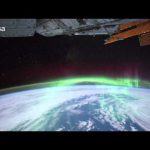
André took this video of Aurora Australis from the European Cupola module in the Space Station. The beautiful phenomenon is caused by bursts of particles from the Sun pouring down Earth’s magnetic field into the atmosphere.