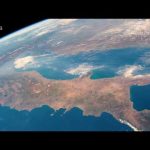
Māori, as native New Zealanders, refer to their islands as “Aotearoa” or “the land of the long white cloud”. This timelapse from ESA astronaut Alexander Gerst shows Australia and New Zealand shrouded in cloud from the unique viewpoint of the International Space Station.
Comprised of 5,175 photos, this timelapse is 12.5 times faster than actual speed and is set to the soundtrack “Try or Die” sourced from Audio Network Limited.
Orbiting Earth once every 90 minutes, the International Space Station soars into 16 sunrises and sunsets every single day. Many of these sunrises occur while the crew is working or sleeping, but ESA astronaut Alexander Gerst captured this stunning timelapse of a sunrise to share with us here on Earth.
These photos were taken by Alexander at an interval of two per second and the video has been edited at 25 frames per second.
Music: First Survivors 4 by Los Angeles-based British composer, Luke Richards. Sourced from Audio Network Limited.
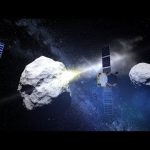
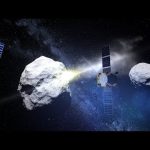
Hera is the European contribution to an ESA-NASA double-spacecraft mission intended to test whether a kinetic deflection technique can be used to shift the orbit of an asteroid. The target of the mission is a double asteroid system, called Didymos, which will come a comparatively close 11 million km to Earth in 2022. The 800-m diameter main body is orbited by a 170-m moon, informally called ‘Didymoon’.
In 2022 NASA’s DART spacecraft will first perform a kinetic impact on the smaller of the two bodies, then Hera will follow-up with a detailed post-impact survey that will turn this grand-scale experiment into a well-understood and repeatable planetary defence technique.
Hera will also gather crucial scientific data on asteroids as a whole by carefully studying the exterior and interior properties of both bodies in the system. The spacecraft will also host two 6-unit cubesats that will be deployed near Didymos to perform, for the first time ever, multi-point measurements in a “mother-daughter” configuration. A novel intersatellite link will be used to establish a flexible communications network supporting the close-proximity operations in very low-gravity conditions, a crucial step for future exploration activities around small bodies.
Hera, a further optimisation of ESA’s earlier proposed Asteroid Impact Mission, is currently in Phase B1 of mission development in preparation of the Agency’s Council of Ministers at European Level in late 2019.
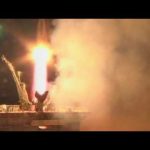
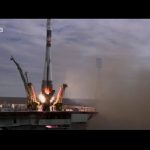
This unique video shows a full launch of the Soyuz MS-09: from liftoff to orbit.
Watch the launch from inside the crew capsule with first-ever shots from outside the spacecraft recorded by cameras fixed to the exterior of the Soyuz.
The intense launch lasts less than ten minutes whereby the Soyuz spacecraft is propelled 1640 km and gains 210 km altitude. Every second for nine minutes, the spacecraft accelerates 50 km/h on average as the rocket’s boosters burn their fuel and are discarded.
See the astronaut’s reactions and what the spacecraft looks like as the main steps are carried out to get into orbit:
-00:12 Launch command issued
-00:10 Engine turbopumps at flight speed
-00:05 Engines at maximum thrust
00:00 Launch
+1:54 Separation of emergency rescue system
+1:57 First stage separation
+2:38 Fairing separation
+4:48 Second stage separation
+4:58 Tail adapter separation
+8:45 Third stage engine cut off having arrived in orbit
+8:49 Soyuz separation, deploy solar arrays and antennae
The astronauts, from left to right, are NASA astronaut Serena Auñón-Chancellor, Roscosmos commander Sergei Prokopyev and ESA astronaut and flight engineer Alexander Gerst launched in the Soyuz MS-09 spacecraft from the Baikonur cosmodrome in Kazakhstan to the International Space Station on 6 June 2018. ESA astronaut Matthias Maurer and ESA television host Richard Hollingham provide commentary taken from the live event.
Hunched in their Sokol flight suits that offer protection in case of fire or depressurisation, the trio stay in the crew capsule of the Soyuz – the only module that is also designed to survive a return to Earth. The bags above their heads contain supplies for the International Space Station as every bit of space is used.
During a Soyuz launch astronauts typically experience forces of up to 4g – having to work while being pressed into their seats with a force that is four times more than the gravity felt on Earth. The Soyuz commander uses a stick to press buttons as they are too far away from the control panel.
The fluffy toys above the astronauts’ heads are mascots and good luck charms but also serve as a simple but effective test to see when the spacecraft is in orbit: when they start to float the spacecraft is weightless and orbiting Earth. Above Sergei is the mascot for the 2018 FIFA soccer World Cup held in Russia. Alexander took German children television icon “Die Maus” with him.
The launch went as planned as the 50-m tall Soyuz rocket propelled the astronauts to their cruising speed of around 28 800 km/h.
For this launch the astronauts took 34 orbits of Earth over two days to arrive at their destination spending their time in the cramped orbital module of the Soyuz that is no larger than a car. With limited communications and living space the astronauts had time to adapt to weightlessness and reflect on their mission ahead. They aligned their spacecraft with the International Space Station and approached the orbital outpost for docking on 8 June 2018. The files for this video were downloaded by the astronauts after arriving at the Space Station.
Alexander is a returning visitor to the International Space Station, the first of ESA’s 2009 class of astronauts to be sent into space for a second time. During the second part of his mission Alexander will take over as commander of the International Space Station, only the second time an ESA astronaut will take on this role so far.
After orbiting Earth 34 times to catch up to the International Space Station, the car-sized spacecraft carrying ESA astronaut Alexander Gerst, NASA astronaut Serena Auñón-Chancellor and Roscosmos commander Sergei Prokopyev, arrived at the Station two days after launch.
The German astronaut is a returning visitor to the International Space Station, the first of ESA’s 2009 class of astronauts to be sent into space for a second time. During the second part of his mission Alexander will take over as commander of the International Space Station, only the second time an ESA astronaut will take on this role so far.
The mission is called Horizons as a symbol for the unknown and what lies beyond – reflecting on ESA’s strategy to extend human and robotic exploration beyond Earth orbit. While in space, Alexander will work on over 50 European experiments, including testing ways of operating and working with robots to develop techniques required for further human and robotic exploration of our Solar System.
At 11:12 GMT (13:12 CEST), 6 June 2018, ESA astronaut Alexander Gerst was launched into space alongside NASA astronaut Serena Auñón-Chancellor and Roscosmos commander Sergei Prokopyev in the Soyuz MS-09 spacecraft from Baikonur cosmodrome in Kazakhstan.
Tracking the movement of Earth’s water, resupplying the International Space Station, and our Administrator testifies about the agency’s proposed budget – a few of the stories to tell you about – This Week at NASA!
This video is available for download from NASA’s Image and Video Library: https://images.nasa.gov/details-NHQ_2018_0525_Following%20the%20movement%20of%20Earth%E2%80%99s%20water%20on%20This%20Week%20@NASA%20%E2%80%93%20May%2025,%202018.html
Our newest mission to Mars is on its way, Vice President Pence visits our Jet Propulsion Laboratory, and observing our planet’s ever-changing water cycle – a few of the stories to tell you about – This Week at NASA!
This video is available for download from NASA’s Image and Video Library: https://images.nasa.gov/details-NHQ_20218_0505_Our%20Newest%20Mission%20to%20Mars%20on%20This%20Week%20@NASA%20%E2%80%93%20May%205,%202018.html
Following its launch in February 2016 and subsequent commissioning phase, the Copernicus Sentinel-3A satellite has been systematically measuring our oceans, land, ice and atmosphere. The information feeds a range of practical applications and is used for monitoring and understanding large-scale global dynamics. Sentinel-3A will soon be joined in orbit by its identical twin, Sentinel-3B. Both satellites carry a suite of cutting-edge instruments to supply a new generation of data products, which are particularly useful for marine applications. For example, they monitor ocean-surface temperatures for ocean and weather forecasting services, aquatic biological productivity, ocean pollution and sea-level change. The mission also delivers unique and timely information about changing land cover, vegetation, urban heat islands, and for tracking wildfires. With the two satellites in orbit, global coverage and data delivery will be optimised.
A series of daytime photos were taken by ESA astronaut Paolo Nespoli from on board the International Space Station flying from Africa, to Italy and Russia to create this time-lapse of Earth.
ESA astronaut Paolo Nespoli in currently working and living on board the International Space Station as part of the Italian Space Agency’s long-duration VITA mission.
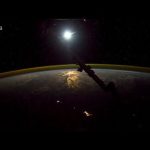
A series of nighttime photos were taken by ESA astronaut Paolo Nespoli to create this time-lapse of the Earth as seen from the Space Station and the Moon rising above the horizon.
ESA astronaut Paolo Nespoli in currently working and living on board the International Space Station as part of the Italian Space Agency’s long-duration VITA mission.
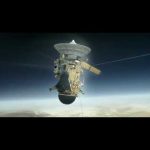
On Sept. 15, NASA’s Cassini spacecraft completed its remarkable story of exploration with an intentional plunge into Saturn’s atmosphere, ending its mission after nearly 20 years in space. Live commentary of Cassini’s end of mission activities was shown on NASA TV and the agency’s website. Launched in 1997, Cassini arrived in orbit around Saturn in 2004 on a mission to study the giant planet, its rings, moons and magnetosphere.
ESA astronaut Paolo Nespoli, NASA astronaut Randy Bresnik and Roscosmos commander Sergey Ryazansky launched to the International Space Station on 28 July from Baikonur Cosmodrome on their Soyuz MS-05 spacecraft.
Paolo, Randy and Sergey will spend five months in space working and living on the International Space Station.
Thomas Pesquet will shortly be returning to Earth after a six-month stay onboard the International Space Station. Named Proxima, this mission is the ninth long-duration flight for an ESA astronaut.
Thomas’s in-orbit schedule includes around 50 experiments for ESA and the French Space Agency CNES, and he’s so far carried out two maintenance spacewalks alongside station commander Shane Kimbrough.
As a centre of excellence for mission operations since 1967, ESA’s ‘mission control’ delivers expertise and experience in a unique mix that serves the scientific and engineering goals of ESA, and enables economically vital European programmes like Copernicus and Galileo.
ESOC is home to highly specialised teams who control and navigate spacecraft, manage ESA’s worldwide tracking station network, and build the ground systems that enable satellites to conduct their missions. Spacecraft flown from ESOC are studying our planet and helping us understand climate change through realtime Earth data, and are exploring our Sun and Solar System or peering deep into the mysteries of time and space.
The centre is unique and unparalleled in its ability to control sophisticated probes, and to design, develop and build everything needed on ground to successfully fly satellites in space.
Our world is about systems, communication and exploration; our passion is for humanity’s voyages into the Universe.
NASA held a news conference April 4 at the Jet Propulsion Laboratory, with participation from NASA headquarters, to preview the final phase of the Cassini spacecraft’s mission to Saturn. On April 26, Cassini will begin its “Grand Finale” – a series of deep dives between the planet and its rings. No other mission has ever explored this unique region that is so close to the planet. Cassini will make 22 orbits that swoop between the rings and the planet before ending its 20-year mission on Sept. 15, with a final plunge into Saturn. The mission team hopes to gain powerful insights into the planet’s internal structure and the origins of the rings, obtain the first-ever sampling of Saturn’s atmosphere and particles coming from the main rings, and capture the closest-ever views of Saturn’s clouds and inner rings. Also, Next Space Station Crew Travels to Launch Site, New Target Launch Date for Orbital ATK Mission to ISS, Lightfoot Visits Industry Partners, Human Exploration Rover Challenge, and John Glenn Interred at Arlington National Cemetery.
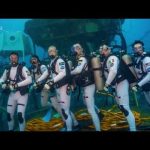
In July 2016, ESA astronaut Matthias Maurer took part in NASA’s Extreme Environment Mission Operations, or NEEMO – a 16-day underwater sortie to enact a mission to Mars and test equipment for astronauts.
NEEMO’s underwater habitat off Florida acts as makeshift a space base for astronauts to make regular ‘waterwalks’ in full scuba gear. Both underwater missions plan sorties for the astronauts to simulate spacewalks.
For NEEMO 21, a rotating crew of four complemented Matthias and NASA astronaut Megan McArthur who tested new techniques, operation procedures and technology.
On 17 November 2016, ESA astronaut Thomas Pesquet will be the tenth French astronaut to be launched into space, alongside Roscosmos commander Oleg Novitsky and NASA astronaut Peggy Whitson.
They will travel from Baikonur Cosmodrome in Kazachstan on the Soyuz MS-03, a recently upgraded version of Russia’s workhorse that has been in service for almost 50 years.
Thomas’s mission is called Proxima and it is the ninth long-duration mission for an ESA astronaut. It was named after the closed star to the Sun – continuing a tradition of naming missions with French astronauts after stars and constellations.
During Proxima, Thomas will perform more than 50 scientific experiments for ESA and CNES as well as take part in many research activities for the other Space Station partners.
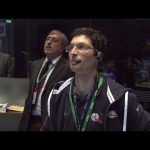
Inside the main control room at ESA’s operation centre as the Rosetta spacecraft sends its last signal from Comet 67P/Churyumov–Gerasimenko, confirming the end of the spacecraft’s 12.5 year journey in space.
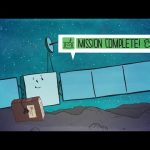
On the last day of her incredible mission, Rosetta slowly descends to the surface of Comet 67P/Churyumov-Gerasimenko. After having sent her extraordinary data back home, she is ready to join Philae for a well deserved rest on the comet. But is there one last surprise in store?
On the last day of her incredible mission, Rosetta slowly descends to the surface of Comet 67P/Churyumov-Gerasimenko. After having sent her extraordinary data back home, she is ready to join Philae for a well deserved rest on the comet. But is there one last surprise in store?
On the last day of her incredible mission, Rosetta slowly descends to the surface of Comet 67P/Churyumov-Gerasimenko. After having sent her extraordinary data back home, she is ready to join Philae for a well deserved rest on the comet. But is there one last surprise in store?
On the last day of her incredible mission, Rosetta slowly descends to the surface of Comet 67P/Churyumov-Gerasimenko. After having sent her extraordinary data back home, she is ready to join Philae for a well deserved rest on the comet. But is there one last surprise in store?
On Sept. 14, officials from the White House and NASA discussed the space agency’s Asteroid Redirect Mission (ARM) during a televised event at NASA’s Goddard Space Flight Center. On the mission, which is targeted for launch in Dec. 2021, NASA plans to send a robotic spacecraft to an asteroid tens of millions of miles from Earth, capture a multi-ton boulder, and bring it to an orbit near the moon for future exploration by astronauts on a following mission aboard NASA’s Orion spacecraft. During the live discussion, John Holdren, assistant to President Obama for Science and Technology, NASA Administrator Charles Bolden and ARM Program Director Michele Gates highlighted the mission’s scientific and technological benefits, how the mission will support NASA’s goal of sending humans to Mars in the 2030s, and how it will demonstrate technology relevant to defending Earth from potentially hazardous asteroids. Also, Astronaut Tim Kopra Visits DC Area, The Warmest August in 136 Years, and 2016 Arctic Sea Ice Minimum Ties 2nd Lowest on Record!
On August 17, NASA hosted a briefing at the agency’s headquarters in Washington, DC to preview the launch of the Origins, Spectral Interpretation, Resource Identification, Security-Regolith Explorer (OSIRIS-REx) spacecraft – the first U.S. spacecraft destined to rendezvous with, study and return a sample of an asteroid. OSIRIS-REx will launch September 8 from Cape Canaveral Air Force Station in Florida on its mission to study, in detail, an asteroid called Bennu. The mission represents a valuable opportunity to learn more about the origins of our solar system, the sources of water and organic molecules on Earth, and the hazards and resources in near-Earth space.
The 21st NASA Extreme Environment Mission Operations got underway July 21 in the Florida Keys. NASA astronauts Reid Wiseman and Megan McArthur are part of the international crew of NEEMO-21 aquanauts performing research during the 16-day mission, which takes place about 60 feet below the surface of the Atlantic Ocean, in the Aquarius habitat – the world’s only undersea science station. Simulated spacewalks are designed to evaluate tools and mission operation techniques that could be used on future space missions. NEEMO-21’s objectives include testing a mini DNA sequencer similar to the one NASA astronaut Kate Rubins also will test aboard the International Space Station, and a telemedicine device that will be used for future space applications. The mission also will simulate communications delays like those that would be encountered on a mission to Mars. Also, Space Launch System Work Platforms, All-Electric X-Plane Arrives, Asteroid Mission Technology, and NASA @Comic-Con International.
ESA astronaut Tim Peake shares his views of Earth and his six-month Principia mission while on the International Space Station. Narrated by Tim himself taken from interviews while in space, this video shows the best views, experiments and shares the experience of Tim’s life in space.
La misión AIM (Asteroid Impact Mission), candidata a ser desarrollada, actualmente en fase de diseño preliminar.
AIM se lanzaría en octubre de 2020 y su objetivo es viajar al sistema binario de asteroides Dídimos para estudiar la luna Didymoon. El sistema Didimos cuenta con un cuerpo principal de unos 800 metros de diámetro y una luna que orbita alrededor de este cuerpo principal, de unos 170 metros de diámetro aproximadamente, está luna se la conoce con el nombre de Didymoon. El sistema Didimos se aproximará a 11 millones de kilómetros de la tierra en 2022.
AIM escaneará la pequeña Didymoon en detalle con su cámara VIS, con imágenes térmicas y un radar de alta resolución para construir mapas detallados de su superficie y estructura interior.
La nave principal de AIM llevará al menos tres sondas más pequeñas – el módulo de aterrizaje, Mascot-2, desarrollado por el Centro Aeroespacial Alemán (Mascot-1 ya está volando en la misión Hayabusa-2 de JAXA), así como dos o más CubeSats. Así, AIM pondría a prueba las comunicaciones ópticas y los enlaces inter-satelitales en el espacio profundo, una tecnología que será esencial para la exploración futura del espacio.
Si se aprueba, AIM también será la contribución europea a la misión AIDA, Asteroid Impact and Deflection Assessment. En 2022, la sonda DART (Double-Asteroid Redirection Test), parte dirigida por la NASA, llegará al sistema binario y se estrellará contra Didymoon a una velocidad de unos 6 km/s.
El impacto será observado por AIM y por sus CubeSats. A través de las imágenes de alta resolución de AIM se evaluará el tamaño y la profundidad del cráter tras el impacto. AIM realizará una segunda fase de mediciones para comparar detalladamente la estructura del objeto, así como su órbita al rededor del asteroide mayor, antes y después del impacto.
Named after Isaac Newton’s text Naturalis Principia Mathematica, ESA’s Principia mission will be the eighth long-duration mission to the International Space Station. British astronaut Tim Peake will be launched from Baikonur in Kazakhstan onboard a Russian Soyuz vehicle, spending five months in orbit. He’ll carry out an intensive schedule of European and international experiments, in addition to numerous educational activities from space.
LISA Pathfinder will pave the way for future missions by testing in flight the very concept of gravitational wave detection: it will put two test masses in a near-perfect gravitational free-fall and control and measure their motion with unprecedented accuracy. LISA Pathfinder will use the latest technology to minimise the extra forces on the test masses, and to take measurements.
The inertial sensors, the laser metrology system, the drag-free control system and an ultra-precise micro-propulsion system make this a highly unusual mission.
LISA Pathfinder is an ESA mission, which will also carry a NASA payload.
Sentinel-3A’s preparation is finished and the satellite will soon be shipped to the Russian Cosmodrome of Plesetsk, in Northern Russia for its launch on top of a Rockot planned end of this year. Carrying a suite of state-of-the-art instruments, Sentinel-3 is set to play a key role in Copernicus, the world’s largest environmental monitoring programme operated by the European Commission. It will provide highly accurate measurements on Earth’s oceans, land, ice and atmosphere.
The Rosetta Mission has captured the interest and imagination of a generation and it is not over yet! Take a look at this Royal Observatory Greenwich video which explains what Rosetta and Philae have achieved as well as the impact the mission has had on our knowledge of our very own solar system. http://bit.ly/rogvideo #rogrosetta
ESA astronaut Andreas Mogensen, commander Sergei Volkov and Aidyn Aimbetov were launched into space this morning 2 September at 04:37:43 GMT (06:37:43 CEST) from Baikonur cosmodrome, Kazakhstan.
The launch marks the start of ESA’s 10-day ‘iriss’ mission that will focus on testing new technologies and ways of running complex space missions.
The astronaut’s Soyuz TMA-18M spacecraft was pushed into Earth orbit as planned accelerating 50 km/h on every second for the first nine minutes of their launch.
The spacecraft separated from the Soyuz launcher at 04:46 GMT (06:46 CEST)
Weekly pre-flyby updates aired June 23 on NASA TV provides an overview of the New Horizons mission, the spacecraft and its suite of instruments being prepared for a July 14 flyby, and a summary of Pluto science to date.
A new NASA mission to investigate the habitability of Jupiter’s ocean moon Europa has moved from the concept phase to the development phase known as formulation, after successfully completing its first major review by the agency. Europa is considered to be one of the best places in the solar system to search for signs of present-day life beyond Earth. Plans for the mission call for a spacecraft to be launched to the Jupiter system sometime in the 2020s. Also, Seeking other worlds suitable for life, Agreements advance Mars exploration, Asteroid exploration update, Newman visits Langley, Rainfall spacecraft re-enters over tropics and Sample Robot Return Challenge!
The Asteroid Impact Mission (AIM) is a candidate mission currently undergoing preliminary design work.
Launched in October 2020, AIM would travel to a binary asteroid system – the paired Didymos asteroids, which will come a comparatively close 11 million km to Earth in 2022. The 800 m-diameter main body is orbited by a 170 m moon, informally called ‘Didymoon’.
This smaller body is AIM’s focus: the spacecraft would perform high-resolution visual, thermal and radar mapping of the moon to build detailed maps of its surface and interior structure.
The main AIM spacecraft is planned to carry at least three smaller spacecraft – the Mascot-2 asteroid lander, being provided by DLR (Mascot-1 is already flying on JAXA’s Hayabusa-2), as well as two or more CubeSats. AIM would test optical communications and inter-satellite links in deep space, essential technology for future exploration.
If approved, AIM would also be Europe’s contribution to the larger Asteroid Impact & Deflection Assessment mission: AIDA. In late 2022, the NASA-led part of AIDA will arrive: the Double Asteroid Redirection Test, or DART, probe will approach the binary system – then crash straight into the asteroid moon at about 6 km/s.
AIM is intended to be watching closely as DART hits Didymoon. In the aftermath, it will perform detailed before-and-after comparisons on the structure of the body itself, as well as its orbit, to characterise DART’s kinetic impact and its consequences.
ESA astronaut Samantha Cristoforetti, from Italy, will shortly be ending her long-duration stay onboard the International Space Station. Launched in November 2014, the Futura mission is the result of a special agreement between NASA and the Italian Space Agency ASI.
During her time in orbit Samantha Cristoforetti has undergone an intensive programme of scientific research, educational and maintenance activities, as well as overseeing the undocking of ESA’s fifth – and last – Automated Transfer Vehicle.