These are solar sounds generated from 40 days of the Solar and Heliospheric Observatory’s (SOHO) Michelson Doppler Imager (MDI) data and processed by A. Kosovichev. Read more & download audio: https://go.nasa.gov/2JR0wLL
The procedure he used for generating these sounds was the following. He started with doppler velocity data, averaged over the solar disk, so that only modes of low angular degree (l = 0, 1, 2) remained. Subsequent processing removed the spacecraft motion effects, instrument tuning, and some spurious points. Then Kosovichev filtered the data at about 3 mHz to select clean sound waves (and not supergranulation and instrumental noise). Finally, he interpolated over the missing data and scaled the data (speeded it up a factor 42,000 to bring it into the audible human-hearing range (kHz)).
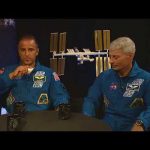
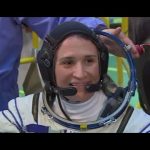
During a recent visit to NASA headquarters astronauts Joe Acaba and Mark Vande Hei sat down for an informal Q&A session with Administrator Jim Bridenstine – and responded to questions from the agency’s social media followers.
The astronauts, who returned from the International Space Station in late February, talked about the station’s role as a platform to help us live and work in space. The cutting-edge research and technology development on the station is helping prepare our astronauts to take the next giant leap in human space exploration. The agency plans to return to the Moon and eventually send humans to Mars and destinations beyond.
This video is available for download from NASA’s Image and Video Library: https://images.nasa.gov/details-NHQ_2018_0725_NASA%20Administrator%20Bridenstine%20Chats%20with%20Astronauts%20Acaba%20and%20Vande%20Hei.html
NASA heliophysicist Alex Young explains how sound connects us with the Sun and all other stars. This piece features low frequency sounds of the Sun. Raw audio (no commentary): https://youtu.be/-I-zdmg_Dno Read more: https://go.nasa.gov/2JR0wLL
Credit: NASA’s Goddard Space Flight Center
Micheala Sosby (NASA/GSFC): Lead Producer
Katie Atkinson (GSFC Interns): Lead Producer
C. Alex Young (NASA/GSFC): Narrator
Aaron E. Lepsch (ADNET Systems Inc.): Technical Support
Music: “Flow” by Lee Rosevere
This video is public domain and along with other supporting materials can be downloaded from the Scientific Visualization Studio at: https://svs.gsfc.nasa.gov/13011
NASA Administrator Jim Bridenstine recently sat down with Nobel Prize winner John Mather and the agency’s Associate Administrator for Science, Thomas Zurbuchen for a conversation about NASA’s James Webb Space Telescope. They talked about the challenges of building the world’s premier space telescope and why it’s all worth it. Webb is the first telescope of its kind, an unprecedented feat of engineering, and is at the very leading edge of technological innovation and development. Webb will find the first galaxies that formed in the early universe and peer through dusty clouds to see stars forming planetary systems.
This video is available for download from NASA’s Image and Video Library: https://images.nasa.gov/details-NASA%20Administrator%20Bridenstine%20Talks%20Webb%20Science%20with%20Nobel%20Laureate.html
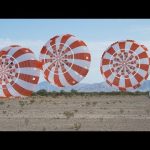
Another successful parachute test for Orion, how we’re getting back to the Moon, and an Apollo 11 virtual experience … a few of the stories to tell you about – This Week at NASA!
NASA’s Parker Solar Probe is heading to the Sun.Thermal Protection System Engineer Betsy Congdon (Johns Hopkins APL) outlines why Parker can take the heat. More: https://go.nasa.gov/2O7YKsK | NASA launch schedule: https://go.nasa.gov/2JfklMB
Music credit: Cheeky Chappy [Main Track] by Jimmy Kaleth, Ross Andrew McLean Credit: NASA’s Goddard Space Flight Center Genna Duberstein (USRA): Lead Producer/Lead Editor Rob Andreoli (AIMM): Lead Videographer Betsy Congdon (Johns Hopkins University/APL): Lead Engineer Ryan Fitzgibbons (USRA): Narrator Genna Duberstein (USRA): Writer Steve Gribben (Johns Hopkins University/APL ): Animator Brian Monroe (USRA): Animator Josh Masters (USRA): Animator Michael Lentz (USRA): Animator Genna Duberstein (USRA): Animator Mary P. Hrybyk-Keith (TRAX International Corporation): Illustrator This video is public domain and along with other supporting visualizations can be downloaded from the Scientific Visualization Studio at: https://svs.gsfc.nasa.gov/12867
Tracing the source of a cosmic phenomenon, the sound of plasma waves in space, and X-ray exploration of the Eagle Nebula … a few of the stories to tell you about – This Week at NASA!
This video is available for download from NASA’s Image and Video Library: https://images.nasa.gov/details-NHQ_2018_0713_Tracing%20The%20Source%20of%20a%20Cosmic%20Phenomenon%20on%20This%20Week%20@NASA%20%E2%80%93%20July%2013,%202018.html
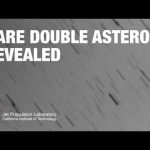
Three of the world’s largest radio telescopes team up to show a rare double asteroid. 2017 YE5 is only the fourth binary near-Earth asteroid ever observed in which the two bodies are roughly the same size, and not touching. More: https://go.nasa.gov/2zxrh7U
This video shows radar images of the pair gathered by Goldstone Solar System Radar, Arecibo Observatory and Green Bank Observatory.
A new resupply mission arrives at the Space Station, a closer look at dwarf planet, Ceres, and the Parker Solar Probe is ready for the heat … a few of the stories to tell you about – This Week at NASA!
This video is available for download from NASA’s Image and Video Library: https://images.nasa.gov/details-NHQ_2018_0706_New%20Supplies%20and%20Research%20for%20the%20Space%20Station%20on%20This%20Week%20@NASA%20%E2%80%93%20July%206,%202018.html
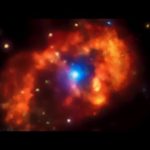
A new study using data from NASA’s NuSTAR space telescope suggests that the most luminous and massive stellar system within 10,000 light-years, Eta Carinae, is accelerating particles to high energies — some of which may reach Earth as cosmic rays. https://go.nasa.gov/2tPxKpA
Cosmic rays with energies greater than 1 billion electron volts (eV) come to us from beyond our solar system. But because these particles — electrons, protons and atomic nuclei — all carry an electrical charge, they veer off course whenever they encounter magnetic fields. This scrambles their paths and masks their origins. Eta Carinae, located about 7,500 light-years away in the southern constellation of Carina, contains a pair of massive stars whose eccentric orbits bring them unusually close every 5.5 years. The stars contain 90 and 30 times the mass of our Sun.
Both stars drive powerful outflows called stellar winds, which emit low-energy X-rays where they collide. NASA’s Fermi Gamma-ray Space Telescope observes gamma rays — light packing far more energy than X-rays — from a source in the direction of Eta Carinae.
But Fermi’s vision isn’t as sharp as X-ray telescopes, so astronomers couldn’t confirm the connection. To bridge this gap, astronomers turned to NASA’s NuSTAR observatory. Launched in 2012, NuSTAR can focus X-rays of much greater energy than any previous telescope.
The team examined NuSTAR observations acquired between March 2014 and June 2016, along with lower-energy X-ray observations from the European Space Agency’s XMM-Newton satellite over the same period. NuSTAR detects a source emitting X-rays above 30,000 eV, some three times higher than can be explained by shock waves in the colliding winds. For comparison, the energy of visible light ranges from about 2 to 3 eV.
The researchers say both the X-ray emission s een by NuSTAR and the gamma-ray emission seen by Fermi is best explained by electrons accelerated in shock waves where the winds collide. The X-rays detected by NuSTAR and the gamma rays detected by Fermi arise from starlight given a huge energy boost by interactions with these electrons. Some of the superfast electrons, as well as other accelerated particles, must escape the system and perhaps some eventually wander to Earth, where they may be detected as cosmic rays. Zoom into Eta Carinae, where the outflows of two massive stars collide and shoot accelerated particles cosmic rays into space.
Credit: NASA’s Goddard Space Flight Center
Music: “Expectant Aspect” from Killer Tracks
This video is public domain and may be downloaded from NASA Goddard’s Scientific Visualization Studio at: https://svs.gsfc.nasa.gov/12989
NASA wishes you a safe and happy Independence Day.
Since the beginning of human space flight, NASA’s astronauts, rockets and
spacecraft have flown the American flag to Earth orbit, the Moon, Mars, and beyond.
Thomas Zurbuchen, associate administrator of NASA’s Science Mission Directorate, and John Mather, senior project scientist, comment on an independent review board’s findings on the agency’s James Webb Space Telescope. Webb is now targeting March 2021 as a new launch date, after the board assessed delays in integration and testing. NASA and the board unanimously agree that Webb can still achieve mission success.
NASA Administrator Jim Bridenstine discusses the findings of the Independent Review Board on one of our flagship missions, the James Webb Space Telescope. Despite Webb’s major challenges during the final testing and integration phase, the board and NASA unanimously agreed that Webb will achieve mission success with the implementation of the board’s recommendations, many of which are already underway.
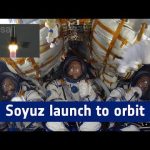
This unique video shows a full launch of the Soyuz MS-09: from liftoff to orbit.
Watch the launch from inside the crew capsule with first-ever shots from outside the spacecraft recorded by cameras fixed to the exterior of the Soyuz.
The intense launch lasts less than ten minutes whereby the Soyuz spacecraft is propelled 1640 km and gains 210 km altitude. Every second for nine minutes, the spacecraft accelerates 50 km/h on average as the rocket’s boosters burn their fuel and are discarded.
See the astronaut’s reactions and what the spacecraft looks like as the main steps are carried out to get into orbit:
-00:12 Launch command issued
-00:10 Engine turbopumps at flight speed
-00:05 Engines at maximum thrust
00:00 Launch
+1:54 Separation of emergency rescue system
+1:57 First stage separation
+2:38 Fairing separation
+4:48 Second stage separation
+4:58 Tail adapter separation
+8:45 Third stage engine cut off having arrived in orbit
+8:49 Soyuz separation, deploy solar arrays and antennae
The astronauts, from left to right, are NASA astronaut Serena Auñón-Chancellor, Roscosmos commander Sergei Prokopyev and ESA astronaut and flight engineer Alexander Gerst launched in the Soyuz MS-09 spacecraft from the Baikonur cosmodrome in Kazakhstan to the International Space Station on 6 June 2018. ESA astronaut Matthias Maurer and ESA television host Richard Hollingham provide commentary taken from the live event.
Hunched in their Sokol flight suits that offer protection in case of fire or depressurisation, the trio stay in the crew capsule of the Soyuz – the only module that is also designed to survive a return to Earth. The bags above their heads contain supplies for the International Space Station as every bit of space is used.
During a Soyuz launch astronauts typically experience forces of up to 4g – having to work while being pressed into their seats with a force that is four times more than the gravity felt on Earth. The Soyuz commander uses a stick to press buttons as they are too far away from the control panel.
The fluffy toys above the astronauts’ heads are mascots and good luck charms but also serve as a simple but effective test to see when the spacecraft is in orbit: when they start to float the spacecraft is weightless and orbiting Earth. Above Sergei is the mascot for the 2018 FIFA soccer World Cup held in Russia. Alexander took German children television icon “Die Maus” with him.
The launch went as planned as the 50-m tall Soyuz rocket propelled the astronauts to their cruising speed of around 28 800 km/h.
For this launch the astronauts took 34 orbits of Earth over two days to arrive at their destination spending their time in the cramped orbital module of the Soyuz that is no larger than a car. With limited communications and living space the astronauts had time to adapt to weightlessness and reflect on their mission ahead. They aligned their spacecraft with the International Space Station and approached the orbital outpost for docking on 8 June 2018. The files for this video were downloaded by the astronauts after arriving at the Space Station.
Alexander is a returning visitor to the International Space Station, the first of ESA’s 2009 class of astronauts to be sent into space for a second time. During the second part of his mission Alexander will take over as commander of the International Space Station, only the second time an ESA astronaut will take on this role so far.
The third meeting of the National Space Council, seeking a partnership to power our Gateway, and – an educational activity that’s quite a blast … a few of the stories to tell you about – This Week at NASA!
This video is available for download from NASA’s Image and Video Library: https://images.nasa.gov/details-NHQ_2018_0622_Administrator%20Bridenstine%20Attends%20National%20Space%20Council%20Meeting%20on%20This%20Week%20@NASA%20%E2%80%93%20June%2022,%202018.html
The largest of Pluto’s five moons, Charon, was discovered on June 22, 1978, by James Christy and Robert Harrington at the U.S. Naval Observatory in Flagstaff, Arizona.
Read the story: https://www.nasa.gov/feature/charon-at-40-four-decades-of-discovery-on-pluto-s-largest-moon
Charon was discovered only about six miles from where Pluto itself was discovered at Lowell Observatory. They weren’t even looking for satellites of Pluto – Christy, examining a series of grainy telescope images, trying to refine Pluto’s orbit around the Sun.
Christy and others tell the story of this amazing scientific find, which fueled Pluto’s transformation from a telescopic dot into an actual planetary system – and a source of many discoveries to come.
Astronauts on the International Space Station get food that’s chosen for nutritional value and specially prepared and packaged to be accessible on orbit. Could the same food feed the needs of people stuck on planet Earth? We conducted an experiment to find out how well two regular people could get by eating only astronaut food for a full week—a week that included a holiday weekend feast, just to up the difficulty factor. Could they resist the lure of their favorite foods? Take a look at how they fared…
The flight will help to move the United States one step closer to normalizing unmanned aircraft operations in the airspace used by commercial and private pilots. The Ikhana aircraft is based at NASA’s Armstrong Flight Research Center in Edwards, California.
A new crew aboard the space station, Curiosity rover’s new science findings on Mars, and – Celebrating 60 years of NASA … a few of the stories to tell you about – This Week at NASA!
This video is available for download from NASA’s Image and Video Library: https://images.nasa.gov/details-NHQ_2018_0608_Curiosity%E2%80%99s%20New%20Mars%20Science%20Results%20on%20This%20Week%20@NASA%20%E2%80%93%20June%208,%202018.html
The National Symphony Orchestra Pops and the John F. Kennedy Center for the Preforming Arts hosted a celebration for NASA’s 60th Anniversary June 1, 2018.
This video is available for download from NASA’s Image and Video Library: https://images.nasa.gov/details-NHQ_2018_0606_The%20National%20Symphony%20Orchestra%20Pops%20Celebrates%20NASA%E2%80%99s%2060th%20Anniversary.html
Tracking the space station’s next crew, a distant and lonely neutron star, and taking the bite out of some very dangerous bugs – a few of the stories to tell you about – This Week at NASA!
This video is available for download from NASA’s Image and Video Library: https://images.nasa.gov/details-NHQ_2018_0601_Tracking%20the%20Space%20Station%E2%80%99s%20Next%20Crew%20on%20This%20Week%20@NASA%20%E2%80%93%20June%201,%202018.html
Tracking the movement of Earth’s water, resupplying the International Space Station, and our Administrator testifies about the agency’s proposed budget – a few of the stories to tell you about – This Week at NASA!
This video is available for download from NASA’s Image and Video Library: https://images.nasa.gov/details-NHQ_2018_0525_Following%20the%20movement%20of%20Earth%E2%80%99s%20water%20on%20This%20Week%20@NASA%20%E2%80%93%20May%2025,%202018.html
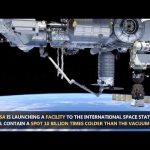
The new Cold Atom Lab (CAL) facility is among the cargo launching to the International Space Station on the Orbital ATK CRS-9 mission. The Cold Atom Lab could help answer some big questions in modern physics. CAL produces clouds of atoms that are ten billion times colder than deep space. The facility uses lasers and magnetic forces to freeze the atoms until they are almost motionless. In the microgravity environment on the space station, it’s possible to observe these ultra-cold atoms for much longer in than what’s possible on the ground. The research done using CAL could potentially lead to a number of improved technologies, including sensors, quantum computers and atomic clocks used in spacecraft navigation. Read more at: https://coldatomlab.jpl.nasa.gov/
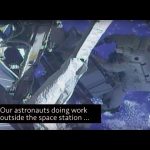
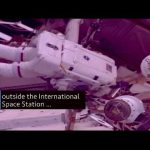
Our astronauts doing work outside the space station, an agencywide town hall with our new administrator, and old data provide new insight about Jupiter’s moon Europa – a few of the stories to tell you about – This Week at NASA!
This video is available for download from NASA’s Image and Video Library: https://images.nasa.gov/details-NHQ_2018_0518_Astronauts%20Working%20Outside%20the%20Space%20Station%20on%20This%20Week%20@NASA%20%E2%80%93%20May%2018,%202018.html
Sending a helicopter to Mars, a busy week for our new Administrator, and showcasing how technology enables exploration – a few of the stories to tell you about – This Week at NASA!
This video is available for download from NASA’s Image and Video Library: https://images.nasa.gov/details-NHQ_2018_0511_A%20Copter%20Companion%20for%20the%20Mars%202020%20Rover%20on%20This%20Week%20@NASA%20%E2%80%93%20May%2011,%202018.html
Our newest mission to Mars is on its way, Vice President Pence visits our Jet Propulsion Laboratory, and observing our planet’s ever-changing water cycle – a few of the stories to tell you about – This Week at NASA!
This video is available for download from NASA’s Image and Video Library: https://images.nasa.gov/details-NHQ_20218_0505_Our%20Newest%20Mission%20to%20Mars%20on%20This%20Week%20@NASA%20%E2%80%93%20May%205,%202018.html
InSight, NASA’s next Mars explorer, has arrived at Vandenberg Air Force Base in California – a big step forward in the countdown to T-zero on May 5, 2018. The spacecraft is called InSight – short for Interior Exploration using Seismic Investigations, Geodesy and Heat Transport – and it’s being tested, fueled and encapsulated for launch aboard the powerful United Launch Alliance Atlas V rocket. The upcoming liftoff will mark the first time an interplanetary mission has launched from the West Coast.
Spacecraft in orbit and on Mars’s surface have made many exciting discoveries, transforming our understanding of the planet and unveiling clues to the formation of our Solar System, as well as helping us understand our home planet. The next step is to bring samples to Earth for detailed analysis in sophisticated laboratories where results can be verified independently and samples can be reanalysed as laboratory techniques continue to improve.
Bringing Mars to Earth is no simple undertaking—it would require at least three missions from Earth and one never-been-done-before rocket launch from Mars.
A first mission, NASA’s 2020 Mars Rover, is set to collect surface samples in pen-sized canisters as it explores the Red Planet. Up to 31 canisters will be filled and readied for a later pickup – geocaching gone interplanetary.
In the same period, ESA’s ExoMars rover, which is also set to land on Mars in 2021, will be drilling up to two meters below the surface to search for evidence of life.
A second mission with a small fetch rover would land nearby and retrieve the samples in a Martian search-and-rescue operation. This rover would bring the samples back to its lander and place them in a Mars Ascent Vehicle – a small rocket to launch the football-sized container into Mars orbit.
A third launch from Earth would provide a spacecraft sent to orbit Mars and rendezvous with the sample containers. Once the samples are safely collected and loaded into an Earth entry vehicle, the spacecraft would return to Earth, release the vehicle to land in the United States, where the samples will be retrieved and placed in quarantine for detailed analysis by a team of international scientists.
Vice President Pence swears in our new NASA Administrator, a Hubble anniversary flythrough of a nebula, and the smell in the clouds of one of our outermost planets – a few of the stories to tell you about – This Week at NASA!
This video is available for download from NASA’s Image and Video Library: https://images.nasa.gov/details-NHQ_2018_0427_%20Bridenstine%20Sworn%20in%20as%20NASA%20Administrator%20on%20This%20Week%20@NASA%20%E2%80%93%20April%2027,%202018.html
When people think about the big players of the space industry, they don’t tend to think about Europe. But believe it or not the European Space Agency or ESA has the second highest budget out of any space agency. So what are they doing with all that money?
A challenge for the next generation of explorers, an eye-popping virtual tour of the Moon, and introducing the public to a universe of discovery – a few of the stories to tell you about – This Week at NASA!
This video is available for download from NASA’s Image and Video Library: https://images.nasa.gov/details-NHQ_2018_0413_Human%20Exploration%20Rover%20Challenge%20on%20This%20Week%20@NASA%20%E2%80%93%20April%2013,%202018.html
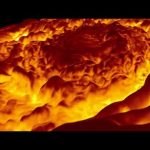
In this animation the viewer is taken low over Jupiter’s north pole to illustrate the 3-D aspects of the region’s central cyclone and the eight cyclones that encircle it.
Read more: https://www.nasa.gov/feature/jpl/nasa-s-juno-mission-provides-infrared-tour-of-jupiter-s-north-pole
The movie utilizes imagery derived from data collected by the Jovian Infrared Auroral Mapper (JIRAM) instrument aboard NASA’s Juno mission during its fourth pass over the massive planet. Infrared cameras are used to sense the temperature of Jupiter’s atmosphere and provide insight into how the powerful cyclones at Jupiter’s poles work. In the animation, the yellow areas are warmer (or deeper into Jupiter’s atmosphere) and the dark areas are colder (or higher up in Jupiter’s atmosphere). In this picture the highest “brightness temperature” is around 260K (about -13°C) and the lowest around 190K (about -83°C). The “brightness temperature” is a measurement of the radiance, at 5 µm, traveling upward from the top of the atmosphere towards Juno, expressed in units of temperature.
Credit: NASA/JPL-Caltech/SwRI/ASI/INAF/JIRAM
Our alien friend Paxi, ESA Education’s mascot, went to visit American astronaut Scott Tingle on board the International Space Station. Tingle tells Paxi about how astronauts sleep in weightlessness, an important aspect of living on the ISS.
Building the future of quiet supersonic flight, science and supplies delivered to the space station, and uncovering the farthest star ever seen – a few of the stories to tell you about, This Week at NASA!
This video is available for download from NASA’s Image and Video Library: https://images.nasa.gov/details-Lowering%20the%20Boom%20of%20Supersonic%20Flight%20on%20This%20Week%20@NASA%20%E2%80%93%20April%206,%202018.html
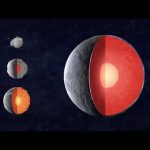
Psyche is both the name of an asteroid orbiting the Sun between Mars and Jupiter — and the name of a NASA space mission to visit that asteroid, led by Arizona State University. Join the Psyche team to explore why this mission was selected for NASA’s Discovery Program, how we’ll get to the asteroid, what we hope to learn from Psyche, and the importance of scientific discovery.
Credits: NASA/JPL-Caltech/Arizona State Univ./Peter Rubin/SSL
Our astronauts at work outside the space station, preparing for launch of our next planet-hunting mission, and finding exploding stars – a few of the stories to tell you about, This Week at NASA!
This video is available for download from NASA’s Image and Video Library: https://images.nasa.gov/details-NHQ_2018_0330_Astronauts%20at%20Work%20Outside%20the%20Space%20Station%20on%20This%20Week%20@NASA%20%E2%80%93%20March%2030,%202018.html
A new crew at the space station, some science on the next SpaceX resupply mission, and testing Orion’s parachutes – a few of the stories to tell you about – This Week at NASA!
This video is available for download from NASA’s Image and Video Library: https://images.nasa.gov/details-NHQ_2018_0323_New%20Crew%20Arrives%20at%20the%20Space%20Station%20on%20This%20Week%20@NASA%20%E2%80%93%20March%2023,%202018.html
NASA is honoring visionary physicist Stephen Hawking, who died at his home in Cambridge, England, early Wednesday morning.
Acting NASA Administrator Robert Lightfoot noted Hawking’s role as a “passionate communicator who wanted to share the excitement of discovery with all,” adding that his “impact cannot be overstated.”
“Stephen’s breakthroughs in the fields of physics and astronomy not only changed how we view the cosmos, but also has played, and will continue to play, a pivotal role in shaping NASA’s efforts to explore our solar system and beyond,” said Lightfoot.
A chance to send your name to the Sun, testing systems for our Orion spacecraft, and sizing up Earth, from space – a few of the stories to tell you about – This Week at NASA!
This video is available for download from NASA’s Image and Video Library: https://images.nasa.gov/details-NHQ_2018_0309_Send%20Your%20Name%20to%20the%20Sun%20on%20This%20Week%20@NASA%20%E2%80%93%20March%209,%202018.html
The bands were thought to be an expression of Jovian weather, related to winds blowing eastward and westward at different speeds.
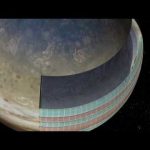
This animation illustrates a recent discovery by Juno that demonstrates these east-west flows, also known as jet-streams penetrate deep into the planet’s atmosphere, to a depth of about 1,900 miles (3,000 kilometers). Due to Jupiter’s rapid rotation (Jupiter’s day is about 10 hours), these flows extend into the interior parallel to Jupiter’s axis of rotation, in the form of nested cylinders. Below this layer the flows decay, possibly slowed by Jupiter’s strong magnetic field.
The depth of these flows surprised scientists who estimate the total mass involved in these jet streams to be about 1% of Jupiter’s mass (Jupiter’s mass is over 300 times that of Earth). This discovery was revealed by the unprecedented accuracy of Juno’s measurements of the gravity field.