Tag: Near-Earth Object

  • We’ll be prepared for asteroids ☄️ #shorts

    We’ll be prepared for asteroids ☄️ #shorts

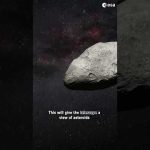
    Asteroids, like stars, only come out at night. Hidden in the glare of our Sun are an unknown number of asteroids on paths we cannot track, many of which could be heading for Earth, and we just don’t know it.

    Our planned NEOMIR mission will be located between Earth and the Sun and will act as an early warning system for asteroids 20 metres and larger that cannot be seen from the ground.

    By making observations in the infrared part of the light spectrum, NEOMIR will detect the heat emitted by asteroids themselves, which isn’t drowned out by sunlight. This thermal emission is absorbed by Earth’s atmosphere, but from space NEOMIR will be able to see closer to the Sun than we can currently from Earth.

    Learn more: https://www.esa.int/Space_Safety/Planetary_Defence/NEOMIR_finding_risky_asteroids_outshone_by_Sun

    ★ Subscribe: http://bit.ly/ESAsubscribe and click twice on the bell button to receive our notifications.

    Check out our full video catalog: http://bit.ly/SpaceInVideos
    Follow us on Twitter: http://bit.ly/ESAonTwitter
    On Facebook: http://bit.ly/ESAonFacebook
    On Instagram: http://bit.ly/ESAonInstagram
    On LinkedIn: https://bit.ly/ESAonLinkedIn
    On Pinterest: https://bit.ly/ESAonPinterest
    On Flickr: http://bit.ly/ESAonFlickr

    We are Europe’s gateway to space. Our mission is to shape the development of Europe’s space capability and ensure that investment in space continues to deliver benefits to the citizens of Europe and the world. Check out https://www.esa.int/ to get up to speed on everything space related.

    Copyright information about our videos is available here: https://www.esa.int/ESA_Multimedia/Terms_and_Conditions

    #ESA
    #NEOMIR
    #PlanetaryDefence

  • New Details about Interstellar Visitor on This Week @NASA – November 24, 2017

    New Details about Interstellar Visitor on This Week @NASA – November 24, 2017

    New data reveal that the interstellar asteroid that recently zipped through our solar system is rocky, cigar-shaped, and has a somewhat reddish hue. It’s the first confirmed object from another star observed in our solar system, and was discovered Oct. 19 by the University of Hawaii’s Pan-STARRS1 telescope team, funded by NASA’s Near-Earth Object Observations Program. The telescope team named it ‘Oumuamua (oh MOO-uh MOO-uh) – Hawaiian for “a messenger from afar arriving first.” The unusually-shaped asteroid, which is up to a quarter mile long and perhaps 10 times as long as it is wide, may provide new clues into how other solar systems formed. Also, Advanced Weather Satellite Launched, James Webb Space Telescope Completes Final Cryogenic Testing, Recurring Martian Streaks: Flowing Sand, Not Water? and Happy Thanksgiving, from Space!

    This video is available for download from NASA’s Image and Video Library: https://images.nasa.gov/details-NHQ_2017_1124_New%20Details%20about%20Interstellar%20Visitor%20on%20This%20Week%20@NASA%20%E2%80%93%20November%2024,%202017.html

  • A meteoroid as seen from the Space Station… make a wish!

    A meteoroid as seen from the Space Station… make a wish!

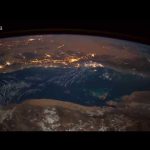
    A series of night-time photos were taken by ESA astronaut Paolo Nespoli on 5 November around 22:33 GMT, here shown in a time-lapse with a 1-second interval, while the Space Station was flying from the southern Atlantic Ocean over to Kazakhstan.

    Paolo was lucky enough to capture a fast fireball falling to Earth over the Atlantic Ocean, off the South Africa west coast — look closely between 00:07 and 00:08 seconds at upper right in this video.

    A fireball is basically a very bright meteoroid — a small bit of natural “space rock” — entering Earth’s atmosphere and burning brighter than the background stars. This particular meteoroid was moving much faster than typical, with an estimated speed of around 40 km/s, according to experts working on near-Earth objects (NEOs) in ESA’s Space Situational Awareness Programme.

    “This speed is actually quite fast for meteoroids, which typically enter the atmosphere at around 20 km/s,” says Rüdiger Jehn, SSA NEO segment co-manager.

    ESA astronaut Paolo Nespoli in currently working and living on board the International Space Station as part of the Italian Space Agency’s long-duration VITA mission.

    Follow the VITA mission: http://blogs.esa.int/VITAmission/
    Connect with Paolo via http://paolonespoli.esa.int

  • AIDA: Asteroid Impact and Deflection Assessment study

    AIDA: Asteroid Impact and Deflection Assessment study

    The Asteroid Impact and Deflection Assessment (AIDA) study examines ways to potentially deflect asteroids from trajectories that could lead to them impacting Earth. The Johns Hopkins University Applied Physics Laboratory would work with NASA and ESA on the mission, which includes two independent spacecraft: an impactor (to be built by APL for NASA) and an impact monitor (to be built by ESA).

    The target of this mission is the binary asteroid system Didymos. The impactor would strike the smaller secondary of Didymos, while the monitor would observe and measure any change in the relative orbit.

    Learn more:
    http://www.esa.int/Our_Activities/Technology/NEO/Asteroid_Impact_Deflection_Assessment_AIDA_study
    http://neo.jpl.nasa.gov/
    http://www.neoshield.net/en/index.htm