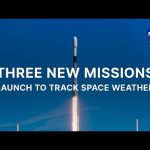
We’re about to launch three new observatories that will study the Sun—and help us protect Earth. Come watch with us!
NASA’s IMAP (Interstellar Mapping and Acceleration Probe) mission, the Carruthers Geocorona Observatory, and NOAA’s Space Weather Follow On–Lagrange 1 (SWFO-L1) observatory are scheduled to lift off from Kennedy Space Center aboard a SpaceX Falcon 9 rocket at 7:32 a.m. EDT (1132 UTC) on Tuesday, Sept. 23.
The IMAP mission will map the boundaries of our heliosphere, the vast bubble created by the Sun’s wind that covers our entire solar system. NASA’s Carruthers Geocorona Observatory will study the ultraviolet glow of Earth’s exosphere, the outermost region of our planet’s atmosphere — helping scientists understand how space weather from the Sun affects our planet.
The SWFO-L1 mission, managed by NOAA and developed with NASA’s Goddard Space Flight Center and commercial partners, will use a suite of instruments to provide real-time measurements of solar wind, along with a compact coronagraph to detect coronal mass ejections from the Sun.
Meet Flyeye — the telescope that sees space like a fly! 🪰
With its very first glimpse of the sky, Flyeye is ready to begin scanning for asteroids that might one day come a little too close to Earth.
Inspired by the compound eye of a fly, it can spot a huge chunk of sky in one go — more than 200 times the area of the full Moon. And it’s designed to do it all automatically, night after night.
It hasn’t found any space rocks yet, but it’s only just opened its eye. This is the first step towards a future network of fly-eyed telescopes keeping watch over our planet.
A new study shows that the Nord Stream methane leak that happened in 2022 was bigger than we thought. How much bigger? Watch our video until the end to find out.
📹 European Space Agency (ESA) 📸 Pexels, contains modified Copernicus Sentinel data (2022), processed by ESA, GHGSat, Pléiades Neo, Planet Labs PBC
🚩 Visit https://betterhelp.com/historymarche or use “historymarche” when you sign up to get a special discount on your first month of therapy with our sponsor BetterHelp. 🚩 If you have any questions about the brand relating to how the therapists are licensed, their privacy policy, or therapist compensation model, check out this FAQ: https://www.betterhelp.com/your-questions-answered/
🚩 If you like what you see, consider supporting my work on Patreon and you get ad-free early access to my videos for as little as $1 https://www.patreon.com/historymarche — You can also show your support by subscribing to the channel and liking the video. Thank you for watching.
In part 20 we continue where we left off after the 2nd Battle of Nola, with Hannibal wintering in Apulia in late 215 BC, and we go up to the Battle of Tarentum in the spring of 212 BC. I won’t give any other spoilers!
🎼 Music: Peaks of Atlas – Omri Lahav EpidemicSound Filmstro
Sources and citations: Hannibal’s Summer campaign of 213 BC – David Feeney (2019) Fall of Carthage – Adrian Goldsworthy (2003) From the Founding of the City – by Livy, translated by Canon Roberts (1905) The Punic Wars – Nigel Bagnall (2008) Hannibal – G. P. Baker (1999) Hannibal’s War – John Peddie (2005) The History of Rome, Livy (2006) The Rise of the Roman Empire – Polybius (translation by Ian Scott-Kilvert) (1980) A companion to the Punic Wars – Dexter Hoyos (2015)
Ai întrebări de știință și vrei răspunsuri personale? Intră acum pe Patreon și eu își voi răspunde direct pe whatsapp ►https://patreon.com/cristianpresura
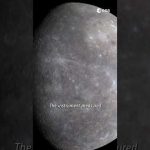
BepiColombo flew past Mercury for the fifth time on 1 December 2024.
During this flyby, BepiColombo gathered more data on the mysterious planet and its surroundings. Aside from taking some ‘regular’ photos of the planet and measuring particles and electromagnetic fields in the space around it, this flyby was the first time that any spacecraft imaged Mercury in mid-infrared wavelengths of light.
BepiColombo will pass much closer to Mercury’s north pole during its final flyby of Mercury on 8 January 2025, its last visit before arriving to enter orbit about the planet in November 2026.
📹 ESA – European Space Agency 📸 MERTIS/DLR/University of Münster & NASA/Johns Hopkins University Applied Physics Laboratory/Carnegie Institution of Washington
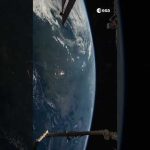
With this Timelapse captured from the ISS by our astronaut Samantha Cristoforetti, the entire ESA family wants to wish you a peaceful, safe and exciting year 2025!
May the new year be full of grand adventures and opportunities! We’ll keep bringing the wonders of the universe and Earth to the palm of your hands.
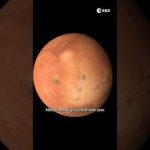
On 12 November 2024, Mars kicks off a fresh New Year! While Earth and Mars both orbit the Sun, a Martian year is full of fascinating twists. Curious about how time flows differently on the Red Planet? Let’s dive into what makes a year on Mars unique—and what it shares with our own!
📹 ESA – European Space Agency 📸 ESA/DLR/Freie Universität Berlin
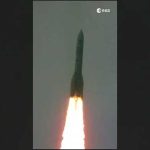
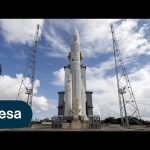
Europe’s new rocket Ariane 6 powered Europe into space taking with it a varied selection of experiments, satellites, payload deployers and reentry demonstrations that represent thousands across Europe, from students to industry and experienced space actors.
This inaugural flight, designated VA262, is a demonstration flight to show the capabilities and prowess of Ariane 6 in escaping Earth’s gravity and operating in space. Nevertheless, it had several passengers on board.
Ariane 6 was built by prime contractor and design authority ArianeGroup. In addition to the rocket, the liftoff demonstrated the functioning of the launch pad and operations on ground at Europe’s Spaceport. The new custom-built dedicated launch zone was built by France’s space agency CNES and allows for a faster turnover of Ariane launches.
Ariane 6 is Europe’s newest heavy-lift rocket, designed to provide great power and flexibility at a lower cost than its predecessors. The launcher’s configuration – with an upgraded main stage, a choice of either two or four powerful boosters and a new restartable upper stage – will provide Europe with greater efficiency and possibility as it can launch multiple missions into different orbits on a single flight, while its upper stage will deorbit itself at the end of mission.
ESA’s main roles in the Ariane 6 programme is as contracting authority – managing the budget from Member States participating in the Ariane 6 development programme; and as launch system architect – ensuring that the rocket and launch pad infrastructure work together.
Ariane 6 is the latest in Europe’s Ariane rocket series, taking over from Ariane 5 featuring a modular and versatile design that can launch missions from low-Earth orbit and farther out to deep space.
★ Subscribe: http://bit.ly/ESAsubscribe and click twice on the bell button to receive our notifications.
We are Europe’s gateway to space. Our mission is to shape the development of Europe’s space capability and ensure that investment in space continues to deliver benefits to the citizens of Europe and the world. Check out https://www.esa.int/ to get up to speed on everything space related.
On 20 June 2024 the first Ariane 6 rocket to launch into space went through its last full ‘wet dress rehearsal’ at Europe’s Spaceport in French Guiana – it provided an exciting sneak peek of what’s to come, stopping just a few seconds before engine ignition and of course, liftoff.
One of the first steps was to roll back the colossal 90-m tall Ariane 6 mobile gantry building 120 m away from the launch pad – the first moment the complete rocket stood free.
The first parts of Ariane 6 began arriving in French Guiana from continental Europe in February 2024 via the Canopée ‘spaceship’. In March, the main stage and upper stage were assembled, followed by the transfer of the two powerful P120C boosters in April.
In May, Ariane 6’s first passengers also arrived in Kourou – a varied selection of experiments, satellites, payload deployers and reentry demonstrations that represent thousands across Europe, from students to industry and experienced space actors NASA and ArianeGroup.
The payloads were integrated onto the ‘ballast’ at the end of May, and just a few days ago the ballast was fitted onto the top of the rocket and the fairing closed around it – the last time Ariane 6’s cargo would see light. From Earth observation to technology demonstrations testing wildlife tracking, 3D printing in open space, open-source software and hardware and science missions looking for the most energetic explosions in the universe, the passengers on Ariane 6’s first flight are a testament to the rocket’s adaptability, complexity, and its role for the future – launching any mission, anywhere.
Credits: ESA – European Space Agency Footage: ESA/ArianeGroup/Arianespace/CNES
★ Subscribe: http://bit.ly/ESAsubscribe and click twice on the bell button to receive our notifications.
We are Europe’s gateway to space. Our mission is to shape the development of Europe’s space capability and ensure that investment in space continues to deliver benefits to the citizens of Europe and the world. Check out https://www.esa.int/ to get up to speed on everything space related.
ESA’s Euclid space mission has released five unprecedented new views of the Universe. These never-before-seen images demonstrate Euclid’s remarkable ability to unravel the secrets of the cosmos. Scientists are now equipped to hunt for rogue planets, study mysterious matter through lensed galaxies, and explore the evolution of the Universe. Join us as we explore these groundbreaking discoveries and what they mean for the future of space exploration.
Credits: ESA – European Space Agency
Chapters: 00:00 – 00:36 Intro 00:36 – 01:14 The Galaxy Cluster Abell 2390 01:15 – 02:14 Messier 78: Stellar Nurseries and Galactic Formation 02:15 – 03:02 Galaxies in the Dorado Group 03:03 – 04:27 NGC 6744 04:28 – 05:25 Abell 2764 05:26 – 6:16 Conclusion
★ Subscribe: http://bit.ly/ESAsubscribe and click twice on the bell button to receive our notifications.
We are Europe’s gateway to space. Our mission is to shape the development of Europe’s space capability and ensure that investment in space continues to deliver benefits to the citizens of Europe and the world. Check out https://www.esa.int/ to get up to speed on everything space related.
A new target launch date for our Boeing Crew Flight Test, making progress on major hardware for Gateway, and presidential honors for helping to advance NASA’s mission … a few of the stories to tell you about – This Week at NASA!
Video Producer: Andre Valentine Video Editor: Haley Reed Narrator: Emanuel Cooper Music: Universal Production Music
Europe’s new launcher, Ariane 6 uses liquid oxygen and hydrogen as fuel to lift it off the ground and into space. This fuel is chilled to -150°C which allows more propellant to be loaded into the rocket with more fuel from the engine.
But Ariane would not get far without the boosters that provide the most thrust by far.
In order to control the direction of Ariane 6 after launch, the nozzles on the boosters and main stage can swivel to keep it on course. This is no easy feat as Ariane 6 is 56 m tall and controlled at the bottom, so it is a careful balancing act.
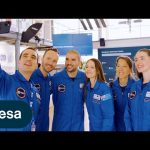
ESA’s newly graduated astronauts reach the end of one year of rigorous basic astronaut training. Discover the journey of Sophie Adenot, Rosemary Coogan, Pablo Álvarez Fernández, Raphaël Liégeois, Marco Sieber, and Australian Space Agency astronaut candidate Katherine Bennell-Pegg. Selected in November 2022, the group began their training in April 2023.
Basic astronaut training provides the candidates with an overall familiarisation and training in various areas, such as spacecraft systems, spacewalks, flight engineering, robotics and life support systems as well as survival and medical training. They received astronaut certification at ESA’s European Astronaut Centre on 22 April 2024.
Following certification, the new astronauts will move on to the next phases of pre-assignment and mission-specific training – paving the way for future missions to the International Space Station and beyond.
Credits: Video: ESA – European Space Agency ISS and EVA footage: ESA/NASA
Music: Scorekeepers
★ Subscribe: http://bit.ly/ESAsubscribe and click twice on the bell button to receive our notifications.
We are Europe’s gateway to space. Our mission is to shape the development of Europe’s space capability and ensure that investment in space continues to deliver benefits to the citizens of Europe and the world. Check out https://www.esa.int/ to get up to speed on everything space related.
More partners in space exploration, new data measuring ocean health, air quality and our climate, and an upgrade to testing facilities for Artemis II … a few of the stories to tell you about – This Week at NASA!
ESA is venturing towards putting a spacecraft into orbit around Mars using a technique that engineers have studied for over half a century but never dared to attempt.
At present it’s as though the distance ladder observed by Hubble and Webb has firmly set an anchor point on one shoreline of a river, and the afterglow of the Big Bang observed by our Planck mission from the beginning of the Universe is set firmly on the other side. How the Universe’s expansion was changing in the billions of years between these two endpoints has yet to be directly observed.
📹 ESA – European Space Agency 📸 NASA, ESA, CSA, Space Telescope Science Inst., A. Riess (JHU/STScI)
A new crew launches to the space station, graduating a new class of Artemis astronauts, and a group of tiny lunar-roving robots are ready to roll … a few of the stories to tell you about – This Week at NASA!
Link to download this video: https://images.nasa.gov/details/A%20New%20Crew%20Launches%20to%20the%20Space%20Station%20on%20This%20Week%20@NASA%20%E2%80%93%20March%208,%202024
Video Producer: Andre Valentine Video Editor: Andre Valentine Narrator: Emanuel Cooper Music: Universal Production Music Credit: NASA
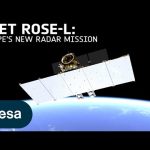
The upcoming Copernicus Radar Observation System for Europe in L-band (ROSE-L) will provide continuous day-and-night all-weather monitoring of Earth’s land, oceans and ice, and offer frequent images at a high spatial resolution.
ROSE-L will carry an active phased array synthetic aperture radar instrument. The radar antenna will be the largest planar antenna ever built measuring an impressive 40 sq m – roughly the size of 10 ping-pong tables.
ROSE-L will deliver essential information on forests and land cover, leading to improved monitoring of the terrestrial carbon cycle and carbon accounting.
The mission will also greatly extend our ability to monitor minute surface displacements and helping detect geohazards. It will automatically map surface soil moisture conditions and monitor sea and land ice – greatly helping climate change research and mitigation.
ROSE-L is one of six Copernicus Sentinel Expansion missions that ESA is developing on behalf of the EU. The missions will expand the current capabilities of the Copernicus Space Component – the world’s biggest supplier of Earth observation data.
This video features interviews with Malcolm Davidson, ROSE-L Mission Scientist, Nico Gebert, ROSE-L Payload Manager and Gianluigi Di Cosimo, ROSE-L Project Manager.
Credits: ESA – European Space Agency
★ Subscribe: http://bit.ly/ESAsubscribe and click twice on the bell button to receive our notifications.
We are Europe’s gateway to space. Our mission is to shape the development of Europe’s space capability and ensure that investment in space continues to deliver benefits to the citizens of Europe and the world. Check out https://www.esa.int/ to get up to speed on everything space related.
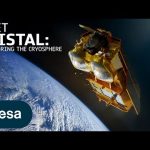
Tracking ice lost from the world’s glaciers, ice sheets and frozen land shows that Earth is losing ice at an accelerating rate. Monitoring the cryosphere is crucial for assessing, predicting and adapting to climate change.
The Copernicus Polar Ice and Snow Topography Altimeter (CRISTAL) mission will provide a full picture of the changes taking place in some of the most inhospitable regions of the world. It will carry – for the first time – a dual-frequency radar altimeter, and microwave radiometer, that will measure and monitor sea-ice thickness, overlying snow depth and ice-sheet elevations.
These data will support maritime operations in the polar oceans and contribute to a better understanding of climate processes. CRISTAL will also support applications related to coastal and inland waters, as well as providing observations of ocean topography.
CRISTAL is one of six Copernicus Sentinel Expansion missions that ESA is developing on behalf of the EU. The missions will expand the current capabilities of the Copernicus Space Component – the world’s biggest supplier of Earth observation data.
This video features interviews with Kristof Gantois, CRISTAL Project Manager and Paolo Cipollini, CRISTAL Mission Scientist.
Credits: ESA – European Space Agency
★ Subscribe: http://bit.ly/ESAsubscribe and click twice on the bell button to receive our notifications.
We are Europe’s gateway to space. Our mission is to shape the development of Europe’s space capability and ensure that investment in space continues to deliver benefits to the citizens of Europe and the world. Check out https://www.esa.int/ to get up to speed on everything space related.
In moments years (and sometimes decades) in the making, scientists react to new discoveries from the James Webb Space Telescope, the most powerful space telescope ever built.
Today, our Gaia mission releases a goldmine of knowledge about our galaxy and beyond. Among other findings, the star surveyor surpasses its planned potential to reveal half a million new and faint stars in a massive cluster, identify over 380 possible cosmic lenses, and pinpoint the positions of more than 150 000 asteroids within the Solar System.
A new long-duration spaceflight record, our SpaceX Crew-6 mission is back home, and our asteroid sample return mission is on target … a few of the stories to tell you about – This Week at NASA! Link to download this video: https://images.nasa.gov/details/A%20New%20Long-Duration%20Spaceflight%20Record%20on%20This%20Week%20@NASA%20%E2%80%93%20September%2015,%202023
Video Producer: Andre Valentine Video Editor: Andre Valentine Narrator: Andre Valentine Music: Universal Production Music Credit: NASA
A new crew heads to the space station, a major storm spotted from space, and a robotic spacecraft enabling human missions to the Moon … a few of the stories to tell you about – This Week at NASA!
Link to download this video: https://images.nasa.gov/details/A%20New%20Crew%20Heads%20to%20the%20Space%20Station%20on%20This%20Week%20@NASA%20%E2%80%93%20September%201,%202023
Video Producer: Andre Valentine Video Editor: Andre Valentine Narrator: Andre Valentine Music: Universal Production Music Credit: NASA
Showcasing our new Earth Information Center, in search of an atmosphere around a rocky exoplanet, and getting ready for an important delivery … a few of the stories to tell you about – This Week at NASA!
Link to download this video: https://images.nasa.gov/details/Showcasing%20Our%20New%20Earth%20Information%20Center%20on%20This%20Week%20@NASA%20%E2%80%93%20June%2023,%202023
Video Producer: Andre Valentine Video Editor: Andre Valentine Narrator: Andre Valentine Music: Universal Production Music Credit: NASA
Watch the recording of the live session from the Paris Air Show 2023 for a conference examining Europe’s aspirations in human and robotic space exploration. Speakers include ESA Director General Josef Aschbacher, CNES CEO Philippe Baptiste, Director General of the German Space Agency Walther Pelzer, and President of the Italian Space Agency (ASI) Teodoro Valente. ESA astronauts Thomas Pesquet, Samantha Cristoforetti, and Matthias Maurer will provide their perspectives.
★ Subscribe: http://bit.ly/ESAsubscribe and click twice on the bell button to receive our notifications.
We are Europe’s gateway to space. Our mission is to shape the development of Europe’s space capability and ensure that investment in space continues to deliver benefits to the citizens of Europe and the world. Check out https://www.esa.int/ to get up to speed on everything space related.
Europe’s latest weather satellite, the Meteosat Third Generation Imager, has just delivered its first image of Earth. What does this satellite do exactly? And what does this mean for weather forecasting? Learn more about the Meteosat Third Generation and how this new generation of satellites is set to revolutionise weather forecasting in Europe.
We are Europe’s gateway to space. Our mission is to shape the development of Europe’s space capability and ensure that investment in space continues to deliver benefits to the citizens of Europe and the world. Check out https://www.esa.int/ to get up to speed on everything space related.
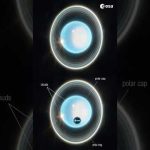
The NASA/ESA/CSA James Webb Space Telescope has taken a stunning image of the Solar System’s other ice giant, the planet Uranus. The new image features dramatic rings as well as bright features in the planet’s atmosphere. The new Webb data of Uranus offer exquisite sensitivity, revealing the faintest dusty rings.
The seventh planet from the Sun, Uranus is strange: it rotates on its side, at a nearly 90-degree angle from the plane of its orbit. This causes unusual seasons since the planet’s poles experience 42 years of constant sunlight and 42 years of complete darkness (Uranus takes 84 years to orbit the Sun). Currently, it is late spring at the northern pole, which is on the right side of this image; Uranus’s northern summer will be in 2028.
Credit: NASA, ESA, CSA, STScI, J. DePasquale (STScI), N. Bartmann Music: Stellardrone – The Belt of Orion
★ Subscribe: http://bit.ly/ESAsubscribe and click twice on the bell button to receive our notifications.
We are Europe’s gateway to space. Our mission is to shape the development of Europe’s space capability and ensure that investment in space continues to deliver benefits to the citizens of Europe and the world. Check out https://www.esa.int/ to get up to speed on everything space related.
The next crew heads to the space station, navigating the lunar landscape, and a view to look forward to. A few of the stories to tell you about – This Week at NASA!
With this Timelapse captured from the ISS by our astronaut Samantha Cristoforetti, the entire ESA family wants to wish you a peaceful, safe and exciting year 2023!
May the new year be full of grand adventures and opportunities!
We’ll keep bringing the wonders of the universe and Earth to the palm of your hands 😉
📹 @EuropeanSpaceAgency / @NASA – S. Cristoforetti
★ Subscribe: http://bit.ly/ESAsubscribe and click twice on the bell button to receive our notifications.
We are Europe’s gateway to space. Our mission is to shape the development of Europe’s space capability and ensure that investment in space continues to deliver benefits to the citizens of Europe and the world. Check out https://www.esa.int/ to get up to speed on everything space related.
As Mars orbits around our Sun, time on the Red Planet is measured in years. However, there are some significant differences between a year on Mars and a year on Earth. Let’s look at some similarities and differences between a year on the two planets.
We are Europe’s gateway to space. Our mission is to shape the development of Europe’s space capability and ensure that investment in space continues to deliver benefits to the citizens of Europe and the world. Check out https://www.esa.int/ to get up to speed on everything space related.
ESA’s new class of astronauts was announced in Paris on 23 November 2022. It includes career astronauts, reserve astronauts and astronauts with a physical disability for a feasibility project.
Last year and for the first time since 2008, ESA launched a call for applications and it received more than 22 500 valid applications. At an event on 23 November, ESA revealed which of these were successful. The event was moderated by Louise Houghton.
We are Europe’s gateway to space. Our mission is to shape the development of Europe’s space capability and ensure that investment in space continues to deliver benefits to the citizens of Europe and the world. Check out https://www.esa.int/ to get up to speed on everything space related.
Launching a new crew to the space station, the plan moving forward for Artemis I, and Webb’s new look at a pair of galaxies … a few of the stories to tell you about – This Week at NASA!
The final pre-launch preparations for the first Meteosat Third Generation (MTG) satellite are underway. The first satellite, called MTG-I1, built by a European industrial consortium led by Thales Alenia Space carries two imagers: an advanced Flexible Combined Imager and, in a first for Europe, a Lightning Imager that will allow the earlier detection of storms and extreme weather events, as well as improve aviation safety.
Building on the long-standing partnership between ESA and Eumetsat, the MTG-I1 will be one of six satellites operating in a fleet, of three at a time, to ensure the continuity of data from the previous Meteosat satellites over the next 20 years. The first Meteosat was launched in 1977 and this third generation of spacecraft will be the most advanced yet, with improved image resolution and providing close to real time data for users, or ‘nowcasting’ of fast-developing, high-impact weather.
The launch is currently scheduled for the end of 2022.
The film includes soundbites from ESA Director of Earth Observation Programmes: Simonetta Cheli, ESA Meteosat Programme Manager: Paul Blythe, ESA Meteosat Third Generation Payload Manager: Donny Aminou and EUMETSAT, Meteosat Third Generation Programme Manager: Alexander Schmid.
★ Subscribe: http://bit.ly/ESAsubscribe and click twice on the bell button to receive our notifications.
We are Europe’s gateway to space. Our mission is to shape the development of Europe’s space capability and ensure that investment in space continues to deliver benefits to the citizens of Europe and the world. Check out https://www.esa.int/ to get up to speed on everything space related.
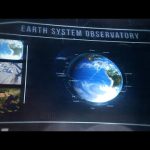
For more than 50 years, NASA has been collecting and providing data about Earth’s land, water, ice and atmosphere. Now, a new era of Earth Science has begun. NASA will launch a fleet of state-of-the-art satellites forming the Earth System Observatory, which will create a comprehensive 4D view of Earth like never before. NASA, working with federal partners, will equip decision makers with the information they need to mitigate, adapt and respond to climate change through the new Earth Information Center. A new satellite observatory in the sky and an information center here on Earth, protecting our planet for the next generation.
We are Europe’s gateway to space. Our mission is to shape the development of Europe’s space capability and ensure that investment in space continues to deliver benefits to the citizens of Europe and the world. Check out https://www.esa.int/ to get up to speed on everything space related.