Tag: Orbital

  • Orbital Thanksgiving in 360° | Cosmic Kiss

    Orbital Thanksgiving in 360° | Cosmic Kiss

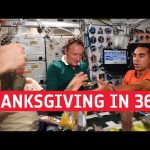
    Feel like a guest and join ESA astronaut Matthias Maurer and his Expedition 66 crew mates enjoying a festive Thanksgiving meal on board the International Space Station in 360°. Explore the space station’s dining area and see what’s on the menu for this year’s orbital Thanksgiving.

    Matthias says: “One of the best things about international collaboration, beyond our daily work on science and operations, is sharing international celebrations and culture. I’m thankful for all my crew mates up here on the International Space Station and everyone supporting our mission from Earth”.

    Matthias was launched to the International Space Station on Crew Dragon Endurance as part of Crew-3 at 02:03 GMT/03:03 CET Thursday 11 November 2021. His ESA mission is known as Cosmic Kiss and will see him live and work in orbit for approximately six months.

    Follow Matthias: https://bit.ly/ESACosmicKiss

    ★ Subscribe: http://bit.ly/ESAsubscribe and click twice on the bell button to receive our notifications.

    Check out our full video catalog: http://bit.ly/SpaceInVideos
    Follow us on Twitter: http://bit.ly/ESAonTwitter
    On Facebook: http://bit.ly/ESAonFacebook
    On Instagram: http://bit.ly/ESAonInstagram
    On LinkedIn: https://bit.ly/ESAonLinkedIn
    On Pinterest: https://bit.ly/ESAonPinterest
    On Flickr: http://bit.ly/ESAonFlickr

    We are Europe’s gateway to space. Our mission is to shape the development of Europe’s space capability and ensure that investment in space continues to deliver benefits to the citizens of Europe and the world. Check out https://www.esa.int/ to get up to speed on everything space related.

    Copyright information about our videos is available here: https://www.esa.int/ESA_Multimedia/Terms_and_Conditions

    #ESA
    #360
    #CosmicKiss

  • Episode 01: The Orbital Test Flight of Boeing’s Starliner

    Episode 01: The Orbital Test Flight of Boeing’s Starliner

    On December 20th 2019 Boeing conducted the first test flight ever of their new spacecraft Starliner. Together, NASA and Boeing made history in the face of challenges. This test flight was another step toward returning American space launch capability to American shores.

    This video is available for download from NASA’s Image and Video Library: https://images.nasa.gov/details-Episode%2001%20-%20The%20Orbital%20Test%20Flight%20of%20Boeing%E2%80%99s%20Starliner

  • Horizons mission time-lapse – an orbital sunrise

    Horizons mission time-lapse – an orbital sunrise

    Orbiting Earth once every 90 minutes, the International Space Station soars into 16 sunrises and sunsets every single day. Many of these sunrises occur while the crew is working or sleeping, but ESA astronaut Alexander Gerst captured this stunning timelapse of a sunrise to share with us here on Earth.

    These photos were taken by Alexander at an interval of two per second and the video has been edited at 25 frames per second.

    Music: First Survivors 4 by Los Angeles-based British composer, Luke Richards. Sourced from Audio Network Limited.

    ★ Subscribe: http://bit.ly/ESAsubscribe

    Follow Alexander and the Horizons mission on social media via http://bit.ly/AlexanderGerstESA and on http://bit.ly/HorizonsBlogESA.

  • Orbital ATK’s Cygnus Cargo Spacecraft Launches to the ISS

    Orbital ATK’s Cygnus Cargo Spacecraft Launches to the ISS

    On April 18, Orbital ATK’s Cygnus cargo space craft launched from Cape Canaveral Air Force Station in Florida aboard a United Launch Alliance rocket, on Orbital ATK’s seventh resupply mission to the International Space Station. Cygnus is packed with 7,600 pounds of supplies and research for the crew aboard the orbiting laboratory.

  • Orbital ATK Launches to ISS from NASA’s Wallops Flight Facility

    Orbital ATK Launches to ISS from NASA’s Wallops Flight Facility

    On Oct. 17, Orbital ATK launched its Cygnus cargo spacecraft atop an Antares rocket to the International Space Station. The spacecraft launched from the Mid-Atlantic Regional Spaceport at NASA’s Wallops Flight Facility in Virginia. This is the sixth cargo mission to the International Space Station for Orbital ATK.

  • NASA News Conference on Completion of COTS Program

    NASA News Conference on Completion of COTS Program

    NASA Administrator Charles Bolden discusses the success of the agency’s Commercial Orbital Transportation Services (COTS) initiative during a televised news briefing at NASA Headquarters. Through COTS, NASA’s partners Space Exploration Technologies Corp. (SpaceX) and Orbital Sciences Corp., developed new U.S. rockets and spacecraft, launched from U.S. soil, capable of transporting cargo to low-Earth orbit and the International Space Station. A successful Orbital Sciences demonstration mission to the space station was completed in October, signifying the end of COTS development. SpaceX made its first trip to the space station in May 2012 and completed its COTS partnership with NASA the same year. The agency now contracts space station cargo resupply missions with both companies.

    The briefing participants were:

    — Charles Bolden, NASA Administrator
    — Alan Lindenmoyer, Manager of Commercial Crew and Cargo Program, NASA
    — Gwynne Shotwell, President, SpaceX
    — Frank Culbertson, Executive Vice President and General Manager, Orbital Sciences Advanced Programs Group
    — Frank Slazer, Vice President of Space Systems, Aerospace Industries Association
    — Phil McAlister, Director of Commercial Spaceflight Development, NASA

  • One Year on Mars! On This Week @NASA

    One Year on Mars! On This Week @NASA

    So what can a planetary rover do with a year on Mars? All NASA’s Curiosity rover did was beam back over 190 gigabits of data, more than 36-thousand images and zap 75-thousand-plus laser shots at science targets … and oh by the way, it also completed the mission’s main science goal by finding evidence that life was possible on Mars in the past. The agency celebrated the one year anniversary of Curiosity’s landing on Mars with live events from the Jet Propulsion Laboratory — featuring rover team members. And at NASA Headquarters — a discussion about how Curiosity and other robotic projects are benefitting future human space exploration. Also, Maven Arrives, Garver Leaving NASA, Great Ball of Fire, Supply Ship Arrives Safely, Carbon Copy, The First Barrel Segment and more!

  • ORBITAL DEBRIS SAFELY PASSES INTERNATIONAL SPACE STATION

    ORBITAL DEBRIS SAFELY PASSES INTERNATIONAL SPACE STATION

    A small piece of Cosmos 2251 satellite debris safely passed by the International Space Station at 2:38a.m. EDT, Saturday March 24 allowing the six Expedition 30 crew members onboard the orbiting complex to exit their Soyuz spacecraft and resume normal activities.

    The crew sheltered in the two Soyuz spacecraft as a precaution, the third time in station history that a crew has had to shelter in place due to the possibility of a conjunction with orbital debris and the first since June 2011. NASA’s Expedition 30 Commander Dan Burbank and Russian cosmonauts Anton Shkaplerov and Anatoly Ivanishin were in their Soyuz TMA-22 spacecraft attached to the Poisk module on the space-facing side of the Zvezda service module, while cosmonaut Oleg Kononenko, NASA’s Don Pettit and Andre Kuipers of the European Space Agency were in their Soyuz TMA-03M spacecraft on the Earth-facing side of the Zarya module.

    The piece of debris was a remnant of a Feb. 10, 2009 collision between the dormant Cosmos 2251 satellite and an operational Iridium 33 communications satellite. The collision added about 2,000 trackable items to the orbital debris catalog. At the time of closest approach, the debris was moving from left to right in front of the station at an estimated overall miss distance of between 11 and 14 kilometers and a radial miss distance of 120 meters.

  • Columbus: ESA’s real estate’ in space

    Columbus: ESA’s real estate’ in space

    In February 2008, the Columbus module was launched on the Space Shuttle Atlantis, creating space history when it was attached to the International Space Station as the first European laboratory dedicated to long-term research in microgravity.