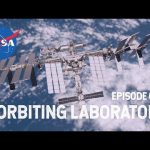
Things behave a bit differently aboard the International Space Station, thanks to microgravity.
Sure, floating looks like fun, but it could also unlock new scientific discoveries.
Microgravity makes the station the perfect place to perform research that is changing the lives of people on Earth, and preparing us to go deeper into space. This season on #NASAExplorers, we are following science into low-Earth orbit and seeing what it takes to do research aboard the space station.
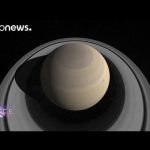
Right now the Cassini spacecraft is flying between the rings of Saturn and the planet itself, a daring trajectory chosen to conclude a unique exploration mission.
To find out what that orbit means, and to look back at some of Cassini-Huygens finest moments, we met up with key members of the science team in the UK for this edition of Space.
Die Cassini-Huygens-Mission am Saturn startete vor zwanzig Jahren, 2004 schwenkte die Doppel-Sonde in ihre Umlaufbahn um den Saturn ein. Im Dezember 2004 koppelte der Lander Huygens von der Cassini-Sonde ab und setzte im Januar 2005 auf dem Titan auf. Die Mission entdeckte unter anderem ein Eismeer auf dem Saturn-Mond Enceladus und fliegt jetzt zwischen den Ringen des Saturn und dem Planeten selbst. Im September soll Cassini mangels Treibstoffvorräten in der Saturn-Atmosphäre verglühen.
Die Saturn-Spezialisten des Mullard Space Science Laboratory (MSSL) in Südengland verfolgen die Mission und erforschen das Sonnensystem des pittoresken Planeten. Die Cassini-Sonde wird gerade auf ihre finale Umlaufbahn gebracht, um nächstmögliche Eindrücke vom Saturn zu gewinnen.
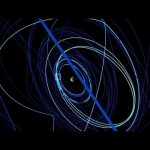
Animation visualising Rosetta’s two-year journey around Comet 67P/Churyumov–Gerasimenko.
The animation begins on 31 July 2014, during Rosetta’s final approach to the comet after its ten-year journey through space. The spacecraft arrived at a distance of 100 km on 6 August whereupon it gradually approached the comet and entered initial mapping orbits that were needed to select a landing site for Philae. These observations also enabled the first comet science of the mission. The manoeuvres in the lead up to, during and after Philae’s deployment on 12 November are seen, before Rosetta settled into longer-term science orbits.
In February and March 2015 the spacecraft made several flybys. One of the closest flybys triggered a ‘safe mode’ event that forced it to retreat temporarily until it was safe to gradually draw closer again. The comet’s increased activity in the lead up to and after perihelion in August 2015 meant that Rosetta remained well beyond 100 km distances for several months.
In June 2015, contact was restored with Philae again – albeit temporary, with no permanent link able to be maintained, despite a series of dedicated trajectories flown by Rosetta for several weeks.
Following perihelion, Rosetta performed a dayside far excursion some 1500 km from the comet, before re-approaching to closer orbits again, enabled by the reduction in the comet’s activity. In March–April 2016 Rosetta went on another far excursion, this time on the night side, followed by a close flyby and orbits dedicated to a range of science observations.
The animation finishes at 9 August 2016, before the details of the end of mission orbits were known. A visualisation of the trajectories leading to the final descent to the surface of the comet on 30 September will be provided once available.
The trajectory shown in this animation is created from real data, but the comet rotation is not. An arrow indicates the direction to the Sun as the camera viewpoint changes during the animation.
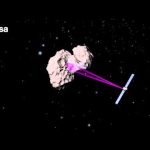
Rosetta orbiting Comet 67P/Churyumov–Gerasimenko and scanning its surface to make scientific measurements. The colours of the beams and their shape on the surface represent two different instruments imaging and analysing the comet.
The Rosetta orbiter has a total of 11 instruments to study the characteristics and environment of the comet. Rosetta is taking images of the comet at a variety of different wavelengths, measuring its gravity, mass, density, internal structure, shape and rotation, and assessing the properties of its gaseous, dust-laden atmosphere, or coma. It is also probing the surrounding plasma environment and analysing how it interacts with the solar wind.
Rosetta also carries a small lander, Philae, which will descend to the surface of the comet and make in situ measurements using its suite of 10 instruments.
The animation is not to scale; the comet is about 4.1 km wide and Rosetta is 32 m across including its solar wings, and it conducts scientific investigations at a range of altitudes. The comet shape is based on a true comet shape model.
NASA’s first spacecraft dedicated to studying carbon dioxide in Earth’s atmosphere was successfully launched from Vandenberg Air Force Base, California. OCO-2 will be collecting a great number of high-resolution measurements, which will provide a greater spatial distribution of CO2 over the entire globe, in short, a bigger, clearer, more complete picture of global CO2. These measurements will be combined with data from the ground-based network to provide scientists with the information that they need to better understand the processes that regulate atmospheric CO2 and its role in the carbon cycle.