Tag: Parabolic flight

  • Experiencing zero gravity on Earth

    Experiencing zero gravity on Earth

    Ever wondered how astronauts prepare for the weightlessness of space? In Bordeaux, France, our astronauts train for microgravity using parabolic flights! These special flights create brief periods of zero gravity, mimicking the conditions of space.

    By performing a series of steep climbs and descents, the plane allows astronauts to experience intense 2G forces before entering a 22-second weightless phase! This crucial training helps future astronauts adapt to moving, working, and even jumping in zero gravity.

    Join us as we follow Rosemary Coogan, Sławosz Uznański-Wiśniewski, and John McFall on their parabolic flight training.

    Credits: ESA – European Space Agency
    Footage: ESA/Novaspace

    ★ Subscribe: http://bit.ly/ESAsubscribe and click twice on the bell button to receive our notifications.

    Check out our full video catalog: http://bit.ly/SpaceInVideos
    Follow us on Twitter: http://bit.ly/ESAonTwitter
    On Facebook: http://bit.ly/ESAonFacebook
    On Instagram: http://bit.ly/ESAonInstagram
    On LinkedIn: https://bit.ly/ESAonLinkedIn
    On Pinterest: https://bit.ly/ESAonPinterest
    On Flickr: http://bit.ly/ESAonFlickr

    We are Europe’s gateway to space. Our mission is to shape the development of Europe’s space capability and ensure that investment in space continues to deliver benefits to the citizens of Europe and the world. Check out https://www.esa.int/ to get up to speed on everything space related.

    Copyright information about our videos is available here: https://www.esa.int/ESA_Multimedia/Terms_and_Conditions

    #ESA #Space #ZeroGravity
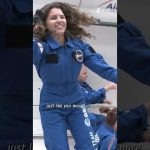
  • Floating in zero gravity… on Earth? 🌍 How is that possible?

    Floating in zero gravity… on Earth? 🌍 How is that possible?

    Air Zero G’s parabolic flights create a weightless environment by flying along a curved path called a parabola. This short period of weightlessness lasts about 22 seconds, during which people and experiments on board the parabolic flight can experience the same weightlessness as astronauts in orbit on the International Space Station.

    The price to pay for this free-floating freedom is two short periods of hypergravity, during which everything weighs almost double for 20 seconds: first when the aircraft pulls up sharply and then again when it pulls out sharply afterwards to return to a normal flight path.

    Each parabola takes about one minute to complete and is repeated 31 times in one flight, providing a total of about ten minutes of zero-gravity.

    The flights provide European scientists with access to a repeatable, low-gravity research environment. Hundreds of experiments have flown over thousands of parabolas, enabling extensive scientific endeavours across many disciplines and resulting in a huge legacy of publications.

    📹 ESA – European Space Agency

    📸 ESA/Novespace

    #ESA #ZeroG #ParabolicFlight

  • Zero gravity Science

    Zero gravity Science

    ESA’s parabolic flight project coordinator Neil Melville explains why 40 researchers working on 12 technologically-advanced experiments are put in an aircraft that flies at maximum thrust in repeated 50° angles at the limits of the Novespace aircraft’s design.

    Parabolic flights offer sessions of 20 seconds of zero gravity giving a total of 10 minutes of weightlessness each flight. The advantage of parabolic flights over other platforms for experimentation in altered gravity is that researchers can join the flight and interact with their experiment – fine tuning hardware, running tests on human subjects or changing parameters on the fly. The experiments are carefully chosen for potential benefits, safety and uniqueness.

    Neil highlights some of the experiments on ESA’s 72nd campaign that covered disciplines as diverse as astronomy, cooling techniques, metallurgy, weather and human physiology.

    The Progra2 experiment is creating clouds of matter and recording how light is scattered by micrometre-sized particles. The carbon-based dust is chosen to resemble the clouds found in our Solar System such as around asteroids and comets. Knowing how light is scattered by these particles in microgravity will help interpret observations made from telescopes and increase our understanding the Universe.

    An experiment from the Université Libre de Bruxelles in Belgium is looking at healing wounds with bio-mimetic materials by submitting them to mechanical stresses typical in weightlessness. The knowledge acquired will pave the way for the development of biophysical models and a have a direct impact on the industrial market of wearable electronics.

    The VIP-GRAN team is looking into how particles behave in reduced gravity to understand the underlying physics in detail. On this flight they investigated the jamming of particles as they flow through small openings. This can be an annoyance on Earth when salt gets stuck in the shaker for example, but the phenomenon is influenced by gravity and the researchers want to know more. This was the ninth flight for the VIP-GRAN team and who are working towards having a version of their experiment fly on the International Space Station with even more weightless time.

    Air Zero-G exterior footage courtesy of Airborne Films and Novespace.

    ★ Subscribe: http://bit.ly/ESAsubscribe and click twice on the bell button to receive our notifications.

    Check out our full video catalog: http://bit.ly/SpaceInVideos
    Follow us on Twitter: http://bit.ly/ESAonTwitter
    On Facebook: http://bit.ly/ESAonFacebook
    On Instagram: http://bit.ly/ESAonInstagram
    On Flickr: http://bit.ly/ESAonFlickr

    We are Europe’s gateway to space. Our mission is to shape the development of Europe’s space capability and ensure that investment in space continues to deliver benefits to the citizens of Europe and the world. Check out http://www.esa.int/ESA to get up to speed on everything space related.

    Copyright information about our videos is available here: http://www.esa.int/spaceinvideos/Terms_and_Conditions

  • ESA’s 71st parabolic flight campaign experiments

    ESA’s 71st parabolic flight campaign experiments

    Engineers, pilots, researchers and scientists convened in Bordeaux, France, for ESA’s 71st parabolic flight campaign. Over the course of three days they flew on a specially-fitted commercial aircraft, testing equipment and running research as the pilots put the plane through repeated parabolas, giving the passengers and their experiments brief bouts of microgravity.

    ESA’s project coordinator Neil Melville introduces the experiments that flew on this campaign, from plasma to granular physics and heat pipes.

    Parabolic flights are one of many platforms ESA offers for European researchers to run experiments for spaceflight. These flights are one of the few that allow the researchers to interact with their own experiments “hands-on” in a weightless environment. Send a proposal through our continuously open research announcements and you could be flying on the next campaign.

    More on ESA’s parabolic flights and research in zero gravity here: http://bit.ly/ESAparabolicFlights

    ★ Subscribe: http://bit.ly/ESAsubscribe and click twice on the bell button to receive our notifications.

    Check out our full video catalog: http://bit.ly/SpaceInVideos
    Follow us on Twitter: http://bit.ly/ESAonTwitter
    On Facebook: http://bit.ly/ESAonFacebook
    On Instagram: http://bit.ly/ESAonInstagram
    On Flickr: http://bit.ly/ESAonFlickr

    We are Europe’s gateway to space. Our mission is to shape the development of Europe’s space capability and ensure that investment in space continues to deliver benefits to the citizens of Europe and the world. Check out http://www.esa.int/ESA to get up to speed on everything space related.

    Copyright information about our videos is available here: http://www.esa.int/spaceinvideos/Terms_and_Conditions

    #ESA
    #ZeroG
    #ParabolicFlight

  • Clubbing in Zero-G

    Clubbing in Zero-G

    On 7 February 2018, 10 years to the day that Europe’s Columbus space laboratory was launched to the International Space Station, 20 lucky clubbers got a taste of weightlessness – not to conduct gravity-free science but to party with superstar DJs Steve Aoki, W&W and Le Shuuk.

    Taking off from Frankfurt airport and organised by BigCityBeats, the WORLD CLUB DOME project served as a teaser party for a bigger event on Earth in June. The aircraft flew up and down angled at 45º – at the top of the curve the passengers and experiments experience around 20 seconds of microgravity. Before and after the weightless period, increased gravity of up to 2 g is part of the ride.

    ESA astronauts Pedro Duque and Jean-Francois Clervoy joined the weightless flight and provided background and safety tips to the DJs and party-goers.

    The aircraft was on loan from its usual airport in Bordeaux, France, where it is used for scientific research and testing equipment for spaceflight. These flights are the only way to test microgravity with humans without going through lengthy astronaut-training and flights to the International Space Station. For this reason, parabolic flights are often used to validate space instruments and train astronauts before spaceflight.

    ESA’s parabolic flight campaigns for science and technology investigations are generally performed twice a year, in spring and autumn.

    ESA, Fraport Frankfurt and the City of Frankfurt and BigCityBeats combined a fascination of science with the joy and fun of dancing in this world’s-first flight.

    More about ESA’s parabolic flights: http://www.esa.int/Our_Activities/Human_Spaceflight/Research/Parabolic_flights

    This event was the official pre-party to the BigCityBeats WORLD CLUB DOME “The Hollywood Edition” taking place 1/2/3 June 2018 in Frankfurt. More info via http://www.worldclubdome.com

    Credit: BigCityBeats/WorldClubDome

  • ‘Zero-G’ science

    ‘Zero-G’ science

    ESA is taking advantage of Novespace’s latest ‘Zero-G’ aircraft to perform a number of experiments in microgravity. Twelve experiments – which include six by professional scientists and six by students as part of ESA’s Fly Your Thesis programme – took to the skies for three series of 31 parabolas off the coast of France. Conditions of microgravity, or weightlessness, are unique for research ranging from fundamental physics, testing Einstein’s weak equivalence principle, to psychology, neuroscience and the deployment of a balloon that may one day make measurements while falling through Mars’ atmosphere.

    More about the Parabolic Flight Campaigns:
    http://www.esa.int/Our_Activities/Human_Spaceflight/Research/Parabolic_flights

  • Paxi joins ESA Education’s Fly Your Thesis! 2016 campaign

    Paxi joins ESA Education’s Fly Your Thesis! 2016 campaign

    Paxi has joined ESA Education’s Fly Your Thesis! 2016 campaign where 4 teams of university students are running their experiments in an environment of microgravity.

    More about Fly Your Thesis!:
    http://www.esa.int/Education/Fly_Your_Thesis

    More about Paxi:
    http://www.esa.int/paxi/

  • ESA Euronews: Flying Zero-G

    ESA Euronews: Flying Zero-G

    If you fly a plane in the right way at the right speed, you can be weightless for a few seconds. By throwing the aircraft into an orbit-like path within Earth’s atmosphere, you can enter the wonderful world of weightlessness.
    It is one of the best ways to simulate the environment of space, and a valuable experimental tool for scientists with a special interest in microgravity. If they want to find out how the brain works, study the natural posture of humans in space, or how water boils in a weightless environment, this is the way to do it.
    Take a journey into a free-floating world of the parabola in this edition of Space.