Missions to Mars have made many exciting discoveries that have transformed our understanding of the planet, but the next step is to bring samples to Earth for detailed analysis in sophisticated laboratories.
Detect, fetch and collect. A seemingly easy task is being tested to find the best strategy to collect samples on the martian surface, some 290 000 million km away from home.
Testing technologies for Mars exploration is part of the daily job of Laura Bielenberg, an ESA graduate trainee for the Mars Sample Return campaign.
The test takes place at the rock-strewn recreation of the Red Planet at ESA’s ESTEC technical centre in Noordwijk, the Netherlands. The nickname of this test site is the ‘Mars Yard’ and is part of the Planetary Robotics Laboratory.
The tube is a replica of the sample caches that NASA’s Perseverance rover is leaving on Mars hermetically sealed with precious martian samples inside. They are called RSTA, an acronym of Returnable Sample Tube Assembly, and to most people on Earth they look like lightsabers. Laura is investigating sample tube collection strategies, from autonomous detection to pose estimation of sample tubes on Mars, with a testbed called the RABBIT (RAS Bread Boarding In-house Testbed).
The Sample Transfer Arm will need to load the tubes from the martian surface for delivery towards Earth. ESA’s robotic arm will collect them from the Perseverance rover, and possibly others dropped by sample recovery helicopters as a backup.
Besides cameras and sensors, the team relies on neural networks to detect the tubes and estimate their pose. Inspired by the way the human brain works, neural networks mimic the way biological neurons signal to one another.
We are Europe’s gateway to space. Our mission is to shape the development of Europe’s space capability and ensure that investment in space continues to deliver benefits to the citizens of Europe and the world. Check out https://www.esa.int/ to get up to speed on everything space related.
The mission to return martian samples back to Earth will see a European 2.5 metre-long robotic arm pick up tubes filled with precious soil from Mars and transfer them to a rocket for an historic interplanetary delivery.
The sophisticated robot, known as the Sample Transfer Arm or STA, will play a crucial role in the success of the Mars Sample Return campaign. The joint endeavour between @NASA and ESA aims to bring back martian samples to the best labs in our planet by 2033.
The robotic arm will land on Mars to retrieve the sample tubes NASA’s Perseverance rover is currently collecting from the surface. Able to “see”, “feel” and take autonomous decisions, the Sample Transfer Arm will identify, pick up and transfer the tubes into the first rocket fired off another planet – the Mars Launch System.
Only after the robot closes the container’s lid, the martian samples will be launched for rendezvous with ESA’s Earth Return Orbiter (ERO) and bring the material back to Earth.
The Sample Transfer Arm is conceived to be autonomous, highly reliable and robust.
Its architecture mimics a human arm with a shoulder, elbow and wrist, and has its own built-in brain and eyes. The robot can perform a large range of movements with seven degrees of freedom.
We are Europe’s gateway to space. Our mission is to shape the development of Europe’s space capability and ensure that investment in space continues to deliver benefits to the citizens of Europe and the world. Check out http://www.esa.int/ESA to get up to speed on everything space related.
This concluding part of ESA’s ‘Analog-1’ project took place as part of a larger multi-agency, multi-rover campaign, organised by the @DLR. The Autonomous Robotic Networks to Help Modern Societies, ARCHES, project probed the ability of autonomous robots to collaborate and share data on a networked basis.
ESA’s four-wheeled, two-armed Interact rover was built by the Agency’s Human Robot Interaction Lab and modified for the rugged slopes of the volcano. This robot formed part of a team consisting of two DLR rovers – Lightweight Rover Units 1 and 2 – along with a fixed ‘lunar’ lander supplying WiFi and power to the rovers, plus a drone for surface mapping. The Karlsruhe Institute of Technology contributed the centipede-like Scout crawler, optimised for tough terrain, which could also serve as a relay between Interact and the lander, boosting its effective area of operations.
We are Europe’s gateway to space. Our mission is to shape the development of Europe’s space capability and ensure that investment in space continues to deliver benefits to the citizens of Europe and the world. Check out https://www.esa.int/ to get up to speed on everything space related.
Wheeled, tracked and walking rovers competed to survey a shadowy analogue of the polar lunar surface for useable resources during the first field test of the ESA-ESRIC Space Resources Challenge. Some 12 teams from across Europe and Canada took part in the field test in the Netherlands, with five winners going on to the next phase of the contest.
The Space Resources Challenge – supported by ESA and the European Space Resources Innovation Centre (ESRIC) in Luxembourg – asked European (and Canadian) researchers and institutions to develop and demonstrate a system of one or more vehicles capable of prospecting resources on the Moon in the near future.
Working inside a former aircraft hangar, the competition organisers spread 200 tons of lava rock across an area equivalent to seven tennis courts, landscaping it into a Moon-like environment, including the main crater of interest. Then they scattered rocks, including a hundred simulated boulders larger than a metre across, whose positions were precisely geo-referenced.
These measurements served as the basis of a map provided to the rover teams. The idea was to give them the equivalent level of local information from satellite imagery, while still leaving smaller-scale surprises. Once complete, the moonscape was kept concealed from the rover groups behind black curtains, so they would see it only through the cameras of their rovers. The 12 teams each made their prospecting attempt one at a time.
The competing rovers had to navigate and map the whole test environment to prospect for useable resources – meaning first of all to track down their location, identify the best and safest passages and then to gather information about the characteristics and the composition of the rocks they located.
Credit: ESA
★ Subscribe: http://bit.ly/ESAsubscribe and click twice on the bell button to receive our notifications.
We are Europe’s gateway to space. Our mission is to shape the development of Europe’s space capability and ensure that investment in space continues to deliver benefits to the citizens of Europe and the world. Check out https://www.esa.int/ to get up to speed on everything space related.
Europe’s Columbus laboratory is a hive of activity in this 360° timelapse as ESA astronaut Matthias Maurer works on an experiment called Fluidics and his @NASA colleague Raja Chari carries out activity in the Veggie plant habitat.
Developed by French space agency @CNES and co-funded by @Airbus, the Fluidics experiment investigates how liquids behave in space. It was first run by ESA astronaut Thomas Pesquet in 2017 during his Proxima mission.
Made up of six small, transparent spheres housed in the black centrifuge seen here, the experiment studies two phenomena. The first is ‘sloshing’ or how liquids move in enclosed spaces. The second is wave turbulence.
Understanding the underlying physics of how liquids move in space will help improve the fuel economy of spacecraft and our knowledge of Earth’s oceans. By observing how surface forces behave in reduced gravity and singling out interactions, scientists aim to improve climate models for forecasting sea states and better understand wave formation on Earth.
Fluidics is just one of many European and international science experiments Matthias is supporting throughout his six-month Cosmic Kiss mission.
We are Europe’s gateway to space. Our mission is to shape the development of Europe’s space capability and ensure that investment in space continues to deliver benefits to the citizens of Europe and the world. Check out https://www.esa.int/ to get up to speed on everything space related.
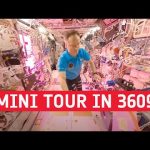
Join ESA astronaut Matthias Maurer on a 360° fly-through of Europe’s Columbus laboratory, @JAXA | 宇宙航空研究開発機構’s Kibo Module and the Crew Dragon capsule on the International Space Station.
Matthias has been living and working on the International Space Station for around 100 days, following the launch of Crew-3 from @NASA’s Kennedy Space Center in Florida on 11 November 2021. He will spend approximately six months in orbit for his Cosmic Kiss mission. Much of this time is being spent inside the Columbus lab supporting European and international science.
Columbus is ESA’s single largest contribution to the International Space Station and was also the first permanent European research facility in space. In this video you can see the different experiment racks in the module as he flies through, including NASA’s Veggie greenhouses omitting a pink light.
We are Europe’s gateway to space. Our mission is to shape the development of Europe’s space capability and ensure that investment in space continues to deliver benefits to the citizens of Europe and the world. Check out https://www.esa.int/ to get up to speed on everything space related.
Tour the Italian-built Permanent Multipurpose Module (PMM) of the International Space Station in 360° with ESA astronaut Matthias Maurer.
Attached to Node 3, PMM is a large, reusable, pressurised element that was originally used to ferry cargo to and from the Station. It can hold up to 16 racks of equipment, experiments and supplies and has an end-cone with additional storage space for cargo bags, trash and other items.
The only thing PMM has no room for is a fear of enclosed spaces. Watch as Matthias maneuvers between the boxes and bags in this vital module in orbit.
Matthias is currently living and working aboard the International Space Station for his first mission, Cosmic Kiss. Find out more about Matthias and his ESA mission on the Cosmic Kiss mission webpage.
We are Europe’s gateway to space. Our mission is to shape the development of Europe’s space capability and ensure that investment in space continues to deliver benefits to the citizens of Europe and the world. Check out https://www.esa.int/ to get up to speed on everything space related.
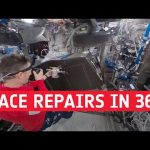
Scientist, engineer, test subject and tradesperson – astronauts in orbit wear many different hats. In this 360° timelapse, ESA astronaut Matthias Maurer works to repair a faulty valve behind EXPRESS-Rack 3.
Water On-Off Valve 8 (WOOV-8), along with WOOV-6 and WOOV-7, determines whether the cooling water of Europe’s Columbus module flows through, or bypasses, the heat exchange system that transfers waste heat to downstream cooling circuits outside the International Space Station. The valve has been a problem child for ground teams and astronauts for the past few years and was first replaced during a complicated operation in 2013.
It was last replaced by ESA astronaut Thomas Pesquet in October 2021, but continued issues led Matthias to try out a reserve valve to see if an unplanned conversion was possible. The operation was successfully completed on the real WOOV-8 in December 2021, and all involved breathed a sigh of relief.
Performing maintenance and repair tasks in weightlessness is especially difficult as astronauts have the added challenge of trying to hold themselves in position while turning a screw or securing a hatch. Watch Matthias carefully fold down the rack, set-up lighting and complete the task as you explore his workspace in 360°.
Matthias was launched to the International Space Station for his Cosmic Kiss mission on 11 November 2021. He will spend approximately six months living and working in orbit, supporting over 35 European and many more international experiments on board.
We are Europe’s gateway to space. Our mission is to shape the development of Europe’s space capability and ensure that investment in space continues to deliver benefits to the citizens of Europe and the world. Check out https://www.esa.int/ to get up to speed on everything space related.
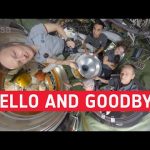
Spaceflight participants Yusaku Maezawa and Yozo Hirano and Russian cosmonaut Alexander Misurkin were welcomed to the International Space Station on 8 December 2021 for a 12 day stay in space. Experience their arrival and farewell in 360° as captured by ESA astronaut Matthias Maurer from within the Russian segment.
Also seen in this video are Expedition 66 Commander Anton Shkaplerov, @Roscosmos Mediacosmonaut Pyotr Dubrov and @NASA astronauts Mark Vande Hei, Raja Chari, Tom Marshburn, and Kayla Barron.
Matthias was launched to the International Space Station for his six-month ESA mission known as Cosmic Kiss on 11 November 2021. During his time on board, he will support around 35 European and many more international experiments in orbit.
We are Europe’s gateway to space. Our mission is to shape the development of Europe’s space capability and ensure that investment in space continues to deliver benefits to the citizens of Europe and the world. Check out https://www.esa.int/ to get up to speed on everything space related.
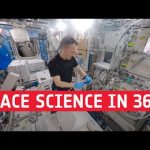
Immerse yourself in 360° of science with ESA astronaut Matthias Maurer as he prepares an experiment to examine how human cells behave in weightlessness.
The Cytoskeleton experiment is a biological study that aims to determine the changing function of RhoGTPases when in vitro cell cultures are exposed to weightlessness. It will run in the Biolab facility of Europe’s Columbus laboratory.
In this video, we see Matthias remove Cytoskeleton cell cultures from the Minus Eighty Lab Freezer ISS (MELFI) and prepare them in the Life Sciences Glovebox (LSG) before installing the experiment in Columbus’s BioLab.
Matthias was launched to the International Space Station for his current Cosmic Kiss mission on 11 November 2021. In his approximately six months on board, he will support over 35 European experiments and many more international experiments in orbit.
We are Europe’s gateway to space. Our mission is to shape the development of Europe’s space capability and ensure that investment in space continues to deliver benefits to the citizens of Europe and the world. Check out https://www.esa.int/ to get up to speed on everything space related.
Join ESA astronaut Matthias Maurer inside Kibo, the Japanese laboratory module of the International Space Station in 360°, setting up Astrobee robotic free-flyers for the ReSWARM experiment. Short for RElative Satellite sWArming and Robotic Maneuvering, this robotics demonstration tests autonomous microgravity motion planning and control for on-orbit assembly and coordinated motion.
This investigation aims to test coordination between multiple robots, robots and cargo, and robots and their operating environment as developers envision the future of autonomous robot operations in space.
Matthias was launched to the International Space Station on Crew Dragon Endurance as part of Crew-3 at 02:03 GMT/03:03 CET Thursday 11 November 2021. His ESA mission on board is known as Cosmic Kiss and will see him live and work for approximately six months in orbit.
We are Europe’s gateway to space. Our mission is to shape the development of Europe’s space capability and ensure that investment in space continues to deliver benefits to the citizens of Europe and the world. Check out https://www.esa.int/ to get up to speed on everything space related.
Europe’s Rosalind Franklin ExoMars rover has a younger ’sibling’, ExoMy. The blueprints and software for this mini-version of the full-size Mars explorer are available for free so that anyone can 3D print, assemble and program their own ExoMy.
Learn more at www.esa.int/exomy
★ Subscribe: http://bit.ly/ESAsubscribe and click twice on the bell button to receive our notifications.
We are Europe’s gateway to space. Our mission is to shape the development of Europe’s space capability and ensure that investment in space continues to deliver benefits to the citizens of Europe and the world. Check out https://www.esa.int/ to get up to speed on everything space related.
Will robots replace humans one day? When it comes to space exploration, robots are our precursors, gathering data to prepare humans for deep space. ESA robotics engineer Martin Azkarate discusses some of the upcoming missions involving robots and the unique science they will perform in this episode of Meet the Experts.
We are Europe’s gateway to space. Our mission is to shape the development of Europe’s space capability and ensure that investment in space continues to deliver benefits to the citizens of Europe and the world. Check out http://www.esa.int/ESA to get up to speed on everything space related.
ESA astronaut Luca Parmitano tested new functionality for the astronaut aid Cimon relating to mood detection and enjoyed a few favourite songs on the first weekend of February 2020, his last weekend in space for the Beyond mission on the International Space Station.
Short for Crew Interactive Mobile CompanioN, Cimon is a 3D-printed plastic sphere designed to test human-machine interaction in space. It was developed and built by Airbus in Friedrichshafen and Bremen, Germany, on behalf of German aerospace centre DLR and uses artificial intelligence software by IBM Watson. Ludwig Maximilians University Clinic in Munich (LMU) is in charge of the project’s scientific aspects. Cimon was first used by ESA astronaut Alexander Gerst during his 2018 Horizons.
Cimon weighs around 5 kg on Earth and has a display screen at its centre. Its main aim is to support and increase astronaut efficiency by displaying and explaining information needed to carry out scientific experiments and repairs.
Other applications include mobile photography and videography and the ability to document experiments, search for objects and maintain an inventory. Cimon can also see, hear and understand what it observes and is equipped with an autonomous navigation system, allowing astronauts to issue voice commands like you would to virtual assistants like Alexa, Siri or Cortana on the ground.
Circling our planet at 28 800 km/h the International Space Station offers space for six astronauts to conduct experiments for researchers all over the world in weightlessness as well as test and demonstrate techniques needed to further explore our Solar System.
Europe’s laboratory Columbus was launched over 10 years ago and more than 200 experiments have been done inside. Columbus houses as many disciplines as possible in a small volume, from astrobiology to solar science through metallurgy and psychology. Countless papers have been published drawing conclusions from experiments performed in Columbus, and Cimon is another example of the research conducted in space.
We are Europe’s gateway to space. Our mission is to shape the development of Europe’s space capability and ensure that investment in space continues to deliver benefits to the citizens of Europe and the world. Check out http://www.esa.int/ESA to get up to speed on everything space related.
Description
Cartoon channel with modern educational and Islamic content delivered while having lot of fun. To keep the soul of child nourished with Islamic knowledge along with enhancing their brain development and knowledge. Our primary focus is to inculcate following values from glorious Quran:
1. Don’t lie (22:30)
2. Don’t waste (17:26)
3. Don’t insult (49:11)
4. Feed the poor (22:36)
5. Don’t backbite (49:12)
6. Restrain your anger (3:134)
7. Think good of others (24:12)
8. Be good to guests (51:24-27)
9. Don’t be rude to your parents (17:23)
10. Don’t make fun of others (49:11)
video is for educational purpose only.Copyright Disclaimer Under Section 107 of the Copyright Act 1976, allowance is made for “fair use” for purposes such as criticism, comment, news reporting, teaching, scholarship, and research. Fair use is a use permitted by copyright statute that might otherwise be infringing. Non-profit, educational or personal use tips the balance in favor of fair use.
the tonight show jimmy fallon tonight showbotics snakebot sophia emotion butterflies nbc nbc tv television funny talk show comedic humor snl fallon stand-up fallon monologue tonight show jokes funny video interview variety comedy sketches talent celebrities video clip highlight robot bot tech technology lol girl lady fembot fem snake butterfly fly
Open your child’s world to millions of possibilities by bridging play and learning. Miko 2 is all about giving your child a fun, exciting platform to help them grow, whether their next step is kindergarten or middle school. Now available at Miko.ai with Free US shipping!
A Personal, At-Home Teacher For Playful Learning
From academic topics to child-friendly news bulletins, fun facts and more, Miko 2 is packed with relevant and freshly updated content specially designed by educationists and child-specialists. Your little one won’t even realize they’re learning.
Entertainment that Lasts For Hours
Miko can sing, dance, play games, narrate stories, share jokes and run fun quizzes. Your child won’t even know that while they’re laughing, they’re learning!
Personality That Adapts To Your Child
Advanced facial and voice recognition technology allow Miko 2 to understand and react to your child’s moods. Improving over time, Miko 2 learns who your child is and what matters to them.
See & Speak Through Miko 2
Away from your child? Use the camera and chat features to engage with your child remotely with completely encrypted control.
Healthy Technology Experience
Miko 2 is a healthy alternative to traditional screen time exposure. Curated content and parental controls give your child all the benefits—and you all of the control.
Complete Parental Control
Get insights and analytics on your child’s interests. Easily limit playtime and even control conversation topics—all from your smartphone.
Private, Secure & Safe
End-to-end data encryption ensures your child and your privacy are safe. No personal information is shared or stored.
Astronauts on the Moon found themselves hopping around, rather than simply walking. Switzerland’s SpaceBok planetary exploration robot has followed their example, launching all four legs off the ground during tests at our technical heart.
SpaceBokis a quadruped robot designed and built by a Swiss student team from ETH Zurich and ZHAW Zurich, currently being tested using Automation and Robotics Laboratories (ARL) facilities at our technical centre in the Netherlands. The robot is being used to investigate the potential of ‘dynamic walking’ and jumping to get around in low gravity environments.
SpaceBok could potentially go up to 2 m high in lunar gravity, although such a height poses new challenges. Once it comes off the ground the legged robot needs to stabilise itself to come down again safely – like a mini-spacecraft.So, like a spacecraft. SpaceBok uses a reaction wheel to control its orientation
We are Europe’s gateway to space. Our mission is to shape the development of Europe’s space capability and ensure that investment in space continues to deliver benefits to the citizens of Europe and the world. Check out http://www.esa.int/ESA to get up to speed on everything space related.
Overview of the Heracles mission. We are leading an alliance of international space agencies to prepare a robotic mission to the Moon to retrieve samples and return them to Earth.
The video shows a launch on an Ariane 6 rocket, separation from the rocket boosters over Earth and a transfer to the Moon.
The Heracles lander will target a previously unexplored region near the lunar South Pole as an interesting area for researchers. A lander with a rover inside and ascent module on top will land there.
Monitored and controlled from the lunar Gateway, the rover will scout the terrain in preparation for the future arrival of astronauts, and collect samples.
The ascent module will take off from the surface and fly to the Gateway with the samples taken by the rover.
When the ascent module carrying the sample container arrives, the Gateway’s robotic arm will capture it and extract the sample container. The sample container will be received by the astronauts via a science airlock and pack it in NASA’s Orion spacecraft that is powered by the European Service Module.
Orion will fly to Earth with astronauts and land with the Heracles lunar samples for analysis in the best laboratories on Earth.
Other goals of the mission include testing new hardware, demonstrating technology and gaining experience in operations while strengthening international partnerships in exploration. Its development will provide an Ariane 64-based lunar cargo lander available for commercialisation by European and partners’ industry.
Heracles is an international programme to use the Gateway to the fullest and deliver samples to scientists on Earth using new technology that is more capable and lighter than previous missions.
Credits: ESA – Ducros – ATG/medialab
★ Subscribe: http://bit.ly/ESAsubscribe and click twice on the bell button to receive our notifications.
We are Europe’s gateway to space. Our mission is to shape the development of Europe’s space capability and ensure that investment in space continues to deliver benefits to the citizens of Europe and the world. Check out http://www.esa.int/ESA to get up to speed on everything space related.
Handle is a mobile manipulation robot designed for logistics. Handle autonomously performs mixed SKU pallet building and depalletizing after initialization and localizing against the pallets. The on-board vision system on Handle tracks the marked pallets for navigation and finds individual boxes for grasping and placing.
When Handle places a boxes onto a pallet, it uses force control to nestle each box up against its neighbors. The boxes used in the video weigh about 5 Kg (11 lbs), but the robot is designed to handle boxes up to (15 Kg) (33 lb). This version of Handle works with pallets that are 1.2 m deep and 1.7 m tall (48 inches deep and 68 inches tall).
The second part of the ExoMars programme is ongoing.
In Stevenage, UK, a rover is being built that will carry a drill and a suite of instruments dedicated to exobiology and geochemistry research. It will be the first mission to combine the capability to move across the surface and to study Mars at depth.
The primary goal of the ExoMars programme is to address the question of whether life has ever existed on the red planet.
The first part of the programme was launched in March 2016 with the Trace Gas Orbiter. The second part is planned for launch in 2020 and comprises the rover and surface science platform
ExoMars is a joint endeavour between ESA and the Russian space agency, Roscosmos.
★ Subscribe: http://bit.ly/ESAsubscribe and click twice on the bell button to receive our notifications.
ESA is Europe’s gateway to space. Our mission is to shape the development of Europe’s space capability and ensure that investment in space continues to deliver benefits to the citizens of Europe and the world. Check out http://www.esa.int/ESA to get up to speed on everything space related.
Basic Introduction to robots video for kids. Learn With Lily! Subscribe, comment and like!
Today we learn about artificial intelligence and robots for kids.
Robots and AI
– What does artificial mean?
– What is intelligence?
– What is artificial intelligence?
– What is A.I.?
– Review of the Vector Home Robot by Anki
educational videos for preschoolers. educational videos for toddlers
#baby #children #babies #toddlers #preschool #babyvideos #kids #teach #learn #boostIQ
Sony’s puppy-sized robot dog aibo, equipped with cameras, artificial intelligence and internet capability, can now remotely check up on family members, children or even pets, the Japanese electronics giant says.
ESA astronaut Alexander Gerst welcomed a new face to the Columbus laboratory, thanks to the successful commissioning of technology demonstration Cimon. Short for Crew Interactive Mobile CompanioN, Cimon is a 3D-printed plastic sphere designed to test human-machine interaction in space.
Developed and built by Airbus in Friedrichshafen and Bremen, Germany, on behalf of German Space Agency DLR, Cimon uses artificial intelligence software by IBM Watson. Its scientific aspects are overseen by researchers at Ludwig Maximilians University Clinic in Munich.
This video shows Alexander’s first interactions with Cimon on board the International Space Station. After introducing himself, where he comes from and what he can do, Cimon tests his free-flying abilities, helps Alexander with a procedure and even plays Alexander’s favourite song ‘Man Machine’ by Kraftwerk. In fact, Cimon likes the music so much, he does not want to stop.
Happy with his initial outing, both Cimon’s developers and Alexander hope to see Cimon back in action again soon. While no further sessions are planned during the Horizons mission at this stage, it could mark the beginning of exciting collaboration between astronauts, robotic assistants and possible future artificial intelligence in space.
ESA is Europe’s gateway to space. Our mission is to shape the development of Europe’s space capability and ensure that investment in space continues to deliver benefits to the citizens of Europe and the world. Check out http://www.esa.int/ESA to get up to speed on everything space related.
SpaceX Dragon carried an Artificial Intelligence (AI) robot named CIMON to the ISS. CIMON stands for ‘Crew Interactive Mobile Companion’ and is the first-ever AI space robot. Watch BusinessToday.In’s video to know more about CIMON, built by Airbus and how he assists astronauts in relieving their stress.
———————-
About the Channel: Watch Business Today videos to get the latest news on Business, stock market, sensex – BSE India, NSE India, personal finance, gold prices, petrol prices and more. Also, get an insight into the dealings of the top companies in India from Business Today’s award-winning journalists. Get up to date with all investment options (Mutual Funds, SIPs, Debt, Equity, Insurance, Home Loans, Pension Schemes, Retirement Plans) from our Money Today team. Also, watch interviews of top CEOs.
Regular shows to watch out:
The Good The Bad and The Ugly with BusinessToday.in Editor Rajeev Dubey to know the top stories of the day specially curated from the world of business and economy.
Watch Inside India’s Factories to find out how different products get manufactured and processed for final consumption.
Spacecraft in orbit and on Mars’s surface have made many exciting discoveries, transforming our understanding of the planet and unveiling clues to the formation of our Solar System, as well as helping us understand our home planet. The next step is to bring samples to Earth for detailed analysis in sophisticated laboratories where results can be verified independently and samples can be reanalysed as laboratory techniques continue to improve.
Bringing Mars to Earth is no simple undertaking—it would require at least three missions from Earth and one never-been-done-before rocket launch from Mars.
A first mission, NASA’s 2020 Mars Rover, is set to collect surface samples in pen-sized canisters as it explores the Red Planet. Up to 31 canisters will be filled and readied for a later pickup – geocaching gone interplanetary.
In the same period, ESA’s ExoMars rover, which is also set to land on Mars in 2021, will be drilling up to two meters below the surface to search for evidence of life.
A second mission with a small fetch rover would land nearby and retrieve the samples in a Martian search-and-rescue operation. This rover would bring the samples back to its lander and place them in a Mars Ascent Vehicle – a small rocket to launch the football-sized container into Mars orbit.
A third launch from Earth would provide a spacecraft sent to orbit Mars and rendezvous with the sample containers. Once the samples are safely collected and loaded into an Earth entry vehicle, the spacecraft would return to Earth, release the vehicle to land in the United States, where the samples will be retrieved and placed in quarantine for detailed analysis by a team of international scientists.
——————————————————————————————————
Join Amazon Prime For Amazing Offers(Free 30 Days Trial) : http://amzn.to/2HjTpKM
——————————————————————————————————-
Some Cheap & Cool Doll Girls & Toys You Can Buy On Amazon – Here all links are Affiliate links:
—————————————————————————————-
—————————————————————————————-
1. Eileen MK MysticKids Doll Girl BJD Doll 1/3 58CM BJD Doll Dollfie / 100% Custom-made / Free Make-up + Free Gifts
What can Meccano M.A.X. do once you build this interactive robot? Watch how you can use this hands-on STEM toy as a DJ to mix music, play Are You Smarter Than a Robot and more!
*This video is sponsored by Spin Master*
Produced in association with Arm, this short and thoughtful film looks at the role robots powered by Artificial Intelligence (AI) may be set to play in our lives: from becoming our friends and keeping us company; to helping children with autism communicate; or assisting a rapidly ageing population. Jem Davies, Fellow and General Manager for Machine Learning at Arm, joins other experts from industry and academia to offer their perspective on the future possibilities for companion robots and AI.
Written and directed by: Colin Ramsay and James Uren
Producer: Colin Ramsay
Executive Producer: Beth Singler
A Little Dragon Films production
Co-funded by the Faraday Institute for Science and Religion
What makes a brain or machine conscious? Will robots become more conscious than we are? One theory, which can actually calculate consciousness, is beginning to provide some answers.
Subscribe: http://youtube.com/whatthephysics?sub_confirmation=1
↓Want more info?↓
From the internationally renowned maker of robotics building sets arises a new model of impressive proportions. Unlike anything else Meccano has created, M.A.X. combines Artificial Intelligence (AI) with customizable programming. The result is a one-of-a-kind robot of your own creation! Budding engineers, innovators and creators can expand their knowledge of programming as they personalize this robot to their specifications. Once built, M.A.X measures 12” in tall. Control it using voice commands, buttons on the MeccaBrain, or the free app! You’ll know exactly what its thinking based on its expressive facial graphics. As a S.T.E.M robotics platform, M.A.X is designed to engage kids in intellectually stimulating play, drawing on their knowledge of science, technology, engineering and math. Not just a learning tool, this robot loves fun! Try playing on M.A.X’s built-in gaming platform; test your knowledge in a trivia game or listen to some funny jokes! With a multitude of features, kids will want to bring their new friend everywhere! This robot comes with built-in infrared sensors, enabling it to move with agility and avoid obstacles in its path. If you know a young mind in need of a challenge, introduce them to their new friend, M.A.X!
4-year old Sophia talks and plays with Buddy’s Flashcards (MyBuddy.ai) to learn numbers and discover animals. English is Sophia’s second language, and Buddy helps her to learn new words and improve her pronunciation. She picks it up right away.
Sign up at MyBuddy.ai to be notified when the App will be available on the App Store.
Subscribe now for more! http://bit.ly/1NbomQa
Piers, Susanna, and Kate talk to Sophia, a sophisticated humanoid robot.
Broadcast on 21/06/17
Like, follow and subscribe to Good Morning Britain!
The Good Morning Britain YouTube channel delivers you the news that you’re waking up to in the morning. From exclusive interviews with some of the biggest names in politics and showbiz to heartwarming human interest stories and unmissable watch again moments.
Join Susanna Reid, Piers Morgan, Ben Shephard, Kate Garraway, Charlotte Hawkins and Sean Fletcher every weekday on ITV from 6am.
This video is part of “Escaping from Children’s Abuse of Social Robots,” by Dražen Brščić, Hiroyuki Kidokoro, Yoshitaka Suehiro, and Takayuki Kanda from ATR Intelligent Robotics and Communication Laboratories and Osaka University, and “Why Do Children Abuse Robots?”, by Tatsuya Nomura, Takayuki Uratani, Kazutaka Matsumoto, Takayuki Kanda, Hiroyoshi Kidokoro, Yoshitaka Suehiro, and Sachie Yamada from Ryukoku University, ATR Intelligent Robotics and Communication Laboratories, and Tokai University, presented at the 2015 ACM/IEEE International Conference on Human-Robot Interaction. Learn more: http://spectrum.ieee.org/automaton/robotics/artificial-intelligence/children-beating-up-robot
The Tonight Show Starring Jimmy Fallon features hilarious highlights from the show including: comedy sketches, music parodies, celebrity interviews, ridiculous games, and, of course, Jimmy’s Thank You Notes and hashtags! You’ll also find behind the scenes videos and other great web exclusives.
There are plenty of cool robots and robotics gadgets or toy robots that kids will absolutely love. Robot toys are best tech toys that will keep your kids entertained and maybe even spark their interest in robotics.We have created a shortlist of the top five robot toys for kids. 5 Best Robots for Kids : Games, Fun and Learning
*********************************************
Welcome to ZedIOptimA
* Thanks for Watching If You Like my Content Please please
* Subscribe my channel :- https://goo.gl/CG0awN
* Hit Like
* Comment for encourage us
* Favorite in your list
* Share with your friends and family
—————————————-———————























![Artificial Intelligence News – Toddler Robots Help Solve How Children Learn☑️[Computer and Math]](https://video.kidibot.ro/wp-content/uploads/2019/12/923/artificial-intelligence-news-toddler-robots-help-solve-how-children-learnefb88fcomputer-and-math-150x150.jpg)