ESA Director General Josef Aschbacher shares the outcome of the ESA Council extraordinary meeting in this virtual Q&A with journalists. Additional updates are provided on ESA’s main programmes, the overall rollout of Agenda 2025 on the way to the ESA Ministerial Meeting in November 2022 as well as further implications of the current geopolitical situation on ESA’s activities.
We are Europe’s gateway to space. Our mission is to shape the development of Europe’s space capability and ensure that investment in space continues to deliver benefits to the citizens of Europe and the world. Check out https://www.esa.int/ to get up to speed on everything space related.
The ExoMars team have performed important parachute drop tests as crucial preparation for a safe touchdown on Mars in 2023. The European Rosalind Franklin rover will search for signs of past life beneath the surface of Mars with its unique two metre drill and onboard laboratory. The Russian surface science platform Kazachok will study the environment at the landing site. Landing on Mars is always a challenging endeavour and all possible parameters are taken into account.
We are Europe’s gateway to space. Our mission is to shape the development of Europe’s space capability and ensure that investment in space continues to deliver benefits to the citizens of Europe and the world. Check out https://www.esa.int/ to get up to speed on everything space related.
Monday 2 November, 2020 marks 20 years since the first crew took up residence on the International Space Station. Since then, 240 people including 18 ESA astronauts have lived and worked on the orbital outpost, carrying out essential research to benefit life on Earth.
In this clip, ESA astronauts Luca Parmitano, Alexander Gerst, Thomas Pesquet, Tim Peake, Andreas Mogensen, André Kuipers, Christer Fuglesang, Frank De Winne and Reinhold Ewald pay tribute to the Station. ESA Director General Jan Wörner and NASA Administrator Jim Bridenstine also speak about the Station’s significance for space exploration and international collaboration.
The next ESA mission to the International Space Station is set for 2021, when Thomas Pesquet will become the first European to fly on a SpaceX Crew Dragon spacecraft for his Alpha mission.
★ Subscribe: http://bit.ly/ESAsubscribe and click twice on the bell button to receive our notifications.
We are Europe’s gateway to space. Our mission is to shape the development of Europe’s space capability and ensure that investment in space continues to deliver benefits to the citizens of Europe and the world. Check out https://www.esa.int/ to get up to speed on everything space related.
ESA astronaut Luca Parmitano and NASA astronaut Drew Morgan take you on a unique tour of the International Space Station shot in one take with two cameras strapped together. Luca and Drew take it in turns to guide you through the modules and spacecraft docked to the orbital outpost.
Starting from the Soyuz MS-15 spacecraft that bought Drew to the Space Station, the duo show each module and spacecraft docked with the International Space Station at the time it was recorded around the New Year 2020. Passing colleagues include NASA astronaut Jessica Meir and Christina Koch exercising and Russian cosmonauts Alexander Skvortsov and Oleg Skripochka.
This is the first tour of the International Space Station with two astronauts presenting and the first done in a single take.
At the time of recording three supply vehicles were docked, the Russian Progress MS-13, Space-X’s Dragon-19 and Northrup Grumman’s Cygnus-12, as well as two astronaut vehicles the Soyuz MS-15 and Soyuz MS-13.
The map overlay graphic erroneously shows the future Nauka module instead of Pirs. The Russian Multipurpose Laboratory Module Nauka is planned for launch in the future and will replace Pirs, but we put it on the map already.
Skip to specific modules or features such as the toilets using the timestamps below:
00:00:06 Soyuz MS-15
00:04:53 Zvezda service module
00:08:01 Pirs
00:09:27 Mini Research Module-2 (MRM-2)
00:10:30 Soyuz MS-13
00:11:44 MRM-2
00:12:27 Progress
00:13:19 Functional Cargo Block (FGB)
00:07:12 Mini Research Module-1 (MRM-1)
00:19:36 Pressurised Mating Adapter
00:20:42 Node-1 Unity
00:22:46 Northrup Grumman Cygnus-12
00:27:32 Quest Airlock
00:29:27 Node-3 Tranquility
00:30:58 T2 Treadmill
00:31:17 Toilet
00:33:38 Cupola at night
00:34:11 Permanent Multipurpose Module Leonardo (PMM)
00:36:42 US laboratory Destiny
00:37:45 Robotics station for Canadarm2
00:38:40 Exercise bike
00:42:21 Node-2 Harmony
00:44:40 Space X Dragon
00:46:35 European laboratory Columbus
00:49:53 Japanese laboratory Kibo
00:56:17 Space Station fly through
01:00:43 Cupola daytime
01:04:27 Goodbye from Cupola
★ Subscribe: http://bit.ly/ESAsubscribe and click twice on the bell button to receive our notifications.
We are Europe’s gateway to space. Our mission is to shape the development of Europe’s space capability and ensure that investment in space continues to deliver benefits to the citizens of Europe and the world. Check out http://www.esa.int/ESA to get up to speed on everything space related.
ExoMars 2020 has passed a number of milestones. The European carrier module was delivered in March. The European rover, which contains nine instruments, has been assembled by Airbus UK and is under environmental testing in Toulouse. It should be integrated with the spacecraft by the end of the year. The spacecraft is now in the Thales Alenia Space test facilities in Cannes to start the environmental and performance verification test campaign that will last until February 2020.
However, there remain some important challenges ahead for the parachute system of the descent module. Recent balloon high-altitude drop tests were unsuccessful. As a result, the next and final two drop tests, scheduled between January and March 2020, must be fully successful otherwise the mission cannot launch in 2020.
The joint ESA and Russian mission consists of four elements: a carrier module to propel the spacecraft to Mars, a descent module, a surface science platform and the Rosalind Franklin rover, which will use its drill up to depths of two meters to search for signs of life.
We are Europe’s gateway to space. Our mission is to shape the development of Europe’s space capability and ensure that investment in space continues to deliver benefits to the citizens of Europe and the world. Check out http://www.esa.int/ESA to get up to speed on everything space related.
The ExoMars mission foresees Rosalind Franklin the rover and its surface platform Kazachok landing on the Red Planet in 2021. The rover will move across many types of terrain, collect samples with a 2 m-long drill and analyse them with instruments in its onboard laboratory.
This episode about ExoMars shows the integration of the locomotion system and the science payload to the rover in a specially designed, fit-for-purpose cleanroom at Airbus Defence and Space in Stevenage, United Kingdom.
Mars is a primary target in the search for evidence of extraterrestrial life, past or present. There are stringent planetary protection requirements in place to make sure that ExoMars does not introduce terrestrial biological contamination to the Red Planet. ESA ensures planetary protection according to the legal obligations of the United Nations Outer Space Treaty.
Microbiological contamination is strictly controlled during the assembly of the rover. The cleanroom is amongst the cleanest places on Earth, cleaner than a standard hospital operating theatre thanks to filtered air, application of rigorous cleanliness procedures and workers who remain fully shrouded within ‘bunny suits’.
The rover spent 18 months at Stevenage before departing for Airbus Toulouse, France at the end of August, for four months of environmental testing to confirm it is ready for the conditions on Mars.
More information on ExoMars: http://www.esa.int/exomars
Credits: ESA, Airbus Defence and Space UK, ESA/DLR/FU Berlin (CC BY-SA 3.0 IGO)
★ Subscribe: http://bit.ly/ESAsubscribe and click twice on the bell button to receive our notifications.
We are Europe’s gateway to space. Our mission is to shape the development of Europe’s space capability and ensure that investment in space continues to deliver benefits to the citizens of Europe and the world. Check out http://www.esa.int/ESA to get up to speed on everything space related.
The ExoMars mission will see Rosalind Franklin the rover and its surface platform Kazachok land on the Red Planet in 2021. From fine-grained soil to large boulders and slopes, the rover has to be able to move across many types of terrain, collect samples with a 2 m-long drill and analyse them with instruments in its onboard laboratory.
This second episode about ExoMars features the challenges of leaving the surface platform, overcoming obstacles and walking on dunes.
ESA, Roscosmos, Thales, Airbus and RUAG engineers put a full-sized model through a series of tests to fine-tune how the rover will move from its landing platform onto the martian terrain.
Rovers on Mars have previously been caught in sand, and turning the wheels dug them deeper – just like a car stuck in mud or snow. To avoid this, Rosalind the rover has a unique locomotion mode called ‘wheel walking’.
We are Europe’s gateway to space. Our mission is to shape the development of Europe’s space capability and ensure that investment in space continues to deliver benefits to the citizens of Europe and the world. Check out http://www.esa.int/ESA to get up to speed on everything space related.
In the first episode of our ‘Fit for space’ training series, ESA astronauts Samantha Cristoforetti and Luca Parmitano share how crewmembers prepare for their journey to the International Space Station in the Russian Soyuz spacecraft.
Training for the critical moments of Soyuz spaceflight – launch, ascent, docking and landing – take place at Roscosmos’ Gagarin Cosmonaut Training Centre (GCTC) in Star City, Russia. Here, astronauts use sophisticated Soyuz simulators to practice procedures and respond to emergency situations.
The Soyuz simulators at GCTC are designed to act and be operated in exactly the same way as the spacecraft itself. Astronauts must demonstrate their proficiency in manually controlling the Soyuz to prepare for the unlikely event that automated and ground-based operations fail.
They also prepare for emergency events that could occur onboard the International Space Station itself.
★ Subscribe: http://bit.ly/ESAsubscribe and click twice on the bell button to receive our notifications.
We are Europe’s gateway to space. Our mission is to shape the development of Europe’s space capability and ensure that investment in space continues to deliver benefits to the citizens of Europe and the world. Check out http://www.esa.int/ESA to get up to speed on everything space related.
The ExoMars rover’s Analytical Laboratory Drawer (ALD) was integrated into the rover at Airbus, Stevenage, UK in May 2019. The video is shown at 18 times real speed; in reality the sequence of events took around 11.5 minutes.
The ExoMars rover, named Rosalind Franklin, will be the first of its kind to both roam the Mars surface and to study it at depth. Rosalind Franklin will drill down to two metres into the surface to sample the soil, analyse its composition and search for evidence of past – and perhaps even present – life hidden underground. A miniature laboratory inside the rover – the ALD – will analyse the samples with three different instruments, with some baked in the onboard oven to release gases for analysis, a technique used to search for traces of organic compounds.
The rover will relay its data back to Earth via the ExoMars Trace Gas Orbiter, which is already conducting its science mission from Mars orbit.
The ExoMars programme is a joint endeavour between ESA and Roscosmos.
We are Europe’s gateway to space. Our mission is to shape the development of Europe’s space capability and ensure that investment in space continues to deliver benefits to the citizens of Europe and the world. Check out http://www.esa.int/ESA to get up to speed on everything space related.
50 years after the first human landed on the Moon, what is next? The exploration of our Moon is a global endeavour with Europeans and commercial actors playing a large role. The European Space Agency has developed an exploration programme based on four main missions.
Luna Resurs is a partnership with the Russian agency Roscosmos that will carry European technology to land precisely and safely on the Moon (PILOT) and to extract and analyse samples of the lunar terrain (PROSPECT).
Orion and the European Service Module will return humans to the Moon and take advantage of the new technology for human space transportation. Orion, the NASA spacecraft, will bring humans farther than they have never been before. ESA is providing the service modules that will provide propulsion, life support, power, air and water, and control the temperature in the crew module.
ISRU aims to extract and process resources on the Moon into useful products and services: “In-situ resource utilisation”. A mission to explore lunar resources could be a reality from 2025. The goal is to produce drinkable water or breathable oxygen on the Moon.
The Heracles mission could take of in 2028 to allow us to gain knowledge on human-robotic interaction while landing a spacecraft on the Moon, collecting samples with a rover operated from the lunar Gateway and send samples back to Earth.
ESA is Europe’s gateway to space. Our mission is to shape the development of Europe’s space capability and ensure that investment in space continues to deliver benefits to the citizens of Europe and the world. Check out http://www.esa.int/ESA to get up to speed on everything space related.
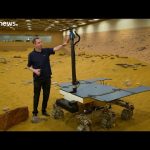
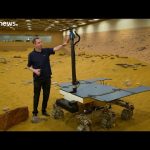
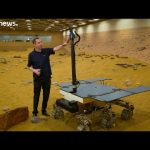
ExoMars is the first mission to head to the Red Planet to seek signs of life, now or in the past. It’s a massive scientific and technical challenge, and Euronews meets some of the team involved in this joint ESA-Roscosmos project in this month’s edition of Space.
ESA is Europe’s gateway to space. Our mission is to shape the development of Europe’s space capability and ensure that investment in space continues to deliver benefits to the citizens of Europe and the world. Check out http://www.esa.int/ESA to get up to speed on everything space related.
Bei der ExoMars-Mission, die nach Leben auf dem roten Planeten sucht, wächst die Spannung: Denn bereits der erste Satellit dieses europäisch-russischen Projekts entdeckte viel mehr Wassereis knapp unter der Marsoberfläche, als irgendjemand erwartet hatte. Jetzt arbeiten die Ingenieure fieberhaft daran, den Rover rechtzeitig zum Start im Jahr 2020 fertigzustellen.
ESA is Europe’s gateway to space. Our mission is to shape the development of Europe’s space capability and ensure that investment in space continues to deliver benefits to the citizens of Europe and the world. Check out http://www.esa.int/ESA to get up to speed on everything space related.
Los científicos e ingenieros que trabajan en ExoMars lo hacen a contrarreloj para finalizar un todoterreno y una plataforma de aterrizaje que les permitirán, en 2021, explorar la superficie y el subsuelo de Marte y comprobar si hay o ha habido vida en el Planeta Rojo.
Euronews ha viajado hasta el Reino Unido y Bélgica para hablar con los científicos e ingenieros que trabajan en ExoMars, un equipo europeo y ruso.
ESA is Europe’s gateway to space. Our mission is to shape the development of Europe’s space capability and ensure that investment in space continues to deliver benefits to the citizens of Europe and the world. Check out http://www.esa.int/ESA to get up to speed on everything space related.
Space fait le point sur l’avancée de la mission ExoMars dont le deuxième volet consistera à envoyer prochainement un rover capable de forer le sol martien à la recherche d’éventuelles traces de vie.
ESA is Europe’s gateway to space. Our mission is to shape the development of Europe’s space capability and ensure that investment in space continues to deliver benefits to the citizens of Europe and the world. Check out http://www.esa.int/ESA to get up to speed on everything space related.
Στη Βρετανία επιστήμονες και μηχανικοί εργάζονται για την αποστολή ExoMars, την κοινή Ευρωπαϊκή και ρωσική προσπάθεια που θα ταξιδέψει στον κόκκινο πλανήτη, ψάχνοντας για ζωή.
Ο Μπρούνο, είναι το ρόβερ που θα πάει στον Άρη. Είναι ένα όχημα με έξι ρόδες που μπορεί να αναπτύξει ταχύτητα δύο εκατοστών το δευτερόλεπτο και μπορεί να κινηθεί ημιαυτόνομα στην επιφάνεια του πλανήτη. Τις δοκιμές κάνουν οι μηχανικοί της Airbus, που είναι υπεύθυνοι για την κατασκευή του πρώτου οχήματος που θα ψάξει για ζωή στον κόκκινο πλανήτη.
ESA is Europe’s gateway to space. Our mission is to shape the development of Europe’s space capability and ensure that investment in space continues to deliver benefits to the citizens of Europe and the world. Check out http://www.esa.int/ESA to get up to speed on everything space related.
À procura de vida em Marte, a Agência Espacial Europeia (ESA, na sigla em inglês) e a congénere russa Roscosmos estão a ultimar a próxima missão ExoMars, a qual vai integrar também tecnologia de origem portuguesa. A Euronews deslocou-se a Stevenage, a norte de Londres, no Reino Unido, onde a Airbus está a desenvolver um novo veículo com o objetivo específico de procurar sinais de vida no planeta vermelho, o “vizinho” mais próximo da Terra no Sistema Solar.
ESA is Europe’s gateway to space. Our mission is to shape the development of Europe’s space capability and ensure that investment in space continues to deliver benefits to the citizens of Europe and the world. Check out http://www.esa.int/ESA to get up to speed on everything space related.
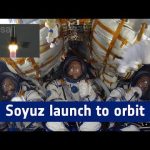
This unique video shows a full launch of the Soyuz MS-09: from liftoff to orbit.
Watch the launch from inside the crew capsule with first-ever shots from outside the spacecraft recorded by cameras fixed to the exterior of the Soyuz.
The intense launch lasts less than ten minutes whereby the Soyuz spacecraft is propelled 1640 km and gains 210 km altitude. Every second for nine minutes, the spacecraft accelerates 50 km/h on average as the rocket’s boosters burn their fuel and are discarded.
See the astronaut’s reactions and what the spacecraft looks like as the main steps are carried out to get into orbit:
-00:12 Launch command issued
-00:10 Engine turbopumps at flight speed
-00:05 Engines at maximum thrust
00:00 Launch
+1:54 Separation of emergency rescue system
+1:57 First stage separation
+2:38 Fairing separation
+4:48 Second stage separation
+4:58 Tail adapter separation
+8:45 Third stage engine cut off having arrived in orbit
+8:49 Soyuz separation, deploy solar arrays and antennae
The astronauts, from left to right, are NASA astronaut Serena Auñón-Chancellor, Roscosmos commander Sergei Prokopyev and ESA astronaut and flight engineer Alexander Gerst launched in the Soyuz MS-09 spacecraft from the Baikonur cosmodrome in Kazakhstan to the International Space Station on 6 June 2018. ESA astronaut Matthias Maurer and ESA television host Richard Hollingham provide commentary taken from the live event.
Hunched in their Sokol flight suits that offer protection in case of fire or depressurisation, the trio stay in the crew capsule of the Soyuz – the only module that is also designed to survive a return to Earth. The bags above their heads contain supplies for the International Space Station as every bit of space is used.
During a Soyuz launch astronauts typically experience forces of up to 4g – having to work while being pressed into their seats with a force that is four times more than the gravity felt on Earth. The Soyuz commander uses a stick to press buttons as they are too far away from the control panel.
The fluffy toys above the astronauts’ heads are mascots and good luck charms but also serve as a simple but effective test to see when the spacecraft is in orbit: when they start to float the spacecraft is weightless and orbiting Earth. Above Sergei is the mascot for the 2018 FIFA soccer World Cup held in Russia. Alexander took German children television icon “Die Maus” with him.
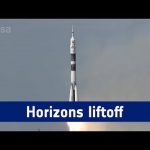
The launch went as planned as the 50-m tall Soyuz rocket propelled the astronauts to their cruising speed of around 28 800 km/h.
For this launch the astronauts took 34 orbits of Earth over two days to arrive at their destination spending their time in the cramped orbital module of the Soyuz that is no larger than a car. With limited communications and living space the astronauts had time to adapt to weightlessness and reflect on their mission ahead. They aligned their spacecraft with the International Space Station and approached the orbital outpost for docking on 8 June 2018. The files for this video were downloaded by the astronauts after arriving at the Space Station.
Alexander is a returning visitor to the International Space Station, the first of ESA’s 2009 class of astronauts to be sent into space for a second time. During the second part of his mission Alexander will take over as commander of the International Space Station, only the second time an ESA astronaut will take on this role so far.
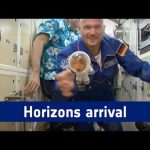
After orbiting Earth 34 times to catch up to the International Space Station, the car-sized spacecraft carrying ESA astronaut Alexander Gerst, NASA astronaut Serena Auñón-Chancellor and Roscosmos commander Sergei Prokopyev, arrived at the Station two days after launch.
The German astronaut is a returning visitor to the International Space Station, the first of ESA’s 2009 class of astronauts to be sent into space for a second time. During the second part of his mission Alexander will take over as commander of the International Space Station, only the second time an ESA astronaut will take on this role so far.
The mission is called Horizons as a symbol for the unknown and what lies beyond – reflecting on ESA’s strategy to extend human and robotic exploration beyond Earth orbit. While in space, Alexander will work on over 50 European experiments, including testing ways of operating and working with robots to develop techniques required for further human and robotic exploration of our Solar System.
At 11:12 GMT (13:12 CEST), 6 June 2018, ESA astronaut Alexander Gerst was launched into space alongside NASA astronaut Serena Auñón-Chancellor and Roscosmos commander Sergei Prokopyev in the Soyuz MS-09 spacecraft from Baikonur cosmodrome in Kazakhstan.
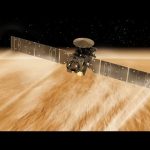
Since arriving at Mars in October 2016, the ExoMars Trace Gas Orbiter has been aerobraking its way into a close orbit of the Red Planet by using the top of the atmosphere to create drag and slow down. It is almost in the right orbit to begin observations – only a few hundred kilometres to go! With aerobraking complete, additional manoeuvres will bring the craft into a near-circular two-hour orbit, about 400 km above the planet, by the end of April. The mission’s main goal is to take a detailed inventory of the atmosphere, sniffing out gases like methane, which may be an indicator of active geological or biological activity. The camera will help to identify surface features that may be related to gas emissions. The spacecraft will also look for water-ice hidden below the surface, which could influence the choice of landing sites for future exploration. It will also relay large volumes of science data from NASA’s rovers on the surface back to Earth and from the ESA–Roscosmos ExoMars rover, which is planned for launch in 2020.
Acting Administrator Robert Lightfoot was in Kazakhstan on July 28 to observe the launch to the International Space Station of our astronaut Randy Bresnik with his crewmates – Sergey Ryazanskiy of Roscosmos, and Paolo Nespoli of the European Space Agency. The trio is scheduled to spend more than four months on the station working on hundreds of science and technology experiments. Also, New 4K Footage of Spacewalk, NASA Technologies Showcased at AirVenture Event, Preparing to Chase the Total Solar Eclipse from the Sky, and Another Successful RS-25 Engine Test!
NASA astronaut Randy Bresnik, Paolo Nespoli of ESA (European Space Agency), and Sergey Ryazanskiy of the Russian space agency Roscosmos, who are scheduled to launch to the International Space Station in late spring, participated in a news conference Jan. 25, at the agency’s Johnson Space Center in Houston.
This will be Bresnik’s second trip to the space station, the second expedition for Ryazanskiy, and Nespoli’s third trip to the space station. They will be part of Expeditions 52 and 53.
The Expedition 50/51 crew, including NASA astronaut Peggy Whitson, launched aboard a Soyuz spacecraft from the Baikonur Cosmodrome in Kazakhstan Nov. 17 eastern time, to begin a two-day flight to the International Space Station. Whitson, Oleg Novitskiy of the Russian space agency Roscosmos and Thomas Pesquet of ESA (European Space Agency) are scheduled to join Expedition 50 commander Shane Kimbrough of NASA and Roscosmos cosmonauts Sergey Ryzhikov and Andrey Borisenko, who all have been aboard the orbiting laboratory since October. Whitson will assume command of the station in February – making her the first woman to command the space station twice. Whitson and her Expedition 50 crewmates are scheduled to return to Earth next spring. Also, Supermoon Shines Bright, Newman Participates in Operation IceBridge, and Advanced Weather Satellite Mission Previewed!
Expedition 47 Commander Tim Kopra of NASA, Soyuz Commander Yuri Malenchenko of Roscosmos and Flight Engineer Tim Peake of ESA (European Space Agency) were greeted in a traditional ceremony in Kazakhstan June 18, a few hours after their safe return to Earth from a 186 day mission on the International Space Station.
Footage of NASA Astronaut Kate Rubins training with her Expedition 48/49 crewmates in preparation for their upcoming mission to the International Space Station. Rubins, Anatoly Ivanishin of Roscosmos and Takuya Onishi of the Japan Aerospace Exploration Agency launch June 24 from the Baikonur Cosmodrome in Kazakhstan for a four-month tour aboard the ISS.
After spending nearly a year aboard the International Space Station — conducting a host of biomedical and psychological research on the impacts of long-duration spaceflight on the human body, NASA’s Scott Kelly and Mikhail Kornienko of the Russian space agency Roscosmos wrapped up their historic mission on March 1 – with a safe parachute landing in Kazakhstan . Just over a day, later – at Houston’s Ellington Field, near Johnson Space Center, a host of family, colleagues and VIPs welcomed Kelly back to the United States, including Second Lady of the United States Dr. Jill Biden, Assistant to the President for Science and Technology Dr. John P. Holdren, and NASA Administrator Charles Bolden. There were cheers, embraces and expressions of appreciation for his efforts to help advance deep space exploration and America’s Journey to Mars. Also, Next ISS crew heads to launch site, “Low boom” aircraft, Orion Service Module’s solar array wing deployment and more!
Follow ESA astronaut André Kuipers and his crewmates, NASA astronaut Donald Pettit and Roscosmos cosmonaut Oleg Kononeko, on their journey from Baikonur cosmodrome, in Kazakhstan, up to their launch onboard a Soyuz TMA-03M spacecraft to the International Space Station (ISS).
On 21 December 2011, André embarked on ESA’s fourth long-duration mission to the ISS, “PromISSe”. During his five months onboard this human outpost in space, Andre is serving as a flight engineer for Expedition 30.
This exceptional 3D video shows some of the main events before launch, including: the city of Baikonur, the avenue of cosmonauts with the tree once planted by Yuri Gagarin, the Gagarin Museum, the roll-out of Soyuz in the early morning hours, the vertical erection of the rocket on the launch pad, the pre-launch press conference, the ready-to-fly report of the crew commander, and of course – the amazing light show of a night launch from the Gagarin launch pad in Baikonur.
Stereoscopic 3D glasses are required to properly enjoy the full 3D effect of this footage.
André and his fellow crew members will return to Earth by the end of May 2012.