Tag: RS-25

  • NASA Rocket Engine Fireplace – 8 Hours in 4K

    NASA Rocket Engine Fireplace – 8 Hours in 4K

    Just what you need for the holidays… the coziness of a crackling and roaring rocket engine!

    Technically, this fireplace packs the heat of the SLS rocket’s four RS-25 engines and a pair of solid rocket boosters – just enough to get you to the Moon! (And get through the holidays with your in-laws.)

    This glowing mood-setter is brought to you by the SLS (Space Launch System) rocket that launched Artemis I on its mission around the Moon and back on Nov. 16, 2022. 8.8 million pounds of total thrust – and a couple glasses of eggnog – might just be enough to make your holidays merry.

    Video description: A stock fireplace illustration frames looping archival video of the blasting RS-25 engines that launched the Artemis I rocket to the Moon on Nov. 16, 2022 (source: https://go.nasa.gov/4g6LnWc ). The illustration includes stone tiling, a pillow, a basket of firewood, and contains elements generated with AI. NASA added two framed pictures to the illustration. One shows an archival image of the Orion capsule flying through space. The other shows the Artemis logo. The audio features the roar of the rockets at a low level, with the addition of the sounds of a crackling wood fire.

    Credit: NASA
    Producers: Sami Aziz, John Sackman
    Designer: Chris Chamberland

    https://www.nasa.gov/humans-in-space/artemis/

    Download: https://go.nasa.gov/4g6vKhi

    #Fireplace #YuleLog #NASA
  • Milestone Hot Fire Engine Test for NASA’s Space Launch System Rocket

    Milestone Hot Fire Engine Test for NASA’s Space Launch System Rocket

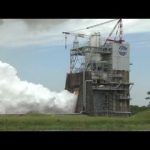
    NASA is a step closer to returning astronauts to the Moon in the next five years following this successful “hot fire” test of flight engine No. 2062 on the A-1 Test Stand at Stennis Space Center in Mississippi. This April 4, 2019 test caps more than four years of testing for the RS-25 engines that will help power the first four missions of the Space Launch System rockets. It also concludes a 51-month test series that demonstrated RS-25 engines can perform at the higher power level needed to launch the super heavy-lift SLS rocket.

    Download this video: https://go.nasa.gov/2TTrTty

  • Feel the Rumble! RS-25 Engine Test on This Week @NASA – January 19, 2018

    Feel the Rumble! RS-25 Engine Test on This Week @NASA – January 19, 2018

    Firing the engine that will power humans to deep space, testing a potential source of power for future exploration, and practicing water recovery of the Orion spacecraft – a few of the stories to tell you about – This Week at NASA!

    This video is available for download from NASA’s Image and Video Library: https://images.nasa.gov/details-NHQ_2018_0119_Feel%20the%20Rumble!%20RS-25%20Engine%20Test%20on%20This%20Week%20@NASA%20%E2%80%93%20January%2019,%202018.html

  • First Light Detected from Gravitational Wave Event on This Week @NASA – October 20, 2017

    First Light Detected from Gravitational Wave Event on This Week @NASA – October 20, 2017

    For the first time, NASA scientists have detected light tied to a gravitational-wave event. The gravitational wave – caused by an explosive merger of two neutron stars, about 130 million light-years from Earth – produced a gamma-ray burst and a rarely seen flare-up called a “kilonova”. The phenomenon was captured by our Fermi, Swift, Hubble, Chandra and Spitzer missions, along with dozens of NASA-funded ground-based observatories. Also, Trio of Station Spacewalks Completed, Fresh Findings from Cassini, and Test of SLS RS-25 Flight Engine!

    This video is available for download from NASA’s Image and Video Library: https://images.nasa.gov/#/details-NHQ_20171023_This%20Week%20@%20NASA.html

  • NASA Tests RS-25 Flight Engine for Space Launch System

    NASA Tests RS-25 Flight Engine for Space Launch System

    Engineers at NASA’s Stennis Space Center in Mississippi on Oct. 19 completed a hot-fire test of RS-25 rocket engine E2063, a flight engine for NASA’s new Space Launch System (SLS) rocket. Engine E2063 is scheduled to help power SLS on its Exploration Mission-2 (EM-2), the first flight of the new rocket to carry humans.

    This video is available for download from NASA’s Image and Video Library: https://images.nasa.gov/#/details-NASA%20Tests%20RS-25%20Flight%20Engine%20for%20Space%20Launch%20System.html

  • Catastrophic Storm Seen from Space on This Week @NASA – September 1, 2017

    Catastrophic Storm Seen from Space on This Week @NASA – September 1, 2017

    We worked with our partner agencies to use space-based assets to capture imagery of Hurricane Harvey that impacted the Texas-Louisiana Gulf Coast region. Imagery captured from the vantage point of space, provides data that weather forecasters, emergency responders and other officials can use to better inform the public. Views from the International Space Station, and NOAA’s GOES East satellite showed the massive size and movement of the storm. While our Global Precipitation Measurement (GPM) Mission analyzed the storm’s record-breaking rainfall – which led to catastrophic flooding in Texas and Louisiana. Due to the storm, our Johnson Space Center in Houston is closed through Labor Day, while the region recovers, but Mission Control remains operational in support of the crew aboard the International Space Station. Also, Final RS-25 Engine Test of the Summer, Key SLS Rocket Hardware Finished, and Researching Quiet Supersonic Flight!

    This video is available for download from NASA’s Image and Video Library: https://images.nasa.gov/#/details-NHQ_2017_0901_Catastrophic%20Storm%20Seen%20from%20Space%20on%20This%20Week%20@NASA%20%E2%80%93%20September%201,%202017.html

  • NASA’s RS-25 Rocket Engine Fires Up Again

    NASA’s RS-25 Rocket Engine Fires Up Again

    Engineers conduct the third in a series of RS-25 flight controller tests on July 25, 2017, for NASA’s Space Launch System (SLS) rocket. The more than 8 1/2 minute test on the A-1 Test Stand at NASA’s Stennis Space Center in Mississippi signaled another step toward launch of NASA’s new Space Launch System (SLS). The SLS rocket, powered by four RS-25 engines, along with the Orion spacecraft will take astronauts on a new era of exploration beyond Earth’s orbit into deep space.

  • NASA’s Stennis Space Center Conducts RS-25 Engine Test

    NASA’s Stennis Space Center Conducts RS-25 Engine Test

    On March 23, NASA conducted a test of an RS-25 engine at the agency’s Stennis Space Center in Bay St. Louis, Mississippi. Four RS-25’s will help power NASA’s Space Launch System (SLS) rocket to space. During this test, engineers evaluated the engine’s new controller or “brain”, which communicates with the SLS vehicle. Once test data is certified, the engine controller will be removed and installed on one of the four flight engines that will help power the first integrated flight of SLS and the Orion spacecraft.

  • RS-25 Rocket Engine Test Firing

    RS-25 Rocket Engine Test Firing

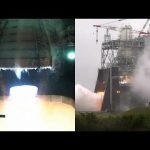
    The 7.5-minute test conducted at NASA’s Stennis Space Center is part of a series of tests designed to put the upgraded former space shuttle engines through the rigorous temperature and pressure conditions they will experience during a launch. The tests also support the development of a new controller, or “brain,” for the engine, which monitors engine status and communicates between the rocket and the engine, relaying commands to the engine and transmitting data back to the rocket.