Want to catch a glimpse of the northern lights? You’ll need dark skies, the right location, good space weather and a little patience!
Auroras happen when charged particles from the Sun interact with Earth’s magnetic field, creating dazzling light shows in the sky. A NASA scientist shares tips on where, when and how to see these stunning displays.
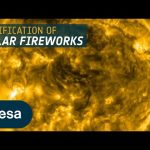
At the start of this new year, close-up pictures and solar flare data that the ESA-led Solar Orbiter mission has been recording for more than three years. See and hear for yourself how the number of flares and their intensity increase, a clear sign of the Sun approaching the peak of the 11-year solar cycle.
This video combines ultraviolet images of the Sun’s outer atmosphere (the corona, yellow) taken by Solar Orbiter’s Extreme Ultraviolet Imager (EUI) instrument, with the size and locations of solar flares (blue circles) as recorded by the Spectrometer/Telescope for Imaging X-rays (STIX) instrument. The accompanying audio is a sonification based on the detected flares and the spacecraft’s distance to the Sun.
Solar Orbiter moves on an elliptical path around the Sun, making a close approach to our star every six months. We can see this in the video from the spacecraft’s perspective, with the Sun moving closer and farther over the course of each year. In the sonification, this is represented by the low background humming that loudens as the Sun gets closer and becomes quieter as it moves further away. (There are some abrupt shifts in distance visible in the video, as it skips over dates where one or both instruments were inactive or collecting a different type of data.)
The blue circles represent solar flares: bursts of high-energy radiation of which STIX detects the X-rays. Flares are sent out by the Sun when energy stored in ‘twisted’ magnetic fields (usually above sunspots) is suddenly released. The size of each circle indicates how strong the flare is, with stronger flares sending out more X-rays. We can hear the flares in the metallic clinks in the sonification, where the sharpness of the sound corresponds to how energetic the solar flare is.
Many thanks to Klaus Nielsen (DTU Space / Maple Pools) for making the sonification in this video. If you would like to hear more sonifications and music by this artist, please visit: https://linktr.ee/maplepools Solar Orbiter is a space mission of international collaboration between ESA and NASA, operated by ESA.
————————————————— Credits Credit: ESA & NASA/Solar Orbiter/EUI & STIX, Klaus Nielsen (DTU Space/Maple Pools) Acknowledgements: Data processing for video by Laura Hayes License: CC BY-SA 3.0 or ESA Standard License
Video credit slate Solar Orbiter animation: ESA Sun images: ESA & NASA/Solar Orbiter/EUI Solar flare data: ESA & NASA/Solar Orbiter/STIX Data processing for video: Laura Hayes Data sonification & music: Klaus Nielsen (DTU Space/Maple Pools) —————————————————
★ Subscribe: http://bit.ly/ESAsubscribe and click twice on the bell button to receive our notifications.
We are Europe’s gateway to space. Our mission is to shape the development of Europe’s space capability and ensure that investment in space continues to deliver benefits to the citizens of Europe and the world. Check out https://www.esa.int/ to get up to speed on everything space related.
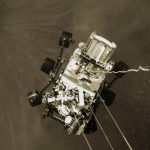
NASA’s Perseverance Mars Rover safely touched down on the Red Planet on Feb. 18. So what will the robotic scientist “see” on her descent and what will she do next? Join mission experts for update about the rover – the biggest, heaviest, cleanest, and most sophisticated six-wheeled robot ever launched into space – including imagery it captured and its mission to explore Mars.
From the @Airbus integration halls in Bremen, Germany, this replay of a live event shows a sneak peek of the two European Service Modules that will power astronauts to the Moon and back as part of @NASA’s Orion spacecraft.
Orion is NASA’s next exploration spacecraft to send astronauts farther into space than ever before, beyond the Moon to asteroids and even Mars.
ESA has contracted and is overseeing the development of the European Service Module, the part of the Orion spacecraft that provides air, electricity and propulsion. Much like a train engine pulls passenger carriages and supplies power, the European Service Module will power the Orion crew module to its destination and back to Earth.
The programme includes Andreas Hammer, Head of @Airbus Defence and Space Exploration showing the European Service Modules in production, ESA Director General Jan Wörner announcing future developments, a statement by ESA’s head of European Service Module programme Philippe Deloo, a statement by Airbus head of European Service Module programme Didier Radola, a Moon missions overview with ESA astronaut Alexander Gerst and ESA’s head of Space Transportation Nico Dettmann on how ESA is building Orion with industry.
★ Subscribe: http://bit.ly/ESAsubscribe and click twice on the bell button to receive our notifications.
We are Europe’s gateway to space. Our mission is to shape the development of Europe’s space capability and ensure that investment in space continues to deliver benefits to the citizens of Europe and the world. Check out https://www.esa.int/ to get up to speed on everything space related.
How can you train yourself to be a quantum detector? Quantum interactions happen at impossibly small scales. But the life-size effects are all around you. You can detect quantum mechanics all over — if you know how to look for it.
ADVANCED SCIENTIFIC NOTE: Quantum mechanics would be much more obvious if we had very sensitive eyes. If your eyes identified each photon individually, you would see them land as described in the video, and only build up to this wave pattern. The pattern that we see can be explained classically by waves, it is *ultimately* a quantum phenomenon. The only reason it’s hard to tell is because our light detectors (eyes) aren’t quite sensitive enough.
After an epic space journey, the European Huygens probe landed on Saturn’s moon Titan, a mysterious satellite that has perplexed astronomers for decades. On 14 January 2005, Huygens made the farthest touchdown of any human-built object sent to land on another world.