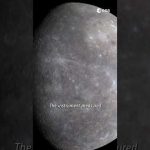
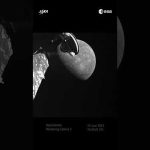
BepiColombo flew past Mercury for the fifth time on 1 December 2024.
During this flyby, BepiColombo gathered more data on the mysterious planet and its surroundings. Aside from taking some ‘regular’ photos of the planet and measuring particles and electromagnetic fields in the space around it, this flyby was the first time that any spacecraft imaged Mercury in mid-infrared wavelengths of light.
BepiColombo will pass much closer to Mercury’s north pole during its final flyby of Mercury on 8 January 2025, its last visit before arriving to enter orbit about the planet in November 2026.
📹 ESA – European Space Agency 📸 MERTIS/DLR/University of Münster & NASA/Johns Hopkins University Applied Physics Laboratory/Carnegie Institution of Washington
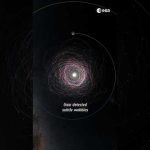
Thanks to the incredible precision of our Gaia mission, scientists have discovered potential moons orbiting over 350 asteroids! This nearly doubles the known number of ‘binary asteroids,’ revealing a whole new layer of complexity in our Solar System.
In mythology, centaurs are half-human, half-horse creatures, but in space, they’re celestial objects orbiting the Sun between Jupiter and Neptune.
Centaurs are “hybrid” objects in the sense that they share characteristics with trans-Neptunian objects from the Kuiper Belt reservoir and short-period comets. A team of scientists used the James Web Telescope to study Centaur 29P.
While data from previous observations of Centaur 29P showed a carbon monoxide (CO) gas jet pointed toward Earth, Webb parsed the jet’s composition in greater detail, and also detected multiple never-before-seen features of the centaur: two jets of carbon dioxide (CO2) emanating in the north and south directions, and another jet of CO pointing toward the north.
Centaur 29P’s different CO and CO2 abundances suggest that the body may be composed of different pieces that coalesced together during its formation. However, other scenarios to explain Centaur 29P’s outgassing activity are still being considered.
Ten years ago, on 19 December 2013, our billion star-mapping satellite Gaia launched.
Since then, Gaia has been scanning the sky and gathering an enormous amount of data on the positions and motions of 1.8 billion stars, enabling discoveries about the history of our galaxy.
Gaia is creating an extraordinarily precise three-dimensional map of more than a billion stars throughout our Milky Way galaxy and beyond, mapping their motions, luminosity, temperature and composition.
This huge stellar census will provide the data needed to tackle an enormous range of important questions related to the origin, structure and evolutionary history of our galaxy.
Gaia’s catalogue is ever-growing containing data on stars and other cosmic objects such as galaxies, exoplanets, and binary stars. Here’s to more discoveries!
Missions to Mars have made many exciting discoveries that have transformed our understanding of the planet, but the next step is to bring samples to Earth for detailed analysis in sophisticated laboratories.
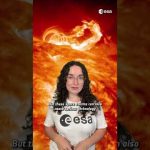
Coronal Mass Ejections or CMEs, are an eruption of around a billion tonnes of particles that comes from the solar atmosphere, the corona, and travels through the solar system. CMEs are an important part of ‘space weather’. The particles spark aurorae on planets with atmospheres, and can cause malfunctions in some technology. They can also be harmful to unprotected astronauts. So it is important to understand CMEs, and be able to track their progress.
Credits: ESA – European Space Agency
★ Subscribe: http://bit.ly/ESAsubscribe and click twice on the bell button to receive our notifications.
We are Europe’s gateway to space. Our mission is to shape the development of Europe’s space capability and ensure that investment in space continues to deliver benefits to the citizens of Europe and the world. Check out https://www.esa.int/ to get up to speed on everything space related.
Explore the mysteries behind the Earth-Moon system’s origin with these four intriguing theories. 🌍🌕 Which one do you think holds the key to our celestial companion’s creation?
On May 16, 2023, NASA’s Juno spacecraft flew past Jupiter’s volcanic moon Io, and then the gas giant soon after. Io is the most volcanically active body in the solar system. Slightly larger than Earth’s moon, Io is a world in constant torment. Not only is the biggest planet in the solar system forever pulling at it gravitationally, but so are its Galilean siblings – Europa and the biggest moon in the solar system, Ganymede. The result is that Io is continuously stretched and squeezed, actions linked to the creation of the lava seen erupting from its many volcanoes.
This rendering provides a “starship captain” point of view of the flyby, using images from JunoCam. For both targets, Io and Jupiter, raw JunoCam images were reprojected into views similar to the perspective of a consumer camera. The Io flyby and the Jupiter approach movie were rendered separately and composed into a synchronous split-screen video.
Launched on Aug. 5, 2011, Juno embarked on a 5-year journey to Jupiter. Its mission: to probe beneath the planet’s dense clouds and answer questions about the origin and evolution of Jupiter, our solar system, and giant planets in general across the cosmos. Juno arrived at the gas giant on July 4, 2016, after a 1.7-billion-mile journey, and settled into a 53-day polar orbit stretching from just above Jupiter’s cloud tops to the outer reaches of the Jovian magnetosphere. Now in its extended mission, NASA’s most distant planetary orbiter continues doing flybys of Jupiter and its moons.
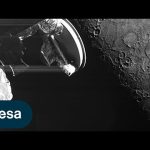
Watch Mercury appear from the shadows as the ESA/JAXA BepiColombo spacecraft sped by the planet’s night side during its 19 June 2023 close flyby, and enjoy a special flyover of geologically rich terrain.
Credits: Image: ESA/BepiColombo/MTM, CC BY-SA 3.0 IGO; Music composed by ILĀ. Shape from shading processing and animation (using Unity) by K. Wohlfarth and M. Tenthoff (TU Dortmund), based on techniques described by Tenthoff et al. (2020) and Domingue et al. (2015) with a global terrain model from Becker et al. (2016).
Music: Tim Garland – Moonlight Mystery
★ Subscribe: http://bit.ly/ESAsubscribe and click twice on the bell button to receive our notifications.
We are Europe’s gateway to space. Our mission is to shape the development of Europe’s space capability and ensure that investment in space continues to deliver benefits to the citizens of Europe and the world. Check out https://www.esa.int/ to get up to speed on everything space related.
Watch Mercury appear from the shadows as the ESA/JAXA BepiColombo spacecraft sped by the planet’s night side during its 19 June 2023 close flyby, and enjoy a special flyover of geologically rich terrain.
The first part of the movie is composed of 217 images captured by BepiColombo’s monitoring camera M-CAM3. The image sequence starts from 19:46:25 UTC on 19 June 2023, at an altitude of 1 789 km above the planet’s surface, and ends at 20:34:25 UTC on 20 June 2023, when BepiColombo was 331 755 km away. The image cadence was roughly once per minute around closest approach, but much slower in the later phases.
The second part of the movie cuts to a flyover of a special region of interest, rotating around features such as the 600 km-long Beagle Rupes curved escarpment and the elongated Sveinsdóttir impact crater that it cuts through. It also features the 218 km-wide Manley Crater and the straight Challenger Rupes scarp. At the end, the animated topography fades out and the projected image used for 3D reconstruction appears. Regions like these will be important for BepiColombo’s main science mission, to learn more about Mercury’s geological history.
Music was composed for the sequence by ILĀ, with the assistance of AI tools developed by the Machine Intelligence for Musical Audio (MIMA) group, University of Sheffield.
Credits: Image: ESA/BepiColombo/MTM, CC BY-SA 3.0 IGO; Music composed by ILĀ. Shape from shading processing and animation (using Unity) by K. Wohlfarth and M. Tenthoff (TU Dortmund), based on techniques described by Tenthoff et al. (2020) and Domingue et al. (2015) with a global terrain model from Becker et al. (2016).
★ Subscribe: http://bit.ly/ESAsubscribe and click twice on the bell button to receive our notifications.
We are Europe’s gateway to space. Our mission is to shape the development of Europe’s space capability and ensure that investment in space continues to deliver benefits to the citizens of Europe and the world. Check out https://www.esa.int/ to get up to speed on everything space related.
The 30th June marks Asteroid Day, which aims to emphasise the importance of asteroids –their role in the formation of our solar system, their impact in space resources and the importance of defending our planet from future impacts. This year we are celebrating along with @UniversalPictures for the release of Wes Anderson’s new movie Asteroid City to bring you all the information you need to know about asteroids and how we protect our planet from them. #AsteroidCityxAsteroidDay #AsteroidDay2023
📹 @EuropeanSpaceAgency
★ Subscribe: http://bit.ly/ESAsubscribe and click twice on the bell button to receive our notifications.
We are Europe’s gateway to space. Our mission is to shape the development of Europe’s space capability and ensure that investment in space continues to deliver benefits to the citizens of Europe and the world. Check out https://www.esa.int/ to get up to speed on everything space related.
Detect, fetch and collect. A seemingly easy task is being tested to find the best strategy to collect samples on the martian surface, some 290 000 million km away from home.
Testing technologies for Mars exploration is part of the daily job of Laura Bielenberg, an ESA graduate trainee for the Mars Sample Return campaign.
The test takes place at the rock-strewn recreation of the Red Planet at ESA’s ESTEC technical centre in Noordwijk, the Netherlands. The nickname of this test site is the ‘Mars Yard’ and is part of the Planetary Robotics Laboratory.
The tube is a replica of the sample caches that NASA’s Perseverance rover is leaving on Mars hermetically sealed with precious martian samples inside. They are called RSTA, an acronym of Returnable Sample Tube Assembly, and to most people on Earth they look like lightsabers. Laura is investigating sample tube collection strategies, from autonomous detection to pose estimation of sample tubes on Mars, with a testbed called the RABBIT (RAS Bread Boarding In-house Testbed).
The Sample Transfer Arm will need to load the tubes from the martian surface for delivery towards Earth. ESA’s robotic arm will collect them from the Perseverance rover, and possibly others dropped by sample recovery helicopters as a backup.
Besides cameras and sensors, the team relies on neural networks to detect the tubes and estimate their pose. Inspired by the way the human brain works, neural networks mimic the way biological neurons signal to one another.
We are Europe’s gateway to space. Our mission is to shape the development of Europe’s space capability and ensure that investment in space continues to deliver benefits to the citizens of Europe and the world. Check out https://www.esa.int/ to get up to speed on everything space related.
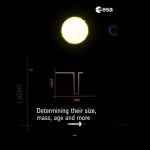
More than 5000 exoplanets have been discovered to date, but what do they look like? ESA’s dedicated exoplanet missions Cheops, Plato and Ariel are on a quest to find out. Cheops will focus its search on mini-Neptunes, planets with sizes between Earth and Neptune, on short orbits around their stars. Cheops will find out how large these planets are, and may detect whether the planets have clouds. Plato will look at all kinds of exoplanets and determine their sizes and ages. Plato’s instruments are so sensitive it may discover the first Earth-like planet on an Earth-like orbit. Finally, Ariel will look at the atmospheres of exoplanets using the technique of transmission spectroscopy and discover what they are made of. Together these missions will discover what exoplanets and their systems look like and they will also reveal how special our own Solar System is.
We are Europe’s gateway to space. Our mission is to shape the development of Europe’s space capability and ensure that investment in space continues to deliver benefits to the citizens of Europe and the world. Check out https://www.esa.int/ to get up to speed on everything space related.
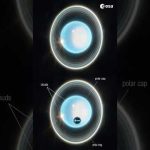
The NASA/ESA/CSA James Webb Space Telescope has taken a stunning image of the Solar System’s other ice giant, the planet Uranus. The new image features dramatic rings as well as bright features in the planet’s atmosphere. The new Webb data of Uranus offer exquisite sensitivity, revealing the faintest dusty rings.
The seventh planet from the Sun, Uranus is strange: it rotates on its side, at a nearly 90-degree angle from the plane of its orbit. This causes unusual seasons since the planet’s poles experience 42 years of constant sunlight and 42 years of complete darkness (Uranus takes 84 years to orbit the Sun). Currently, it is late spring at the northern pole, which is on the right side of this image; Uranus’s northern summer will be in 2028.
Credit: NASA, ESA, CSA, STScI, J. DePasquale (STScI), N. Bartmann Music: Stellardrone – The Belt of Orion
★ Subscribe: http://bit.ly/ESAsubscribe and click twice on the bell button to receive our notifications.
We are Europe’s gateway to space. Our mission is to shape the development of Europe’s space capability and ensure that investment in space continues to deliver benefits to the citizens of Europe and the world. Check out https://www.esa.int/ to get up to speed on everything space related.
Chariklo is an icy, small body, but the largest of the known Centaur population, located more than 3.2 billion kilometres away beyond the orbit of Saturn. Chariklo is only 250 kilometers or ~51 times smaller than Earth in diameter, and its rings orbit at a distance of about 400 kilometers from the center of the body.
On 18 October 2022, a team used the James Webb Space Telescipe to closely monitor the star Gaia DR3 6873519665992128512, and watch for the tell-tale dips in brightness indicating an occultation had taken place. The shadows produced by Chariklo’s rings were clearly detected, demonstrating a new way of using Webb to explore solar system objects. The star shadow due to Chariklo itself tracked just out of Webb’s view. This appulse (the technical name for a close pass with no occultation) was exactly as had been predicted after the last Webb course trajectory maneuver.
Credit: @NASA, ESA, CSA, Leah Hustak (STScI), Pablo Santos-Sanz (IAA-CSIC), Nicolás Morales (IAA-CSIC), Bruno Morgado (UFRJ, ON/MCTI, LIneA)
★ Subscribe: http://bit.ly/ESAsubscribe and click twice on the bell button to receive our notifications.
We are Europe’s gateway to space. Our mission is to shape the development of Europe’s space capability and ensure that investment in space continues to deliver benefits to the citizens of Europe and the world. Check out https://www.esa.int/ to get up to speed on everything space related.
When a spacecraft launches on a mission to another planet it must first break free of the Earth’s gravitational field. Once it has done that, it enters interplanetary space, where the dominant force is the gravitational field of the Sun.
The spacecraft begins to follow a curving orbit, around the Sun, which is similar to the orbit of a comet. When this orbit brings it close to its target destination the spacecraft must fire a retrorocket to slow down and allow itself to be captured by the gravitational field of its target. The smaller the target, the more the spacecraft must slow down.
Sometimes passing a planet can result in the spacecraft being accelerated, even without the spacecraft firing any of its thrusters. This is known as the ‘slingshot’ effect. Such ‘gravity assist’ manoeuvres are now a standard part of spaceflight and are used by almost all our interplanetary missions. They take advantage of the fact that the gravitational attraction of the planets can be used to change the trajectory and speed of a spacecraft.
The amount by which the spacecraft speeds up or slows down is determined by whether it is passing behind or in front of the planet as the planet follows its orbit. When the spacecraft leaves the influence of the planet, it follows an orbit on a different course than before.
📹 @EuropeanSpaceAgency
★ Subscribe: http://bit.ly/ESAsubscribe and click twice on the bell button to receive our notifications.
We are Europe’s gateway to space. Our mission is to shape the development of Europe’s space capability and ensure that investment in space continues to deliver benefits to the citizens of Europe and the world. Check out https://www.esa.int/ to get up to speed on everything space related.
Asteroids, like stars, only come out at night. Hidden in the glare of our Sun are an unknown number of asteroids on paths we cannot track, many of which could be heading for Earth, and we just don’t know it.
Our planned NEOMIR mission will be located between Earth and the Sun and will act as an early warning system for asteroids 20 metres and larger that cannot be seen from the ground.
By making observations in the infrared part of the light spectrum, NEOMIR will detect the heat emitted by asteroids themselves, which isn’t drowned out by sunlight. This thermal emission is absorbed by Earth’s atmosphere, but from space NEOMIR will be able to see closer to the Sun than we can currently from Earth.
We are Europe’s gateway to space. Our mission is to shape the development of Europe’s space capability and ensure that investment in space continues to deliver benefits to the citizens of Europe and the world. Check out https://www.esa.int/ to get up to speed on everything space related.
What happens next for the new 2022 class of ESA astronauts? Which upcoming launch to a faraway planet and its moons is getting everyone excited? And which anniversary will we be celebrating on 12 March? Get all the answers and more in our new edition of Space Round Up, your news gateway to space.
We are Europe’s gateway to space. Our mission is to shape the development of Europe’s space capability and ensure that investment in space continues to deliver benefits to the citizens of Europe and the world. Check out https://www.esa.int/ to get up to speed on everything space related.
The Webb observations which revealed this small asteroid were not originally designed to hunt for new asteroids — in fact, they were calibration images of the main-belt asteroid (10920) 1998 BC1, which astronomers discovered in 1998, but the calibration team considered them to have failed for technical reasons due to the brightness of the target and an offset telescope pointing. Despite this, the data on asteroid 10920 were used by the team to establish and test a new technique to constrain an object’s orbit and to estimate its size. The validity of the method was demonstrated for asteroid 10920 using Webb observations combined with data from ground-based telescopes and ESA’s Gaia mission.
In the course of the analysis of Webb’s data, the team found the smaller and previously unknown interloper in the same field of view. The team’s results suggest the object measures 100–200 meters, occupies a very low-inclination orbit, and was located in the inner main-belt region at the time of the Webb observations.
We are Europe’s gateway to space. Our mission is to shape the development of Europe’s space capability and ensure that investment in space continues to deliver benefits to the citizens of Europe and the world. Check out https://www.esa.int/ to get up to speed on everything space related.
Terrae Novae is not only literally about exploring new worlds, but by describing the limitless opportunities for discovery, economic growth and inspiration it also expresses our ambitions for Europe’s future innovators, scientists and explorers.
This video shows the many exploration activities ESA is conducting or has planned in our Solar System, from the International Space Station to the Moon with the European Service Module and lunar Gateway modules for Artemis, and on to Mars with the Mars Sample Return campaign.
We are Europe’s gateway to space. Our mission is to shape the development of Europe’s space capability and ensure that investment in space continues to deliver benefits to the citizens of Europe and the world. Check out https://www.esa.int/ to get up to speed on everything space related.
During a break from looking at planets around other stars, ESA’s CHaracterising ExOPlanet Satellite (Cheops) mission has observed a dwarf planet in our own Solar System and made a decisive contribution to the discovery of a dense ring of material around it.
Studying these dwarf planets is difficult because of their small sizes and extreme distances. Quaoar itself orbits the Sun at almost 44 times the Sun-Earth distance. So, occultations are particularly valuable tools. Until recently, however, it has been difficult to predict exactly when and where they will take place.
For an occultation to occur, the alignment between the occulting object (here the TNO), the star, and the observing telescope must be extremely precise. In the past, it has been almost impossible to meet the stringent accuracy requirements to be certain of seeing an event. Nevertheless, to pursue this goal the European Research Council Lucky Star project, coordinated by Bruno Sicardy, Sorbonne University & Paris Observatory – PSL (LESIA), was created to predict upcoming occultations by TNOs, and to co-ordinate the observation of these events from professional and amateur observatories around the globe.
We are Europe’s gateway to space. Our mission is to shape the development of Europe’s space capability and ensure that investment in space continues to deliver benefits to the citizens of Europe and the world. Check out https://www.esa.int/ to get up to speed on everything space related.
As Mars orbits around our Sun, time on the Red Planet is measured in years. However, there are some significant differences between a year on Mars and a year on Earth. Let’s look at some similarities and differences between a year on the two planets.
We are Europe’s gateway to space. Our mission is to shape the development of Europe’s space capability and ensure that investment in space continues to deliver benefits to the citizens of Europe and the world. Check out https://www.esa.int/ to get up to speed on everything space related.
After the uncrewed Artemis I test flight, the Artemis II mission will have astronauts demonstrate what the Orion spacecraft – powered by a European Service Module – can do on its voyage around the Moon.
Two astronauts will fly on the second Artemis mission and take over controls to show how Orion handles at close-quarter flying. While in Earth orbit the spacecraft will detach from its second stage, fly away, turn around, approach the second stage and then fly away again – all using the European Service Module’s 33 thrusters.
Whereas in the first Artemis mission the second stage fired Orion into its lunar orbit, for the second mission it will be the European Service Module that will give the spacecraft its final push to its voyage around the Moon.
The crew will fly Orion to 8889 km beyond the Moon before completing a lunar flyby and returning to Earth. The mission will take a minimum of eight days and will collect valuable flight test data.
The European Service Module is one of ESA’s many contributions to NASA’s Orion spacecraft and the Artemis programme that will send astronauts to the Moon and beyond. It provides electricity, water, oxygen and nitrogen as well as keeping the spacecraft at the right temperature and on course.
The European Service Module has 33 thrusters, 11 km of electrical wiring, four propellant and two pressure tanks that all work together to supply propulsion and everything needed to keep astronauts alive far from Earth – there is no room for error.
★ Subscribe: http://bit.ly/ESAsubscribe and click twice on the bell button to receive our notifications.
We are Europe’s gateway to space. Our mission is to shape the development of Europe’s space capability and ensure that investment in space continues to deliver benefits to the citizens of Europe and the world. Check out https://www.esa.int/ to get up to speed on everything space related.
The Space Launch System (SLS) rocket with the Orion spacecraft aboard lifted off at 07:47 CET from @NASA’s Kennedy Space Center in Florida, USA on 16 November 2022.
The most powerful rocket ever built sent NASA’s Orion spacecraft and ESA’s European Service Module (ESM) to a journey beyond the Moon and back. No crew will be on board Orion this time, and the spacecraft will be controlled by teams on Earth.
ESM provides for all astronauts’ basic needs, such as water, oxygen, nitrogen, temperature control, power and propulsion.
Much like a train engine pulls passenger carriages and supplies power, the European Service Module will take the Orion capsule to its destination and back.
We are Europe’s gateway to space. Our mission is to shape the development of Europe’s space capability and ensure that investment in space continues to deliver benefits to the citizens of Europe and the world. Check out https://www.esa.int/ to get up to speed on everything space related.
Meet Hera, our very own asteroid detective. Together with two CubeSats – Milani the rock decoder and Juventas the radar visionary – Hera is off on an adventure to explore Didymos, a double asteroid system that is typical of the thousands that pose an impact risk to planet Earth.
Suitable for kids and adults alike, this episode of ‘The Incredible Adventures of Hera’ details the miniaturised James-Bond-style technology that Hera and its CubeSats will carry aboard with them to explore their asteroid target.
We are Europe’s gateway to space. Our mission is to shape the development of Europe’s space capability and ensure that investment in space continues to deliver benefits to the citizens of Europe and the world. Check out https://www.esa.int/ to get up to speed on everything space related.
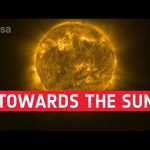
This sequence was taken by Solar Orbiter’s Extreme Ultraviolet Imager using the Full Sun Imager telescope, and shows the Sun at a wavelength of 17 nanometers. This wavelength is emitted by gas in the Sun’s atmosphere with a temperature of around one million degrees. The colour on this image has been artificially added because the original wavelength detected by the instrument is invisible to the human eye.
Credit: ESA & @NASA /Solar Orbiter/EUI Team
★ Subscribe: http://bit.ly/ESAsubscribe and click twice on the bell button to receive our notifications.
We are Europe’s gateway to space. Our mission is to shape the development of Europe’s space capability and ensure that investment in space continues to deliver benefits to the citizens of Europe and the world. Check out https://www.esa.int/ to get up to speed on everything space related.
Meet Hera, our very own asteroid detective. Together with two small CubeSats – Milani the rock decoder and Juventas the radar visionary – Hera is off on an adventure to explore Didymos, a double asteroid system that is typical of the thousands that pose an impact risk to planet Earth.
Suitable for space enthusiasts young and old, this episode of ‘The incredible adventures of the Hera mission’ is all about craters. What are they? Why are they important? Why is NASA’s DART spacecraft about to collide with an asteroid to create the Solar System’s newest – and perhaps most important – crater? And why do we need Hera to unveil the secrets of this crater?
We are Europe’s gateway to space. Our mission is to shape the development of Europe’s space capability and ensure that investment in space continues to deliver benefits to the citizens of Europe and the world. Check out https://www.esa.int/ to get up to speed on everything space related.
Most striking about Webb’s new image is the crisp view of the planet’s dynamic rings — some of which haven’t been seen at all, let alone with this clarity, since the Voyager 2 flyby in 1989. In addition to several bright narrow rings, the Webb images clearly show Neptune’s fainter dust bands. Webb’s extremely stable and precise image quality also permits these very faint rings to be detected so close to Neptune.
We are Europe’s gateway to space. Our mission is to shape the development of Europe’s space capability and ensure that investment in space continues to deliver benefits to the citizens of Europe and the world. Check out https://www.esa.int/ to get up to speed on everything space related.
NASA will host a briefing to provide highlights from the first year-and-a-half of the Perseverance rover’s exploration of Mars.
The rover landed in Mars’ Jezero Crater in February 2021 and is collecting samples of rock and other materials from the Martian surface. Perseverance is investigating the sediment-rich ancient river delta in the Red Planet’s Jezero Crater.
Speakers: • Lori Glaze, director of NASA’s Planetary Science Division, NASA Headquarters • Laurie Leshin, JPL director • Rick Welch, Perseverance deputy project manager, JPL • Ken Farley, Perseverance project scientist, Caltech • Sunanda Sharma, Scanning Habitable Environments with Raman and Luminescence for Organics and Chemicals (SHERLOC) scientist, JPL • David Shuster, Perseverance returned sample scientist, University of California, Berkeley
Solar Orbiter has made the first ever remote sensing observation consistent with a magnetic phenomenon called a solar switchback – sudden and large deflections of the solar wind’s magnetic field. The new observation provides a full view of the structure, in this case confirming it has an S-shaped character, as predicted. Furthermore, the global perspective provided by the Solar Orbiter data indicates that these rapidly changing magnetic fields can have their origin near the surface of the Sun.
We are Europe’s gateway to space. Our mission is to shape the development of Europe’s space capability and ensure that investment in space continues to deliver benefits to the citizens of Europe and the world. Check out https://www.esa.int/ to get up to speed on everything space related.
The European Service Module is ESA’s contribution to @NASA’s Orion spacecraft that will send astronauts to the Moon and beyond. It provides electricity, water, oxygen and nitrogen as well as keeping the spacecraft at the right temperature and on course.
We are Europe’s gateway to space. Our mission is to shape the development of Europe’s space capability and ensure that investment in space continues to deliver benefits to the citizens of Europe and the world. Check out https://www.esa.int/ to get up to speed on everything space related.
Webb’s Jupiter observations will give scientists even more clues to Jupiter’s inner life since with giant storms, powerful winds, aurorae, and extreme temperature and pressure conditions, the planet has a lot going on.
We are Europe’s gateway to space. Our mission is to shape the development of Europe’s space capability and ensure that investment in space continues to deliver benefits to the citizens of Europe and the world. Check out https://www.esa.int/ to get up to speed on everything space related.
The Artemis I mission is almost ready for launch: it will send an uncrewed spacecraft beyond the Moon and back. Join this virtual Q&A to learn more about Europe’s contribution to the mission: ESA is overseeing the development of the European Service Module, that provides air, electricity and propulsion to the spacecraft. Participants to this media briefing include Josef Aschbacher, ESA Director General ; David Parker, ESA Director for Human and Robotic Exploration ; Jean-Marc Nasr, @Airbus EVP Space Systems and Marc Steckling, Airbus Head of Space Exploration.
We are Europe’s gateway to space. Our mission is to shape the development of Europe’s space capability and ensure that investment in space continues to deliver benefits to the citizens of Europe and the world. Check out https://www.esa.int/ to get up to speed on everything space related.
We are Europe’s gateway to space. Our mission is to shape the development of Europe’s space capability and ensure that investment in space continues to deliver benefits to the citizens of Europe and the world. Check out https://www.esa.int/ to get up to speed on everything space related.
The Orion spacecraft with European Service Module will fly farther from Earth than any human-rated vehicle has ever flown before. This video gives an overview of the first mission – without astronauts – for Artemis, focussing on ESA’s European Service Module that powers the spacecraft.
The spacecraft will perform a flyby of the Moon, using lunar gravity to gain speed and propel itself 70 000 km beyond the Moon, almost half a million km from Earth – further than any human has ever travelled, where it will inject itself in a Distant Retrograde Orbit around the Moon.
On its return journey, Orion will do another flyby of the Moon before heading back to Earth.
The total trip will take around 20 days, ending with a splashdown in the Pacific Ocean without the European Service Module – it separates and burns up harmlessly in the atmosphere.
The second Artemis mission will have a simplified flight plan with only a flyby of the Moon but with four astronauts. The third Artemis mission will see astronauts taken to the lunar surface.
The European Service Module is ESA’s contribution to @NASA’s Orion spacecraft that will send astronauts to the Moon and beyond. It provides electricity, water, oxygen and nitrogen as well as keeping the spacecraft at the right temperature and on course.
The European Service Module has 33 thrusters, 11 km of electrical wiring, four propellant and two pressure tanks that all work together to supply propulsion and everything needed to keep astronauts alive far from Earth – there is no room for error.
★ Subscribe: http://bit.ly/ESAsubscribe and click twice on the bell button to receive our notifications.
We are Europe’s gateway to space. Our mission is to shape the development of Europe’s space capability and ensure that investment in space continues to deliver benefits to the citizens of Europe and the world. Check out https://www.esa.int/ to get up to speed on everything space related.
ESA and NASA are working hand in hand before the first Artemis mission to the Moon through a series of joint mission simulations. Teams based at the Erasmus Support Facility (ESF) at ESA’s ESTEC facility in The Netherlands, the German Space Operations Centre at ESA’s Columbus Control Centre in Oberphfaffenhofen and NASA’s Johnson Space Center in Houston are combining their expertise in a series of exercises to ensure a successful launch.
When it comes to simulations, it’s important that not everything goes perfectly right as it recreates – in real time – different stages of the mission to monitor the spacecraft’s position, propulsion, power, avionics and thermal properties. The European team, consisting of 40 people from ESA and industry, apply their considerable expertise from working on the European Service Module (ESM) to any unexpected problems. The ESM will provide power for the Orion spacecraft and propel it along its orbit to the Moon.
We are Europe’s gateway to space. Our mission is to shape the development of Europe’s space capability and ensure that investment in space continues to deliver benefits to the citizens of Europe and the world. Check out https://www.esa.int/ to get up to speed on everything space related.
The mission to return martian samples back to Earth will see a European 2.5 metre-long robotic arm pick up tubes filled with precious soil from Mars and transfer them to a rocket for an historic interplanetary delivery.
The sophisticated robot, known as the Sample Transfer Arm or STA, will play a crucial role in the success of the Mars Sample Return campaign. The joint endeavour between @NASA and ESA aims to bring back martian samples to the best labs in our planet by 2033.
The robotic arm will land on Mars to retrieve the sample tubes NASA’s Perseverance rover is currently collecting from the surface. Able to “see”, “feel” and take autonomous decisions, the Sample Transfer Arm will identify, pick up and transfer the tubes into the first rocket fired off another planet – the Mars Launch System.
Only after the robot closes the container’s lid, the martian samples will be launched for rendezvous with ESA’s Earth Return Orbiter (ERO) and bring the material back to Earth.
The Sample Transfer Arm is conceived to be autonomous, highly reliable and robust.
Its architecture mimics a human arm with a shoulder, elbow and wrist, and has its own built-in brain and eyes. The robot can perform a large range of movements with seven degrees of freedom.
We are Europe’s gateway to space. Our mission is to shape the development of Europe’s space capability and ensure that investment in space continues to deliver benefits to the citizens of Europe and the world. Check out http://www.esa.int/ESA to get up to speed on everything space related.
The ESA/ @JAXA-HQ BepiColombo mission has made its second gravity assist of planet Mercury, capturing new close-up images as it steers closer towards Mercury orbit in 2025.
The closest approach took place at 09:44 UTC (11:44 CEST) on 23 June 2022, about 200 km above the planet’s surface. Images from the spacecraft’s three monitoring cameras (MCAM), along with scientific data from a number of instruments, were collected during the encounter.
We are Europe’s gateway to space. Our mission is to shape the development of Europe’s space capability and ensure that investment in space continues to deliver benefits to the citizens of Europe and the world. Check out https://www.esa.int/ to get up to speed on everything space related.
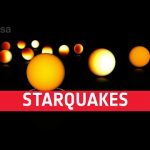
One of the surprising discoveries coming out of Gaia data release 3, is that Gaia is able to detect starquakes – tiny motions on the surface of a star – that change the shapes of stars, something the observatory was not originally built for.
Previously, Gaia already found radial oscillations that cause stars to swell and shrink periodically, while keeping their spherical shape. But Gaia has now also spotted other vibrations that are more like large-scale tsunamis. These nonradial oscillations change the global shape of a star and are therefore harder to detect.
Nonradial oscillation modes cause a star’s surface to move while it rotates, as shown in the animation. Dark patches are slightly cooler than bright patches, giving rise to periodic changes in the brightness of the star. The frequency of the rotating and pulsating stars was increased 8.6 million times to shift them into the audible range of humans.
Credit: ESA/Gaia/DPAC, CC BY-SA 3.0 IGO. Acknowledgement: Animation and sonification were created by: Dr. Joey Mombarg, KU Leuven, Belgium. Based on information from Gaia Data Release 3: Pulsations in main-sequence OBAF stars as observed by Gaia by the Gaia Collaboration, De Ridder et al., 2022, submitted to A&A. Van Reeth et al. 2015, ApJS 218, id.2, 32 pp. Mombarg et al. 2021, A&A 650, id.A58, 23 pp.
★ Subscribe: http://bit.ly/ESAsubscribe and click twice on the bell button to receive our notifications.
We are Europe’s gateway to space. Our mission is to shape the development of Europe’s space capability and ensure that investment in space continues to deliver benefits to the citizens of Europe and the world. Check out https://www.esa.int/ to get up to speed on everything space related.
Since its launch in 2013 ESA’s Gaia observatory has been mapping our galaxy from Lagrange point 2, creating the most accurate and complete multi-dimensional map of the Milky Way. By now two full sets of data have been released, the first set in 2016 and a second one in 2018. These data releases contained stellar positions, distances, motions across the sky, and colour information, among others. Now on 13 June 2022 a third and new full data set will be released. This data release will contain even more and improved information about almost 2 billion stars, Solar System objects and extragalactic sources. It also includes radial velocities for 33 million stars, a five-time increase compared to data release 2. Another novelty in this data set is the largest catalogue yet of binary stars in the Milky Way, which is crucial to understand stellar evolution.
We are Europe’s gateway to space. Our mission is to shape the development of Europe’s space capability and ensure that investment in space continues to deliver benefits to the citizens of Europe and the world. Check out https://www.esa.int/ to get up to speed on everything space related.