– Number of rocket launches since the start of the space age in 1957: About 6500 (excluding failures).
– Number of satellites these rocket launches have placed into Earth orbit: About 16 990
– Number of these still in space: About 11 500
– Number of these still functioning: About 9000
– Number of debris objects regularly tracked by Space Surveillance Networks and maintained in their catalogue: About 35 150
– Estimated number of break-ups, explosions, collisions, or anomalous events resulting in fragmentation: More than 640
– Total mass of all space objects in Earth orbit: More than 11500 tonnes
– Not all objects are tracked and catalogued. The number of debris objects estimated based on statistical models to be in orbit [MASTER-8, future population 2021]: ・36500 space debris objects greater than 10 cm ・1 000 000 space debris objects from greater than 1 cm to 10 cm ・130 million space debris objects from greater than 1 mm to 1 cm
2409 new objects were launched into space in 2022, that’s more than ever before.
Last year though, also saw a record number of satellites reenter Earth’s atmosphere.
The rising number of reentries is not necessarily a bad thing. Disposing of satellites efficiently is one of the most important things for keeping low-Earth orbits safe.
However, most objects reenter in an uncontrolled manner: they are switched off at the end of their mission and left to fall and burn up in Earth’s atmosphere.
There is good news though. Advancing technology has seen a recent increase in “controlled reentries” for rocket bodies. A controlled reentry allows operators to remove their hardware from protected regions more quickly and with greater control over where, when and how it reenters – and even lands – at the cost of allocating some fuel to do so.
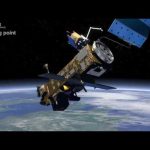
By the way, just because an older satellite wasn’t designed to be controlled during its descent doesn’t mean it’s impossible to do so. In July 2023, our teams guided the Aeolus satellite to burn up over uninhabited regions in the Atlantic and Antarctica, even though the satellite was designed in the late 1990s with no intention to control it in this way.
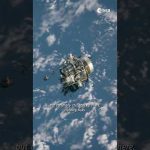
The Drag Augmentation Deorbiting System Nano – a 3.6-sq-m aluminium-coated polyamide membrane attached to four metallic booms – deployed from a 10 cm box aboard a satellite platform launched in 2021 used to deliver miniature ‘CubeSats’ into their individual orbits.
By increasing the overall area of the satellite, the sail will increase the gradual air drag acting upon it from atoms at the top of the atmosphere, and speed up its atmospheric reentry.
📹 @EuropeanSpaceAgency 📸 @hpsgermany on Instagram
★ Subscribe: http://bit.ly/ESAsubscribe and click twice on the bell button to receive our notifications.
We are Europe’s gateway to space. Our mission is to shape the development of Europe’s space capability and ensure that investment in space continues to deliver benefits to the citizens of Europe and the world. Check out https://www.esa.int/ to get up to speed on everything space related.
Our planet is surrounded by spacecraft helping us study our changing climate, save lives following disasters, deliver global communication and navigation services and help us answer important scientific questions.
But these satellites are at risk. Accidental collisions between objects in space can produce huge clouds of fast-moving debris that can spread and damage additional satellites with cascading effect.
In this animation, find out how teams at ESA’s European Space Operations Centre in Darmstadt, Germany, take action to keep satellites safe after receiving an alert warning of a possible collision between an active satellite and a piece of space debris.
When the alert is raised, ESA experts determine the risk of a collision and plan a collision avoidance manoeuvre that can be used to get the satellite out of harm’s way if necessary.
Additional observations of the piece of space debris help the team better understand its path and the risk of collision. If that risk remains too high (typically 1 in 10 000), the planned manoeuvre is carried out to temporarily change the orbit of the satellite until the threat has passed.
Each manoeuvre comes at a price. They take skill and time to plan, cost precious fuel – shortening the lifetime of the mission – and often require instruments to be temporarily shut off, preventing them from collecting important data.
While most alerts do not end up requiring evasive action, the number of alerts is rapidly increasing. Hundreds are already issued every week. Several companies have begun to launch large constellations into low-Earth orbit to provide global internet access. They have great benefits, but could be a source of huge disruption if we do not change our behaviour.
In just a few years, our current methods for avoiding collisions in space will no longer be enough. To safeguard humankind’s continued access to space for future generations, ESA is developing technologies for an automated collision avoidance system.
We are Europe’s gateway to space. Our mission is to shape the development of Europe’s space capability and ensure that investment in space continues to deliver benefits to the citizens of Europe and the world. Check out https://www.esa.int/ to get up to speed on everything space related.
The launch of Sputnik, humankind’s first satellite, in 1957 marked the dawn of a new era for the people of the ‘Pale Blue Dot’.
Decades later, our planet is now surrounded by spacecraft carrying out extraordinary work to study our changing climate, save lives following disasters, deliver global communication and navigation services and help us answer important scientific questions.
But these satellites are at risk. Accidental collisions between objects in space can produce huge clouds of fast-moving debris. These clouds can spread and damage additional satellites with cascading effect, eventually making the most useful orbits around Earth no longer safe for spacecraft or people.
Satellites today have to carry out collision avoidance manoeuvres to avoid possible impact with debris. These are costly, and hundreds of collision avoidance alerts are already issued every week. [add para space}
And this is nothing compared to what is coming. Several companies have begun to launch mega-constellations into low-Earth orbit to provide global internet access. They have great benefits, but could be a source of huge disruption if we do not change our behaviour.
Our current methods for avoiding collisions in space will become inadequate in just a few years – and even compliance with space debris mitigation guidelines may no longer be enough.
It’s time to act.
ESA is developing technologies for an automated collision avoidance system, as well as methods for refuelling, repairing and upgrading satellites in orbit, extending the lifetime of missions and potentially reducing the number of new satellites that need to be launched.
ESA is also working on debris removal missions that will fly up to dead spacecraft and debris objects, capture them and move them to safety – either by sending them down to burn up in Earth’s atmosphere or up into ‘graveyard orbits’.
By reaching into space, we have brought huge benefits down to Earth, providing technologies that enrich our societies, connect people in previously unimaginable ways and give us an incredible perspective and understanding of our planet.
We know what will happen if we continue on our current path, but we also know exactly what we need to do to change that fate and ensure humankind’s access to space is guaranteed for future generations.
We are Europe’s gateway to space. Our mission is to shape the development of Europe’s space capability and ensure that investment in space continues to deliver benefits to the citizens of Europe and the world. Check out https://www.esa.int/ to get up to speed on everything space related.
A lot goes into planning a space mission, including how to de-orbit the spacecraft once it completes its mission. Systems engineer Sara Morales Serrano of ESA’s Clean Space office discusses the problem of space debris and the tools available to clean up space.
We are Europe’s gateway to space. Our mission is to shape the development of Europe’s space capability and ensure that investment in space continues to deliver benefits to the citizens of Europe and the world. Check out http://www.esa.int/ESA to get up to speed on everything space related.
Every week, on average, a substantial, inert satellite drops into our atmosphere and burns up. Monitoring these reentries and warning European civil authorities has become routine work for ESA’s space debris experts.
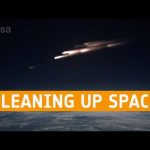
Each year, about 100 tonnes of defunct satellites, uncontrolled spacecraft, spent upper stages and discarded items like instrument covers are dragged down by Earth’s upper atmosphere, ending their lives in flaming arcs across the sky.
Some of these objects are big and chunky, and pieces of them survive the fiery reentry to reach the surface. Our planet, however, is a big place, mostly covered by water, and much of what falls down is never seen by anyone, sinking to the bottom of some ocean, or landing far from human habitation.
While still in orbit, these and many other objects are tracked by a US military radar network, which shares the data with ESA, since Europe has no such capability of its own.It’s the task of ESA’s Space Debris team to look at these data and issue updates to ESA Member States and partner civil authorities around the globe.
The European Space Agency (ESA) is part of an international effort to monitor and – ultimately – tackle space debris. This junk – accumulated in orbit since the dawn of the space age sixty years ago – poses an increasing risk to operational spacecraft.
ESA is developing missions to tackle the problem to help prevent a serious collision in space. The Agency is also monitoring possible dangers caused by fragments of redundant spacecraft falling to Earth, such as China’s space station Tiangong-1 – due to enter the atmosphere in the coming months.
Earth is surrounded by a cloud of space debris. This material ranges from dead satellites and rocket stages to fragments of material and even flecks of paint… and all this junk could do enormous damage to working satellites.
During 18–21 April, experts from around the world will meet at ESA’s European Space Operations Centre, Darmstadt, Germany for the 7th European Conference on Space Debris.
Delegates will discuss the extent of the debris problem and what can be done to ensure that satellites we rely on – providing us with services such as navigation, TV and weather forecasting – can operate safely in the future.
Talks will address acute issues like current practices in debris avoidance, novel concepts for removing debris, and the deployment of large constellations of several thousand satellites for telecommunications.
The conference will be opened by ESA Director General Jan Woerner and NASA’s former orbital debris chief scientist, Donald Kessler.
On 18 April and 21 April, live webcasts will cover the keynote address and press briefing, respectively. Details via esa.int/debris.
ESA’s proposed e.Deorbit mission plans to demonstrate the retrieval and disposal of a derelict satellite from low-Earth orbit. The mission needs to capture a massive, drifting object left in an uncertain state, which may well be tumbling rapidly. Several capture mechanisms are being studied in parallel – including casting a net.
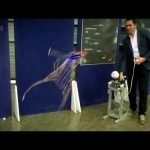
Polish company SKA Polska won this new ESA Member State’s first competitive contract to design a prototype net gun that could be tested in microgravity on a parabolic flight. Wojtek Gołebiowski of SKA Polska brought it along to the Industry Days of ESA’s Clean Space initiative – tasked with safeguarding both terrestrial and orbital environments – in May 2016. The net gun is comparatively low power (because it was designed for weightlessness) but here he demonstrates how it works on some low-flying drones. Results from firing the net, which is multi-coloured to make it easier to track by cameras, are being used to sharpen the fidelity of software models of net behaviour.
ESA’s Clean Space initiative is studying an active debris removal mission called e.Deorbit, which will target an ESA-owned derelict satellite in low orbit, capture it, then safely burn it up in a controlled atmospheric reentry. e.Deorbit will be the world’s first active debris removal mission, and will provide an opportunity for European industries to showcase their technological capabilities to a global audience.