Tag: stars

  • The future of the Orion constellation

    The future of the Orion constellation

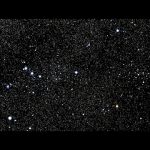
    This video reveals how our view of the Orion constellation will evolve over the next 450 000 years.

    Amid a myriad of drifting stars, the shape of Orion as defined by its brightest stars is slowly rearranged into a new pattern as time goes by.

    The portion of the sky depicted in the video measures 40 x 20º – as a comparison, the diameter of the full Moon in the sky is about half a degree.

    The video is based on data from ESA’s Gaia and Hipparcos satellites, as well as additional information from ground-based observations.

    A speeded-up version of the video is available here: http://sci.esa.int/gaia/59209

    Full story: The future of the Orion constellation http://www.esa.int/Our_Activities/Space_Science/Gaia/The_future_of_the_Orion_constellation

    The evolution of two million stellar positions on the entire sky is shown here: https://www.youtube.com/watch?v=87lgSRVUSxM

    Copyright: ESA/Gaia/DPAC CC BY-SA 3.0 IGO: https://creativecommons.org/licenses/by-sa/3.0/igo/

  • The motion of two million stars

    The motion of two million stars

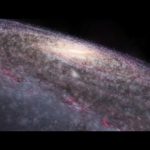
    This video reveals the changing face of our Galaxy, tracing the motion of two million stars five million years into the future using data from the Tycho-Gaia Astrometric Solution, one of the products of the first Gaia data release. This provides a preview of the stellar motions that will be revealed in Gaia’s future data releases, which will enable scientists to investigate the formation history of our Galaxy.

    The stars are plotted in Galactic coordinates and using a rectangular projection: in this, the plane of the Milky Way stands out as the horizontal band with greater density of stars.

    The video starts from the positions of stars as measured by Gaia between 2014 and 2015, and shows how these positions are expected to evolve. The frames in the video are separated by 750 years, and the overall sequence covers five million years. The stripes visible in the early frames reflect the way Gaia scans the sky and the preliminary nature of the first data release; these artefacts are gradually washed out in the video as stars move across the sky.

    The shape of the Orion constellation can be spotted towards the right edge of the frame, just below the Galactic Plane, at the beginning of the video. As the sequence proceeds, the familiar shape of this constellation (and others) evolves into a new pattern. Two stellar clusters – groups of stars that were born together and consequently move together – can be seen towards the left edge of the frame: these are the alpha Persei (Per OB3) and Pleiades open clusters.

    More about this video:
    http://sci.esa.int/gaia/59004-two-million-stars-on-the-move/

    Credit: ESA/Gaia/DPAC CC BY-SA 3.0 IGO: https://creativecommons.org/licenses/by-sa/3.0/igo/

  • The Stars of Passengers Quiz NASA Scientist

    The Stars of Passengers Quiz NASA Scientist

    NASA Scientist Tiffany Kataria drops in on Jennifer Lawrence, Chris Pratt and Michael Sheen for a fun, not so serious chat about science fiction, other worlds and time travel???

  • Press Conference: First Data Release from ESA’s Gaia Mission

    Press Conference: First Data Release from ESA’s Gaia Mission

    Launched in December 2013, Gaia is destined to create the most accurate map yet of the Milky Way. By making accurate measurements of the positions and motions of stars in the Milky Way, it will answer questions about the origin and evolution of our home galaxy.

    The first intermediate data release, containing among other things three-dimensional positions and two-dimensional motions of a subset of two million stars, demonstrates that Gaia’s measurements are as precise as planned, paving the way to create the full map of one billion stars to be released towards the end of 2017.

  • From the Solar System to the Hyades cluster

    From the Solar System to the Hyades cluster

    A virtual journey, from our Solar System through the Milky Way, based on data from the first release of ESA’s Gaia satellite.

    The journey starts by looking back at the Sun, surrounded by its eight planets. We then move away from the Sun and travel towards and around the Hyades star cluster, the closest open cluster to the Solar System, some 150 light-years away.

    The 3D positions of the stars shown in the animation are drawn from the Tycho-Gaia Astrometric Solution (TGAS), which combines information from Gaia’s first year of observations with the earlier Hipparcos and Tycho-2 Catalogues, both based on data from ESA’s Hipparcos mission.

    This new dataset contains positions on the sky, distances and proper motions of over two million stars. It is twice as precise and contains almost 20 times as many stars as the previous reference for astrometry, the Hipparcos Catalogue.

    The journey continues showing the full extent size of the stars contained in the Tycho-Gaia Astrometric Solution, all relatively near to the Sun, in the overall context of our Milky Way galaxy.

    The final Gaia catalogue will contain the most detailed 3D map ever made of the Galaxy, charting a billion stars – about 1% of the Milky Way’s stellar content – to unprecedented accuracy.

    For more information about Gaia, visit: http://www.esa.int/gaia

    Credit: ESA/Gaia/DPAC; Acknowledgement: S. Jordan & T. Sagristà Sellés (Zentrum für Astronomie der Universität Heidelberg)

  • Space timelapse over Brazil

    Space timelapse over Brazil

    ESA astronaut Alexander Gerst recorded this timelapse from the International Space Station as it flew over Brazil and the Atlantic Ocean at speeds of 28 800 km/h, 400 km above our planet.

    Read more about the Blue Dot:
    http://www.esa.int/bluedot

    Connect with Alexander Gerst:
    http://alexandergerst.esa.int

  • Gaia… mapping one billion stars

    Gaia… mapping one billion stars

    Gaia is ESA’s billion-star surveyor, designed to provide a precise 3D map of our Milky Way galaxy in order to understand its composition, formation and evolution.

  • ESA – Space to Relax / Stellar Works of Art

    ESA – Space to Relax / Stellar Works of Art

    Journey through galaxies, past star-forming clouds, around mammoth stars, and inside gas and dust nebulas. A relaxation programme of astronomical wonders by the European Space Agency.

    Originally produced for Lufthansa inflight entertainment (released June 2011).

    Credit images: XMM-Newton, Herschel, Planck, Cluster, Integral, Joint ESA/NASA Hubble Space Telescope and ESA amateur ground-based cameras.
    Credit music: “Dream Elements” by Green Sun, licensed by AmbientMusicGarden.com

  • ESA Euronews: Desvelando los secretos de Venus

    ESA Euronews: Desvelando los secretos de Venus

    Es conocido como el lucero del alba o la estrella de la mañana, pero no es una estrella: es un planeta. Venus es, junto con Marte, nuestro vecino más cercano, y al mismo tiempo, un gran desconocido. Levantamos el velo que esconde los misterios del planeta ardiente.

  • ESA Euronews: Quand Vénus se dévoile

    ESA Euronews: Quand Vénus se dévoile

    On l’appelle l’étoile du berger ou encore l’étoile du matin, mais c’est tout sauf une étoile. C’est même une planète de notre voisinage immédiat. Vénus est, avec Mars, la plus proche planète de la Terre. Proche peut-être mais au combien différente. On commence tout juste à lever quelques pans du voile qui entoure le mystère de la planète brûlante.

  • ESA Euronews: Unveiling Venus

    ESA Euronews: Unveiling Venus

    It can be called the morning or evening star, depending on where you are or what time it is, but it is anything but a star. In fact, it is one of our nearest planetary neighbours. Venus and Mars may be Earth’s close cousins, but they are oh-so different. Only now are we starting to peer through Venus’ clouds to reveal the burning planet’s secrets.

  • Understanding the Universe with ESA’s next science missions

    Understanding the Universe with ESA’s next science missions

    Herschel will investigate how stars and galaxies formed and how they continue to form in our own and other galaxies, meanwhile Planck will look back at the dawn of time, helping astronomers to study the birth and evolution of the Universe.

  • Kepler – A Search for Habitable Planets

    Kepler – A Search for Habitable Planets

    “Kepler is a critical component in NASA’s broader efforts to ultimately find and study planets where Earth-like conditions may be present,” said Jon Morse, the Astrophysics Division director at NASA Headquarters in Washington. “The planetary census Kepler takes will be very important for understanding the frequency of Earth-size planets in our galaxy and planning future missions that directly detect and characterize such worlds around nearby stars.”

    The mission will spend three and a half years surveying more than 100,000 sun-like stars in the Cygnus-Lyra region of our Milky Way galaxy. It is expected to find hundreds of planets the size of Earth and larger at various distances from their stars. If Earth-size planets are common in the habitable zone, Kepler could find dozens; if those planets are rare, Kepler might find none.

    In the end, the mission will be our first step toward answering a question posed by the ancient Greeks: are there other worlds like ours or are we alone?

  • NASA 50th Anniversary Lecture – Dr. Stephen Hawking – Part 4

    NASA 50th Anniversary Lecture – Dr. Stephen Hawking – Part 4

    NASA 50th Anniversary Lecture Series
    Dr. Stephen Hawking Lecture
    “Why We Should Go Into Space”
    George Washington University
    April 21, 2008

    In 4 parts

  • NASA 50th Anniversary Lecture – Stephen Hawking – Part 3

    NASA 50th Anniversary Lecture – Stephen Hawking – Part 3

    NASA 50th Anniversary Lecture Series
    Dr. Stephen Hawking Lecture
    “Why We Should Go Into Space”
    George Washington University
    April 21, 2008

    In 4 parts

  • NASA 50th Anniversary Lecture – Dr. Stephen Hawking – Part 1

    NASA 50th Anniversary Lecture – Dr. Stephen Hawking – Part 1

    NASA 50th Anniversary Lecture Series
    Dr. Stephen Hawking Lecture
    “Why We Should Go Into Space”
    George Washington University
    April 21, 2008

    In 4 parts