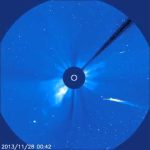
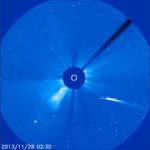
The ESA/NASA SOHO satellite watched as Comet ISON made its closest approach to the Sun on 28 November, at a distance of around 1.2 million kilometres from the Sun’s visible surface. Did it survive? Early reports suggested that only the comet’s tail continued to follow along ISON’s orbit. Further observations will reveal if a chunk of the comet’s nucleus survived. See the latest images: http://soho.esac.esa.int/hotshots/index.html/
Comet ISON on the approach to the Sun. It entered the SOHO LASCO C3 field of view at 01:41 UT on 27 November. This video covers over 24 hours of the journey so far. Will ISON survive its closest approach with the Sun? Stay tuned: http://soho.esac.esa.int/hotshots/index.html/
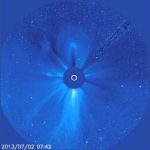
Two coronal mass ejections (CMEs) expand side-by-side from the Sun and out into space in this movie, playing out in front of the ESA/NASA Solar and Heliospheric Observatory, SOHO, on 1-2 July 2013.
The shaded disc at the centre of the image is a mask in SOHO’s LASCO instrument that blots out direct sunlight to allow study of the faint details in the Sun’s corona. The white circle added within the disc shows the size and position of the visible Sun.
Read the full experiment at http://www.stevespanglerscience.com/experiment/solar-oven-s-mores There are just some things that are synonymous with “summertime snacks,” and we can’t think of a summer snack we enjoy quite as much as s’mores. But what would you do if you weren’t allowed to have a fire or just didn’t have the tools necessary for a fire? We came up with a pretty neat way to harness the heat and energy of the sun to create a solar powered cooker that makes a delicious batch of s’mores without a fire!
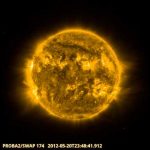
ESA’s space weather microsatellite Proba-2 observed the solar eclipse on the evening of 20 May 2012. It passed through the Moon’s shadow a total of four times, imaging a sequence of partial solar eclipses in the process. The first contact was made on Sunday May 20 at 21:09 GMT. The last contact finished at 03:04 GMT.
Mercury has always been something of a puzzle for planetary scientists. Its close position to the Sun means it is very difficult to observe, but now a series of satellites is getting up close to this fascinating planet. The European Space Agency’s BepiColombo mission is among them, and it will offer an unprecedented level of information about the mysterious world of Mercury.
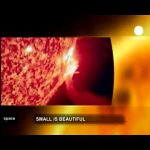
Sie haben die Größe einer Waschmaschine, doch sie beschaffen wertvolle Informationen bei der Beobachtung der Erde und der Sonne. Die Rede ist von Mikrosatelliten mit dem Namen Proba.
Comets are primeval leftovers from the origins of the Solar System. To fully understand these ancient objects and perhaps the origins of life on Earth, ESA’s Rosetta mission will rendezvous with comet Churyumov-Gerasimenko in 2014. In November of that year, Rosetta’s Philae lander will touchdown on the comet and thoroughly investigate its composition.
Space missions are complicated pieces of orbital choreography. When planning a mission, spacecraft engineers must calculate how to point the solar panels towards the Sun, the main antenna towards Earth and the instruments towards the target. ESA Space Scientist Detlef Koschny build a LEGO model of Rosetta mission in order to visualise these precise orientations.
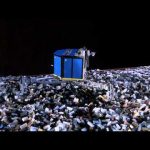
Built using LEGO Mindstorms, the Philae lander model can be controlled using a home computer. It can rotate and move the drill up and down to simulate the behaviour of the real lander. As part of ESA’s Rosetta space mission, Philae will land on comet Churyumov-Gerasimenko in November 2014 to study its composition.
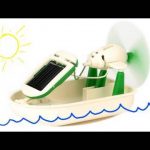
Order now at http://www.stevespanglerscience.com/product/6-in-1-solar-kit This cool science toy uses the sun to power a windmill, a plane, a boat, a car, and even make a dog wag its tail. You can build six different things with the Mini 6-in-1 Solar Kit.
About Steve Spangler Science…
Steve Spangler is a celebrity teacher, science toy designer, speaker, author and an Emmy award-winning television personality. Spangler is probably best known for his Mentos and Diet Coke geyser experiment that went viral in 2005 and prompted more than 1,000 related YouTube videos. Spangler is the founder of www.SteveSpanglerScience.com, a Denver-based company specializing in the creation of science toys, classroom science demonstrations, teacher resources and home for Spangler’s popular science experiment archive and video collection. Spangler is a frequent guest on the Ellen DeGeneres Show where he takes classroom science experiments to the extreme. Check out his pool filled with 2,500 boxes of cornstarch!
On the education side, Spangler started his career as a science teacher in the Cherry Creek School district for 12 years. Today, Steve travels extensively training teachers in ways to make learning more engaging and fun. His hands-on science boot camps and summer institutes for teachers inspire and teach teachers how to prepare a new generation for an ever-changing work force. Over the last 15 years, he has also made more than 500 television appearances as an authority on hands-on science and inquiry-based learning.
On the business side, Spangler is the founder and CEO of Steve Spangler Science, a Denver-based company specializing in the creation of educational toys and kits and hands-on science training services for teachers. The companys unique business strategies and viral creations have been featured in the Wall Street Journal, Inc. Magazine, Wired and TIME Magazine where online readers voted Steve Spangler #18 in the Top 100 Most Influential People of the Year for 2006 (what were they thinking?). You’ll find more than 140 Spangler created products available online at SteveSpanglerScience.com and distributed to toy stores and mass-market retailers worldwide.
Spangler joined NBC affiliate 9News in 2001 as the science education specialist. His weekly experiments and science segments are designed to teach viewers creative ways to make learning fun. His now famous Mentos Geyser experiment, turning 2-liter bottles of soda into erupting fountains, became an Internet sensation in September 2005 when thousands of people started posting their own Mentos explosions on YouTube.com.
As founder of SteveSpanglerScience.com, Spangler and his design team have developed more than 140 educational toys and science-related products featured by mass-market retailers like Target, Wal-Mart, Toys R’ Us, Discovery Channel Stores and over 1,400 independent specialty toy stores. His educational science catalog and on-line business offers more than a thousand science toys and unique learning resources. Recently, Spangler has been featured in the Wall Street Journal, Inc. Magazine, WIRED, the History Channel, Food Network and TIME Magazine where on-line readers voted Steve Spangler #18 in the Top 100 Most Influential People of the Year for 2006.
His recent appearances on the Ellen DeGeneres Show have taught viewers how to blow up their food, shock their friends, create mountains of foam, play on a bed of nails, vanish in a cloud of smoke and how to turn 2,500 boxes of cornstarch and a garden hose into a swimming pool of fun.
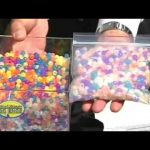
Order now at http://www.stevespanglerscience.com/product/1350 Become an ultraviolet detective with these amazing UV-sensitive beads! It’s solar magic in action! Make bracelets, test the effectiveness of sunscreen, or experiment with color while you learn about the power of sunlight. Included is a science activity guide with lots of fun experiments with solar radiation and light.
Make amazing white on blue prints with your favorite objects! Just place leaves, flowers, shells or whatever you choose on the photo-sensitive paper and place in the sun. Remove the objects after a couple of minutes and rinse the paper to “fix” it. Congratulations, you’ve made a permanent piece of sun art!