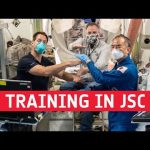
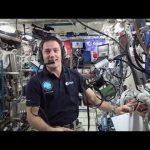
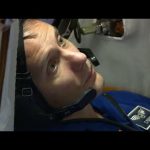
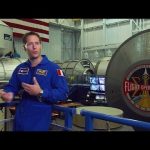
Watch as astronaut Thomas Marshburn reads out loud from the children’s book “Goodnight Moon” by Margaret Wise Brown while floating in microgravity aboard the International Space Station. Also, Astronaut Mark Vande Hei joins Thomas to answer questions sent to them. This video was featured as a part of the Crayola and Harper Kids “Read Along, Draw Along” event to commemorate the 75th anniversary of the book’s publication. Astronauts will return to the Moon as part of the Artemis program. Artemis I will be an important step in NASA’s goal to land the first woman and the first person of color on the Moon, and establish long-term lunar exploration. This mission will be the first flight test of the integrated Orion spacecraft and Space Launch System rocket.
Watch as astronaut Thomas Marshburn reads out loud from the children’s book “Goodnight Moon” by Margaret Wise Brown while floating in microgravity aboard the International Space Station. This video was featured as a part of the Crayola and Harper Kids “Read Along, Draw Along” event to commemorate the 75th anniversary of the book’s publication. Astronauts will return to the Moon as part of the Artemis program. Artemis I will be an important step in NASA’s goal to land the first woman and the first person of color on the Moon, and establish long-term lunar exploration. This mission will be the first flight test of the integrated Orion spacecraft and Space Launch System rocket.
ESA astronaut Thomas Pesquet gives a brief interview in Cologne, Germany, less than 48 hours after leaving the International Space Station.
He talks with ESA Web TV editor Julien Harrod about returning to Earth after his six-month International Space Station mission Alpha, how it feels to splash down in a @SpaceX Crew Dragon, and the differences with the Russian Soyuz spacecraft that flew him to space on his first mission, Proxima, in 2017.
After completing two six-month Space Station missions in five years, Thomas recounts the changes he saw while observing our planet Earth from 400 km above.
Thomas is the first European to fly to the International Space Station and return on a commercial spacecraft. SpaceX’s Crew Dragon Endeavour transporting Crew-2 autonomously undocked from the International Space Station and after a series of burns, entered Earth’s atmosphere and deployed parachutes for a soft water-landing. Thomas and crew splashed down on 9 November 2021 at 03:33 GMT (04:33 CET).
Thomas flew to Cologne, Germany, where he is being monitored by ESA’s space medicine team as he readapts to Earth’s gravity at ESA’s European Astronaut Centre (EAC) and @DLR ‘Envihab’ facility.
Over 200 experiments were run during Thomas’ time in space, with 40 European ones and 12 new experiments led by the French space agency @CNES. The experiments continue on Earth charting the astronauts physical adaptation to living with gravity again.
We are Europe’s gateway to space. Our mission is to shape the development of Europe’s space capability and ensure that investment in space continues to deliver benefits to the citizens of Europe and the world. Check out https://www.esa.int/ to get up to speed on everything space related.
On 4 October 2021 ESA astronaut Thomas Pesquet became commander of the International Space Station, taking over from @JAXA | 宇宙航空研究開発機構 astronaut and fellow Crew-2 member Akihiko Hoshide. Thomas will hold this role until shortly before Crew-2 return to Earth in November. Thomas officially accepted his new position during a traditional ceremony, broadcast live from the International Space Station, where a symbolic handover of a key from Aki to Thomas denoted the change of command. The full title of this role is International Space Station crew commander. While overall command of the Station lies with ground-based flight directors, unless there is an emergency on board, the role of crew commander is vital to mission success. Aki became commander on 27 April 2021 when he took over from @NASA astronaut Shannon Walker. In September Aki and Thomas conducted the first spacewalk without a Russian or US astronaut.
We are Europe’s gateway to space. Our mission is to shape the development of Europe’s space capability and ensure that investment in space continues to deliver benefits to the citizens of Europe and the world. Check out https://www.esa.int/ to get up to speed on everything space related.
Join ESA astronaut Thomas Pesquet for a tour of the International Space Station’s Russian MLM module. The module docked to the Station on 29 July 2021, bringing with it the European Robotic Arm (ERA) that will provide unprecedented access outside the Russian segment.
In this tour, Thomas explains what happened when the module arrived on Station and gives an overview of its facilities and functions. Short for Multipurpose Laboratory Module, and also known as Nauka, the module increases opportunities for science and research in microgravity.
Thomas shows the hatch to access the module, its main hall and a new toilet – the third toilet for the Space Station. He also shows the scientific racks, the piloting station for ERA, a crew quarter, and a second part of the module that will be used for docking with an airlock that will allow experiments to be sent out into the vacuum of space, and a window that – once it is functional – will provide more incredible views over Earth.
We are Europe’s gateway to space. Our mission is to shape the development of Europe’s space capability and ensure that investment in space continues to deliver benefits to the citizens of Europe and the world. Check out https://www.esa.int/ to get up to speed on everything space related.
“I like new experiences. I like to learn all the time.”
Born in Rouen, France, Thomas Pesquet is a European Space Agency Astronaut and is assigned as a Crew-2 Mission Specialist.
Thomas was selected as an ESA astronaut in May 2009. In 2016, he launched to the International Space Station for his six-month Proxima mission, as a flight engineer for Expeditions 50 and 51. His busy mission was the first to see all four cargo vehicles in operation at the time (HTV, Cygnus, Dragon and Progress). He tracked and captured two of them using the Station’s robotic arm.
During his stay in space, he took part in over 50 experiments and the six crew members set a record for hours of time spent working on science. Other highlights of his mission included two spacewalks to maintain the Station: one to replace batteries on an electrical channel, and one to fix a cooling leak and service the robotic arm.
Thomas is a black belt in judo and enjoys basketball, jogging, swimming, squash and outdoor sports such as mountain biking, kite surfing, sailing, skiing and mountaineering. He also has extensive experience in scuba diving and skydiving. His other interests include travelling, playing the saxophone and reading. Get to know Thomas Pesquet, Crew-2 Mission Specialist.
Thomas Pesquet a postulé en 2008 pour devenir un astronaute de l’ESA. Le 22 avril 2021, il décollera à destination de la Station spatiale internationale pour sa deuxième mission. Thomas partage dans cette vidéo la manière dont il s’est frayé un chemin vers l’espace, et encourage son audience à suivre la passion qui les anime alors que l’ESA est à la recherche de sa prochaine classe d’astronautes.
Personne n’est parfait la première fois qu’il effectue une tâche, mais Thomas explique que la seule manière de s’améliorer, c’est d’essayer et de continuer à essayer. Même si devenir astronaute semblait un rêve lointain quand il était plus jeune, c’est en se mettant continuellement au défi et en apprenant au fil du temps qu’il a développé les compétences nécessaires pour se présenter et faire partie du petit groupe de personnes qui sont allées dans l’espace.
Son conseil s’applique quelle que soit votre passion : faites de votre mieux, et si vous ne réussissez pas, ce n’est pas grave. Ce qui importe, c’est la persévérance.
Rendez-vous sur le https://bit.ly/YourWayToSpace pour en savoir plus sur comment devenir un astronaute de l’ESA et découvrir les autres opportunités de carrière à l’ESA.
★ Subscribe: http://bit.ly/ESAsubscribe and click twice on the bell button to receive our notifications.
We are Europe’s gateway to space. Our mission is to shape the development of Europe’s space capability and ensure that investment in space continues to deliver benefits to the citizens of Europe and the world. Check out https://www.esa.int/ to get up to speed on everything space related.
Born in Rouen, France, aerospace engineer and commercial pilot Thomas Pesquet was selected for ESA’s Astronaut Corps in 2009. He was launched on his first flight to the International Space Station in November 2016, remaining in space until June 2017 as part of his Proxima mission. He will soon be launched for on his second long-duration mission to the International Space Station called Alpha. Thomas has been training with the Station’s international partners for the new mission, including learning about the Crew Dragon, he will be the first ESA astronaut to fly on this new commercial spacecraft.
We are Europe’s gateway to space. Our mission is to shape the development of Europe’s space capability and ensure that investment in space continues to deliver benefits to the citizens of Europe and the world. Check out https://www.esa.int/ to get up to speed on everything space related.
French ESA astronaut Thomas Pesquet will soon begin his second mission to the International Space Station. Called Alpha, the mission will begin with the second operational flight of the SpaceX Crew Dragon, launched from Cape Canaveral in Florida, USA. Thomas will be the first ESA astronaut to fly in this spacecraft, which will remain docked to the Space Station for around six months before returning the crew to Earth.
We are Europe’s gateway to space. Our mission is to shape the development of Europe’s space capability and ensure that investment in space continues to deliver benefits to the citizens of Europe and the world. Check out https://www.esa.int/ to get up to speed on everything space related.
Join ESA astronauts Thomas Pesquet and Matthias Maurer at NASA’s Johnson Space Center in Houston, Texas, USA. In part four of this video series, the astronauts discuss taking photos on the International Space Station.
Though mission details and dates are yet to be confirmed, Thomas and Matthias are the next two European astronauts in line for flights. Thomas has flown to the International Space Station before, while Matthias will fly for the first time.
Prior to a mission, astronauts train extensively to ensure they are familiar with the vast array of systems and operations on board. In this video, the pair reflect on the images Thomas took during his first mission and how he plans to approach space photography the second time around.
This video was filmed in June 2020. At that time, the platform Thomas and Matthias were standing on – in front of a full-scale mock-up of the International Space Station – was the only place at NASA’s JSC that they could interact without face masks. Despite this, the pair were required to maintain social distance at all times as a precaution.
We are Europe’s gateway to space. Our mission is to shape the development of Europe’s space capability and ensure that investment in space continues to deliver benefits to the citizens of Europe and the world. Check out http://www.esa.int/ESA to get up to speed on everything space related.
ESA astronaut Thomas Pesquet has been assigned to the second operational flight of @SpaceX’s Crew Dragon spacecraft, launching to the International Space Station in 2021. Thomas’ second mission to the International Space Station will be called Alpha. This is after Alpha Centauri, the closest stellar system to Earth, following the French tradition to name space missions after stars or constellations.
We are Europe’s gateway to space. Our mission is to shape the development of Europe’s space capability and ensure that investment in space continues to deliver benefits to the citizens of Europe and the world. Check out http://www.esa.int/ESA to get up to speed on everything space related.
Join ESA astronauts Thomas Pesquet and Matthias Maurer at NASA’s Johnson Space Center in Houston, Texas, USA. In part one of this video series, the two astronauts compare notes on their journey to date as they prepare for missions to the International Space Station.
Though mission details and dates are yet to be confirmed, Thomas and Matthias are the next two European astronauts in line for flights. Thomas has flown to the International Space Station before, while Matthias will fly for the first time.
Prior to a mission, astronauts train extensively to ensure they are familiar with the vast array of systems and operations on board. In this video, the pair discuss how training for a second mission differs from a first mission, the challenges of training during a global pandemic, and how flying to the Station on US commercial crew vehicles may differ from flying on the Russian Soyuz spacecraft.
This video was filmed in June 2020. At that time, the platform Thomas and Matthias were standing on – in front of a full-scale mock-up of the International Space Station – was the only place at NASA’s JSC that they could interact without face masks. Despite this, the pair were required to maintain social distance at all times as a precaution.
We are Europe’s gateway to space. Our mission is to shape the development of Europe’s space capability and ensure that investment in space continues to deliver benefits to the citizens of Europe and the world. Check out http://www.esa.int/ESA to get up to speed on everything space related.
Our astronaut Thomas Pesquet is back at NASA’s Johnson Space Center in Houston, USA.
His first mission to the International Space Station ended in June 2017. He is now working to prepare for a his next assignment. Currently Thomas is sharing his spaceflight experience with other astronauts and engineers, acting for example as a CapCom.
We are Europe’s gateway to space. Our mission is to shape the development of Europe’s space capability and ensure that investment in space continues to deliver benefits to the citizens of Europe and the world. Check out http://www.esa.int/ESA to get up to speed on everything space related.
L’astronaute de l’ESA Thomas Pesquet, de retour sur terre, répond depuis le salon du Bourget aux questions à propos de la mission Proxima durant laquelle il a passé six mois à bord de la station spatiale internationale. Au cours de la mission, il a travaillé sur plus de 60 expériences scientifiques pour l’ESA, pour le CNES et pour les partenaires de l’ISS.
– – – – – – – – – – – – – – – – – – –
ESA astronaut Thomas Pesquet, who recently returned from the International Space Station, answers questions from the public at the Paris Air and Space Show 2017 about his six-month Proxima mission in which he took part in over 60 scientific experiments for ESA and France’s space agency CNES and the ISS partners.
Interview with ESA astronaut Thomas Pesquet at the Paris Air and Space Show, on the science of his Proxima mission and some career advice for his younger followers, 19 June 2017.
Replay of the press conference (in French) with ESA astronaut Thomas Pesquet held at the European Astronaut Centre in Cologne, Germany, on 6 June 2017. Thomas returned to Earth on 2 June 2017 after completion of his six-month Proxima mission to the International Space Station.
Thomas took part in more than 60 experiments during his mission. His experiments are helping to understand the human brain, ocean currents and radiation in space, how atoms behave and tested new spacecraft materials. Other highlights included his two spacewalks to improve and maintain the Space Station.
Highlights from ESA astronaut Thomas Pesquet’s return to Earth at the end of his six-month Proxima mission to the International Space Station on 2 June 2017.
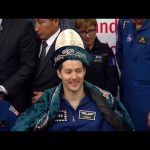
After farewells and hatch closure, Thomas and his Expedition 50/51 crewmate and Soyuz commander Oleg Novitsky undocked from the International Space Station at 12:47 CEST (10:47 GMT). Just a few hours later their spacecraft reentered Earth’s atmosphere, landing in the Kazakh Steppe at 16:10 CEST (14:10 GMT). Thomas and Oleg were helped out of the Soyuz by a recovery crew and, after medical checks, they were flown to Karaganda airport where they received the traditional welcoming ceremony. Thomas then flew directly from Karaganda to Cologne, in Germany, home to the European Astronaut Centre, to start post-flight testing.
Thomas and Oleg spent 196 days in space. Thomas took part in more than 60 experiments during his Proxima mission. His experiments are helping to understand the human brain, ocean currents and radiation in space, how atoms behave and tested new spacecraft materials. Other highlights included his two spacewalks to improve and maintain the Space Station.
Thomas Pesquet will shortly be returning to Earth after a six-month stay onboard the International Space Station. Named Proxima, this mission is the ninth long-duration flight for an ESA astronaut.
Thomas’s in-orbit schedule includes around 50 experiments for ESA and the French Space Agency CNES, and he’s so far carried out two maintenance spacewalks alongside station commander Shane Kimbrough.
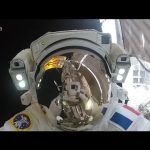
This unedited video without sound lasts over five hours and shows almost all of ESA astronaut Thomas Pesquet’s spacewalk outside the International Space Station.
NASA astronaut Shane Kimbrough and Thomas left the International Space Station airlock 24 March 2017 on their second spacewalk together. Thomas and Shane worked separately throughout their sortie.
Thomas was tasked to inspected the Station’s cooling system for leaks. He took photos and videos as he patted and prodded the cooling pipes to see if any coolant leaked out. This video starts when he turns on the camera used to record cooling system inspection for analysis by ground control.
Thomas’ second task was to maintain the multipurpose robotic hand Dextre – he had the laborious job of applying lubricant. After setting up a foot restraint to allow him to work with both hands, NASA astronaut Peggy Whitson moved Dextre into position using the controls inside the Station.
The video ends with Thomas returning to the Quest airlock – the spacewalk lasted six hours and 34 minutes in total with time spent in the airlock included.
The mission is part of ESA’s vision to use Earth-orbiting spacecraft as a place to live and work for the benefit of European society while using the experience to prepare for future voyages of exploration further into the Solar System.
This music video, directed by Jérôme de Gerlache, is a collaboration between French musician Yuksek and ESA astronaut Thomas Pesquet on the International Space Station.
The friends came up for the concept of this film to show both ships of creation: Yuksek’s studio where he composed the music inspired by Thomas Pesquet’s flight, and the spaceship where Thomas is performing science for the benefit of humanity.
Illustrating their everyday working life, they are brought together by music that crosses borders and travels easily from Earth to space. Music connects people anywhere, it is universal and that is its intrinsic beauty.
Thomas is spending six months on the International Space Station as part of his Proxima mission. During Proxima, Thomas will perform around 50 scientific experiments for ESA and France’s space agency CNES as well as take part in many research activities for the other Station partners. The mission is part of ESA’s vision to use Earth-orbiting spacecraft as a place to live and work for the benefit of European society while using the experience to prepare for future voyages of exploration further into the Solar System.
Music: Yuksek « Live Alone feat Roman Rappak »
Directed by Jérôme de Gerlache
Director of photography [space] Thomas Pesquet
Director of photography [earth] Jacques Ballard
Editor Nicolas Capus
Colorgrading Arthur Paux
Thanks to Emilien Lazaron.
Many thanks to Partyfine, Universal Music, Have a great day films, Sparks seeker
Thomas Pesquet from France has been onboard the International space Station since 19 November 2016. He is about to take part in his first Extra-Vehicular Activity (EVA, or spacewalk), performing maintenance outside the Space Station to upgrade its batteries to newer lithium-ion versions. Intensive preparations for this procedure took place in the months leading up to launch, with classroom sessions at NASA’s Johnson Space Centre in conjunction with underwater training in NASA’s Neutral Buoyancy Lab.
En tant qu’ambassadeur UNICEF, l’astronaute de l’ESA Thomas Pesquet, actuellement à bord de la Station spatiale internationale dans le cadre de l’Expédition 50, souhaite attirer l’attention sur le besoin de protéger et soutenir les jeunes générations, à l’heure où le changement climatique met toujours plus en péril leur avenir.
In his role as an ambassador for UNICEF France, ESA astronaut Thomas Pesquet, who is currently on the International Space Station as part of the Expedition 50 crew, spreads the message about the need to protect and support children in a time when climate change increasingly endangers their lives.
ESA astronaut Thomas Pesquet gives a tour of the International Space Station’s kitchen and the special food will share with his crewmates in space.
Astronauts get so-called “bonus food” for special occasions such as Christmas and New Year’s dinner. Thomas’ bonus food was prepared by ESA and France’s space agency CNES together with French chefs Thierry Marx and Alain Ducasse.
ESA astronaut Thomas Pesquet shares his Christmas plans and wishes on the International Space Station.
Flying 400 km above Earth, astronauts on the International Space Station have a unique experience and vision of our planet that they share in this video. Thomas recounts his memories growing up in Normany, France, and explains what Christmas means to him.
His end-of-year meal was prepared by French chefs – canned of course, there is no way to cook food on the Space Station and includes ox-tongue from his home-region prepared by Thierry Marx, chicken-supreme and for desert, apple gingerbread.
ESA astronaut Thomas Pesquet shares his Christmas plans and wishes on the International Space Station with Expedition 50 crewmates Shane Kimbrough and Peggy Whitson.
Flying 400 km above Earth, astronauts on the International Space Station have a unique experience and vision of our planet that they share in this video. Thomas recounts his memories growing up in Normany, France, and explains what Christmas means to him.
His end-of-year meal was prepared by French chefs – canned of course, there is no way to cook food on the Space Station and includes ox-tongue from his home-region prepared by Thierry Marx, chicken-supreme and for desert, apple gingerbread.
ESA astronaut Thomas Pesquet gives a guided tour of the International Space Station’s crew quarters – the bedrooms and only private areas for the six astronauts in the outpost.
After a day’s work running experiments and maintaining the weightless research centre astronauts can retreat to their private quarters that is no larger than a changing room. In this small space they can store personal items, use a laptop for internet and float to sleep in their sleeping bag.
On 17 November 2016, ESA astronaut Thomas Pesquet will be the tenth French astronaut to be launched into space, alongside Roscosmos commander Oleg Novitsky and NASA astronaut Peggy Whitson.
They will travel from Baikonur Cosmodrome in Kazachstan on the Soyuz MS-03, a recently upgraded version of Russia’s workhorse that has been in service for almost 50 years.
Thomas’s mission is called Proxima and it is the ninth long-duration mission for an ESA astronaut. It was named after the closed star to the Sun – continuing a tradition of naming missions with French astronauts after stars and constellations.
During Proxima, Thomas will perform more than 50 scientific experiments for ESA and CNES as well as take part in many research activities for the other Space Station partners.
With a background as an aerospace engineer and commercial pilot, Thomas Pesquet is the youngest member of ESA’s astronaut corps. Having completed several years of international training since his selection in 2009, he’ll shortly become the tenth French national to travel into orbit. His stay onboard the International Space Station – known as the Proxima mission – will last around six months.