ESA’s future launcher preparatory programme is crafting a space transportation ecosystem, guiding the companies and engineers of today to develop and test the technologies required to meet future needs.
Space transportation will be moving towards frequent reusable launchers supporting a complete industrial ecosystem around Earth. In the coming decades, the European Space Agency (ESA) foresees transportation hubs in orbit around our planet providing logistic services much like airports or train stations on Earth. These hubs will offer refilling and maintenance services for spacecraft and provide platforms for manufacturing and assembly and in space transportation to other destinations.
To create this new transportation ecosystem, new technology developments are needed, such as automatic rendezvous and capturing of spacecraft, transfer of fuel and payloads between spacecraft, tugging spacecraft to other orbits around Earth or destinations in space.
The end goal for companies working on a proof of concept is to fly a demonstrator mission in space. Together with ESA, industry will get to this point through a process that starts with discussing needs and proposing solutions, and is followed by proving their use-case and collaborating on standards and regulations. Developing and demonstrating these new technologies is also expected to open commercial opportunities for European space transportation companies.
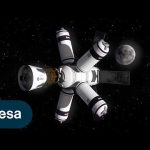
Finally, the Odyssey project proposes to put all these key technologies together into one package by providing a dedicated service for transport vehicles and spacecraft in orbit: an uncrewed propellant depot offering refilling services. Called Odyssey (a loose abbreviation for Orbital Depot for Your Sustained Space Exploration & beYond) this depot would store propellant brought from visiting supply rockets and distribute it as needed to spacecraft on a stopover to destinations farther away such as the Moon or Mars, or to Earth-orbiting navigation satellites that have used all their propellant and need a refill to extend their working life.
The Odyssey concept, if it can be demonstrated to be viable, would also be a contribution to a more sustainable use of space, by providing important elements of a future circular space economy.
Credits: European Space Agency (ESA)
Access the video on the ESA video library: https://www.esa.int/ESA_Multimedia/Videos/2025/09/Europe_s_future_space_transport_ecosystem
★ Subscribe: http://bit.ly/ESAsubscribe and click twice on the bell button to receive our notifications.
Check out our full video catalog: http://bit.ly/SpaceInVideos
Follow us on Twitter: http://bit.ly/ESAonTwitter
On Facebook: http://bit.ly/ESAonFacebook
On Instagram: http://bit.ly/ESAonInstagram
On LinkedIn: https://bit.ly/ESAonLinkedIn
On Pinterest: https://bit.ly/ESAonPinterest
On Flickr: http://bit.ly/ESAonFlickr
We are Europe’s gateway to space. Our mission is to shape the development of Europe’s space capability and ensure that investment in space continues to deliver benefits to the citizens of Europe and the world. Check out https://www.esa.int/ to get up to speed on everything space related.
Copyright information about our videos is available here: https://www.esa.int/ESA_Multimedia/Terms_and_Conditions