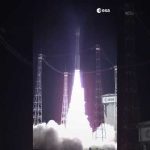
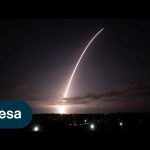
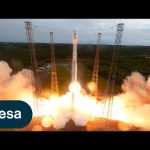
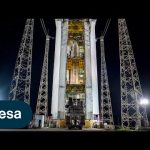
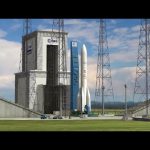
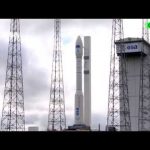
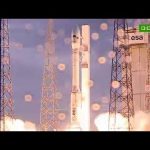
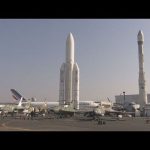
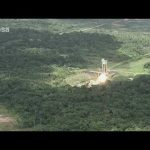
The third Copernicus Sentinel-2 satellite, Sentinel-2C, has launched aboard the last Vega rocket, flight VV24, from Europe’s Spaceport in French Guiana. The rocket lifted off on 5 September at 03:50 CEST (4 September 22:50 local time).
Sentinel-2C was the last liftoff for the Vega rocket – after 12 years of service this was the final flight, the original Vega is being retired to make way for an upgraded Vega-C.
🎥 ESA – European Space Agency Credits: ESA/CNES/Arianespace
The Copernicus Sentinel-2C satellite lifted off on 5 September at 03:50 CEST (4 September 22:50 local time) aboard the last Vega rocket, flight VV24, from Europe’s Spaceport in French Guiana.
Sentinel-2C will continue the legacy of delivering high-resolution data that are essential to Copernicus – the Earth observation component of the EU Space Programme. Developed, built and operated by ESA, the Copernicus Sentinel-2 mission provides high-resolution optical imagery for a wide range of applications including land, water and atmospheric monitoring.
Sentinel-2C was the last liftoff for the Vega rocket – after 12 years of service this was the final flight, the original Vega is being retired to make way for an upgraded Vega-C.
Credits: ESA/CNES/Arianespace
Chapters: 00:00 Waiting for liftoff 01:10 Liftoff 04:25 Second stage separation 06:18 Sentinel-2C separation 06:46 Acquisition of signal 07:23 Statements
★ Subscribe: http://bit.ly/ESAsubscribe and click twice on the bell button to receive our notifications.
We are Europe’s gateway to space. Our mission is to shape the development of Europe’s space capability and ensure that investment in space continues to deliver benefits to the citizens of Europe and the world. Check out https://www.esa.int/ to get up to speed on everything space related.
Vega joined the family of launch vehicles at Europe’s Spaceport in French Guiana in 2012. At 30-m tall the rocket weighs 137 tonnes on the launch pad and reaches orbit with three solid-propellant powered stages before the fourth liquid-propellant stage takes over. By rocket standards Vega is lightweight and powerful, the first three stages burn through their fuel and bringing Vega and its satellites to space in just six minutes.
Specialising in launches of small satellites to orbits flying the Earth’s poles, Vega has an impressive roster of missions that it has sent to space. Flagship ESA missions that flew Vega include technology demonstrator and Earth vegetation watcher Proba-V and wind-monitoring satellite Aeolus. Vega’s heaviest payload launched was the 1906-kg LISA Pathfinder, a forerunner to LISA that will measure gravitational waves in space..
In 2015 Vega launched three ESA missions in one year, including reentry demonstrator IXV that showed Europe has the technology to launch a vehicle to space and return it safely to Earth. In less than two hours Vega accelerated IXV to speeds of 27 000 km/h at a height of 412 km before the reentry vehicle splashed down in the Atlantic Ocean. This demonstration mission was a precursor to the reuseable Space Rider spacecraft that will offer regular access to space for research and in orbit validation and demonstration missions and is paired with the Vega family of launchers.
With its Vespa secondary payload adapter, first launched in 2013 on Vega’s second flight, Vega offered different options for payload ride-sharing where multiple satellites are launched on one rocket. In 2020 a variant of Vespa called the Small Spacecraft Mission Service transported over 50 satellites at once to orbit.
Sentinel-2C is the last payload that the Vega rocket launches into space – after 12 years of service. Fittingly the Sentinel-2A and Sentinel-2B satellites were launched on Vega marking a logical conclusion to Vega’s stellar roster of satellites launched.
Credits: ESA – European Space Agency
★ Subscribe: http://bit.ly/ESAsubscribe and click twice on the bell button to receive our notifications.
We are Europe’s gateway to space. Our mission is to shape the development of Europe’s space capability and ensure that investment in space continues to deliver benefits to the citizens of Europe and the world. Check out https://www.esa.int/ to get up to speed on everything space related.
It’s time to say goodbye to our rocket with its final liftoff.
On this last flight, it will carry the Copernicus Sentinel-2C, into orbit. Vega already delivered Sentinel-2A and 2B to space in 2015 and 2017 ensuring constant monitoring of our planet for precision farming, water quality monitoring, natural disaster management and detecting methane emissions.
Since its inaugural flight in 2012, Vega has launched over 20 times, serving Europe with precision and excellence. Now, Vega-C is ready to take the reins, bringing more power and capacity to future missions.
Sentinel-2C is ready for launch! The new satellite will soon join its Copernicus Sentinel-2 family in orbit – where it will continue to provide detailed views of Earth’s land and coastal waters.
The mission is based on a constellation of two identical satellites: Sentinel-2A and Sentinel-2B. The constellation was originally designed to monitor land surfaces – but its scope has since expanded.
It now covers a wide range of applications including deforestation, water quality, monitoring natural disasters, methane emissions and much more. Sentinel-2C, once in orbit, will replace the Sentinel-2A unit – prolonging the life of the Sentinel-2 mission – ensuring a continuous supply of data for Copernicus, the Earth observation component of the EU Space Programme.
Tune in to ESA WebTV on 4 September from 03:30 CEST to watch the satellite soar into space on the last Vega rocket to be launched from Europe’s Spaceport in Kourou, French Guiana.
Credits: ESA – European Space Agency
★ Subscribe: http://bit.ly/ESAsubscribe and click twice on the bell button to receive our notifications.
We are Europe’s gateway to space. Our mission is to shape the development of Europe’s space capability and ensure that investment in space continues to deliver benefits to the citizens of Europe and the world. Check out https://www.esa.int/ to get up to speed on everything space related.
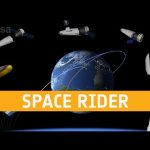
Space Rider is an uncrewed robotic laboratory about the size of two minivans. After launch on Vega-C, this reusable spacecraft will stay in low orbit for about two months, conducting research in microgravity or observing the Earth or deep space. At the end of its mission, Space Rider will return to Earth with its payloads to be unloaded and refurbished for another flight.
Credit: ESA/Frame by Frame
★ Subscribe: http://bit.ly/ESAsubscribe and click twice on the bell button to receive our notifications.
We are Europe’s gateway to space. Our mission is to shape the development of Europe’s space capability and ensure that investment in space continues to deliver benefits to the citizens of Europe and the world. Check out https://www.esa.int/ to get up to speed on everything space related.
Enjoy the inaugural flight of ESA’s new Vega-C rocket. The principal payload of this flight is LARES-2, a scientific mission of @AsiTV. Also onboard are six European research CubeSats.
We are Europe’s gateway to space. Our mission is to shape the development of Europe’s space capability and ensure that investment in space continues to deliver benefits to the citizens of Europe and the world. Check out https://www.esa.int/ to get up to speed on everything space related.
Enjoy the inaugural flight of ESA’s new Vega-C rocket. The principal payload of this flight is LARES-2, a scientific mission of @AsiTV. Also onboard are six European research CubeSats.
We are Europe’s gateway to space. Our mission is to shape the development of Europe’s space capability and ensure that investment in space continues to deliver benefits to the citizens of Europe and the world. Check out https://www.esa.int/ to get up to speed on everything space related.
Enjoy the inaugural flight of ESA’s new Vega-C rocket. The principal payload of this flight is LARES-2, a scientific mission of the @AsiTV. Also onboard are six European research CubeSats.
We are Europe’s gateway to space. Our mission is to shape the development of Europe’s space capability and ensure that investment in space continues to deliver benefits to the citizens of Europe and the world. Check out https://www.esa.int/ to get up to speed on everything space related.
As always, a new year brings new and exciting missions and launches for ESA. In science the world looks forward to the first image releases of the recently launched James Webb Space Telescope and the third data release for Gaia, both teaching us more about our galaxy and Universe. ESA’s new Mars rover will be launched with the ExoMars mission, and we will also see the maiden flights of Vega-C, Ariane 6 and the Artemis I flight. Astronaut Samantha Cristoforetti will return to the ISS for her second mission and a new class of astronauts will be presented to the world. After the groundwork has been laid in 2021 a new Ministerial Council Meeting will gather to look at the future of ESA, and the need for ESA and Europe to accelerate space and integrated space technology into the fabric of our lives.
★ Subscribe: http://bit.ly/ESAsubscribe and click twice on the bell button to receive our notifications.
We are Europe’s gateway to space. Our mission is to shape the development of Europe’s space capability and ensure that investment in space continues to deliver benefits to the citizens of Europe and the world. Check out https://www.esa.int/ to get up to speed on everything space related.
As the world leaves behind the strange and challenging year of 2020, we look towards 2021 with a mixture of relief and expectation. And this is the same at ESA, where we look forward to a brighter and very exciting 2021. This year will see Vega-C making its maiden flight, two ESA astronauts start long-duration missions on board the International Space Station, and BepiColombo and Solar Orbiter continuing their voyages around the Solar System. Also this year, we will say farewell to our current Director General Jan Wörner as his tenure ends, while welcoming into office his successor, Josef Aschbacher.
★ Subscribe: http://bit.ly/ESAsubscribe and click twice on the bell button to receive our notifications.
We are Europe’s gateway to space. Our mission is to shape the development of Europe’s space capability and ensure that investment in space continues to deliver benefits to the citizens of Europe and the world. Check out https://www.esa.int/ to get up to speed on everything space related.
Multiple small satellites will be launched at once on the Vega VV16 mission from Europe’s Spaceport in Kourou, French Guiana. This flight will demonstrate the modular SSMS dispenser resting on its upper stage intended to bring routine affordable launch opportunities for light satellites from 0.2 kg CubeSats up to 400 kg minisatellites.
Until now the smallest classes of satellites – all the way down to tiny CubeSats, built from 10 cm modular boxes – have typically ‘piggybacked’ to orbit. They have to make use of any spare capacity as a single large satellite is launched, meaning their overall launch opportunities are limited.
The new Vega Small Spacecraft Mission Service switches this into a ‘rideshare’ model, with multiple small satellites being flown together, splitting the launch cost.
SAB Aeropsace in the Czech Republic and Bercella in Italy designed and manufactured this modular dispenser for ESA’s Vega prime contractor Avio. The component structures are made of very low-density aluminium ‘sandwich’ panels protected by carbon fibre reinforced polymer skins. This makes it very lightweight and rigid.
The SSMS comprises two main sections, the hexagonal lower section can hold six nanosatellites or up to a dozen CubeSat deployers while the upper section section is used for microsatellites, minisatellites and small satellites. The lower section can also be used independently, coupled with a larger satellite replacing the top section.
The hexagonal module, a central column, towers, a supporting platform and a set of standard satellite interface spacers are assembled to suit each mission and combination of satellites. For this flight, a configuration called Flexi-3 weighing just 330 kg is being used.
This demonstration flight aims to prove the technical and financial viability of the rideshare service. ESA has collaborated with the European Union, which has partly funded this mission within the Horizon 2020 programme. This is part of the Contribution Agreement between ESA and the EU on space technology activities signed on 16 April 2019.
The animation shows the separation of the ESAIL mission which is a joint ESA LuxSpace project to extend the monitoring of maritime traffic beyond existing land-based tracking of Automatic Identification Systems (AIS) through the means of an array of microsatellites: SAT-AIS.
★ Subscribe: http://bit.ly/ESAsubscribe and click twice on the bell button to receive our notifications.
We are Europe’s gateway to space. Our mission is to shape the development of Europe’s space capability and ensure that investment in space continues to deliver benefits to the citizens of Europe and the world. Check out http://www.esa.int/ESA to get up to speed on everything space related.
Workers are returning to Europe’s Spaceport in Kourou, French Guiana to resume preparations for Vega and Ariane 5 launches. Construction of the new Ariane 6 launch pad has also restarted.
COVID-19 lockdown measures introduced in March meant that all but safety-critical operations were suspended at the Spaceport and the vast site had to be secured. Strict new safety and hygiene procedures have now been introduced. Launch teams returning from mainland Europe will spend two weeks in quarantine.
Vega is due to return to flight this summer on its first rideshare mission dedicated to small satellites and Vega’s new dispenser called the Small Spacecraft Mission Service.
★ Subscribe: http://bit.ly/ESAsubscribe and click twice on the bell button to receive our notifications.
We are Europe’s gateway to space. Our mission is to shape the development of Europe’s space capability and ensure that investment in space continues to deliver benefits to the citizens of Europe and the world. Check out http://www.esa.int/ESA to get up to speed on everything space related.
Europe’s Spaceport lies northeast of South America in French Guiana, an overseas department of France. This location near the equator enables the Ariane, Soyuz and Vega launch vehicles operated at the Spaceport to complete a wide range of missions to any orbit for clients from around the globe.
The Spaceport comes under the responsibility of the French space agency CNES while infrastructures are funded by the European Space Agency.
ESA owns the launcher and satellite preparation buildings, launch operation facilities and a plant for making solid propellant and integrating solid rocket motors.
ESA also finances new facilities, such as launch complexes and industrial production facilities for new launchers such as Vega-C and Ariane 6.
★ Subscribe: http://bit.ly/ESAsubscribe and click twice on the bell button to receive our notifications.
We are Europe’s gateway to space. Our mission is to shape the development of Europe’s space capability and ensure that investment in space continues to deliver benefits to the citizens of Europe and the world. Check out http://www.esa.int/ESA to get up to speed on everything space related.
We strive for the future of Europe in space and key to this endeavour is maintaining access to space.
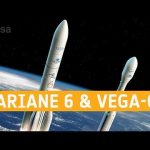
This objective is accomplished by supporting the development of new launch vehicles and next year will be an important year: Vega-C and Ariane 6 will fly for the first time.
Vega-C is an enhanced version of Europe’s current Vega, with increased power and capacity.
Ariane 6 is Europe’s next heavy-lift launcher which will replace Ariane 5. With Ariane 6 the approach is evolving for the assembly and production processes, and also in the sharing of responsibilities between us and Industry.
In parallel to preparing a new generation of launchers, we are also working on its first reusable spacecraft, Space Rider, that will fly on top of a Vega-C and which should be confirmed at Space19+, the Ministerial Conference in Seville in November 2019.
Already, the future of European Space transportation is clearly visible in Kourou where Vega-C and Ariane 6 are step-by-step becoming a reality.
★ Subscribe: http://bit.ly/ESAsubscribe and click twice on the bell button to receive our notifications.
We are Europe’s gateway to space. Our mission is to shape the development of Europe’s space capability and ensure that investment in space continues to deliver benefits to the citizens of Europe and the world. Check out http://www.esa.int/ESA to get up to speed on everything space related.
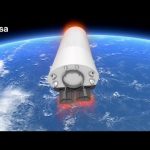
This animation shows the launch of our reusable lifting body called Space Rider atop Vega-C.
On reaching low-Earth orbit, Space Rider will serve as an unmanned high-tech space laboratory operating for periods longer than two months. It offers an array of orbit altitudes and inclinations for a large variety of experiments and demonstrations in microgravity.
After each mission Space Rider will return to Earth to land on ground to return its cargo before minimal refurbishment for its next mission.
We are Europe’s gateway to space. Our mission is to shape the development of Europe’s space capability and ensure that investment in space continues to deliver benefits to the citizens of Europe and the world. Check out http://www.esa.int/ESA to get up to speed on everything space related.
Europe’s Vega launch vehicle operating from Europe’s Spaceport in Kourou, French Guiana, has a flawless record.
Vega serves a wide range of missions and payload configurations, responding to different market opportunities. It is the ideal launcher for most scientific and Earth observation missions, benchmarked to loft 1500 kg into a 700 km-altitude circular orbit at 90° inclination.
Based on this success a more powerful #Vega, Vega-C, now in development is set to launch in mid-2019 offering greater performance at no additional cost.
Vega-C shares technology with Europe’s other new launcher Ariane 6. The P120C solid fuel motor will be used as the first stage for Vega-C and two or four will be used as strap-on boosters for Ariane 6.
ESA is Europe’s gateway to space. Our mission is to shape the development of Europe’s space capability and ensure that investment in space continues to deliver benefits to the citizens of Europe and the world. Check out http://www.esa.int/ESA to get up to speed on everything space related.
At the end of 2019 Vega-C will be launched from Europe’s Spaceport in French Guiana increasing performance from Vega’s current 1.5 t to about 2.2 t in its reference 700 km polar orbit, with no increase in launch costs.
Vega-C’s first stage is based on the P120, the largest single segment carbon fibre solid-propellant rocket motor ever built. It was successfully tested in July 2018. Its development relies on new technologies derived from Vega’s current first stage P80 motor. Two or four P120C motors will also be used for the liftoff boosters on Ariane 6.
Vega-C’s 3.3 m diameter fairing will accommodate larger payloads such as Earth observation satellites of more than two tonnes, and ESA’s Space Rider reentry vehicle.
The Vega launch pad and mobile gantry are being modified to accommodate Vega-C leading into a period when launch facilities will accommodate both vehicles.
ESA is Europe’s gateway to space. Our mission is to shape the development of Europe’s space capability and ensure that investment in space continues to deliver benefits to the citizens of Europe and the world. Check out http://www.esa.int/ESA to get up to speed on everything space related.
Euronews had a unique chance to visit the Avio rocket factory, situated in Colleferro, just south of Rome, Italy, where engineers are lovingly crafting the next generation of carbon fibre European launchers.
The site is one of the very few space rocket factories in Europe. It’s the place where the lightweight Vega launcher was born, and where the launchers of the future are being created.
Το εργοστάσιο κατασκευής πυραύλων Avio βρίσκεται στα νότια της Ρώμης. Αυτό είναι ένα από τα λίγα εργοστάσια διαστημικών πυραύλων στην Ευρώπη. Εδώ οι μηχανικοί κατασκευάζουν την επόμενη γενιά ευρωπαϊκών εκτοξευτών από ανθρακόνημα. Εδώ κατασκευάζεται ο πανάλαφρος Vega και σχεδιάζονται οι πύραυλοι του μέλλοντος.
Nella puntata di Space di questo mese abbiamo la chance unica di visitare questo posto alle mie spalle, l’azienda aerospaziale Avio a Colleferro, in provincia di Roma, dove un team di ingegneri sta lavorando alla nuova generazione europea di lanciatori in fibra di carbonio. E’ una cosa rara poter filmare dentro luoghi simili. Entriamo, quindi, incontriamo il team e scopriamo cosa c’è di nuovo.
Questa è una delle poche aziende del settore in Europa. Qui è nato il lanciatore leggero Vega. E qui saranno creati i razzi spaziali del futuro.
At the European spaceport in Kourou, French Guiana, the new launch facilities for ESA’s Ariane 6 launcher are being built. With the Ariane 6 launcher and the upgrade of the Vega to Vega C, Europe expands its launching capacities by creating versatile launchers that meet market demands. At the same time ESA supports both institutional missions and European industry as both Ariane 6 and Vega C will be fully European. With Ariane 6 and Vega C, Europe secures its independent access to space for years to come.
Replay of the liftoff of Vega VV04 with ESA’s Intermediate eXperimental Vehicle, IXV, launched from Kourou, French Guiana on 11 February 2015.
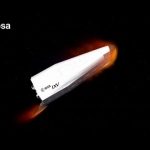
IXV was launched 340 km into space atop a Vega rocket, VV04, from Kourou in French Guiana on 11 February 2015. After separation from Vega, IXV coasted to 412 km before beginning a punishing glide back through the atmosphere. During its autonomous flight, IXV tested the latest technologies and critical systems to extend Europe’s capability for space exploration.
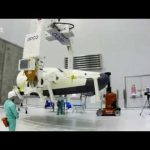
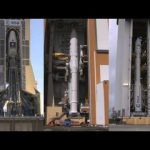
This time-lapse video shows IXV’s preparation, fairing encapsulation, transfer to the Vega mobile gantry and upper composite integration on the Vega launcher, at Europe’s Spaceport in Kourou, French Guiana, in January 2015. IXV will be launched 340 km into space on top of a Vega rocket, flight VV04, climbing to 412 km before beginning a long glide back through the atmosphere. During the flight, IXV will test the latest technologies and critical systems to help guide the design of future spaceplanes.
IXV, Europe’s Intermediate Experimental Vehicle, will soon be launched by Vega into a suborbital path. As it reenters Earth’s atmosphere, IXV will test new critical technologies to advance Europe’s ambition to return autonomously from space.
Soon, IXV, Europe’s Intermediate Experimental Vehicle, will be launched into space on a Vega launcher from Europe’s spaceport in Kourou, French Guiana. A short but crucial mission to advance Europe’s ambition to return autonomously from space.
2012 has seen three launchers lift off from Europe’s Spaceport in French Guiana. The heavy Ariane 5, the medium Soyuz and the small Vega now provide Europe with a full range of launch services and capabilities. Watch this new video of the trio’s assembly, final preparations, rollout and liftoff.
Vega, le nouveau lanceur de l’ESA, est désormais prêt pour son entrée en exploitation aux côtés d’Ariane-5 et de Soyouz, après le succès de son vol de qualification, effectué ce matin depuis le port spatial de l’Europe à Kourou (Guyane française).
Avec Vega, qui vient compléter la famille des lanceurs disponibles à Kourou, l’Europe est désormais à même de répondre à toute la gamme des besoins de lancement, que ce soit pour mettre sur orbite des petits satellites scientifiques et d’observation de la Terre ou pour entreprendre des missions de vaste envergure comme l’envoi de véhicules ESA de ravitaillement à destination de la Station spatiale internationale (ISS).
Vega a décollé pour la première fois à 10h00 GMT (11h00 heure de Paris, 7h00 heure locale) de son nouveau pas de tir, et son vol de qualification s’est parfaitement déroulé.
The family of European rockets is growing. The next one is the youngest, called Vega, soon to be launched from Europe’s Spaceport in French Guiana.
This new rocket complements the range that Europe already has to offer in the commercial market.
La famiglia dei vettori spaziali europei si allarga con il prossimo lancio di Vega dalla base europea della Guyana francese. Questo nuovo lanciatore va a completare l’offerta della gamma europea nell’ambito dei razzi commerciali. Ne parliamo nella rubrica Space.
This video presents the key events in 2012 for ESA.
André Kuipers continues his PromISSe mission aboard the International Space Station until May, the 4th ESA long duration mission. During his stay the third European ATV cargo ship will bring food and supplies to the orbital outpost. Early in the year the new Vega launcher will make its qualifying flight from Europe’s Spaceport in French Guiana. The end of the year will be marked by an ESA Conference at Ministerial level, a major decision point for the future of Europe in Space.
More backgroud information can be found on: www.esa.int
Ariane 5, la punta de lanza de la industria europea de cohetes espaciales, lidera el mercado de lanzadores comerciales. En breve, otros cohetes se le unirán para completar la oferta europea, haciendo de 2011 el año de los lanzadores espaciales europeos
Ariane 5, the European space industry’s workhorse, continues to successfully carry payloads into orbit. Two new launchers will soon complement Ariane 5, offering a full range of competitive services to Europe. 2011 will be the year of the launchers.
Building Costs are being kept to a minimum by using advanced low-cost technologies and existing production facilities used for Ariane launchers, making access to space easier, quicker and cheaper.