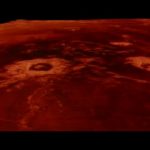
Launched in 2005, ESA’s Venus Express spacecraft has been observing Earth’s so called ‘sister’ planet from a unique point of view: in orbit around Venus itself. This mission is providing scientists with detailed information about the Venusian atmosphere and in the course of these studies many surprises have emerged.
Tag: Venus Express
-

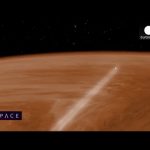
ESA Euronews: Close encounters with Venus
Venus is our mysterious neighbour, a strange world where the Sun rises in the west and sets in the east, and a day lasts longer than a year. ESA’s Venus Express mission has spent the last eight years gathering data to offer science a fresh insight into the atmosphere and climate of the planet, including a daring aerobraking manœuvre this summer that revealed previously unknown waves in the upper atmosphere.
This video is also available in the following languages:
French http://youtu.be/I0uD82RfGHI
German: http://youtu.be/tXgiaR_5kPM
Italian: http://youtu.be/vs3OxPoF80o
Portuguese: http://youtu.be/N7Y_jU7e_FU
Spanish: http://youtu.be/luPHUdRhF1s
Greek: http://youtu.be/xQmFD44gV_w
Hungarian: http://youtu.be/1-hDeyd5ISQ -
ESA Euronews: Találkozások Vénusszal
A Vénusz a Föld legközelebbi szomszédja, amelyről ehhez képest elég keveset tudunk. Különleges világ, ahol a Nap Nyugaton kel és Keleten megy le, egy nap pedig tovább tart, mint egy év. Az Európai Űrügynökség – az ESA Vénusz Expressz missziója az elmúlt évben nagy mennyiségű adatot gyűjtött össze, a bolygó légköréről és klímájáról. Egy kockázatos légfékezési manőverrel pedig korábban ismeretlen hullámzást fedeztek fel a bolygó sűrű atmoszférájának felső rétegeiben.
-
ESA Euronews: Στενές επαφές τρίτου τύπου με την Αφροδίτη
Η Αφροδίτη είναι ο μυστηριώδης γείτονάς μας. Ένας παράξενος κόσμος, όπου ο ήλιος ανατέλλει στη Δύση, δύει στην Ανατολή και μία ημέρα διαρκεί περισσότερο από ένα έτος. Η αποστολή “Venus Express” του Ευρωπαϊκού Οργανισμού Διαστήματος συγκεντρώνει τα τελευταία οκτώ χρόνια στοιχεία, που προσφέρουν μία ανανεωμένη εικόνα για την ατμόσφαιρα και το κλίμα στον πλανήτη Αφροδίτη. Η τολμηρή αεροπέδηση αποκαλύπτει άγνωστα κύματα στα ανώτερα στρώματα της ατμόσφαιρας.
-
ESA Euronews: Acercándose a Venus
Venus, un misterioso vecino. Un extraño mundo donde el Sol sale por el oeste y se oculta por el este y el día dura más de un año terrestre. La misión de la ESA Venus Express ha pasado 8 años recogiendo datos sobre la atmósfera y el clima de este planeta tan singular. Gracias a la técnica del “aerobraking”, la nave pudo acercarse a la atmósfera de Venus revelando la existencia de olas desconocidas hasta ahora.
-
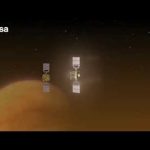
Venus Express aerobraking
Visualisation of the Venus Express aerobraking manoeuvre, which will see the spacecraft orbiting Venus at an altitude of around 130 km from 18 June to 11 July. In the month before, the altitude will gradually be reduced from around 200 km to 130 km. If the spacecraft survives and fuel permits, the elevation of the orbit will be raised back up to approximately 450 km, allowing operations to continue for a further few months. Eventually, however, the spacecraft will plunge back into the atmosphere and the mission will end.
Credit: ESA–C.Carreau
-

ESA Euronews: The real-life space cadets: Abbie, Marc and Maria
Meet the space cadets, three young engineers with enviable jobs that are quite literally out of this world. This edition of Space focuses on three professionals who’ve turned their dreams of working in space into real down-to- Earth careers.
In the UK, 26-year-old Abbie Hutty, a spacecraft structures engineer at Astrium, is a proud member of the ExoMars team. She is developing the structure of the mission’s rover, ensuring that the actual body of the vehicle and other components are all structurally strong enough to withstand the launch from Earth, and landing on Mars.
Twenty-seven-year-old Marc Costa Sitjà, Science Operations Engineer at the European Space Agency, uses the huge antenna at Cebreros, west of Madrid, to ‘drive’ ESA’s Venus Express spacecraft around the planet. Every day he sends commands and receives data to and from the spacecraft from the agency’s ESAC facility near the Spanish capital.
Maria Komu, a 27-year-old researcher at the Finnish Meteorological Institute, works on Finnish mini satellite Aalto-1, and has a hands-on role developing a weather instrument for ESA’s ExoMars EDM mission.
Space is a childhood dream turned reality for all three. For Abbie the realisation that space wasn’t just science fiction came when she was still at school and she heard of the Beagle 2 mission to Mars, a lander that was developed in the UK by British engineers. Maria tells the story of a book about a school visit around the solar system that enchanted her as a young girl. Meanwhile Marc cites a vivid blue image of Venus as an inspiration to his career.
Abbie, Marc and Maria are all educated to masters level, while Maria continues studying towards a doctorate. They’re on the first steps of the career ladder, and that means plenty of learning ‘on-the-job’. Maria had to master soldering, programming, and testing, Marc developed his skills by creating software that helped a mission to better fulfill its purpose, while Abbie had to understand better the behaviour of particular materials in the cold vacuum of space.
The excitement of working in space is summed up by Abbie: “I think the space industry is quite a privileged industry to work in, because whilst you are still managing projects and meeting schedules and deadlines, and creating a product, at the end of the day that requires a certain amount of processes down on it, you can also come down to the clean rooms and look through the window and see your part of a spaceship, and think ‘that’s going to Mars, and I did that bit’, and you don’t get that anywhere else.”
-
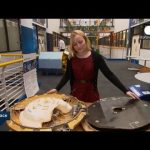
ESA Euronews: Δουλεύοντας στο διάστημα… από τη Γη
Η Μαρία, ο Μαρκ και η Άμπι είναι τρεις νέοι μηχανικοί κι έχουν τρεις διαφορετικές ιστορίες, αλλά με ένα κοινό γνώρισμα. Η δουλειά τους είναι στη Γη, αλλά φεύγει από τα όριά της. Και οι τρεις πραγματοποίησαν το όνειρό τους: δουλεύουν στη διαστημική βιομηχανία. Και δηλώνουν ευτυχισμένοι γι’αυτό.
Λίγο μετά τα είκοσί τους χρόνια, ήδη έχουν σημαντικές ευθύνες.
Η Μαρία εργάζεται σε έναν φινλανδικό μίνι δορυφόρο και σε εργαλεία πρόγνωσης καιρού για την αποστολή ExoMars της ESA. Η Άμπι αναπτύσσει τη δομή του οχήματος της αποστολής. Ο Μαρκ σχεδιάζει τις επιχειρήσεις του δορυφόρου Venus Express της ESA.
Η Άμπι και ο Μαρκ έχουν μεταπτυχιακές σπουδές, ενώ η Μαρία είναι υποψήφια διδάκτωρ. Και οι τρεις λένε πως εμπνεύστηκαν από την ιδέα της εξερεύνησης του ηλιακού μας συστήματος.
Πλοήγηση δορυφόρων, κατασκευή διαστημικών οχημάτων και μετεωρολογικών σταθμών για τον Άρη. Όλα αυτά απαιτούν δεξιότητες, γνώση και αφοσίωση.
Δυσκολίες υπάρχουν σίγουρα. Όμως κανείς εκ των τριών δεν χάνει από το βλέμμα του τη μοναδική φύση μιας καριέρας στο διάστημα.
-
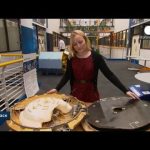
ESA Euronews: La nouvelle génération de l’espace
L’espace fascine bon nombre d’entre nous, mais bien peu ont la chance de travailler dans le domaine de la recherche spatiale. Nous avons rencontré trois jeunes ingénieurs qui ont entamé une carrière, la tête dans les étoiles et les pieds sur Terre.
A Helsinki, Maria Komu nous fait découvrir son lieu de travail : l’Institut météorologique finlandais qui dispose d’un laboratoire spatial. “Il y a à peine cinq ans, mon plus grand rêve, c’était simplement de pouvoir toucher quelque chose qui allait dans l’espace,” nous confie la jeune femme. “Aujourd’hui, je conçois des instruments qui vont dans l’espace, c’est incroyable !” s’enthousiasme-t-elle. Maria travaille sur un mini-satellite et des instruments météo pour le démonstrateur EDM de la mission ExoMars de l’Agence spatiale européenne (ESA).
Au nord de Londres, découvrons à présent, l’univers d’Abbie Hutty, ingénieur spatial structures chez Astrium. Son travail qui d’ailleurs, la passionne : s’assurer que “le corps du rover ExoMars est assez solide pour pouvoir supporter notamment le lancement, l’arrivée au sol et l’entrée dans l’atmosphère,” nous explique-t-elle.
En Espagne, à Cebreros, près de Madrid, Marc Costa Sitjà nous présente l’antenne à gain élevé qui permet à son équipe de communiquer avec le satellite Venus Express (ESA) pour gérer son pilotage. La parabole permet aux scientifiques d’envoyer des ordres de commande à l’engin et de recevoir des données en sa provenance comme une image de Vénus unique qu’ils ont réussi à constituer à partir de toute une série d’observations.
Nos trois jeunes ingénieurs ont choisi ces métiers pour explorer notre système solaire et peut-être éclaircir ses mystères. Une motivation qui les anime parfois depuis l’enfance. Chacun reconnaît avoir de la chance de mener une vie professionnelle dans un secteur qui les fascine. La Finlandaise Maria Komu aimerait poursuivre son rêve éveillé en visitant “d’immenses chambres à vide et peut-être des simulateurs solaires :c’est ce que je préfèrerais,” nous lance-t-elle avant de conclure : “et bien sûr, si je pouvais assister en vrai au lancement d’une fusée, ce serait vraiment cool !”
-

ESA Space Scientist Detlef Koschny explains why he originally built Rosetta in LEGO®
Space missions are complicated pieces of orbital choreography. When planning a mission, spacecraft engineers must calculate how to point the solar panels towards the Sun, the main antenna towards Earth and the instruments towards the target. ESA Space Scientist Detlef Koschny build a LEGO model of Rosetta mission in order to visualise these precise orientations.
Copyright © Lightcurve Films/Maarten Roos, ESA, DLR, Europlanet, LEGO
-
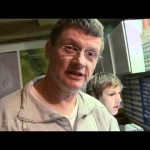
ESA Space Scientist Detlef Koschny demonstrates the prototype LEGO® Philae lander
Built using LEGO Mindstorms, the Philae lander model can be controlled using a home computer. It can rotate and move the drill up and down to simulate the behaviour of the real lander. As part of ESA’s Rosetta space mission, Philae will land on comet Churyumov-Gerasimenko in November 2014 to study its composition.
Copyright © Lightcurve Films/Maarten Roos, ESA, DLR, Europlanet, LEGO