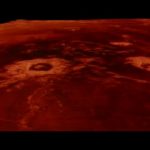
Launched in 2005, ESA’s Venus Express spacecraft has been observing Earth’s so called ‘sister’ planet from a unique point of view: in orbit around Venus itself. This mission is providing scientists with detailed information about the Venusian atmosphere and in the course of these studies many surprises have emerged.
Tag: Venus (Planet)
-

ESA Euronews: Close encounters with Venus
Venus is our mysterious neighbour, a strange world where the Sun rises in the west and sets in the east, and a day lasts longer than a year. ESA’s Venus Express mission has spent the last eight years gathering data to offer science a fresh insight into the atmosphere and climate of the planet, including a daring aerobraking manœuvre this summer that revealed previously unknown waves in the upper atmosphere.
This video is also available in the following languages:
French http://youtu.be/I0uD82RfGHI
German: http://youtu.be/tXgiaR_5kPM
Italian: http://youtu.be/vs3OxPoF80o
Portuguese: http://youtu.be/N7Y_jU7e_FU
Spanish: http://youtu.be/luPHUdRhF1s
Greek: http://youtu.be/xQmFD44gV_w
Hungarian: http://youtu.be/1-hDeyd5ISQ -
ESA Euronews: Találkozások Vénusszal
A Vénusz a Föld legközelebbi szomszédja, amelyről ehhez képest elég keveset tudunk. Különleges világ, ahol a Nap Nyugaton kel és Keleten megy le, egy nap pedig tovább tart, mint egy év. Az Európai Űrügynökség – az ESA Vénusz Expressz missziója az elmúlt évben nagy mennyiségű adatot gyűjtött össze, a bolygó légköréről és klímájáról. Egy kockázatos légfékezési manőverrel pedig korábban ismeretlen hullámzást fedeztek fel a bolygó sűrű atmoszférájának felső rétegeiben.
-
ESA Euronews: Στενές επαφές τρίτου τύπου με την Αφροδίτη
Η Αφροδίτη είναι ο μυστηριώδης γείτονάς μας. Ένας παράξενος κόσμος, όπου ο ήλιος ανατέλλει στη Δύση, δύει στην Ανατολή και μία ημέρα διαρκεί περισσότερο από ένα έτος. Η αποστολή “Venus Express” του Ευρωπαϊκού Οργανισμού Διαστήματος συγκεντρώνει τα τελευταία οκτώ χρόνια στοιχεία, που προσφέρουν μία ανανεωμένη εικόνα για την ατμόσφαιρα και το κλίμα στον πλανήτη Αφροδίτη. Η τολμηρή αεροπέδηση αποκαλύπτει άγνωστα κύματα στα ανώτερα στρώματα της ατμόσφαιρας.
-
ESA Euronews: Acercándose a Venus
Venus, un misterioso vecino. Un extraño mundo donde el Sol sale por el oeste y se oculta por el este y el día dura más de un año terrestre. La misión de la ESA Venus Express ha pasado 8 años recogiendo datos sobre la atmósfera y el clima de este planeta tan singular. Gracias a la técnica del “aerobraking”, la nave pudo acercarse a la atmósfera de Venus revelando la existencia de olas desconocidas hasta ahora.
-
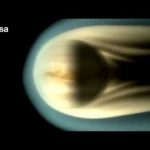
Venus Express plunging into the atmosphere
After eight years in orbit, ESA’s Venus Express has completed routine science observations and is preparing for a daring plunge into the planet’s hostile atmosphere.
Venus Express was launched on 9 November 2005, and arrived at Venus on 11 April 2006.
It has been orbiting Venus in an elliptical 24-hour loop that takes it from a distant 66 000 km over the south pole — affording incredible global views — to an altitude of around 250 km above the surface at the north pole, close to the top of the planet’s atmosphere.
With a suite of seven instruments, the spacecraft has provided a comprehensive study of the ionosphere, atmosphere and surface of Venus.
This video includes interviews in English with Håkan Svedhem, ESA mission scientist and Patrick Martin, ESA Venus Express mission manager
-
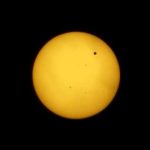
Transiting the midnight sun
Time lapse movie of the transit of Venus, as seen from the land of the midnight sun in Svalbard. Interference from cloud gives an eerie feel to the scene.
Credits: ESA – Andy Oates
-
Venus Express and transit of Venus
This movie was compiled from images taken by the Venus Monitoring Camera on Venus Express as it approached the planet on its elliptical orbit on 1 June 2012. Initially, the spacecraft is looking at the south side of the planet from a distance of 63 000 km and clouds can be seen moving below. As the spacecraft draws closer, Venus starts filling the field of view and the equatorial regions can be seen. The sequence finishes with observations of cloud features at high latitudes.
Copyright: ESA/MPS/DLR/IDA
-
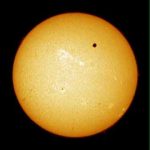
Venus Transit seen from Longyearbyen, Spitsbergen
Cloudy weather did impact on the Venus transit observations at Longyearbyen, Spitsbergen. Still most of the Venus transit could be captured.
Credit: ESA – M. Breitfellner, M. Perez -
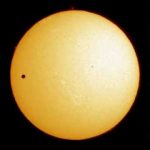
Venus Transit seen from Canberra, Australia (part 2)
Almost the whole Venus transit could be captured despite of some clouds did get into the way of those observing the Venus Transit in Canberra, Australia.
Credit: ESA – Manuel Castillo-Fraile and Miguel Sanchez-Portal -
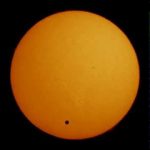
Venus Transit seen from Canberra, Australia (part 1)
Almost the whole Venus transit could be captured despite of some clouds did get into the way of those observing the Venus Transit in Canberra, Australia.
Credit: ESA – Manuel Castillo-Fraile and Miguel Sanchez-Portal -
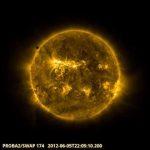
Venus solar transit 2012 – Proba-2’s journey across the Sun
This movie shows the transit of Venus on 5-6 June 2012 as seen from SWAP, a Belgian solar imager onboard ESA’s PROBA2 microsatellite. SWAP, watching the Sun in EUV light, observes Venus as a small, black circle, obscuring the EUV light emitted from the solar outer atmosphere – the corona – from 19:45UT onwards. At 22:16UT – Venus started its transit of the solar disk
The bright dots all over the image (‘snow storm’) are energetic particles hitting the SWAP detector when PROBA2 crosses the South Atlantic Anomaly, a region where the protection of the Earth magnetic field against space radiation is known to be weaker.
Note also the small flaring activity in the bright active region in the northern solar hemisphere as Venus passes over. Towards the end, you can see a big dim inverted-U-shape moving away from the Sun towards the bottom-right corner. This is a coronal mass ejection taking off.
Credit: ESA/ROB