This stunning artist’s animation of the Milky Way is based on data from ESA’s Gaia space telescope. Gaia has completely reshaped our understanding of our home galaxy—revealing unexpected details about its spiral arms, central bar, and overall structure.
We can’t take a selfie of the Milky Way, but thanks to Gaia, we’re seeing it clearer than ever! And with more data releases on the way, our view will only get sharper.
Oxia Planum contains one of the largest exposures of rocks on Mars that are around 3.9 billion years old and clay-rich, indicating that water once played a role here. The site sits in a wide catchment area of valley systems with the exposed rocks exhibiting different compositions, indicating a variety of deposition and wetting environments.
A European rover, Rosalind Franklin, is part of the ExoMars programme that will explore the surface of Mars. The rover will be the first mission to combine the capability to move across the surface and to study Mars at depth.
On 28 November 1983, the first European-built Spacelab was launched from @NASAKennedy aboard Space Shuttle Columbia.
Also on board was Ulf Merbold, who became our first astronaut in space. The 10-day Spacelab-1 mission marked our entry into human spaceflight activities.
Under a cooperation agreement with @NASA, we were to build a modular research laboratory that would fit inside the Shuttle’s cargo bay.
In 17 years, European Spacelab equipment flew on 36 missions. The two Spacelab modules eventually made 16 flights with five different Shuttle Orbiters.
Many of Spacelab’s features live on in space hardware that is flying today. Europe’s Columbus laboratory on the Station evolved from Spacelab.
★ Subscribe: http://bit.ly/ESAsubscribe and click twice on the bell button to receive our notifications.
We are Europe’s gateway to space. Our mission is to shape the development of Europe’s space capability and ensure that investment in space continues to deliver benefits to the citizens of Europe and the world. Check out https://www.esa.int/ to get up to speed on everything space related.
Explore the mysteries behind the Earth-Moon system’s origin with these four intriguing theories. 🌍🌕 Which one do you think holds the key to our celestial companion’s creation?
Join ESA astronaut Samantha Cristoforetti for a guided tour of the International Space Station’s crew quarters – the bedroom.
After a day’s work running experiments and maintaining the weightless research centre astronauts can retreat to their private quarters that is no larger than a changing room. In this small space they can store personal items, use a laptop for internet and float to sleep in their sleeping bag.
Where are the Moon rocks from the Apollo missions kept? When they’re not being studied by institutions or enjoyed by museumgoers, NASA has a specialized Lunar Sample Curation Laboratory at NASA’s Johnson Space Center to store and keep these otherworldly samples safe. Studying these samples helps us learn more about the origin of not only our moon, but our planet. Deputy Apollo Sample Curator (Sept 2019 – Dec 2022) Dr. Juliane Gross explains more about lunar sample curation.
Producers: Scott Bednar, Jessica Wilde Editor: David Shelton
Where does space begin? Well, it depends. There’s no sharp boundary that marks the end of atmosphere and beginning of space. But no matter where you draw the line in the sand — or the air — Earth’s atmosphere is full of all kinds of interesting stuff. That’s why scientists like Doug Rowland are studying its many layers: https://climate.nasa.gov/news/2919/earths-atmosphere-a-multi-layered-cake/
Mecklenburg–West Pomerania is one of Germany’s least populated states. Nearly two-thirds is covered by farmland with the main crops being rye, wheat, barley and hay. The green areas present in this image are most likely winter wheat and winter rapeseed. The region’s pastures typically support sheep, horses and cattle.
On the state’s coastline on the Baltic Sea lie many holiday resorts, unspoilt nature and the islands of Rügen and Usedom, as well as many others.
We are Europe’s gateway to space. Our mission is to shape the development of Europe’s space capability and ensure that investment in space continues to deliver benefits to the citizens of Europe and the world. Check out https://www.esa.int/ to get up to speed on everything space related.
In Rovaniemi, the Arctic Circle runs through Santa Claus Village, located eight kilometres north of the city centre. The Arctic Circle marks the southernmost latitude where the sun can stay continuously below or above the horizon for 24 hours – these phenomena are known as the Midnight Sun in the summer and the Polar Night in the winter.
We are Europe’s gateway to space. Our mission is to shape the development of Europe’s space capability and ensure that investment in space continues to deliver benefits to the citizens of Europe and the world. Check out https://www.esa.int/ to get up to speed on everything space related.
Where did our Moon come from? Over the years, there have been several theories, but most scientists think it’s likely that a Mars-sized object smashed into Earth, creating what we now see in the sky.
Where do moons come from? From cataclysmic impacts to gravitational capture, NASA planetary scientist Joe Renaud walks us through some of the many theories of how the unique and captivating moons in our solar system came to be. https://solarsystem.nasa.gov/moons/overview/
Producers: Scott Bednar, Jessica Wilde Editor: James Lucas
The universe is incredibly old, astoundingly vast and populated by trillions of planets — so where are all the aliens? Astronomer Stephen Webb has an explanation: we’re alone in the universe. In a mind-expanding talk, he spells out the remarkable barriers a planet would need to clear in order to host an extraterrestrial civilization — and makes a case for the beauty of our potential cosmic loneliness. “The silence of the universe is shouting, ‘We’re the creatures who got lucky,’” Webb says.
The TED Talks channel features the best talks and performances from the TED Conference, where the world’s leading thinkers and doers give the talk of their lives in 18 minutes (or less). Look for talks on Technology, Entertainment and Design — plus science, business, global issues, the arts and more.
As a centre of excellence for mission operations since 1967, ESA’s ‘mission control’ delivers expertise and experience in a unique mix that serves the scientific and engineering goals of ESA, and enables economically vital European programmes like Copernicus and Galileo.
ESOC is home to highly specialised teams who control and navigate spacecraft, manage ESA’s worldwide tracking station network, and build the ground systems that enable satellites to conduct their missions. Spacecraft flown from ESOC are studying our planet and helping us understand climate change through realtime Earth data, and are exploring our Sun and Solar System or peering deep into the mysteries of time and space.
The centre is unique and unparalleled in its ability to control sophisticated probes, and to design, develop and build everything needed on ground to successfully fly satellites in space.
Our world is about systems, communication and exploration; our passion is for humanity’s voyages into the Universe.
Join ESA astronaut Samantha Cristoforetti for a guided tour of the International Space Station’s crew quarters – the bedroom.
After a day’s work running experiments and maintaining the weightless research centre astronauts can retreat to their private quarters that is no larger than a changing room. In this small space they can store personal items, use a laptop for internet and float to sleep in their sleeping bag.
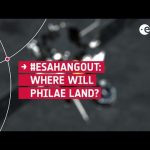
Join us to talk about the possible landing sites on comet 67P/Churyumov-Gerasimenko for Rosetta’s lander Philae.
The Hangout will also include a live draw for participants who took part in our ‘Rosetta, are we there yet?’ photo contest – watch to see if you win ESA swag!
Our hosts will be joined by:
Fred Jansen – Rosetta Mission Manager and/or Matt Taylor – Rosetta Project Scientist [TBC]
Andrea Accomazzo – Rosetta Flight Director
Barbara Cozzoni and/or Valentina Samodelov – Philae Operations Engineer, +DLR, German Aerospace Center [TBC]
Send us your questions before or during the hangout by posting a comment on this event – or on Twitter using #AskRosetta
We don’t know where you’re going, but we do know that Rosetta is about to arrive at comet 67P/Churyumov-Gerasimenko. Join the adventure and share your ‘are we there yet?’ photos to win great prizes.