Pár nappal ezelőtt az Európai Űrügynökség sikeresen felébresztette a hibernációból a Rosetta nevű műholdat, amely hamarosan egyedülálló küldetésre indul: leszállóegységet próbál ereszteni egy üstökös felszínére.
2014. január huszadikán a világ szeme az Európai Űrügynökség csapatára szegeződött, amint arra vártak, hogy az űreszköz válaszoljon.
A bottle balances precariously on it’s mouth. Nothing special, right? Well… put a dollar bill underneath the bottles mouth. Now, bet your friends a dollar that they can’t pull the dollar out from under the bottle without knocking it over. Sit back and enjoy their futile attempts as friend after friend knocks the bottle over. What’s the secret? Read on to find out!
Newly hired ESA staff met for an information day at the European Astronaut Centre and were introduced to particular aspects of the ESA working culture.
Earth from Space is presented by Kelsea Brennan-Wessels from the ESA Web-TV virtual studios. Mount Kilimanjaro in Tanzania and the plains in southern Kenya are pictured in a false-colour image featured in the ninetieth edition.
NASA will reflected on the work of Mars rover Opportunity during a news conference on Jan. 23.
Opportunity landed on the Red Planet Jan. 24, 2004, three weeks behind a twin rover named Spirit. Both rovers made important discoveries about wet environments that could have supported microbial life on ancient Mars. Spirit stopped communicating with Earth in 2010, but Opportunity is continuing to provide scientific results, and currently is investigating the rim of a crater 14 miles (22 kilometers) wide.
You can have a ton of science fun with a straw. You can make it into a blow gun, using the properties of air, or it can double as a pipette when your lab has run out. But did you know you can perform some awesome hands-on science with the straw’s wrapper, too? It’s true. With the Wrapper Worm, we’ll reveal how to turn an ordinary straw wrapper into a growing worm!
Replay of Part 3 of the Rosetta wake-up media briefing at the ESA Operations Centre ESOC, in Darmstadt, Germany, on 20 January 2014.
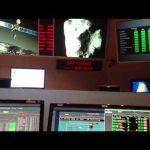
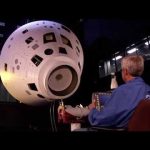
Waiting for the signal from Rosetta. View inside the Mission Control Room at ESOC as the team waits for a first signal that Rosetta has successfully come out of deep space hibernation.
Rosetta was launched in 2004 and has since travelled around the Sun five times, picking up energy from Earth and Mars to line it up with its final destination: comet 67P/Churyumov–Gerasimenko. For the coldest, loneliest leg of the mission, as Rosetta travelled out towards the orbit of Jupiter, the spacecraft was put into deep-space hibernation.
In 2014, Rosetta will complete its cruise towards the comet, rendezvousing with it in August, before putting its Philae lander onto the comet’s surface in November, as it begins its journey closer to the Sun.
The spacecraft’s internal alarm clock is set for 10:00 GMT (11:00 CET) on 20 January. Once it has warmed itself up, it should re-establish communication with Earth several hours later.
Video highlight showing receipt of signal from ESA’s Rosetta comet chaser after 31 months of deep-space hibernation. Teams at ESA’s operations centre in Darmstadt, Germany, leapt for joy as the signal was confirmed via NASA’s 70m tracking stations in California and Australia.
The clock inside ESOC’s Main Mission Control counts down to 10:00 GMT (11:00 CET) on 20 January 2014 – the moment when ESA’s Rosetta spacecraft was woken from a 31-month deep space hibernation.
ESA Director General Jean-Jacques Dordain met with media at the traditional start-of-year briefing on the activities and challenges for 2014. Friday 17 January, ESA-HQ Daumesnil, Paris
Space missions have been chasing comets since the launch of the Giotto spacecraft in 1985. NASA’s Stardust mission flew through a comet’s tail in 2006 and brought a sample of dust back to Earth. Glycene was found in this sample, one of the four basic amino acids in our DNA. We can make a fake comet on Earth using a recipe of water ice, liquid nitrogen and fine carbon particles. By testing the fake comet and simulating the conditions of space, this will help scientists interpret data from ESA’s latest comet chaser – Rosetta. With ESA’s comet chaser Rosetta expectations are great : for the first time a probe will be flying alongside a comet and even placing a lander on its surface.
Singer Tasmin Archer kindly sent this message to Europe’s ‘sleeping satellite’, ESA’s comet-chaser Rosetta. Thanks, Tasmin!
Tasmin Archer is the well-known British singer, whose song ‘Sleeping Satellite’ about the Apollo missions to the Moon was her first single released in 1992. The song went to Number 1 in the UK and Ireland singles charts, and also broke into the US, German and Australian music charts. The song has been covered by numerous artists, including Kim Wilde. Tasmin famously performed an acoustic version of Sleeping Satellite at the International Astronautical Congress Opening ceremony in Glasgow, September 2008 (see http://youtu.be/owYZOOIXUAs).
Video copyright: T. Archer Sleeping Satellite written by: T. Archer, J. Beck, J. Hughes (courtesy Quiverdisc) Video produced by tasminarcher.com
Plug the drain, fill the sink with water, and take the plunge with Steve Spangler’s floating science challenge. We all know that certain things float in water while other things sink, but why? Do all heavy things sink? Why does a penny sink and an aircraft carrier float? Think you know the answers? Well, get ready for a few amazing surprises!
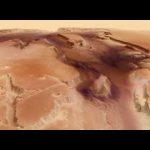
The scene spans 987 km in the north–south direction, 19–36°N, and 1550 km in the east–west direction (280–310°E). It covers 1.55 million square kilometres, an area equivalent to the size of Mongolia.
Kasei Valles is one of the largest outflow channel systems on Mars, created during dramatic flood events. From source to sink, it extends some 3000 km and descends 3 km.
Kasei Valles splits into two main branches that hug a broad island of fractured terrain — Sacra Mensa — rising 2 km above the channels that swerve around it. While weaker materials succumbed to the erosive power of the fast-flowing water, this hardier outcrop has stood the test of time.
Slightly further downstream, the flood waters did their best to erase the 100 km-wide Sharonov crater, crumpling its walls to the south. Around Sharonov many small streamlined islands form teardrop shapes rising from the riverbed as water swept around these natural obstacles.
The Planetary Science and Remote Sensing Group at Freie Universität Berlin produced the movie. The processing of the High Resolution Stereo Camera image data was carried out at the DLR German Aerospace Center.
Credit: ESA/DLR/FU Berlin (G. Neukum) / Music: Crabtambour
This short movie tells the story of Rosetta’s journey through the Solar System so far, through the voices of some of the many people involved in this exciting mission. ESA’s Rosetta spacecraft launched in March 2004 and has since been chasing down comet 67P/Churyumov-Gerasimenko, where it will become the first space mission to orbit a comet, the first to attempt a landing on a comet’s surface, and the first to follow a comet as it swings around the Sun. In the last ten years Rosetta has made 3 flybys of Earth and 1 of Mars, and passed by and imaged asteroids Steins and Lutetia. Operating on solar energy alone, in June 2011 Rosetta was placed into deep space hibernation as it cruised nearly 800 million kilometres from the warmth of the Sun, close to the orbit of Jupiter. On 20 January, Rosetta will wake up at 673 million kilometres from the Sun and about 9 million km from the comet, ready for the next leg of its epic adventure.
NASA Administrator Charlie Bolden and White House Science Advisor John Holdren, announced that the Obama administration is extending usage of the International Space Station to at least the year 2024. In his blog, Bolden noted that NASA is hopeful and optimistic that our ISS partners will join this extension effort and enable continuation of the groundbreaking research being conducted on the unique orbiting laboratory. Also, International Space Exploration Forum, Cygnus’ resupply flight, Super Bowl of Astronomy, 10 years roving Mars, TDRS-L Update and more!
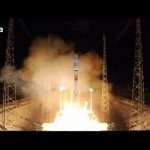
Soyuz flight VS06, with the Gaia space observatory, lifted off from Europe’s Spaceport, French Guiana, on 19 December 2013. This timelapse movie shows Gaia sunshield deployment test, the transfer of the Soyuz from the assembly building to the launch pad and the lift off.
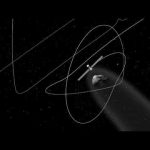
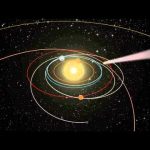
After a ten year journey through space, ESA’s Rosetta spacecraft will reach comet 67P/Churyumov-Gerasimenko in August 2014. After catching up with the comet Rosetta will slightly overtake and enter orbit from the ‘front’ of the comet as both the spacecraft and 67P/CG move along their orbits around the Sun. Rosetta will carry out a complex series of manoeuvres to reduce the separation between the spacecraft and comet from around 100 km to 25-30 km. From this close orbit, detailed mapping will allow scientists to determine the landing site for the mission’s Philae lander. Immediately prior to the deployment of Philae in November, Rosetta will come to within just 2.5 km of the comet’s nucleus.
This animation is not to scale; Rosetta’s solar arrays span 32 m, and the comet is approximately 4 km wide.
Rosetta’s journey from launch in March 2004 to comet 67P/Churyumov-Gerasimenko in August 2014, including 3 flybys of Earth and 1 of Mars. By January 2014 Rosetta is about 9 million kilometres from comet 67P/CG. By early May, Rosetta will be 2 million kilometres from the comet and at the end of May the spacecraft will execute a major rendezvous manoeuvre to line it up for orbit insertion at the start of August.
The comet and planets are not to scale.
There’s something very important about oil that you need to know: oil doesn’t mix with water! That’s why oil spills in the ocean float on the surface and why throwing water on a grease fire is just going to make the fire worse. Now that you recognize that oil and water just don’t mix, let’s have some fun with them.
At 10:00 UTC on 20 January 2014, ESA’s comet-chasing Rosetta spacecraft will wake up from 31 months in deep space hibernation. Save the date and join the adventure — enter our #wakeuprosetta contest by adding your wake up shout video to the Rosetta Mission Facebook page http://www.facebook.com/rosettamission.
Az üstökösök évszázadok óta felcsigázták az emberek fantáziáját. Az Európai Űrügynökség Rosetta nevű missziója megkísérel műszereket eljuttatni egy üstökös felszínére.
Szénből, porból és vízjégből álló égitestek, amelyek a Naphoz közelítve annak fénye miatt csóvát fejlesztenek a maguk mögött húzott törmelékből. Több okból is érdekesek a tudomány számára, de a legizgalmasabb kérdés, hogy van-e közük a földi élet eredetéhez.
A Space üstökösvadász stábjának első útja Jénába, a türingiai tartományi csillagvizsgálóba vezet. A tudósok itt azon dolgoznak, hogy megállapítsák, mi maradt a darabjaira hullott ISON üstökösből. A gyanú az volt, hogy az égitest megsemmisült, de kérdéses volt, hogy a magnak maradtak-e látható darabkái. Azonban napfelkeltéig a tudósoknak nem sikerült megpillantaniuk az ISON maradványait.
Mindeközben Svájcban a berni egyetem kutatói vízjégből, folyékony nitrogénből és szénből mesterséges üstököst állítanak elő. Az így elkészült mintával vákuumkamrában kísérleteznek: arra kíváncsiak, milyen folyamatok mennek végbe egy üstökös felszínén.
Mindezek a kísérletek és megfigyelések csak előkészületek az igazi nagy dobásra: az Európai Űrközpont Rosetta fedőnevű missziója megkísérel műszereket eljuttatni egy üstökös felszínére, és onnan mintákat szállítani.
Ez azért tölti el lelkesedéssel a tudósokat, mert az utolsó hasonló akció, a NASA Csillagpor (Stardust) nevű küldetése meglepő eredményeket hozott. Akkor egy szondát reptettek át a Halley üstökös csóváján, és az így megszerzett minta glicint, egy fontos, DNS-alkotó aminosavat is tartalmazott. Tehát nem életet, de az élet egyik fontos alkotóelemét – ez pedig felveti az üstökösök szerepét a földi élet kialakulásában.
– A földi élethez meghatározott típusú, úgynevezett balkezes aminosavak szükségesek. A kémia elő tud állítani bal és jobbekezes aminosavakat is, de az élet ezek közül csak a balkezeseket használja és szeretnénk érteni, hogy miért – magyarázta az Euronews riporterének Hermann Böhnhardt, a Max Planck Intézet kutatója – Nem tudjuk, de szeretnénk tudni, hogy az üstökösökben található aminosavak jobb vagy balkezesek, mert ha balkezesek, akkor ez újabb arra utaló jel, hogy talán az élet, vagy legalábbis annak alkotóelemei az űrből kerültek a Földre.
A tudományos közösség abban reménykedik, hogy az üstökösöket érintő kérdések sokaságára kapnak választ 2014-ben, ha a Rosetta misszója sikerrel zárul.
A New Year’s video greeting from Expedition 36 flight engineer Karen Nyberg, who returned from the International Space Station in November, and from three of the astronauts currently on board the space station: NASA’s Rick Mastracchio and Mike Hopkins, and Koichi Wakata of the Japan Aerospace Exploration Agency.
On 29 December 2013, ESA’s Mars Express will make the closest flyby yet of the Red Planet’s moon Phobos, skimming past only 45 km above its surface.
As the spacecraft passes close to Phobos, it will be pulled slightly off course by the moon’s gravity, by a few tens of centimetres. This small deviation will be measured using the spacecraft’s radio signals, and then translated into measurements of gravity, mass and density at different locations on the moon.
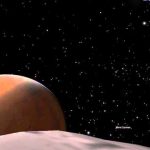
This animation shows the flyby (speeded up) as if you were standing on Phobos, with Mars in the background and Mars Express sweeping out an arc above. Toward the end of the sequence, Mars Express disappears behind Mars and out of sight of Phobos.
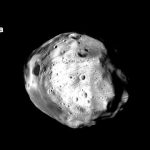
The innermost moon of Mars, Phobos, is seen here in full 360 degree glory. The images were taken by the High Resolution Stereo Camera (HRSC) on ESA’s Mars Express at various times throughout the mission’s 10 years.
The moon’s parallel sets of grooves are perhaps the most striking feature, along with the giant 9 km-wide Stickney impact crater that dominates one face of the 27 x 22 x 18 km moon.
The origin of the moon’s grooves is a subject of much debate. One idea assumes that the crater chains are associated with impact events on the moon itself.
Another idea suggests they result from Phobos moving through streams of debris thrown up from impacts 6000 km away on the surface of Mars, with each ‘family’ of grooves corresponding to a different impact event.
Mars Express has imaged Phobos from a wide range of distances, but will make its closest flyby yet on 29 December 2013, at just 45 km above the moon.
Although this is too close to take images, gravity experiments will give insight into the interior structure of Phobos.
In 2013, NASA helped transform access to low Earth orbit … even as one of our venerable spacecraft reached the boundaries of the solar system … and we moved ahead on technologies — that will help us carry out an ambitious asteroid mission we announced … and, eventually, move on to Mars.
Here’s a quick trip back through 2013 for those and some of the other big things that happened This Year at NASA.
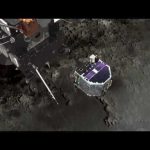
Visualisation of the deployment of the Philae lander from Rosetta at comet 67P/Churyumov-Gerasimenko in November 2014. Rosetta will come to within 2.5 km of the comet’s surface to deploy Philae, which will then take around 2 hours to reach the surface. Because of the comet’s extremely low gravity, a landing gear will absorb the small forces occurring during landing while ice screws in the probe’s feet and a harpoon system will lock the probe to the surface. At the same time a thruster on top of the lander will push it down to counteract the impulse of the harpoon imparted in the opposite direction. Once it is anchored to the comet, the lander will begin its primary science mission, based on its 64-hour initial battery lifetime. Then it will use solar cells to recharge and attempt to operate for several further weeks to months, depending on the activity of the comet and how quickly the solar cells are covered in dust.
ESA’s Gaia mission blasted off on 19 December 2013 on a Soyuz rocket from Europe’s Spaceport in Kourou, French Guiana, on its exciting mission to study a billion suns.
Gaia is destined to create the most accurate map yet of the Milky Way. By making accurate measurements of the positions and motions of 1% of the total population of roughly 100 billion stars, it will answer questions about the origin and evolution of our home Galaxy.
The Soyuz launcher, operated by Arianespace, lifted off at 09:12 GMT (10:12 CET). About ten minutes later, after separation of the first three stages, the Fregat upper stage ignited, delivering Gaia into a temporary parking orbit at an altitude of 175 km.
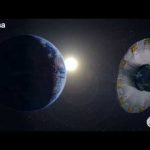
Gaia is now en route towards an orbit around a gravitationally-stable virtual point in space called L2, some 1.5 million kilometres beyond Earth as seen from the Sun.
This video includes highlights of the launch webcast including lift-off from Kourou, the Soyuz mission, separation of Gaia and the successful entry into orbit.
Watch the full replay of the launch coverage of ESA’s billion-star surveyor Gaia. Liftoff occurred at 09:12UT/10:12CET on 19 December and the successful deployment of Gaia’s sunshield was confirmed approximately 90 minutes later. Gaia is now on its way to L2, where it will study the characteristics of 1 billion stars to create the most precise 3D map of our home galaxy, the Milky Way.
Animation showing Gaia launch and journey to its operating orbit. The animation begins by visualising the launch from Europe’s Spaceport in Kourou, French Guiana, on a Soyuz-STB/Fregat-MT vehicle. The rocket’s four boosters are jettisoned 118 seconds after launch, and the spacecraft fairing is jettisoned after 220 seconds. Following two burns, the Fregat upper stage separates from Gaia 42 minutes after launch. The separation activates an automatic sequence onboard Gaia, including switching on the spacecraft’s transmitters, pressurisation of the propulsion system, initial attitude acquisition and deployment of the sunshield. By then Gaia will be on its transfer orbit from Earth towards L2, a virtual point in space some 1.5 million kilometres ‘behind’ Earth as seen from the Sun. Gaia will take about a month to cruise and manoeuvre into a ‘Lissajous’ orbit around L2. The size of the orbit is typically 340 000 x 90 000 km and takes 180 days. There, Gaia will spin slowly in order to make systematic repeated observations of stars covering the whole sky with its two telescopes. Over its five-year mission, Gaia will monitor the positions, motions, temperatures, luminosities and compositions of a billion stars.
Carbon dioxide is a gas that we interact with every day. For instance, CO2 enables plants to perform photosynthesis, you exhale CO2 when you breathe, and CO2 can extinguish fire. You probably knew all those facts, but did you know that you can get really science-y and extremely creative when putting out flames with CO2? It’s as simple as pouring the gas onto fire. Pouring? You better believe it!
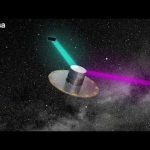
ESA’s Gaia mission will produce an unprecedented 3D map of our Galaxy by mapping, with exquisite precision, the position and motion of a billion stars. The key to this is the billion-pixel camera at the heart of its dual telescope. This animation illustrates how the camera works.
Gaia is ESA’s billion-star surveyor, designed to provide a precise 3D map of our Milky Way galaxy in order to understand its composition, formation and evolution.