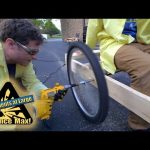
Newton’s Third Law, inertia, air pressure and many other forces can all be harnessed to make objects and vehicles move. Find out how in this compilation! #ScienceMax #Science #ScienceExperiments
(🔔) Subscribe to Science Max for New Videos ▶▶ https://www.youtube.com/@ScienceMax?sub_confirmation=1
Steve Spangler is a bestselling author, STEM educator and Emmy award-winning television personality with more than 1,800 television appearances to his credit.
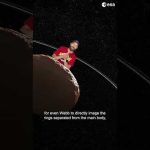
Chariklo is an icy, small body, but the largest of the known Centaur population, located more than 3.2 billion kilometres away beyond the orbit of Saturn. Chariklo is only 250 kilometers or ~51 times smaller than Earth in diameter, and its rings orbit at a distance of about 400 kilometers from the center of the body.
On 18 October 2022, a team used the James Webb Space Telescipe to closely monitor the star Gaia DR3 6873519665992128512, and watch for the tell-tale dips in brightness indicating an occultation had taken place. The shadows produced by Chariklo’s rings were clearly detected, demonstrating a new way of using Webb to explore solar system objects. The star shadow due to Chariklo itself tracked just out of Webb’s view. This appulse (the technical name for a close pass with no occultation) was exactly as had been predicted after the last Webb course trajectory maneuver.
Credit: @NASA, ESA, CSA, Leah Hustak (STScI), Pablo Santos-Sanz (IAA-CSIC), Nicolás Morales (IAA-CSIC), Bruno Morgado (UFRJ, ON/MCTI, LIneA)
★ Subscribe: http://bit.ly/ESAsubscribe and click twice on the bell button to receive our notifications.
We are Europe’s gateway to space. Our mission is to shape the development of Europe’s space capability and ensure that investment in space continues to deliver benefits to the citizens of Europe and the world. Check out https://www.esa.int/ to get up to speed on everything space related.
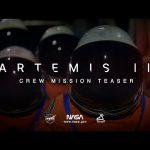
Don’t miss it! NASA and CSA (Canadian Space Agency) will announce during an event at 11 a.m. EDT on Monday, April 3, from NASA Johnson Space Center’s Ellington Field in Houston, the four astronauts who will venture around the Moon. Traveling aboard NASA’s Orion spacecraft during Artemis II, the mission is the first crewed flight test on the agency’s path to establishing a long-term scientific and human presence on the lunar surface.
„La debutul temei “Dreptatea” le-am propus elevilor mei să urmărească un videoclip pe temă, iar la final le-am adresat întrebări. Una din aceste întrebări a fost: ce vi s-a părut surprinzător în materialul urmărit? Un elev a răspuns: nu mi-am imaginat că pe tema asta pot fi atât de multe perspective, că putem discuta despre dreptate din atât de multe unghiuri. Răspunsul lui este motivul pentru care eu intru la clasă. La întrebarea care este rostul predării filosofiei în liceu nu aș vrea să răspund, pentru că în întrebarea aceasta există un cuvânt periculos: predarea filosofiei. Periculos pentru că ne poate duce departe de motivul pentru care eu intru la clasă, adică departe de răspunsul elevului. Ceea ce ne-am putea dori, ca profesori de filosofie, ar fi să ne asigurăm că elevii înțeleg că orice problemă poate fi abordată din mai multe perspective, că această privire ne permite să găsim, individual sau împreună, soluții mai bune pentru o viață mai bună, să evităm falsele convingeri, erorile recurente, suferința”. Preocupată de „problemele perene ale umanității” pe care le abordează fără gust pentru nuanță și rupte de contextul în care au apărut și de cei care le-au pus; în mare parte indiferentă față de teoriile și practicile filosofilor din ultima sută de ani și surdă la dezbaterile care i-au animat, școala românească pare să-și fi asumat sarcina de a promova clișeul că filosofia este vorbărie goală, de niciun ajutor, mai degrabă decât de a le oferi tinerilor instrumentele pentru a-și înțelege lumea și viața. Filosofia din școala românească este ca o caricatură semnată de un artist care și-a privit doar în treacăt subiectul.
Prezentare: Laura BORBE obținut licența în Filosofie, la Facultatea de Istorie- Filosofie, în cadrul UBB Cluj în 1995, a urmat un master la SNSPA pe tema comunicării manageriale și resurselor umane în 2010 și este profesor titular în sistem, din 1996. Actualmente este profesor de socio-umane la Liceul Teoretic Mihai Eminescu din Cluj Napoca. Colaborează din 2008 cu Fundația Noi Orizonturi, din 2019 cu Asociația Teleskop și din 2020 cu Aspire Teachers. Adrian COSTACHE este lector în Departamentul de Didactica Științelor Socio-Umane din cadrul Facultății de Psihologie și Științele Educației de la Universitatea Babeș-Bolyai. Este titularul cursului de Didactica științelor socio-umane adresat, în cadrul modulului pedagogic, studenților de la Filosofie, Științe Politice, Studii Europene, Drept, Business și Teatru și Film și unul dintre responsabilii de formarea continuă a profesorilor de socio-umane din învățământul preuniversitar. Este autorul a două cărți și a mai multor studii de filosofie modernă și contemporană, filosofia educației și pedagogie.
Steve Spangler is a bestselling author, STEM educator and Emmy award-winning television personality with more than 1,800 television appearances to his credit.
➤ Sources: The Islamic Conquest of Syria – by al-Waqidi Byzantium and the Arabs in the Sixth Century – by Irfan Shahid Yarmuk 636 AD: The Muslim Conquest of Syria – by David Nicolle Forgotten Islamic History – by Naeem Ali The Great Islamic Conquests 632 – 750 – by David Nicolle Khalid Bin Al-Waleed (The Sword Of Allah) – by Abdul Basit Ahmad The Byzantine Wars – by John Haldon Byzantium and the Early Islamic Conquests – by Walter E. Kaegi The Early Islamic Conquests – by Fred McGraw Donner Decline and fall of the Sassanian Empire – by Parvaneh Pourshariati
This video zooms in towards the protostar L152 to reveal the object as seen by the NASA/ESA/CSA James Webb Space Telescope, embedded within a cloud of material that is feeding its growth. Material ejected from the star has cleared out cavities above and below it, whose boundaries glow orange and blue in this infrared view. The upper central region displays bubble-like shapes due to stellar ‘burps,’ or sporadic ejections. Webb also detects filaments made of molecular hydrogen that has been shocked by past stellar ejections. Intriguingly, the edges of the cavities at upper left and lower right appear straight, while the boundaries at upper right and lower left are curved. The region at lower right appears blue, as there’s less dust between it and Webb than the orange regions above it.
Credit: ESA/Webb, NASA, CSA, unWISE/JPL-Caltech/D. Lang (Perimeter Institute), E. Slawik, N. Risinger, N. Bartmann, M. Zamani Music: Tonelabs – The Red North (www.tonelabs.com)
★ Subscribe: http://bit.ly/ESAsubscribe and click twice on the bell button to receive our notifications.
We are Europe’s gateway to space. Our mission is to shape the development of Europe’s space capability and ensure that investment in space continues to deliver benefits to the citizens of Europe and the world. Check out https://www.esa.int/ to get up to speed on everything space related.
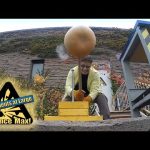
Phil demonstrates Bernoulli’s principle using a leaf blower and a ping pong ball. #ScienceMax #Science #ScienceExperiments #Shorts
(🔔) Subscribe to Science Max for New Videos ▶▶ https://www.youtube.com/@ScienceMax?sub_confirmation=1
Have you ever done a science experiment and wondered “What would this be like if it were HUGE?” Welcome to Science Max, the exciting new series that turbocharges all the science experiments you’ve done at home.
Steve Spangler is a bestselling author, STEM educator and Emmy award-winning television personality with more than 1,800 television appearances to his credit.
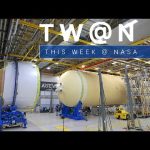
The Artemis II Moon Rocket is Coming Together, a high honor for some space explorers, and an intriguing find for the Webb Space Telescope … a few of the stories to tell you about – This Week at NASA!
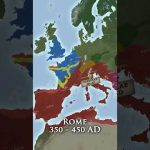
🚩In 450 AD, Attila the Hun invaded the West. By this time, the collapse of the Roman Empire was already 100 years in the making. But the famous general Aetius brought Rome back from the brink in the battle of the Catalaunian Plains, in 451 AD.
In today’s Science Minute, Steve Spangler challenges your critical thinking skills with an experiment you can do at home using balloons, a magnifying glass and energy from the sun.
Steve Spangler is a bestselling author, STEM educator and Emmy award-winning television personality with more than 1,800 television appearances to his credit.
Juice will complete two flybys of Europa in July 2032, approaching the moon at a closest approach of 400 km. During these close encounters, Juice will explore the geology, surface, subsurface, activity and environment of the moon, which appears to have a young, active, colourful and distinctively marked surface.
The mission will characterise the composition and chemistry of Europa’s surface, hunting for substances that are essential to support life and determining the source of the moon’s material. Europa may vent water vapour to space via ‘plumes’ and geysers; Juice will search for pockets of water in the moon’s shallow subsurface using unprecedented ice-penetrating radar, and reveal locations where the transfer of material between subsurface, surface and space may be especially intense.
Juice will complete its first flyby of Callisto in June 2032; the spacecraft will complete a total of 21 flybys of this moon from 2032–2034 (both to explore the moon and to adjust the energy and orientation of Juice’s orbit), coming as close as 200 km from Callisto at nearest approach.
Callisto is also the least geologically evolved Galilean satellite, and therefore offers a unique glimpse into the environment around early Jupiter. As the moon does not seem to have evolved much over time, it stands to reveal unique information about how it initially formed, and about the origin of the wider Jupiter system.
📹 @EuropeanSpaceAgency
★ Subscribe: http://bit.ly/ESAsubscribe and click twice on the bell button to receive our notifications.
We are Europe’s gateway to space. Our mission is to shape the development of Europe’s space capability and ensure that investment in space continues to deliver benefits to the citizens of Europe and the world. Check out https://www.esa.int/ to get up to speed on everything space related.
Have you ever done a science experiment and wondered “What would this be like if it were HUGE?” Welcome to Science Max, the exciting new series that turbocharges all the science experiments you’ve done at home.
Steve Spangler is a bestselling author, STEM educator and Emmy award-winning television personality with more than 1,800 television appearances to his credit.
••NASA celebrates Women’s History Month 2023 by launching a new campaign to mobilize women at NASA to participate in student-centered activities as STEM mentors and role models.
Participants include:
• Kris Brown, deputy associate administrator of NASA STEM Engagement • Christyl Johnson, deputy director of technology and research investments a NASA’s Goddard Space Flight Center • Sandra Cauffman, NASA Headquarters deputy director of astrophysics • Mamta Patel, associate chief scientist for exploration and applied research
Steve Spangler is a bestselling author, STEM educator and Emmy award-winning television personality with more than 1,800 television appearances to his credit.
🚩The Anarchy was a period of civil war and unsettled government in England, often known as The Nineteen Year Winter, that occurred during the reign of King Stephen of England (1135–1154). In this 6-part series I will cover this turbulent period.
🚩Thanks to Bert’s Battles for his work on this series – check out their channel for more history content https://www.youtube.com/@BertsBattles
📢 Narrated by David McCallion
🎼 Music: EpidemicSound.com Filmstro
Sources: Bradbury, J. (2011) Stephen and Matilda: the Civil War of 1139-53. ISBN: 978 07524 71921. Davis, R. H. C. (2013) King Stephen 1135-1154. ISBN: 13: 978-0-582-04000-7. Hanley, C. (2020) Matilda: Empress, Queen, Warrior. ISBN: 978-0-300-25147-0. King, E. (2012) King Stephen. ISBN: 978-0-300-18195-1. William of Malmesbury (2016) Chronicle of the Kings of England: from the Earliest Period to the Reign of King Stephen. ISBN: 9781518363320.
This video takes the viewer on a journey through space to one of Webb’s first observations in 2022, the Wolf-Rayet star WR 124, seen here in unprecedented detail.
Despite being the scene of an impending stellar ‘death’, astronomers also look to Wolf-Rayet stars for insights into new beginnings. Cosmic dust is forming in the turbulent nebulas surrounding these stars, dust that is composed of the heavy-element building blocks of the modern Universe, including life on Earth.
Credit: NASA, ESA, CSA, STScI, Webb ERO Production Team, DSS, N. Bartmann (ESA/Webb), E. Slawik, N. Risinger, D. de Martin (ESA/Webb), M. Zamani (ESA/Webb) Music: Tonelabs – The Red North (www.tonelabs.com)
★ Subscribe: http://bit.ly/ESAsubscribe and click twice on the bell button to receive our notifications.
We are Europe’s gateway to space. Our mission is to shape the development of Europe’s space capability and ensure that investment in space continues to deliver benefits to the citizens of Europe and the world. Check out https://www.esa.int/ to get up to speed on everything space related.
Is Phil going to end up falling in the pool again!? #ScienceMax #Science #ScienceExperiments #Shorts
(🔔) Subscribe to Science Max for New Videos ▶▶ https://www.youtube.com/@ScienceMax?sub_confirmation=1
Have you ever done a science experiment and wondered “What would this be like if it were HUGE?” Welcome to Science Max, the exciting new series that turbocharges all the science experiments you’ve done at home.
The President’s Budget Request for NASA, Crew-5 is safely back on Earth, and a look at a possible Moon mission spacesuit … a few of the stories to tell you about – This Week at NASA!
Steve Spangler is a bestselling author, STEM educator and Emmy award-winning television personality with more than 1,800 television appearances to his credit.
Other Channels…
The Spangler Effect ► youtube.com / thespanglereffect Spangler Science TV ► youtube.com/ spanglersciencetv
The dinosaurs went extinct by an asteroid impact many years ago. Here at NASA and around the world, there are teams of experts making sure we can actually do something about it if an asteroid were to ever threaten Earth. We’re studying these rocky, airless remnants to better understand the early formation of our solar system.
“65” actor Adam Driver and NASA Planetary Defender Kelly Fast discuss how we find, track, and monitor near-Earth asteroids, as well as test technologies that could one day be used to prevent a potential impact, should a hazardous asteroid be discovered in the future. The duo also talks about the OSIRIS-REx mission and the asteroid sample the spacecraft will bring to Earth this September.
As you scan through your social media, you’re bound to find a number of cool hacks to make life easier… but do they really work? Steve Spangler uncovers the science behind a cooking hack that you’ll remember everything you hear the phrase GREEN EGGS AND HAM.
Steve Spangler is a bestselling author, STEM educator and Emmy award-winning television personality with more than 1,800 television appearances to his credit.
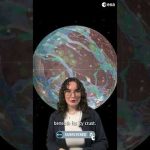
Ganymede is the primary scientific target of the Jupiter Icy Moons Explorer, Juice, mission. With a diameter of about 5260 km, larger than that of Pluto and Mercury, Ganymede tops the Solar-System moons’ size chart. It is the seventh moon from the gas giant (and the third among the Galilean satellites) and orbits Jupiter at a distance of more than 1 million kilometres. Researchers believe there is tidal heating on Ganymede, although to a much smaller degree than on Io and Europa. This heat could drive some tectonic activity and provide one of the necessary conditions for life to emerge: a source of energy.
This high-resolution mapping of the surface can help constrain the moon’s composition and mineralogy, and assess how habitable Ganymede could be by searching for biosignatures. Observations at various wavelengths will allow astronomers to study non-water-ice material to determine the distribution of biologically essential elements—such as carbon or oxygen—and other important elements—such as magnesium and iron—on the planetary body. The mission will also shed light on the origin and evolution of the materials on the surface by exploring which substances form at Ganymede and which are brought in from the plasma environment around the moon.
To study Ganymede in detail, Juice will enter orbit around it, becoming the first spacecraft to orbit a moon in the outer Solar System. The dedicated orbital tour is expected to last about eight months and will be the final stage of the mission.
📹 @EuropeanSpaceAgency
★ Subscribe: http://bit.ly/ESAsubscribe and click twice on the bell button to receive our notifications.
We are Europe’s gateway to space. Our mission is to shape the development of Europe’s space capability and ensure that investment in space continues to deliver benefits to the citizens of Europe and the world. Check out https://www.esa.int/ to get up to speed on everything space related.