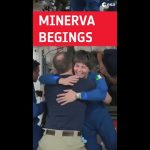
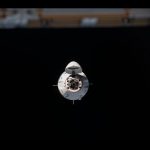
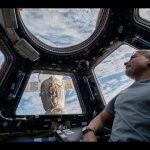
ESA astronaut Samantha Cristoforetti and @NASA astronauts Kjell Lindgren, Robert “Bob” Hines and Jessica Watkins arrive to the International Space Station after docking at 01:37 CEST on Thursday 28 April 2022.
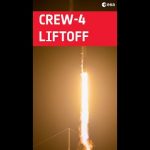
Collectively known as Crew-4, the four astronauts were launched from @NASA’s Kennedy Space Center in Florida, USA, at 09:52 CEST on 27 April 2022.
Samantha is the third ESA astronaut to travel to the orbital outpost in a Crew Dragon. During the journey she and Jessica served as Mission Specialists. Kjell is Crew-4 Commander and Bob is Crew-4 Pilot.
Crew-4 was welcomed aboard by the Station’s current inhabitants, including ESA astronaut Matthias Maurer who was launched to the Station as part of Crew-3 and is expected to return shortly to Earth.
Samantha first flew to space in 2014 for her @AsiTV-sponsored mission Futura. Her ESA space mission, known as Minerva, will officially begin once she reaches the Station.
Throughout her mission, Samantha will hold the role of US Orbital Segment (USOS) lead, taking responsibility for all operations within the US, European, Japanese and Canadian modules and components of the Space Station. She will support around 35 European and many more international experiments in orbit.
We are Europe’s gateway to space. Our mission is to shape the development of Europe’s space capability and ensure that investment in space continues to deliver benefits to the citizens of Europe and the world. Check out https://www.esa.int/ to get up to speed on everything space related.
Watch NASA’s SpaceX Crew-4 astronauts arrive at the International Space Station aboard their Dragon spacecraft Freedom. Docking is scheduled for approximately 7:40 p.m. EDT (23:40 UTC).
Once aboard the orbiting laboratory, astronauts Bob Hines, Jessica Watkins, and Kjell Lindgren of NASA, alongside Samantha Cristoforetti of ESA (European Space Agency), will spend nearly six months conducting new scientific research in areas such as materials science, health technologies, and plant science to prepare for human exploration beyond low-Earth orbit and to benefit life on Earth.
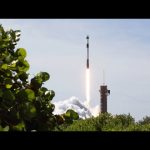
Crew-4 lifted off on April 27 at 3:52 a.m. ET (7:52 UTC) from NASA’s Kennedy Space Center aboard a SpaceX Falcon 9 rocket.
ESAWebTV caught up with the Director General of the European Space Agency, Josef Aschbacher, while he was in Florida for the launch of ESA astronaut, Samantha Cristoferetti and the rest of Crew-4.
★ Subscribe: http://bit.ly/ESAsubscribe and click twice on the bell button to receive our notifications.
We are Europe’s gateway to space. Our mission is to shape the development of Europe’s space capability and ensure that investment in space continues to deliver benefits to the citizens of Europe and the world. Check out https://www.esa.int/ to get up to speed on everything space related.
Crew Dragon Freedom is launched to the International Space Station, carrying ESA astronaut Samantha Cristoforetti and @NASA astronauts Kjell Lindgren, Robert “Bob” Hines and Jessica Watkins.
Collectively known as Crew-4, the four astronauts were launched from @NASA’s Kennedy Space Center in Florida, USA.
Samantha is the third ESA astronaut to travel to the orbital outpost in a @SpaceX Crew Dragon. During the journey she and Jessica will serve as Mission Specialists. Kjell is Crew-4 Commander and Bob is Crew-4 Pilot.
Upon arrival, Crew-4 will be greeted by the Space Station’s current crew – including ESA astronaut Matthias Maurer. Samantha and Matthias will enjoy a brief handover in orbit before he returns to Earth with Crew-3.
Samantha first flew to space in 2014 for her @AsiTV-sponsored mission Futura. Her ESA space mission, known as Minerva, will officially begin once she reaches the Station.
Throughout her mission, Samantha will hold the role of US Orbital Segment (USOS) lead, taking responsibility for all operations within the US, European, Japanese and Canadian modules and components of the Space Station. She will support around 35 European and many more international experiments in orbit.
We are Europe’s gateway to space. Our mission is to shape the development of Europe’s space capability and ensure that investment in space continues to deliver benefits to the citizens of Europe and the world. Check out https://www.esa.int/ to get up to speed on everything space related.
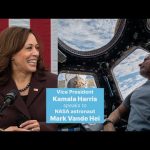
Vice President Kamala Harris recently spoke to astronaut Mark Vande Hei after he returned home from spending 355 days in space — the longest single spaceflight for a NASA astronaut.
Mark’s mission and research in space helps us better understand the effects of long-duration human spaceflight as we prepare for the Artemis missions to the Moon. As head of the National Space Council, VP Harris is working on our priorities in space, including building up America’s STEM workforce, addressing the climate crisis, and promoting rules and norms that govern space.
Learn more about Celestial Immunity, space station research that may help us treat diseases: https://go.nasa.gov/3END1kY
Credit: NASA Video Producer: Jason Clemons Video Editor: Ed Toma
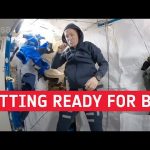
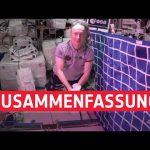
ESA astronaut Matthias Maurer gives a glimpse into his evening routine aboard the International Space Station during his Cosmic Kiss mission.
Matthias’s crew quarters, known as CASA (short for Crew Alternate Sleep Accommodation), is located within the European Columbus science laboratory module.
But before he floats into his sleeping bag in there for the night, Matthias takes a little detour to one of the three “bathrooms” currently on board the Space Station.
Separated from the work areas and installed in different modules of the USOS and Russian segments of the Station to allow them some privacy, the astronauts on board share these bathrooms to wash up, take a “shower” in space and brush their teeth.
We are Europe’s gateway to space. Our mission is to shape the development of Europe’s space capability and ensure that investment in space continues to deliver benefits to the citizens of Europe and the world. Check out https://www.esa.int/ to get up to speed on everything space related.
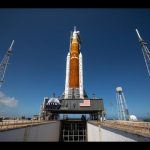
NASA’s SpaceX Crew-4 astronauts prepare for launch, an update on our Artemis I mega Moon rocket and spacecraft, and celebrating our home planet for #EarthDay – just a few of the stories to tell you about This Week at NASA!
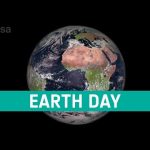
To celebrate Earth Day, this week’s edition of the Earth from Space programme features a spectacular image of Earth captured by Meteosat Second Generation.
We are Europe’s gateway to space. Our mission is to shape the development of Europe’s space capability and ensure that investment in space continues to deliver benefits to the citizens of Europe and the world. Check out https://www.esa.int/ to get up to speed on everything space related.
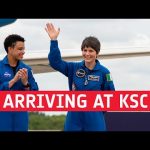
ESA astronaut Samantha Cristoforetti arrives at @NASA’s Kennedy Space Center in Florida, USA, with @NASA astronauts Kjell Lindgren, Bob Hines and Jessica Watkins on 18 April 2022.
Collectively known as Crew-4, the astronauts flew in from Houston, Texas, and will spend the next week in quarantine before being launched to the International Space Station on a @SpaceX Crew Dragon spacecraft.
When they arrive at the Station, Samantha’s Minerva mission will officially begin. This is the second long-duration space mission for Samantha who first flew to the orbital outpost in 2014 for her @AsiTV-sponsored mission Futura.
Samantha will be welcomed on board by fellow ESA astronaut Matthias Maurer and enjoy a short handover in orbit before Matthias returns to Earth in April as part of Crew-3.
Throughout her mission, Samantha will hold the role of US Orbital Segment (USOS) lead, taking responsibility for all operations within the US, European, Japanese and Canadian modules and components of the Space Station. She will support around 35 European and many more international experiments in orbit.
We are Europe’s gateway to space. Our mission is to shape the development of Europe’s space capability and ensure that investment in space continues to deliver benefits to the citizens of Europe and the world. Check out https://www.esa.int/ to get up to speed on everything space related.
Testing our mega Moon rocket and ground systems, preparing the James Webb Space telescope for science, and testing an instrument for future X-59 research … a few of the stories to tell you about – This Week at NASA!
This week’s edition of the Earth from Space programme features an impressive shot of the almost cloud-free Scandinavian Peninsula captured by the Copernicus Sentinel-3 mission.
We are Europe’s gateway to space. Our mission is to shape the development of Europe’s space capability and ensure that investment in space continues to deliver benefits to the citizens of Europe and the world. Check out https://www.esa.int/ to get up to speed on everything space related.
On 23 March 2022, ESA astronaut Matthias Maurer successfully performed his first extravehicular activity (EVA) alongside fellow @NASA astronaut Raja Chari. The spacewalk, dubbed “US EVA 80”, was carried out in support of assembly, refurbishment and maintenance work on the International Space Station.
In this video, Matthias Maurer answers questions and reports on his experiences, feelings and the challenges he faced during his almost seven-hour-long spacewalk.
00:00 – 01:56 What was it like to leave the ISS for the fist time? 01:57 – 04:07 Can you compare a spacewalk with underwater training? 04:08 – 05:37 What was your most difficult task? 05:38 – 08:17 There was a “problem” at the beginning. What happened? 08:18 – 10:21 Were you able to enjoy the view? 10:22 – 11:46 You flew over your homeland, Saarland, during the EVA. Were you able to see your home? 11:47 – 12:39 What surprised you the most and what did you not expect at all? 12:40 – 16:26 How did you feel afterwards and how did you sleep?
During his Cosmic Kiss mission, Matthias Maurer will live and work aboard the International Space Station for approximately six months, conducting and supporting more than 35 European and numerous other international experiments in orbit.
We are Europe’s gateway to space. Our mission is to shape the development of Europe’s space capability and ensure that investment in space continues to deliver benefits to the citizens of Europe and the world. Check out https://www.esa.int/ to get up to speed on everything space related.
ESA Director General Josef Aschbacher shares the outcome of the ESA Council extraordinary meeting in this virtual Q&A with journalists. Additional updates are provided on ESA’s main programmes, the overall rollout of Agenda 2025 on the way to the ESA Ministerial Meeting in November 2022 as well as further implications of the current geopolitical situation on ESA’s activities.
We are Europe’s gateway to space. Our mission is to shape the development of Europe’s space capability and ensure that investment in space continues to deliver benefits to the citizens of Europe and the world. Check out https://www.esa.int/ to get up to speed on everything space related.
Watch the replay of our live Q&A media session (In English and Italian) with ESA astronaut Samantha Cristoforetti.
Samantha is scheduled to be launched to the International Space Station from NASA’s Kennedy Space Centre in Florida, USA, no earlier than 21 April 2022. She will fly to the Station as a Mission Specialist aboard a SpaceX Crew Dragon spacecraft alongside NASA astronauts Kjell Lindgren, Bob Hines and Jessica Watkins.
Upon arrival at the orbital outpost her ESA mission ‘Minerva’ will officially begin. This is the second space mission for Samantha and will see her support over 35 European and many more international experiments in microgravity.
We are Europe’s gateway to space. Our mission is to shape the development of Europe’s space capability and ensure that investment in space continues to deliver benefits to the citizens of Europe and the world. Check out https://www.esa.int/ to get up to speed on everything space related.
Reflecting on a record-setting spaceflight, an update on prelaunch activities for Artemis I, and launching the first private astronaut mission to the International Space Station … a few of the stories to tell you about – This Week at NASA!
Axiom Mission 1 (or Ax-1), set to lift off at 11:17 a.m. EDT (15:17 UTC) April 8, is the first all-private astronaut mission to the International Space Station. Ax-1 is launching from NASA’s Kennedy Space Center aboard SpaceX’s Crew Dragon Endeavour capsule.
During their eight-day stay aboard the orbiting laboratory, crew members Larry Connor, Michael López-Alegría, Mark Pathy, and Eytan Stibbe will engage in technology demonstrations and scientific experiments ranging from robotics to data modeling for future cancer research.
Today’s launch coverage is led by Axiom Space, with support from NASA and SpaceX; NASA’s primary mission responsibilities begin during Endeavour’s approach to the International Space Station, the start of Ax-1 integrated operations. Learn more about NASA’s role in Ax-1 and how we’re working with our industry partners to open low-Earth orbit to more people, more science, and more commercial opportunities: https://go.nasa.gov/3ubIqhP
In this week’s edition of the Earth from Space programme, the Copernicus Sentinel-2 mission takes us over part of Sindh – the third-largest province of Pakistan.
We are Europe’s gateway to space. Our mission is to shape the development of Europe’s space capability and ensure that investment in space continues to deliver benefits to the citizens of Europe and the world. Check out https://www.esa.int/ to get up to speed on everything space related.
NASA and SpaceX are targeting 3:52 a.m. EDT Wednesday, April 27, for launch of the agency’s SpaceX Crew-4 mission to the International Space Station from Launch Complex 39A at NASA’s Kennedy Space Center in Florida.
NASA astronauts Kjell Lindgren, Bob Hines, and Jessica Watkins, as well as ESA (European Space Agency) astronaut Samantha Cristoforetti, will launch aboard a Crew Dragon spacecraft atop a SpaceX Falcon 9 rocket. For the latest updates: https://blogs.nasa.gov/commercialcrew/
We are Europe’s gateway to space. Our mission is to shape the development of Europe’s space capability and ensure that investment in space continues to deliver benefits to the citizens of Europe and the world. Check out https://www.esa.int/ to get up to speed on everything space related.
NASA associate administrators participate in a panel on the collaboration of the Artemis Program and the aerospace industry in building the space economy at the 37th Annual Space Symposium in Colorado Springs, Colorado.
Speakers include: – Dr. Thomas Zurbuchen, Associate Administrator for NASA’s Science Mission Directorate – Jim Free, Associate Administrator for NASA’s Exploration Systems Development Mission Directorate – Jim Reuter, Associate Administrator for NASA’s Space Technology Mission Directorate – Ken Bowersox, Deputy Associate Administrator for NASA’s Space Operations Mission Directorate
The panel is moderated by Northrop Grumman/Space Foundation’s Lauren Smith.
NASA Deputy Administrator Pam Melroy delivers remarks on NASA’s Moon-to-Mars strategy, and shares updates on current milestones in a plenary session at the 37th Annual Space Symposium in Colorado Springs, Colorado.
Join ESA astronaut Matthias Maurer and @NASA astronaut Kayla Barron as they discuss electron microscopes, antimicrobial spoons and other materials science topics aboard the International Space Station.
Matthias starts by explaining an experiment, which saw crew members eat meals with special spoons made of stainless steel and copper. These spoons are part of an investigation into the antimicrobial properties of laser-structured surfaces.
Principal investigators Ralf Möller of the Institute of Space Medicine, @DLR, Cologne and Frank Mücklich from the Institute for Functional Materials, @Universität des Saarlandes have been jointly investigating the antimicrobial effect of laser-structured surfaces for use during space travel since 2017. Though the antimicrobial effect of some metals has been known for a while, modern laser surface structuring is thought to result in up to 80% less bacterial adhesion and could significantly reduce the transmission of harmful germs both in space and here on Earth.
Following this discussion, the astronauts consider potential applications of a scanning electron microscope that is currently in the technology demonstration phase. This could be used to investigate small parts and biological samples aboard the Station.
Matthias and Kayla flew to the Station together in November 2021 as mission specialists for Crew-3. They are expected to return to Earth with NASA colleagues Raja Chari and Thomas Marshburn in April 2022 after approximately six months of science and operations in orbit.
We are Europe’s gateway to space. Our mission is to shape the development of Europe’s space capability and ensure that investment in space continues to deliver benefits to the citizens of Europe and the world. Check out https://www.esa.int/ to get up to speed on everything space related.
What the President’s budget means for NASA, a record-setting astronaut returns safely to Earth, and the next Commercial Crew mission to the space station … a few of the stories to tell you about – This Week at NASA!
Producer: Andre Valentine Editor: Sonnet Apple Music: Universal Production Music
0:00 Introduction 0:14 The President’s Budget and the State of NASA 1:21 Record-Setting U.S. Astronaut Returns to Earth 1:47 NASA Previews SpaceX Crew-4 Mission 2:16 Final Test Ahead of Artemis I Moon Mission 2:43 Hubble Spots Farthest Star Ever Seen
This week’s edition of the Earth from Space programme features a Copernicus Sentinel-2 image of Barranquilla, the capital of the Atlántico department in northwest Colombia.
We are Europe’s gateway to space. Our mission is to shape the development of Europe’s space capability and ensure that investment in space continues to deliver benefits to the citizens of Europe and the world. Check out https://www.esa.int/ to get up to speed on everything space related.
Wheeled, tracked and walking rovers competed to survey a shadowy analogue of the polar lunar surface for useable resources during the first field test of the ESA-ESRIC Space Resources Challenge. Some 12 teams from across Europe and Canada took part in the field test in the Netherlands, with five winners going on to the next phase of the contest.
The Space Resources Challenge – supported by ESA and the European Space Resources Innovation Centre (ESRIC) in Luxembourg – asked European (and Canadian) researchers and institutions to develop and demonstrate a system of one or more vehicles capable of prospecting resources on the Moon in the near future.
Working inside a former aircraft hangar, the competition organisers spread 200 tons of lava rock across an area equivalent to seven tennis courts, landscaping it into a Moon-like environment, including the main crater of interest. Then they scattered rocks, including a hundred simulated boulders larger than a metre across, whose positions were precisely geo-referenced.
These measurements served as the basis of a map provided to the rover teams. The idea was to give them the equivalent level of local information from satellite imagery, while still leaving smaller-scale surprises. Once complete, the moonscape was kept concealed from the rover groups behind black curtains, so they would see it only through the cameras of their rovers. The 12 teams each made their prospecting attempt one at a time.
The competing rovers had to navigate and map the whole test environment to prospect for useable resources – meaning first of all to track down their location, identify the best and safest passages and then to gather information about the characteristics and the composition of the rocks they located.
Credit: ESA
★ Subscribe: http://bit.ly/ESAsubscribe and click twice on the bell button to receive our notifications.
We are Europe’s gateway to space. Our mission is to shape the development of Europe’s space capability and ensure that investment in space continues to deliver benefits to the citizens of Europe and the world. Check out https://www.esa.int/ to get up to speed on everything space related.
Vande Hei and two Roscosmos cosmonauts, Anton Shkaplerov and Pyotr Dubrov, are scheduled to end their mission aboard the International Space Station and return to Earth on Wednesday, March 30.
Vande Hei broke the record for longest single spaceflight by an American astronaut, previously held at 340 days. He will wrap up his second spaceflight with a total of 523 days in space.
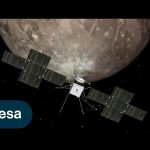
ESA’s Jupiter Icy Moons Explorer, Juice, is set to embark on an eight-year cruise to Jupiter starting April 2023. The mission will investigate the emergence of habitable worlds around gas giants and the Jupiter system as an archetype for the numerous giant planets now known to orbit other stars.
This animation depicts Juice’s journey to Jupiter and highlights from its foreseen tour of the giant planet and its large ocean-bearing moons. It depicts Juice’s journey from leaving Earth’s surface in a launch window 5–25 April 2023 and performing multiple gravity assist flybys in the inner Solar System, to arrival at Jupiter (July 2031), flybys of the Jovian moons Europa, Callisto and Ganymede, orbital insertion at Ganymede (December 2034), and eventual impact on this moon’s surface (late 2035).
An Ariane 5 will lift Juice into space from Europe’s Spaceport in Kourou. A series of gravity assist flybys of Earth, the Earth-Moon system and Venus will set the spacecraft on course for its July 2031 arrival at Jupiter. These flybys are shown here in order – Earth-Moon (August 2024), Venus (August 2025), Earth (September 2026, January 2029) – interspersed by Juice’s continuing orbits around the Sun. Juice’s flyby of the Earth-Moon system, known as a Lunar-Earth gravity assist (LEGA), is a world first: by performing this manoeuvre – a gravity assist flyby of the Moon followed just 1.5 days later by one of Earth – Juice will save a significant amount of propellant on its journey.
Juice will start its science mission about six months prior to entering orbit around Jupiter, making observations as it approaches its destination. Once in the Jovian system, a gravity assist flyby of Jupiter’s largest moon Ganymede – also the largest moon in the Solar System – will help Juice enter orbit around Jupiter, where the spacecraft will spend four years observing the gas giant and three of its moons: Ganymede, Callisto and Europa.
Juice will make two flybys of Europa (July 2032), which has strong evidence for an ocean of liquid water under its icy shell. Juice will look at the moon’s active zones, its surface composition and geology, search for pockets of liquid water under the surface, and study the plasma environment around Europa, also exploring the moon’s tiny atmosphere and hunting for plumes of water vapour (as have been previously detected erupting to space).
A sequence of Callisto flybys will be used to study this ancient, cratered world that may too harbour a subsurface ocean, also changing the angle of Juice’s orbit with respect to Jupiter’s equator, making it possible to explore Jupiter’s higher latitudes (2032–2034).
A sequence of Ganymede and Callisto flybys will adjust Juice’s orbit – properly orienting it while minimising the amount of propellant expended – so that it can enter orbit around Ganymede in December 2034, making it the first spacecraft to orbit another planet’s moon. Juice’s initial elliptical orbit will be followed by a 5000 km-altitude circular orbit, and later a 500 km-altitude circular orbit.
Ganymede is the only moon in the Solar System to have a magnetosphere. Juice will investigate this phenomenon and the moon’s internal magnetic field, and explore how its plasma environment interacts with that of Jupiter. Juice will also study Ganymede’s atmosphere, surface, subsurface, interior and internal ocean, investigating the moon as not only a planetary object but also a possible habitat.
Over time, Juice’s orbit around Ganymede will naturally decay due to lack of propellant, and it will make a grazing impact onto the surface (late 2035).
The Juice launch itself will be a historical milestone for more reasons than one. It will be the final launch for Ariane 5, ending the launcher’s nearly three-decade run as one of the world’s most successful heavy-lift rockets. Its duties are being taken over by Ariane 6.
We are Europe’s gateway to space. Our mission is to shape the development of Europe’s space capability and ensure that investment in space continues to deliver benefits to the citizens of Europe and the world. Check out https://www.esa.int/ to get up to speed on everything space related.
NASA benefits all humanity and our workforce is key to making this happen. Take a look at the universe of NASA missions and projects made possible by our commitment to teamwork, collaboration, equity and inclusiveness.
Our exploration of the universe, our technology development, our work to help understand climate change, and the opportunities the agency creates make our nation more prosperous, stronger, more inclusive and inspired. NASA furthers the nation’s goals to address climate change, advance space exploration, promote equity and diversity and provide educational STEM opportunities. NASA keeps the United States at the forefront of innovation.
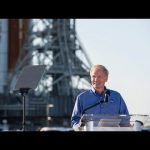
What’s new at NASA? Join us live from our Kennedy Space Center in Florida as NASA Administrator Bill Nelson delivers the #StateOfNASA address for 2022. Learn about our plans to explore the Moon and Mars, address climate change, promote racial and economic equity, and drive economic growth while sustaining U.S. leadership in aviation and aerospace innovation.
It’s the first mission of its kind, set to monitor our active and unpredictable Sun and help protect us from its violent outbursts – and it has a new name.
Once known as “Lagrange,” ESA’s upcoming space weather mission needed a new name that would reflect its vital role: helping to protect Earth’s infrastructure, satellites, inhabitants and space explorers from unpredictable but violent solar events like solar flares and ‘coronal mass ejections’.
During the Name The Mission campaign, 5422 entries were submitted from across Europe and indeed around the world – and after weeks of deliberation, countless spreadsheets, three diverse and expert judges and a lively debate – a new name has been selected for our upcoming space weather mission: ESA Vigil.
“We are thrilled with our mission’s new name,” explains Juha-Pekka Luntama, ESA’s Head of Space Weather.
“When I first heard it, I thought it was just spot on. That is exactly what we do, we keep a vigilant watch and guard Earth”.
In Latin, ‘vigilis exceptus’ means sentry, or guard, while ‘vigilia’ means wakefulness and the act of keeping a devoted watch, which resonates with the mission’s role – a devoted guardian, keeping constant watch over the Sun, for Earth.
Protecting modern life, and life itself
Solar storms can damage power grids, disrupt telecommunications and threaten satellites and the vital services they provide. At the same time, as we launch ever-more satellites into orbit we are creating increasing amounts of debris – dramatically increasing the risks of collision for current and future missions.
These satellites have changed our lives and enlarged our perspective on Earth, but they – and the technologies they make possible on which modernity relies – are vulnerable.
The protection of space assets is at the heart of ESA’s Vision for the future. To do this, the new Protect ‘accelerator’ proposes the development of ‘air traffic control for space’, as well as an early warning system to help us prepare for hazardous solar activity.
We are Europe’s gateway to space. Our mission is to shape the development of Europe’s space capability and ensure that investment in space continues to deliver benefits to the citizens of Europe and the world. Check out https://www.esa.int/ to get up to speed on everything space related.
ESA astronaut Matthias Maurer is currently living and working aboard the International Space Station for his first space mission, Cosmic Kiss. Recently, he experimented with water in microgravity. In this water experiments video series, Matthias demonstrates the different behavior of water in weightlessness and how this research is applied to life on Earth.
In part 5, Matthias explains how studying the behavior of water and other liquids on the International Space Station is important for numerous applications on Earth, such as in industry or food technology.
Matthias will live and work in orbit for approximately six months for his Cosmic Kiss mission. During this time, he will conduct and support more than 35 European and numerous other international experiments in microgravity.
We are Europe’s gateway to space. Our mission is to shape the development of Europe’s space capability and ensure that investment in space continues to deliver benefits to the citizens of Europe and the world. Check out https://www.esa.int/ to get up to speed on everything space related.
Upgrade work continues outside the space station, an updated strategy for landing Artemis astronauts on the Moon, and unsealing pieces of the past … a few of the stories to tell you about – This Week at NASA!
The Smithsonian’s National Air and Space Museum held its Michael Collins Trophy award ceremony March 24 at the museum’s Steven F. Udvar-hazy Center in Chantilly, VA. The 2022 recipients were Wally Funk for Lifetime Achievement and the Mars Ingenuity Helicopter Team for Current Achievement.
Ingenuity rode to the surface of Mars attached to the belly of the Perseverance rover on Feb 18, 2021. And several weeks later, on April 19, the rotorcraft achieved the very first powered, controlled flight on another planet.
While Ingenuity arrived on Mars as a technology demonstration, NASA has extended flight operations through September. The historic rotorcraft has successfully completed 23 flights and counting and will continue supporting the Perseverance rover’s upcoming science campaign exploring the ancient river delta of Jezero Crater. Along the way, it will continue pushing its own capabilities to help inform the design of future Mars aerial vehicles.
Lifetime Achievement recipient, Wally Funk and 12 other women pilots underwent spaceflight training in the ’60s as part of an unofficial program – even outperforming the men – but were denied the chance to fly.
Wally never abandoned her dream of going to space and at 82-years-old that dream came true when she launched aboard the FIRST crewed suborbital mission of Blue Origin’s New Shepard capsule.
ESA astronaut Matthias Maurer is currently living and working aboard the International Space Station for his first space mission, Cosmic Kiss. Recently, he experimented with water in microgravity. In this water experiments video series, Matthias demonstrates the different behavior of water in weightlessness and how this research is applied to life on Earth.
In part 4 of this video series, Matthias takes a closer look at the lens effect and surface tension of water.
Matthias will live and work in orbit for approximately six months for his Cosmic Kiss mission. During this time, he will conduct and support more than 35 European and numerous other international experiments in microgravity.
We are Europe’s gateway to space. Our mission is to shape the development of Europe’s space capability and ensure that investment in space continues to deliver benefits to the citizens of Europe and the world. Check out https://www.esa.int/ to get up to speed on everything space related.
In this week’s edition of the Earth from Space programme, the Copernicus Sentinel-2 mission takes us over Carrara – an Italian city known especially for its world-famous marble.
We are Europe’s gateway to space. Our mission is to shape the development of Europe’s space capability and ensure that investment in space continues to deliver benefits to the citizens of Europe and the world. Check out https://www.esa.int/ to get up to speed on everything space related.
When Apollo astronauts began bringing samples from the Moon to Earth over 50 years ago, NASA chose to keep some samples unopened and untouched for future scientists to study. Now, NASA has opened the final pristine core sample of the Moon from the Apollo 17 mission to be studied in state-of-the-art laboratories with the most up-to-date technologies. Have questions? Join NASA experts Thursday, March 24 at 3:00pm ET for an inside look at how decades-old Moon samples are opened and what we hope to learn.
Meet the Experts:
Dr. Juliane Gross is the Deputy Apollo sample curator. In this role she takes care of the Moon rocks, makes sure they are kept safe and provides assistance with selecting samples to help scientists carry out the best research. Dr. Gross’ favorite part about her job at NASA is working with the lunar curation team, helping other scientists and cool special projects like processing samples cold inside a freezer. In her free time, Dr. Gross loves being active and being outdoors and enjoys hiking, rock climbing, running, biking and traveling.
Andrea Mosey is the Apollo sample principal scientist. In this role she manages the day-to-day activities in the Lunar Curatorial Laboratory as directed by the Apollo Sample Curator. Andrea’s favorite part about working at NASA is being able to touch history, each and every day performing an amazing job as one who oversees the 842 pounds of Apollo lunar samples. In her free time Andrea enjoys spending time with family and friends, watching movies and engaging with students in science.
Dr. Jacob Bleacher is NASA’s Chief Exploration Scientist. In this role, Dr. Bleacher works between NASA’s human exploration and the science mission programs to find ways to do the best science as astronauts explore the Moon and space. He loves working with such a diverse workforce and seeing the innovation and creativity that is needed to tackle tough challenges. In his free time, Dr. Bleacher enjoys hiking and camping with his family and friends.
Joy Ng is your host for this episode. When she’s not hosting episodes of NASA Science Live, Joy creates videos about NASA’s research about the Sun and its impact across the solar system. Her favorite part about working at NASA is getting to learn from the world’s experts on space science. In her free time, Joy enjoys riding motorcycles and baking pastries.
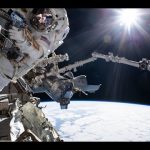
NASA astronaut Raja Chari and European Space Agency (ESA) astronaut Matthias Maurer are conducting a spacewalk on Wednesday, March 23 to install new hoses on the International Space Station’s Radiator Beam Valve Module, which helps regulate the station’s temperature. Chari and Maurer will also install a power and data cable on the station’s Bartolomeo science platform, replace an external camera, and conduct other upgrades to station hardware.
Wednesday’s spacewalk is expected to begin around 8:50 a.m. EDT (12:50 UTC) and take about six-and-a-half hours. This spacewalk will be the second of Chari’s career and the first for Maurer.
ESA astronaut Matthias Maurer is currently living and working aboard the International Space Station for his first space mission, Cosmic Kiss. Recently, he experimented with water in microgravity. In this water experiments video series, Matthias demonstrates the different behavior of water in weightlessness and how this research is applied to life on Earth.
In this second clip in the series, Matthias blows air into a floating water sphere and looks at what happens when he tries to mix it with olive oil.
Matthias will live and work in orbit for approximately six months for his Cosmic Kiss mission. During this time, he will conduct and support more than 35 European and numerous other international experiments in microgravity.
We are Europe’s gateway to space. Our mission is to shape the development of Europe’s space capability and ensure that investment in space continues to deliver benefits to the citizens of Europe and the world. Check out https://www.esa.int/ to get up to speed on everything space related.