Nesta edição de “Space”, a partir do Observatório de Paris, vamos encontrar-nos com astrónomos que trabalham numa missão especial do telescópio Gaia, que tem vigiado mais de mil milhões de estrelas da nossa galáxia, tentando dar resposta a alguns dos mistérios da Via Láctea.
Astronomen haben mit Daten vom Weltraumteleskop Gaia eine Himmelskarte mit mehr als einer Milliarde Sternen erstellt – mehr als genug Material für Jahrzehnte der Forschung.
Groups like Code Club, CoderDojo, Code.org and many others are doing amazing work in helping to introduce kids to coding. Initiatives like Hour of Code have highlighted how those of us in tech can help to support and inspire the next generation of developers.
How can we extend this to include artificial intelligence and machine learning? How can we use the cloud-based machine learning APIs that are increasingly available to us as developers to extend the tools used to teach kids about coding?
In this session, I’ll share the work I’ve been doing to introduce machine learning to kids, and demo the resources that are available to give kids hands-on experiences at training and using machine learning models for themselves.
If you’re familiar with AI and ML technologies, this session will hopefully enable you to share your expertise with local schools, colleges and coding groups. If you’re not as familiar with ML, this session will show you how quick and simple cloud-based machine learning APIs today, and perhaps inspire you to use them in your next project.
Science Max – Phil starts with a Popsicle stick catapult. Then he uses everything he knows about elastic energy to build a full-size catapult that hurls pumpkins! Plus, a maxed out paddle wheel boat and a historical re-enactment (sort of) of how catapults were used in medieval days.
Have you ever done a science experiment and wondered “What would this be like if it were HUGE?” Welcome to Science Max, the exciting new series that turbocharges all the science experiments you’ve done at home.
In season 1, join Phil as he builds rocket cars, uses elastic energy to hurl pumpkins on a giant catapult, builds a bridge out of pasta that can hold a human, find magnets powerful enough to float Phil off the ground, and many more experiments taken to the MAX!
Sending a helicopter to Mars, a busy week for our new Administrator, and showcasing how technology enables exploration – a few of the stories to tell you about – This Week at NASA!
This video is available for download from NASA’s Image and Video Library: https://images.nasa.gov/details-NHQ_2018_0511_A%20Copter%20Companion%20for%20the%20Mars%202020%20Rover%20on%20This%20Week%20@NASA%20%E2%80%93%20May%2011,%202018.html
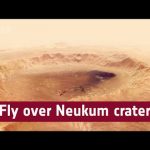
This movie, based on images taken by ESA’s Mars Express, showcases the 102 km wide Neukum Crater in the southern hemisphere of Mars.
The crater is named for the German physicist and planetary scientist, Gerhard Neukum, one of the founders of ESA’s Mars Express mission who inspired and led the development of the high-resolution stereo camera on Mars Express.
This complex impact crater has a diverse geologic history, as indicated by various features on the crater rim and floor. Particularly striking are the dark dune fields, likely made up of volcanic material blown in and shaped by strong winds.
The crater’s shallow interior has been infilled by sediments over its history. It is also marked with two irregular depressions that may be a sign of a weaker material that has since eroded away, leaving behind some islands of more resistant material.
Over time the crater rim has undergone varying degrees of collapse, with landslides and slumped material visible in the crater walls. Many smaller craters have also overprinted the rim and pockmarked the interior since Neukum Crater was formed, highlighting its long history.
Neukum Crater is situated in Noachis Terra, one of the oldest known regions on Mars, dating back to at least 3.9 billion years.
Credits: Animation: ESA/DLR/FU Berlin, CC BY-SA 3.0 IGO; Music: Coldnoise, CC BY-SA 4.0 and Adrian Neesemann
What if the Earth were swallowed by a black hole? Would humanity’s legacy be gone forever? Or could you somehow get back that information from behind the event horizon?
There are three possible answers to this question…but they all break physics as we know it!
‘Horizons’ is the name of ESA astronaut Alexander Gerst’s second mission to the International Space Station.
The mission name evokes exploring our Universe, looking far beyond our planet and broadening our knowledge. Alexander would also like to make people realise that there is always a chance to go beyond their personal horizons.
Alexander will be launched on 6 June with US astronaut Serena Auñón-Chancellor and Russian cosmonaut Sergei Prokopyev from the Baikonur cosmodrome, Kazakhstan in the Soyuz MS-09 spacecraft.
Alexander will take over command of the International Space Station for the second half of his mission. Alexander Gerst is the 11th German citizen to fly into space.
The astronaut is now in the last stages of training for his challenging spaceflight. The science programme is packed with European research: more than 50 experiments will deliver benefits to people back on Earth and prepare for future space exploration.
Credits: ESA
Phil builds a balloon powered car in the lab. Then he tries to make one big enough to ride. Can the Science Max build team find a big enough balloon? Or are balloons the way to go? Plus, Newton’s Cradle out of bowling balls, how Guinea Pigs got their name and Newton’s 3rd Law.
Have you ever done a science experiment and wondered “What would this be like if it were HUGE?” Welcome to Science Max, the exciting new series that turbocharges all the science experiments you’ve done at home.
In season 1, join Phil as he builds rocket cars, uses elastic energy to hurl pumpkins on a giant catapult, builds a bridge out of pasta that can hold a human, find magnets powerful enough to float Phil off the ground, and many more experiments taken to the MAX!
Our newest mission to Mars is on its way, Vice President Pence visits our Jet Propulsion Laboratory, and observing our planet’s ever-changing water cycle – a few of the stories to tell you about – This Week at NASA!
This video is available for download from NASA’s Image and Video Library: https://images.nasa.gov/details-NHQ_20218_0505_Our%20Newest%20Mission%20to%20Mars%20on%20This%20Week%20@NASA%20%E2%80%93%20May%205,%202018.html
InSight, NASA’s next Mars explorer, has arrived at Vandenberg Air Force Base in California – a big step forward in the countdown to T-zero on May 5, 2018. The spacecraft is called InSight – short for Interior Exploration using Seismic Investigations, Geodesy and Heat Transport – and it’s being tested, fueled and encapsulated for launch aboard the powerful United Launch Alliance Atlas V rocket. The upcoming liftoff will mark the first time an interplanetary mission has launched from the West Coast.
Spacecraft in orbit and on Mars’s surface have made many exciting discoveries, transforming our understanding of the planet and unveiling clues to the formation of our Solar System, as well as helping us understand our home planet. The next step is to bring samples to Earth for detailed analysis in sophisticated laboratories where results can be verified independently and samples can be reanalysed as laboratory techniques continue to improve.
Bringing Mars to Earth is no simple undertaking—it would require at least three missions from Earth and one never-been-done-before rocket launch from Mars.
A first mission, NASA’s 2020 Mars Rover, is set to collect surface samples in pen-sized canisters as it explores the Red Planet. Up to 31 canisters will be filled and readied for a later pickup – geocaching gone interplanetary.
In the same period, ESA’s ExoMars rover, which is also set to land on Mars in 2021, will be drilling up to two meters below the surface to search for evidence of life.
A second mission with a small fetch rover would land nearby and retrieve the samples in a Martian search-and-rescue operation. This rover would bring the samples back to its lander and place them in a Mars Ascent Vehicle – a small rocket to launch the football-sized container into Mars orbit.
A third launch from Earth would provide a spacecraft sent to orbit Mars and rendezvous with the sample containers. Once the samples are safely collected and loaded into an Earth entry vehicle, the spacecraft would return to Earth, release the vehicle to land in the United States, where the samples will be retrieved and placed in quarantine for detailed analysis by a team of international scientists.
Vice President Pence swears in our new NASA Administrator, a Hubble anniversary flythrough of a nebula, and the smell in the clouds of one of our outermost planets – a few of the stories to tell you about – This Week at NASA!
This video is available for download from NASA’s Image and Video Library: https://images.nasa.gov/details-NHQ_2018_0427_%20Bridenstine%20Sworn%20in%20as%20NASA%20Administrator%20on%20This%20Week%20@NASA%20%E2%80%93%20April%2027,%202018.html
Have you ever done a science experiment and wondered “What would this be like if it were HUGE?” Welcome to Science Max, the exciting new series that turbocharges all the science experiments you’ve done at home.
Have you ever wondered what it would be like to fall into a black hole? Take a 360° adventure to find out!
SUBSCRIBE: http://youtube.com/whatthephysics?sub
Earth from Space is presented by Kelsea Brennan-Wessels from the ESA Web TV virtual studios. A mosaic of cloud-free images from the Copernicus Sentinel-3A satellite spanning Europe is featured in this edition.
The Copernicus Sentinel-3B satellite spent six weeks at the Plesetsk cosmodrome in Russia being carefully prepared for liftoff. After being shipped from France to the launch site, the satellite was tested, joined to the rocket launch adapter, sealed from view in the fairing and taken by train to the launch pad. Sentinel-3B lifted off on 25 April 2018 at 17:57 GMT (19:57 CEST).
It joins its twin, Sentinel-3A, in orbit. The pairing of identical satellites provides the best coverage and data delivery for Europe’s Copernicus programme – the largest environmental monitoring programme in the world. The satellites carry the same suite of cutting-edge instruments to measure oceans, land, ice and atmosphere. While these data are fed primarily into the Copernicus Marine Environment Monitoring Service, all the Copernicus services benefit to produce knowledge and information products in near-real time for a wide range of applications. The Sentinel-3 mission is essential for applications for ocean and coastal monitoring, numerical weather and ocean prediction, sea-level change and sea-surface topography monitoring, ocean primary production estimation and land-cover change mapping.
The second data release of ESA’s Gaia mission has produced an extraordinary catalogue of over one and a half billion stars in our galaxy. Based on observations between July 2014 to May 2016, it includes the most accurate information yet on the positions, brightness, distance, motion, colour and temperature of stars in the Milky Way as well as information on asteroids and quasars.
Animated 3D view of the sky as observed by ESA’s Gaia satellite using information from the mission’s second data release.
The bright band in the left half of the image is the Milky Way, where most of the stars in our Galaxy reside. The animation starts with the Orion constellation at the centre; we then move towards the neighbouring Taurus constellation and to the Hyades star cluster, which is part of this constellation. Hyades is the closest open cluster to the Solar System, some 150 light-years away.
The animation first shows the 3D structure of the cluster, based on accurate position and distance information from Gaia. Then an animated view of the future motions of stars is shown – both in Hyades and beyond. This is based on Gaia’s measurements of the velocity of stars across the sky, also known as proper motion.
Credit: ESA/Gaia/DPAC, CC BY SA 3.0 IGO
Acknowledgement: Gaia Data Processing and Analysis Consortium (DPAC); Gaia Sky; S. Jordan / T. Sagristà, Astronomisches Rechen-Institut, Zentrum für Astronomie der Universität Heidelberg, Germany
Animated view of 14 099 asteroids in our Solar System, as viewed by ESA’s Gaia satellite using information from the mission’s second data release. The orbits of the 200 brightest asteroids are also shown, as determined using Gaia data.
In future data releases, Gaia will also provide asteroid spectra and enable a complete characterisation of the asteroid belt. The combination of dynamical and physical information that is being collected by Gaia provides an unprecedented opportunity to improve our understanding of the origin and the evolution of the Solar System.
Credit: ESA/Gaia/DPAC, CC BY SA 3.0 IGO
Acknowledgement: Gaia Data Processing and Analysis Consortium (DPAC); Orbits: Gaia Coordinating Unit 4; P. Tanga, Observatoire de la Côte d’Azur, France; F. Spoto, IMCCE, Observatoire de Paris, France; Animation: Gaia Sky; S. Jordan / T. Sagristà, Astronomisches Rechen-Institut, Zentrum für Astronomie der Universität Heidelberg, Germany
A 360° animated view of the entire sky on 25 April 2018.
After a few seconds, the stars start moving in the sky according to parallax, an apparent shift caused by Earth’s yearly motion around the Sun. Then, constellation outlines appear as visual aids. Finally, stars start moving according to their true motion through space, which is visible on the sky as proper motion. Parallaxes have been exaggerated by 100 000 and proper motions have been speeded up by one trillion (10^12) to make them visible in this animation. This animation is based on data from the second data release of ESA’s Gaia satellite, which has measured the positions, parallaxes and motions of more than one billion stars across the sky to unprecedented accuracy.
ESA/Gaia/DPAC, CC BY SA 3.0 IGO
Acknowledgement: Gaia Data Processing and Analysis Consortium (DPAC); Gaia Sky; S. Jordan / T. Sagristà, Astronomisches Rechen-Institut, Zentrum für Astronomie der Universität Heidelberg, Germany
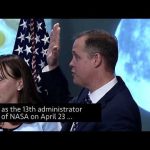
Jim Bridenstine officially took office as the 13th administrator of NASA on Monday, April 23rd, after he was given the oath of office by Vice President Mike Pence at the agency’s headquarters in Washington.
Meet our new space explorers, the spacecraft of the BepiColombo mission, as they begin their adventure to planet Mercury. But first, they have to navigate through Amsterdam Schiphol airport to reach Europe’s spaceport in Kourou, French Guiana.
The spacecraft really do depart from Schiphol; along with essential ground-support equipment they are scheduled to fly in a series of Antonov aircraft during the last week of April and first week of May. Upon arrival at Kourou, an intensive six-months of preparations will prepare the mission for launch. The launch window opens 5 October until 29 November 2018.
Find out more about the BepiColombo mission on esa.int/bepicolombo
Have you ever done a science experiment and wondered “What would this be like if it were HUGE?” Welcome to Science Max, the exciting new series that turbocharges all the science experiments you’ve done at home.
On 25 April 2018, ESA’s Gaia mission will publish its much awaited second data release, including high-precision measurements of nearly 1.7 billion stars in our Galaxy.
Scientists who have been working on creating and validating the data contained in the catalogue tell us why they are waiting for this extraordinary release.
Featured in the video: Antonella Vallenari (INAF, Astronomical Observatory of Padua), Anthony Brown (Leiden University), Timo Prusti (European Space Agency), Annie Robin (Institut UTINAM, OSU THETA Franche-Comté-Bourgogne), Laurent Eyer (University of Geneva) and Federica Spoto (IMCCE, Observatory of Paris).
A media briefing on the second Gaia data release will be held at the ILA Berlin Air and Space Show in Germany on 25 April 11:00-12:15 CEST. Watch the webstream at www.esa.int/live
We meet a surfing scientist and toxic algae hunters to see how Sentinel-3 satellite data is used to study the coastline of the English Channel in this month’s episode of Space.
Bob Brewin is pioneering a new technique in satellite oceanography – by going surfing. The Plymouth Marine Laboratory scientist uses his board to take sea surface temperature measurements, and then use them to better interpret data from European satellite Sentinel-3.
Astronautas de la ESA (Agencia Espacial Europea) explican las maniobras de RCP. El astronauta, Paolo Nespoli, practica habilidades de resucitación cardiopulmonar que salvan vidas a bordo de la Estación Espacial Internacional. Dos miembros de la tripulación de la Estación Espacial son asignados como Oficiales Médicos de la Tripulación y están capacitados para proporcionar apoyo médico durante su misión. Ofrecen apoyo médico básico como un paramédico en la Tierra.
In this special edition of Earth from Space, senior project scientist at Gamma Remote Sensing, Dr Maurizio Santoro, joins the show to discuss how his team estimates forest biomass from space.
When people think about the big players of the space industry, they don’t tend to think about Europe. But believe it or not the European Space Agency or ESA has the second highest budget out of any space agency. So what are they doing with all that money?
Have you ever done a science experiment and wondered “What would this be like if it were HUGE?” Welcome to Science Max, the exciting new series that turbocharges all the science experiments you’ve done at home.
A challenge for the next generation of explorers, an eye-popping virtual tour of the Moon, and introducing the public to a universe of discovery – a few of the stories to tell you about – This Week at NASA!
This video is available for download from NASA’s Image and Video Library: https://images.nasa.gov/details-NHQ_2018_0413_Human%20Exploration%20Rover%20Challenge%20on%20This%20Week%20@NASA%20%E2%80%93%20April%2013,%202018.html