Europe’s next four Galileo satellites lifted off at 11:25 GMT (13:25 CEST, 08:25 local time) on 25 July from Europe’s Spaceport in French Guiana atop an Ariane 5 launcher.
Copyright: ESA/CNES/Arianespace
★ Subscribe: http://bit.ly/ESAsubscribe
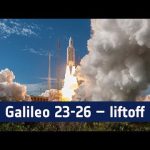
Europe’s next four Galileo satellites lifted off at 11:25 GMT (13:25 CEST, 08:25 local time) on 25 July from Europe’s Spaceport in French Guiana atop an Ariane 5 launcher.
Copyright: ESA/CNES/Arianespace
★ Subscribe: http://bit.ly/ESAsubscribe
At Europe’s Spaceport in French Guiana, everything is being prepared to accommodate Europe’s newest launcher, Ariane 6.
A new launch pad is under construction and the mobile gantry protecting the launcher will soon be visible.
The new assembly building dimensions can now be fully seen as the outer shell is almost complete.
Ariane 6 will guarantee Europe’s independent access to space and should consolidate Arianespace’s leading role on the satellites launch market.
The first Ariane 6 launch is scheduled for July 2020.
More about Ariane 6:
http://www.esa.int/Our_Activities/Space_Transportation/Launch_vehicles/Ariane_6
File download & source material:
http://www.esa.int/esatv/Videos/2018/01/Ariane_6_launch_site_visit
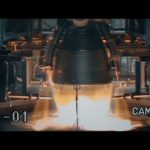
The first hot firing of Ariane 6’s Vulcain 2.1 main engine was performed in January 2018 at the DLR German Aerospace Center test facility in Lampoldshausen, Germany.
The engine, developed by ArianeGroup, has a simplified and more robust nozzle, a gas generator made through additive manufacturing, and an oxygen heater for oxygen tank pressurisation. These features lower the cost of the engine and simplify manufacturing.
Credit: ArianeGroup
Latest news from ArianeGroup on Facebook at:
https://www.facebook.com/ArianeGroup/
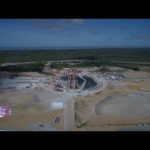
The race is on to build the new launch pad for the Ariane 6 rocket, due to make its maiden voyage in July 2020. Construction is in full swing in French Guiana as Europe builds not only a new rocket but also a new way of launching rockets, in a bid to face down competition from the likes of Space X.
When Euronews visited, around 500 people were active on the site from six in the morning until ten at night, with attention focused on two key elements of the pad – firstly the huge flame trench which will take the hot gases away from the rocket on launch, and the new building in which the Ariane 6 will be built.
This video is also available in the following languages:
German: https://www.youtube.com/watch?v=n4u07oXpMLY

Dans cette édition de Space, nous entrons dans les coulisses d’un chantier colossal au Centre spatial européen de Kourou en Guyane française. Un pas de tir est en train de sortir de terre en vue du vol inaugural d’Ariane 6 programmé en juillet 2020. Grâce à ce projet, l’Europe se relance dans la compétition mondiale qui oppose les acteurs du secteur spatial.
Sur la côte nord-est de l’Amérique du Sud, à Kourou en Guyane, des ingénieurs européens s’affairent à la construction du nouveau pas de tir d’Ariane 6. Ce chantier colossal doit répondre à un objectif simple : diviser par deux, les coûts de lancement par rapport à son modèle précédent. Pour y parvenir, il faut d’abord une quantité astronomique de béton, d’acier et de main-d’oeuvre.
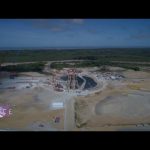
Francia-Guyanáról köszöntjük az Euronews nézőit, Európa űrkikötőjében vagyunk.
Egy hatalmas építkezés zajlik: új kilövőállást alakítanak ki az Ariane-6 rakétához. A tervek szerint 2020 júliusában bocsátják fel.
Ma bepillantunk az előkészületek kulisszái mögé. Ami zajlik már nem csak kutatás, maga az űrbiznisz.
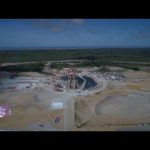
El Puerto Espacial Europeo en la Guyana francesa, está en plena efervescencia. Estamos en medio de una gigantesca obra. Aquí se sitúa la nueva plataforma de lanzamiento de Ariane 6, cuyo despegue está previsto en julio de 2020. Intentamos averigurar qué se necesita para mantenerse a la vanguardia en el negocio del espacio.
Amanece en Guyana y los ingenieros europeos se afanan en la construcción del terminal de lanzamiento de Ariane 6. Esta gigantesca obra tiene un único objetivo: lanzar cohetes al espacio por un coste, dos veces inferior al de Ariane 5. Para lograrlo se necesita un montón de hormigón, de acero y de mano de obra.
At Europe’s Spaceport in French Guiana, Ariane 6 is now a reality with the launch zone taking shape.
Indeed there is no time to lose for the future European launcher since its first launch is planned for July 2020.
But the independent access to space for Europe is at stake along with its leading role on the launcher market.
This video shows the status of Ariane 6 launch zone in Kourou with latest drone images and an interview with Daniel Neuenschwander, ESA’s Director of Space Transportation.
Read more about Ariane 6:
http://www.esa.int/Our_Activities/Space_Transportation/Launch_vehicles/Ariane_6
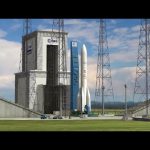
At the European spaceport in Kourou, French Guiana, the new launch facilities for ESA’s Ariane 6 launcher are being built. With the Ariane 6 launcher and the upgrade of the Vega to Vega C, Europe expands its launching capacities by creating versatile launchers that meet market demands. At the same time ESA supports both institutional missions and European industry as both Ariane 6 and Vega C will be fully European. With Ariane 6 and Vega C, Europe secures its independent access to space for years to come.
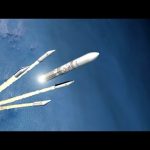
Decided in Luxemburg by the European Space Agency council meeting at Ministerial level, Ariane 6 is a modular three-stage launcher (solid–cryogenic–cryogenic) with two configurations using: four boosters (A64) or two boosters (A62).
More about Ariane 6:
http://www.esa.int/Our_Activities/Launchers/Launch_vehicles/Ariane_6
Credit: ESA-David Ducros
(January 2017)

On 30 September 2015, Ariane 5 flight VA226 lifted off from Europe’s Spaceport in French Guiana and delivered two telecom satellites, Sky Muster and Arsat-2, into their planned orbits.

On 20 August 2015, Ariane 5 flight VA225 lifted off from Europe’s Spaceport in French Guiana and delivered two telecom satellites, Eutelsat-8 West B and Intelsat-34, into their planned orbits.
Credit: Arianespace
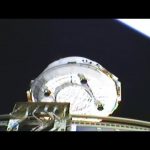
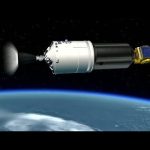
These images were taken by cameras on the Ariane 5 launcher that rocketed skywards on 29 July 2014 with Europe’s last cargo vessel to visit the International Space Station, ATV-5.
The video shows the separation of ATV Georges Lemaîtres and its Ariane 5.
From then on, it was a self-sufficient spacecraft heading towards the Space Station. The video also shows Ariane’s last stage manoeuvring out of the way.
ATV-5 is carrying almost 6.6 tonnes of supplies to the International Space Station, including a record amount of dry cargo – 2682 kg.

The first Ariane 5 launch of 2014 lifted off from Europe’s Spaceport in French Guiana on its mission to place two telecommunications satellites, ABS-2 & Athena–Fidus, into their planned transfer orbits.
Credit: ESA / CNES / Arianespace
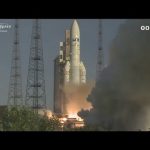
Thursday 2 August 2012 marked the 50th successful Ariane flight in a row: an Ariane 5 was launched from Europe’s Spaceport in French Guiana to perform a dual deployment of two telecommunications satellites, Intelsat 20 and Hylas-2, into their planned transfer orbits.
Lift off of flight VA208 took place at 22:54 CEST; 17:54 French Guiana time. This was Ariane 5’s fourth launch of 2012, continuing a line of launch successes unbroken since 2003.
This video presents the key events in 2012 for ESA.
André Kuipers continues his PromISSe mission aboard the International Space Station until May, the 4th ESA long duration mission. During his stay the third European ATV cargo ship will bring food and supplies to the orbital outpost. Early in the year the new Vega launcher will make its qualifying flight from Europe’s Spaceport in French Guiana. The end of the year will be marked by an ESA Conference at Ministerial level, a major decision point for the future of Europe in Space.
More backgroud information can be found on: www.esa.int
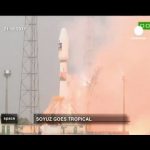
Lançou o Sputnik e Gagarin para o espaço. O mítico foguetão russo Soyuz conta já com mais de 1700 voos. O lançamento do Porto Espacial Europeu, na Guiana Francesa, abre um novo capítulo na sua longa carreira.

Ariane 5, la punta de lanza de la industria europea de cohetes espaciales, lidera el mercado de lanzadores comerciales.
En breve, otros cohetes se le unirán para completar la oferta europea, haciendo de 2011 el año de los lanzadores espaciales europeos
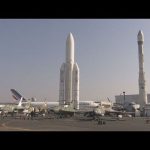
Ariane 5, the European space industry’s workhorse, continues to successfully carry payloads into orbit. Two new launchers will soon complement Ariane 5, offering a full range of competitive services to Europe.
2011 will be the year of the launchers.
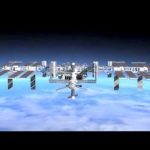
In recent weeks several space freighters, the Russian Progress and Japanese HTV, have arrived at the International Space Station. But the most important logistics spacecraft for the ISS is Europe’s Automated Transfer Vehicle. The ATV-2 called Johannes Kepler is to be launched from Kourou in just over a week and will be docking at the orbital complex on February 23rd with over 7 tonnes of cargo.

On 24 December 1979, Ariane made its first flight from French Guiana, marking the beginning of 30 years of success and giving Europe a guaranteed independent access to space. With Ariane, ESA could develop its own programmes in many different domains: telecommunications, Earth observation, science and exploration. Europe was the pioneer in the civil launch space market, with the creation of Arianespace, the world-leading space transportation company.