ESA’s Rosetta spacecraft is set to complete its incredible mission in a controlled descent to the surface of Comet 67P/C-G on 30 September. Mission experts joined an ESA Hangout on 19 September to discuss Rosetta’s final days and hours of operation, including expectations for the images and other scientific data that will be collected as the spacecraft gets closer and closer to the surface. They also discuss the exciting discovery of Philae that was made earlier this month.
Hangout guests:
Andrea Accomazzo, Flight operations director
Sylvain Lodiot, Rosetta spacecraft operations manager
Claire Vallat or Richard Moissl (TBC), Rosetta science ground segment liaison scientist
Laurence O’Rourke, Rosetta downlink science operations manager (lander search coordinator)
Update on the Rosetta mission, including status of the Philae lander.
Hosted by Emily Baldwin – ESA Science Editor, with:
Andrea Accomazzo – ESA Rosetta Flight Director, ESOC
Stephan Ulamec – Philae Lander Manager, DLR
Matt Taylor – Rosetta Project Scientist, ESA
Philippe Gaudon – CNES Rosetta Project Manager, SONC
Holger Sierks – PI for OSIRIS, Max-Planck-Institute for Solar System Research
Valentina Lommatsch – DLR-Lander Control Center, mission team
Jeff Grossman – OSIRIS-REx Program Scientist, NASA
Gordon Johnston – OSIRIS-REx Program Scientist, NASA
Highlights from coverage of ESA’s Rosetta mission soft-landing its Philae probe on a comet, the first time in history that such an extraordinary feat has been achieved. Including the presentation of the first ROLIS image sent back by Philae as the lander descended to the surface of the comet.
After a tense wait during the seven-hour descent to the surface of Comet 67P/Churyumov–Gerasimenko, the signal confirming the successful touchdown arrived on Earth at 16:03 GMT (17:03 CET).
Highlights from coverage of ESA’s Rosetta mission soft-landing its Philae probe on a comet, the first time in history that such an extraordinary feat has been achieved.
After a tense wait during the seven-hour descent to the surface of Comet 67P/Churyumov–Gerasimenko, the signal confirming the successful touchdown arrived on Earth at 16:03 GMT (17:03 CET).
Scene inside Mission Control as the team regained contact with Rosetta as expected after separation, and with Philae that is descending onto the surface of Comet 67P/C-G.
The third of a trio of music videos released by ESA to celebrate the first ever attempted soft landing on a comet by ESA’s Rosetta mission.
Vangelis, the world-renowned musician, has composed this piece of music specially for ESA and inspired by the Rosetta mission. Vangelis’s music is often linked to themes of science, history and exploration, and he is best known for his Academy Award–winning score for the film Chariots of Fire, composing scores for the films Antarctica, Blade Runner, 1492: Conquest of Paradise and Alexander, and the use of his music in the documentary series Cosmos, by Carl Sagan.
Vangelis said: “Mythology, science and space exploration are subjects that have fascinated me since my early childhood. And they were always connected somehow with the music I write.”
Video copyright: ESA/Vangelis
Original music: Vangelis
The second of a trio of music videos released by ESA to celebrate the first ever attempted soft landing on a comet by ESA’s Rosetta mission.
Vangelis, the world-renowned musician, has composed this piece of music specially for ESA and inspired by the Rosetta mission. Vangelis’s music is often linked to themes of science, history and exploration, and he is best known for his Academy Award–winning score for the film Chariots of Fire, composing scores for the films Antarctica, Blade Runner, 1492: Conquest of Paradise and Alexander, and the use of his music in the documentary series Cosmos, by Carl Sagan.
Vangelis said: “Mythology, science and space exploration are subjects that have fascinated me since my early childhood. And they were always connected somehow with the music I write.”
Video copyright: ESA/Vangelis
Original music: Vangelis
The first of a trio of music videos released by ESA to celebrate the first ever attempted soft landing on a comet by ESA’s Rosetta mission.
Vangelis, the world-renowned musician, has composed this piece of music specially for ESA and inspired by the Rosetta mission. Vangelis’s music is often linked to themes of science, history and exploration, and he is best known for his Academy Award–winning score for the film Chariots of Fire, composing scores for the films Antarctica, Blade Runner, 1492: Conquest of Paradise and Alexander, and the use of his music in the documentary series Cosmos, by Carl Sagan.
Vangelis said: “Mythology, science and space exploration are subjects that have fascinated me since my early childhood. And they were always connected somehow with the music I write.”
Video copyright: ESA/Vangelis Original music: Vangelis
William Shatner, known to millions around the world as Capt. James T. Kirk from the original Star Trek series, sent this message to ESA’s Rosetta team today to wish them good luck for tomorrow’s Philae landing.
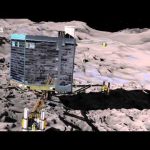
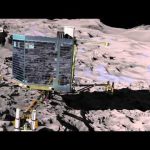
Rosetta’s deployment of Philae to land on Comet 67P/Churyumov–Gerasimenko.
The animation begins with Philae still on Rosetta, which will come to within about 22.5 km of the centre of the nucleus to release the lander on 12 November 2014.
The animation then shows Philae being ejected by Rosetta and deploying its own three legs, and follows the lander’s descent until it reaches the target site on the comet about seven hours later.
The animation is speeded up, but the comet rotation is true: in the time it takes for Philae to descend, the nucleus has rotated by more than 180º (the comet’s rotation period is 12.4 hours).
The final steps of Philae’s descent towards the comet are shown as seen by a hypothetical observer close to the landing site on the comet.
Finally, the animation shows Philae landing on the comet.
Because of the comet’s extremely low gravity, landing gear will absorb the small forces of landing while ice screws in the probe’s feet and a harpoon system will lock the probe to the surface. At the same time a thruster on top of the lander will push it down to counteract the impulse of the harpoon imparted in the opposite direction. Once it is anchored to the comet, the lander will begin its primary science mission, based on its 64-hour initial battery lifetime. The animation shows a number of the science instruments in action on the surface.
Acknowledgement: The background image of the sequence showing Philae closing in on the landing site was taken by Rosetta’s OSIRIS narrow-angle camera (ESA/Rosetta/MPS for OSIRIS Team MPS/UPD/LAM/IAA/SSO/INTA/UPM/DASP/IDA) on 14 September 2014 from a distance of about 30 km.
Philae was provided by a consortium led by DLR, MPS, CNES and ASI.
Media and interested members of the public joined Rosetta mission experts online on Friday, 7 November for a briefing ahead of the historic comet landing on 12 November.
Programme:
Introduction: Emily Baldwin, ESA space science editor
Overview of media events: Jocelyne Landeau-Constantin, Head of ESOC communication office
Science from Rosetta so far: Matt Taylor, ESA Rosetta project scientist
Spacecraft status and operations timeline: Andrea Accomazzo, ESA Rosetta flight director
Key messages: Fred Jansen, ESA Rosetta mission manager
Q&A: all
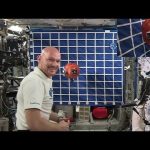
ESA astronaut Alexander Gerst performs a demonstration of how ESA’s Rosetta mission will attempt to put a lander, called ‘Philae’ on the surface of comet 67P/Churyumov–Gerasimenko.
Alexander narrates the story of the Rosetta mission and performs a demonstration that visualises the difficulties of landing on an object that has little gravitational pull. Using the weightless environment of the Space Station, Alexander attempts to land ‘Philae’ (an ear plug) onto the surface of the ‘comet’ (an inactive SPHERES robot) with increasing levels of difficulty: a rotating comet that is not moving to one that is both rotating and moving.
This video is one of the six experiments and demonstrations in the Flying Classroom, Alexander will use small items to demonstrate several principles of physics in microgravity to students aged 10–17 years.
The Rosetta mission’s lander, Philae, will be deployed on 12 November at 08:35 GMT/09:35 CET from a distance of 22.5 km from the centre of the comet. It will land about seven hours later, with confirmation expected to arrive at Earth at around 16:00 GMT/17:00 CET.
After a ten-year journey, Rosetta and Philae had finally reached their destination, Comet 67P/Churyumov–Gerasimenko. Rosetta spent many weeks studying the comet, sending lots of information back to Earth. But where was Philae going to land? Eventually the scientists on Earth found the best place on the comet for Philae to land. Soon it was time to make the final preparations for Philae’s great adventure. Both spacecraft couldn’t wait any longer. The whole world would be watching as Rosetta and Philae prepared for their biggest challenge yet…
Nach einer 10-jährigen Reise haben Rosetta und Philae endlich ihr Ziel erreicht. Den Kometen 67P/Churyumov-Gerasimenko. Rosetta verbrachte mehrere Wochen damit, die Oberfläche des Kometen zu studieren und schickte viele Informationen zurück zur Erde. Aber wo würde Philae wohl landen können? Die Wissenschaftler überlegten lang und intensiv. Letztendlich fanden sie die beste Landestelle für Philae. Beide Raumsonden konnten es nicht mehr erwarten. Die ganze Welt würde zusehen, wenn sich Rosetta und Philae für ihre bisher größte Herausfordung bereit machen…
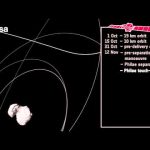
Animation showing Rosetta’s orbit in the lead up to, during and after lander separation.
The animation begins on 1 October 2014, when Rosetta is orbiting about 19 km from Comet 67P/Churyumov–Gerasimenko (all distances refer to the comet’s centre). The animation shows the transition to the close 10 km orbit by mid-October, and then the steps taken to move onto the pre-separation trajectory.
On the day of landing, 12 November, Rosetta makes a further manoeuvre 2–3 hours before separation to move to 22.5 km from the comet centre to deploy the lander, Philae. While Philae descends to the surface over a period of seven hours, Rosetta makes another manoeuvre to maintain visibility with the lander. A series of ‘relay phase’ manoeuvres then move Rosetta out to a distance of about 50 km, before moving first to a 30 km orbit and later to an orbit at about 20 km by early December.
The speed of the animation slows during the separation and lander phase to better highlight these events. The comet shape and rate of rotation is real – the comet rotates with a period of about 12.4 hours.