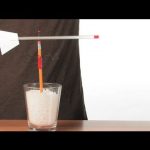
Marshmallows are a delicious, fluffy staple of summer, campouts, and barbecues. Did you know that there isn’t really much to them? It’s true. The best way to see what really comprises a marshmallow is to put it to the Marshmallow Masher pressure test. You’ll use the power of air to demonstrate what you’re really eating when you roasting ‘mallows this summer.
M&Ms have the slogan of melting in your mouth, but not in your hands. You wanna know something cool? The special melting property is totally scientific. The results are an amazing phenomenon that we call Floating Letters.
You’ve seen Steve Spangler use blow dryers or industrial-sized blowers to levitate ping pong balls, beach balls, and send toilet paper flying through the air. You can replicate this levitating object phenomenon on a smaller scale using objects that are right in your home! The Floating Ping Pong Ball trick uses amazing principles of air that are sure to amaze anyone, from your science teacher to your parents to your neighbors!
Putting an item into an empty soda bottle is a piece of cake. Just drop the object through the mouth of the bottle, right? Well, we have a challenge for you. Place a small item in the mouth of a bottle and attempt to blow the object into the bottle using a straw. Not so easy, now is it?
Hard candies are known for their bright colors, delicious tastes, and, well, having a ton of sugar. While having a handful of candy every once in a while is definitely a good thing, we like conducting experiments with them! We especially love Gobstoppers. They have layers of colors that, when they dissolve into water, do something very peculiar…
Purchase DVD here: http://www.stevespanglerscience.com/product/sick-science-dvd-volume-1
If you’ve experienced our Sick Science!™ series before, you know that the videos are all about bringing science to life for young learners. The best part? The hands-on science exploration can be done using items found right in your own home or classroom! Each volume of the Sick Science DVD series features 10 experiments that leave young scientists with a question. Sometimes, they may be asked to figure out why the experiment works. Other times, they may be asked to determine a mystery component of the activity. The entire experience is designed to encourage investigation and inquiry… a sure-fire way to keep everyone engaged and wanting more.
Sick Science™ is a trademark of Steve Spangler, inc.
Tissue paper is known for a few things. For example, tissue paper is soft and nice for blowing your nose. Tissue paper is not, however, known for its tensile strength. Most people wouldn’t be surprised if a common housefly could tear through a piece. In the Magic Tube – Strong Tissue Paper experiment, though, we’ll show you a way to make tissue paper nearly impenetrable.
A vacuum packer is an amazing device that vacuum packs food to seal in the freshness. At least that’s what those late night infomercials tell us. We’re more excited about using this fascinating device to explore amazing scientific properties. Fill the special storage container with marshmallows (we prefer those adorable yellow Peeps) and watch the incredible growing marshmallow trick!
Who taught these noodles to dance, anyway? Go on – gather up some pasta noodles, turn up the music, and get ready for an old-fashioned pasta party. Just when you thought you were done at the dinner table… here is some kitchen science that will have you learning about volume and density in a brand new, hands-on way!
“For this trick, all you need is a bit of un-popped pop corn and a ball bearing.” It’s the perfect phrase to get all of the people around you excited for a bit of science magic. Many people don’t realize that pop corn and ball bearings have a remarkable chemical reaction that turns the ball bearing into a ping pong ball. In fact, when you perform the demonstration, your audience won’t believe their eyes.
A flame goes out inside of an upside down jar and, like magic, the jar is stuck to a plate. You might think that the jar has sucked right to the plate, but we’ll explain why this trick is actually a result of pushing!
If someone told you that they could balance a full-size text book on a piece of paper, you might call up the looney bin. That’s a crazy idea, right? Well, the notion that a book can sit, precariously, atop a plain piece of paper isn’t quite as bonkers as you might think!
Check out the full experiment at http://www.stevespanglerscience.com/experiment/balancing-nails-trick
The object of the challenge is to balance all of the nails on the head of a single nail. All of the nails have to be balanced at the same time and cannot touch anything but the top of the nail that is stuck in the base. If you’re really ambitious, you can try your luck at our large-scale version using landscape nails and a friend as the base. Enough of this idle chatter… get balancing!
Although this effect is presented with modern containers like plastic soda bottles, the original magic trick dates back thousands of years. The magician shows everybody two identical bottles of rice and two chopsticks. When the performer plunges a chopstick into the bottle of rice and lifts, the rice and bottle seem so light that they float upwards as the chopstick is raised. But, when a spectator is invited to do the same thing with the other bottle of rice and chopstick, it refuses to rise. Nothing changes when the performer and spectator exchange chopsticks — the performer’s bottle rises while the spectator’s does not. What is the secret? Read the full experiment to find out: http://www.stevespanglerscience.com/experiment/floating-rice-bottles
Read the full experiment at http://www.stevespanglerscience.com/experiment/egg-drop-inertia-trick
The challenge sounds so simple… just get the egg into the glass of water, but there are a few obstacles. The egg is perched high above the water on a cardboard tube, and a pie plate sits between the tube and the water. Still think it’s easy? Sir Isaac Newton does.
With Halloween right around the corner, all you need to be the hit of the party is a little bit of dry ice, a touch of dish soap, and a bunch of time! Once you make these smoking bubbles, you won’t want them to stop… or maybe its that you can’t make them stop!
Highlighters have a number of uses, from helping acknowledge important text to acting as brightly-colored markers in our favorite coloring book. Around Halloween, though, we’ve found an entirely different use for them. With the Black Light Secret Message experiment, you’ll see that certain highlighters aren’t just brightly-colored – they actually glow underneath a black light! The secret messages and floating images you’ll create with this experiment are sure to create screams of joy and shrieks of excitement.
If you’re a fan of Spangler Science, you know that we love exploding pumpkins… but we’ve also found that glowing pumpkins can be just as fun! Just add Glow Powder to your Halloween pumpkins and you’ll get a spooky Halloween display without all the mess of carving.
Halloween is a big deal around Steve Spangler Science and, needless to say, we’re excited. So, here’s a sneak peak at what we have cooked up for October. What are your Halloween plans? Any cool costume ideas or haunted house schemes? We look forward to hearing what you have going on.
Read the full experiment at http://www.stevespanglerscience.com/experiment/is-black-black
What color is black? Some people answer with a simple “black,” while others respond with something like “black is the absence of all color.” If you have ever run out of black paint or your black pen ran dry, you probably know how to make the color black. Mix a little blue with red and yellow and green and orange and purple and you finally make the color black. Do the people who make black pens mix different colors to make black? Using a technique called chromatography, let’s find out exactly what makes up the color in that black pen.
Sick Science™ is a trademark of Steve Spangler, inc.
Read the full experiment at http://www.stevespanglerscience.com/experiment/homemade-handboiler
Are you hot enough to make water bubble with just the heat from your touch? What would you say if we told you that you could make water boil with nothing more than your touch? Impossible, right? Give this experiment a try and find out.
Read the full experiment at http://www.stevespanglerscience.com/experiment/prayer-vase-genie-in-a-bottle
The science magician displays a bottle and a short length of rope. She explains that according to the ancient legends, a genie lives in the bottle. While you can’t see the genie, if you tickle him with something like a rope, it makes him mad and he hangs onto the rope. The rope is inserted into the bottle and jiggled a bit. When the bottle with the rope still inside it is turned upside down, the rope is seen to dangle unsupported from the bottle. The magician explains that the genie is even strong enough to make the bottle float. Now, the bottle and rope are turned right side up. While holding only the end of the rope, the magician lets go of the bottle and it is seen to float at the end of the rope. On command, the genie releases the rope, it is easily removed from the bottle and handed out for examination. The bottle may be examined, as well. Nothing unusual will be found. But how?
Read the full experiment at http://www.stevespanglerscience.com/experiment/vanishing-styrofoam-cup
Styrofoam is one of the most complex and difficult materials on earth when it comes to decomposition. But, believe it or not, there is a way to make an entire cup of styrofoam vanish in a matter of seconds. It doesn’t involve fire, so there’s no acrid smoke released, either. It’s not actual magic, but knowing the science behind what takes places is pretty darn awesome.
Read the full experiment at http://www.stevespanglerscience.com/experiment/magic-with-physics-pendulum
While many magicians rely on the arts of deception or slight of hand to baffle their audience, we like to use principles of science to achieve the same effect. With the Pendulum Stop trick, you’ll use the sympathetic motion of two pendulums to make your friends think they’ve developed telekinetic powers… or are a Jedi… we’ll leave that part up to them. All you need are some household items and you’ll be fooling people in no time at all!
Graffiti is an oft discussed topic of debate in the modern world. While some consider graffiti a nuisance, others consider it street art. With that debate still raging, we suggest performing the Moss Graffiti experiment on a wall or piece of particle board that you have permission to use. Once you’ve received that permission, you’ll create a beautiful growing, green work of art.
Steve Spangler is a celebrity teacher, science toy designer, speaker, author and an Emmy award-winning television personality. Spangler is probably best known for his Mentos and Diet Coke geyser experiment that went viral in. Spangler is the founder of www.SteveSpanglerScience.com, a Denver-based company specializing in the creation of science toys, classroom science demonstrations, teacher resources and home for Spangler’s popular science experiment archive and video collection. Spangler is a frequent guest on the Ellen DeGeneres Show and Denver 9 News where he takes classroom science experiments to the extreme. For teachers, parents or DIY Science ideas – check out other sources of learning:
There’s something magical about a bubble. It’s just a little puff of air trapped in a thin film of soap and water, but its precise spherical shape and beautiful swirling colors make it a true wonder of science. A bubble’s life expectancy is usually measured in seconds unless you know how to make a SUPER BUBBLE!
Steve Spangler is a celebrity teacher, science toy designer, speaker, author and an Emmy award-winning television personality. Spangler is probably best known for his Mentos and Diet Coke geyser experiment that went viral in. Spangler is the founder of www.SteveSpanglerScience.com, a Denver-based company specializing in the creation of science toys, classroom science demonstrations, teacher resources and home for Spangler’s popular science experiment archive and video collection. Spangler is a frequent guest on the Ellen DeGeneres Show and Denver 9 News where he takes classroom science experiments to the extreme. For teachers, parents or DIY Science ideas – check out other sources of learning:
Read the full experiment at http://www.stevespanglerscience.com/experiment/puff-pop-how-to-make-a-co2-sandwich Mom always warned us never to play with our food… but no one said that the wrappers were off limits. Here’s a fun activity that uses some common items you’ll find around the house and a little creativity to explore the “pop” factor of vinegar and baking soda.
Read the full experiment at http://www.stevespanglerscience.com/experiment/storm-in-a-cup-erupting-wax When you hear about a volcano erupting, what do you think is going on? If you’re like us, you think of red hot chunks of rock being hurled thousands of feet in the air, flows of liquid magma, and plumes of smoke. That’s not always the case. Some volcanoes erupt underwater and their smoking hot by-products are immediately cooled. With the Storm in a Cup, you can see what happens underwater on a smaller, safer scale.
Read the full experiment at http://www.stevespanglerscience.com/experiment/talking-cups From the soulful crooning of an R&B singer to the deep roar of thunder, sounds are created by vibrations. So, if you’re looking to make a cup speak, you have to find a way to make it vibrate. Combining the plastic cups with a toothpick and a length of string is the first step… but how do we make it talk?
Read the full experiment at http://www.stevespanglerscience.com/experiment/rocket-powered-skateboard Anyone who has tried the Mentos and Diet Coke Geyser will tell you that it is totally awesome! But how awesome would it be if you turned that geyser horizontal, strapped it to a skateboard, and made the whole thing an eruption-powered rocket car? You might not believe the amazing results.
Read the full experiment at http://www.stevespanglerscience.com/experiment/balloon-powered-race-car When it comes to powering a race car, there are a ton of different options. Some cars are powered by gasoline, diesel, or other combustible fuels, or you can even power miniature race cars using a mousetrap! In the Balloon Powered Car, we’ll show you how to build a racer that uses the power of air pressure to roll across a room.
Read the full experiment at http://www.stevespanglerscience.com/experiment/mousetraps-in-motion Use the spring-loaded action of a mousetrap to make a real working car. A mousetrap is a stellar example of converting potential energy to kinetic energy. The spring of the mousetrap is held back with a bunch of potential energy and, once released, snaps forward in a burst of kinetic energy. What if you could harness the release of energy to power a car? We’ll show you how with the Mousetraps in Motion experiment.
Read the full experiment at http://www.stevespanglerscience.com/experiment/wind-up-racer
Finding creative, hands-on ways to demonstrate the difference between potential and kinetic energy can be difficult. Not to worry… that’s why you have us! With some simple household items and a little creativity, the Wind Up Racer will have you racing a spool across the room in no time!
Read the full experiment at http://www.stevespanglerscience.com/experiment/cave-pillar-experiment
This crazy cave pillar forms in days, not centuries. If you’ve ever ventured into a naturally formed cave, you probably saw pillars stretching from the ceiling to the floor. They’re called stalactites and they take hundreds and thousands of years to form as precipitation drips from down from the cave’s ceiling. In the Washing Soda Stalactite experiment, you’ll cut the stalactite formation process down to just a couple of days.
Read the full experiment at http://www.stevespanglerscience.com/content/experiment/incredible-egg-geode Forgive the wordplay, but we love to do “eggs-periments.” Get it? We’ve made naked eggs, put eggs in a bottle, folded eggs, and we’ve even shown you how to determine whether an egg is hard-boiled or raw. We want to find something new and amazing to do with eggs, and the Incredible Egg Geode is “eggs-actly” what we are looking for.
Learn more at http://www.stevespanglerscience.com/experiment/tornado-in-a-bottle How long does it take to empty a soda bottle full of water? You’ll amaze your dinner guests and explore some of the scientific properties of air and water when you learn how to empty a full bottle of water in just a few seconds!
Learn more at http://www.stevespanglerscience.com/experiment/cloud-in-a-bottle-experiment Have you ever wondered how clouds form? Moist air rises in the atmosphere, cools, and water droplets form into clouds. Making your own cloud is a popular experiment in many science books, but it can be a little tricky. Sometimes the results are a little hard to see, but practice always makes perfect.
Learn more at http://www.stevespanglerscience.com/content/experiment/weather-vane Early weathermen and women didn’t use Doppler radar or computers to forecast the weather, they relied on tools that were much more simple. Take, for instance, the weather vane. You have probably seen weather vanes atop barns, houses, or mailboxes and they are used to show wind direction. Even though weather vanes are usually made of welded metal, you can make an equally functional weather vane using supplies in your own home!