Tag: environment

  • Iceberg larger than London breaks off Brunt

    Iceberg larger than London breaks off Brunt

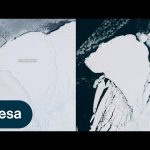
    An iceberg around the size of Greater London broke off Antarctica’s Brunt Ice Shelf due to a natural process called ‘calving’. The iceberg, measuring 1550 sq km, detached from the 150 m-thick ice shelf a decade after scientists first spotted massive cracks in the shelf.

    For more information on the newly-birthed A81 iceberg: https://www.esa.int/Applications/Observing_the_Earth/Copernicus/Giant_iceberg_breaks_away_from_Antarctic_ice_shelf

    ★ Subscribe: http://bit.ly/ESAsubscribe and click twice on the bell button to receive our notifications.

    Check out our full video catalog: http://bit.ly/SpaceInVideos
    Follow us on Twitter: http://bit.ly/ESAonTwitter
    On Facebook: http://bit.ly/ESAonFacebook
    On Instagram: http://bit.ly/ESAonInstagram
    On LinkedIn: https://bit.ly/ESAonLinkedIn
    On Pinterest: https://bit.ly/ESAonPinterest
    On Flickr: http://bit.ly/ESAonFlickr

    We are Europe’s gateway to space. Our mission is to shape the development of Europe’s space capability and ensure that investment in space continues to deliver benefits to the citizens of Europe and the world. Check out https://www.esa.int/ to get up to speed on everything space related.

    Copyright information about our videos is available here: https://www.esa.int/ESA_Multimedia/Terms_and_Conditions

    #ESA
    #Iceberg
    #EarthObservation
  • A sustainable future

    A sustainable future

    With the Covid-19 pandemic halting our daily lives and forcing many countries and region into lockdown, the economic effects have been devastating. Closed borders have caused traffic jams and disrupted supply chains. In Europe, for example, the agriculture industry has suffered. Normally the industry relies on migrant labour to harvest crops, but as the lockdown continues, crops remain unpicked – putting farmers and the food supply under pressure. How can the food supply chain more sustainable?

    ★ Subscribe: http://bit.ly/ESAsubscribe and click twice on the bell button to receive our notifications.

    Check out our full video catalog: http://bit.ly/SpaceInVideos
    Follow us on Twitter: http://bit.ly/ESAonTwitter
    On Facebook: http://bit.ly/ESAonFacebook
    On Instagram: http://bit.ly/ESAonInstagram
    On Flickr: http://bit.ly/ESAonFlickr

    We are Europe’s gateway to space. Our mission is to shape the development of Europe’s space capability and ensure that investment in space continues to deliver benefits to the citizens of Europe and the world. Check out http://www.esa.int/ESA to get up to speed on everything space related.

    Copyright information about our videos is available here: http://www.esa.int/spaceinvideos/Terms_and_Conditions

    #ESA
    #Sustainability
    #Covid19

  • Seen from space: COVID-19 and the environment

    Seen from space: COVID-19 and the environment

    As the COVID-19 pandemic has disrupted lives across the globe, Earth-observing satellites take the pulse of our planet from space. While the global lockdown has had a massive impact on daily life and the economy, there have been environmental benefits that are visible from space. How can we preserve these positives when returning to ‘business as usual’?

    ★ Subscribe: http://bit.ly/ESAsubscribe and click twice on the bell button to receive our notifications.

    Check out our full video catalog: http://bit.ly/SpaceInVideos
    Follow us on Twitter: http://bit.ly/ESAonTwitter
    On Facebook: http://bit.ly/ESAonFacebook
    On Instagram: http://bit.ly/ESAonInstagram
    On Flickr: http://bit.ly/ESAonFlickr

    We are Europe’s gateway to space. Our mission is to shape the development of Europe’s space capability and ensure that investment in space continues to deliver benefits to the citizens of Europe and the world. Check out http://www.esa.int/ESA to get up to speed on everything space related.

    Copyright information about our videos is available here: http://www.esa.int/spaceinvideos/Terms_and_Conditions

    #ESA
    #Environment
    #Covid19

  • Monitoring air quality

    Monitoring air quality

    Featuring how the Sentinel-5P mission of the European Union’s Copernicus Programme has become a game-changer for monitoring our atmosphere while being one of the most important sources of data for the Copernicus Atmosphere Monitoring Service.

    ★ Subscribe: http://bit.ly/ESAsubscribe and click twice on the bell button to receive our notifications.

    Check out our full video catalog: http://bit.ly/SpaceInVideos
    Follow us on Twitter: http://bit.ly/ESAonTwitter
    On Facebook: http://bit.ly/ESAonFacebook
    On Instagram: http://bit.ly/ESAonInstagram
    On Flickr: http://bit.ly/ESAonFlickr

    We are Europe’s gateway to space. Our mission is to shape the development of Europe’s space capability and ensure that investment in space continues to deliver benefits to the citizens of Europe and the world. Check out http://www.esa.int/ESA to get up to speed on everything space related.

    Copyright information about our videos is available here: http://www.esa.int/spaceinvideos/Terms_and_Conditions

    #ESA
    #EarthObservation
    #AirQuality

  • Earth observation to protect natural landscapes | ECOPOTENTIAL

    Earth observation to protect natural landscapes | ECOPOTENTIAL

    Featuring ECOPOTENTIAL, a European funded project that focuses on a set of internationally recognised protected areas, this video describes how the unprecedented availability of satellite data allow scientists to understand large scale changes in our environment and how best to protect it.

    ★ Subscribe: http://bit.ly/ESAsubscribe and click twice on the bell button to receive our notifications.

    Check out our full video catalog: http://bit.ly/SpaceInVideos
    Follow us on Twitter: http://bit.ly/ESAonTwitter
    On Facebook: http://bit.ly/ESAonFacebook
    On Instagram: http://bit.ly/ESAonInstagram
    On Flickr: http://bit.ly/ESAonFlickr

    We are Europe’s gateway to space. Our mission is to shape the development of Europe’s space capability and ensure that investment in space continues to deliver benefits to the citizens of Europe and the world. Check out http://www.esa.int/ESA to get up to speed on everything space related.

    Copyright information about our videos is available here: http://www.esa.int/spaceinvideos/Terms_and_Conditions

    #ESA
    #Ecopotential
    #SatelliteData

  • Earth from Space: Italy and Mediterranean

    Earth from Space: Italy and Mediterranean

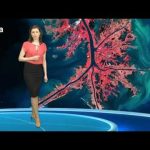
    Earth from Space is presented by Kelsea Brennan-Wessels from the ESA Web TV virtual studios. In this edition, Sentinel-3A treats us to a view stretching from Sardinia to Romania.

    Visit http://www.esa.int/spaceinimages/Images/2018/03/Italy_and_Mediterranean to download the image.

  • Earth from Space: Alakol Lake

    Earth from Space: Alakol Lake

    Earth from Space is presented by Kelsea Brennan-Wessels from the ESA Web-TV virtual studios. In the one hundred ninety-ninth edition, explore Kazakhstan’s Alakol Lake.

    See also http://www.esa.int/spaceinimages/Images/2016/09/Alakol_Lake to download the image.

  • Earth from Space: Sierra Leone River Estuary

    Earth from Space: Sierra Leone River Estuary

    Earth from Space is presented by Kelsea Brennan-Wessels from the ESA Web-TV virtual studios. Ahead of World Wetlands Day, a wetland of international importance in Sierra Leone is featured in the one hundred seventy-first edition.

    See also http://www.esa.int/spaceinimages/Images/2016/01/Sierra_Leone_River_Estuary to download the image.

  • Sentinel-1 soundtrack

    Sentinel-1 soundtrack

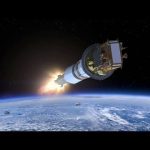
    Sentinel-1A, the first satellite for Europe’s environmental monitoring Copernicus programme, is being launched from Europe’s Spaceport in Kourou, French Guiana on 3 April 2014. It will be lofted into orbit on a Soyuz rocket.

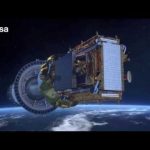
    This animation shows some of the critical stages delivering Sentinel-1 into orbit around Earth. After separating from the Fregat upper stage, the satellite takes around 10 hours to deploy its 12 m-long radar and two 10 m-long solar wings. This deployment sequence is unique, choreographed to ensure that both deploy in the safest possible way. This approach also allows power from the wings to be available as soon as possible so that the satellite is independent.

    Delivering vital information for numerous operational services, from monitoring ice in the polar oceans to tracking land subsidence, Sentinel-1 will play a key role in the largest civil Earth-observation programme ever conceived.

    The animation is set to a track called Sentinel by Mike Oldfield, a world-renowned musician and big space fan.

    Credits:
    Graphics: ESA/ATG medialab; Music written by M. Oldfield/copyright EMI Virgin

  • Why we need radar satellites

    Why we need radar satellites

    The launch of the first Sentinel-1 satellite marks a new paradigm in Earth observation focusing on operational missions to support users for decades to come. This first satellite for Europe’s environmental monitoring Copernicus programme carries an advanced radar to image Earth’s surface no matter what the weather or if it is day or night. Olaf Trieschmann from the European Maritime Safety Agency talks about the need for radar satellites and how data from Sentinel-1 will be used to monitor oil spills and for maritime surveillance. ESA’s Josef Aschbacher talks about how the wide range of services offered through Copernicus will make a step change in the way we manage the environment.

    Credit: ESA/EMSA/European Parliament/DLR/ATG medialab/Funnelweb

  • Sentinel-1: Radar mission

    Sentinel-1: Radar mission

    In early April, Sentinel-1A will be launched from Europe’s Spaceport in French Guiana on a Soyuz launcher. The radar mission is the first of the Copernicus programme, providing an all-weather, day-and-night supply of imagery for Copernicus user services.

  • Copernicus Monitoring the Earth

    Copernicus Monitoring the Earth

    Accurate information about the environmental is crucial. It helps to understand how our planet and climate are changing, the role human activity play in these changes and how this affects our daily lives. Responding to these challenges, the EU and ESA have developed an Earth observation programme called Copernicus, formerly known as Global Monitoring for Environment and Security, – a programme that becomes operational with the launch of Sentinel-1A.

  • Meet ESA, the space agency for Europe

    Meet ESA, the space agency for Europe

    You, together with your 500 million fellow citizens from ESA’s 20* European member nations, are the collective owners of one of the world’s leading space agencies.

    The European Space Agency is an intergovernmental organisation, a cooperative coming together of its Member States in their national interest and common good.

    This new video offers a quick introduction: Europe, meet ESA.

    (*As of February 2015, 22 Member States)

  • Introduction to Astrobiology

    Introduction to Astrobiology

    In this introductory lecture, Dr. Gerda Horneck of the DLR Institute of Aerospace Medicine in Cologne describes Astrobiology as a newly emerging field of science.

    Astrobiology comprises the study of the overall pattern of chemical evolution of potential precursors of life, in the interstellar medium, and on the planets and small bodies of our solar system. Astrobiology also consists of studying the history of life on Earth back to its roots, deciphering the environments of planets in our solar system and of their satellites and searching for other planetary systems in our Galaxy.

    Hereby, Astrobiology provides clues to the understanding of the origin, evolution and distribution of life and its interaction with the environment, here on Earth and in the Universe.

  • Earth from Space: Mississippi River Delta

    Earth from Space: Mississippi River Delta

    Earth from Space is presented by Kelsea Brennan-Wessels from the ESA Web-TV virtual studios.
    In the twenty-fourth edition we look at the Mississippi River Delta, where the largest river in the United States empties into the Gulf of Mexico.

  • Earth from Space: The future of Earth observation

    Earth from Space: The future of Earth observation

    Earth from Space is presented by Kelsea Brennan-Wessels from the ESA Web-TV virtual studios.

    In the nineteenth edition we look at an example of what a high-resolution image could look like from the future Sentinel-2 mission — envisaged for launch next year. The mockup was constructed using 82 images from the German RapidEye satellites.

  • Space for Europe

    Space for Europe

    Space touches us all on Earth – it is used for protecting our environment, for improving our everyday lives, for safety and security, and for stimulating our need for knowledge. Space is a key asset for Europe to face global challenges, for boosting our economic growth, for building our future.

  • Space: for protecting our environment

    Space: for protecting our environment

    Space touches us all on Earth – it is used for protecting our environment, for improving our everyday lives, for safety and security, and for stimulating our need for knowledge. Space is a key asset for Europe to face global challenges, for boosting our economic growth, for building our future.