Steve Spangler is a bestselling author, STEM educator and Emmy award-winning television personality with more than 2,100 television appearances to his credit. Steve appeared as a regular guest on the Ellen DeGeneres Show from 2007-2022. Learn more about Steve at https://stevespangler.com/about-steve-spangler/
How can a satellite the size of a microwave oven help shape human missions to the Moon and beyond?
CAPSTONE will fly in a unique, halo-shaped orbit around the Moon before the orbit is used by Gateway, NASA’s future lunar outpost for our Artemis program. The CAPSTONE mission, short for Cislunar Autonomous Positioning System Technology Operations and Navigation Experiment, will validate navigation technologies and orbital dynamics for Gateway, which will one day serve as a staging area for missions to the Moon and potentially as a jumping point for missions to Mars.
The CubeSat will come within 1,000 miles of one lunar pole on its near pass and 43,500 miles from the other pole at its peak every seven days, requiring less propulsion capability for spacecraft flying to and from the Moon’s surface than other circular orbits. It’s a six-month mission that will help launch a new era of exploration.
CAPSTONE will lift off aboard a Rocket Lab Electron rocket from New Zealand. The mission is targeted to launch no earlier than June 25, 2002.
What would you do with a powerful computer based in space? At just 30 cm in height, OPS-SAT is a tiny CubeSat designed to serve as a large-scale software laboratory in orbit – containing one of the most powerful flight computers ever flown – to test innovative control software from teams all over Europe. Anyone can apply to try out their software aboard OPS-SAT, from companies to research teams to computer clubs, linking directly from the internet. The small satellite packs in a high-resolution camera, radio antennas, optical receiver, reaction wheels and GPS. OPS-SAT can be rebooted if any experimental software crashes, allowing otherwise risky inflight testing as a way to make space smarter.
★ Subscribe: http://bit.ly/ESAsubscribe and click twice on the bell button to receive our notifications.
We are Europe’s gateway to space. Our mission is to shape the development of Europe’s space capability and ensure that investment in space continues to deliver benefits to the citizens of Europe and the world. Check out http://www.esa.int/ESA to get up to speed on everything space related.
On 17 December, ESA will launch a first-of-its-kind space laboratory, OPS-SAT. The small, low-cost test satellite has been specifically designed for operational experiments in space, and includes the most powerful flight computer on board any current ESA spacecraft.
Consumer electronics have gone through a revolution over the last 30 years with computers becoming ever faster, smaller and better. But when it comes to million- or even billion-euro satellites, their onboard hardware and software have not seen this revolution because of the risks of testing new technology in flight.
As spacecraft managers dare to fly only tried-and-tested hard and software in the harsh conditions of space, innovation on the operational side of satellites is a very slow-moving process. This is where OPS-SAT steps in, bringing down the barriers to spacecraft operations it provides a chance to safely test out new mission control techniques.
Anyone can apply to become an ‘experimenter’ and test their innovative software and new mission operations techniques in space. Proving technology for future missions and paving the way for satellites to further evolve with minimum risk, OPS-SAT will be launched with ESA’s Cheops satellite from Europe’s Spaceport in Kourou, French Guiana.
★ Subscribe: http://bit.ly/ESAsubscribe and click twice on the bell button to receive our notifications.
We are Europe’s gateway to space. Our mission is to shape the development of Europe’s space capability and ensure that investment in space continues to deliver benefits to the citizens of Europe and the world. Check out http://www.esa.int/ESA to get up to speed on everything space related.
Flying low over some of the most dramatic landscapes on the planet, a cadre of scientists and pilots have been measuring changes in Alaskan glaciers as part of NASA’s Operation IceBridge for almost a decade. The team has seen significant change in ice extent and thickness over that time. Data from the mission was used in a 2015 study that put numbers on the loss of Alaskan glaciers: 75 billion tons of ice every year from 1994 to 2013. Last summer, Chris Larsen and Martin Truffer, both of the University of Alaska Fairbanks, flew with University of Arizona’s Jack Holt and University of Texas student Michael Christoffersen.
Credit: NASA’s Goddard Space Flight Center
Jefferson Beck (USRA): Lead Producer
Maria-Jose Vinas Garcia (Telophase): Writer
Chris Larsen (University of Alaska Fairbanks): Lead Scientist
Mark Fahnestock (University of Alaska): Scientist
Alex Kekesi (GST): Lead Visualizer
Martin Truffer (University of Alaska): Lead Scientist
Following the launch of Aeolus on 22 August 2018, scientists have been busy fine-tuning and calibrating this latest Earth Explorer satellite. Aeolus carries a revolutionary instrument, which comprises a powerful laser, a large telescope and a very sensitive receiver. It works by emitting short, powerful pulses – 50 pulses per second – of ultraviolet light from a laser down into the atmosphere. The instrument then measures the backscattered signals from air molecules, dust particles and water droplets to provide vertical profiles that show the speed of the world’s winds in the lowermost 30 km of the atmosphere. These measurements are needed to improve weather forecasts. As part of the working being done to calibrate this novel mission, scientists have been taking similar measurements from an aircraft carrying an airborne version of Aeolus’ instrument. The pilot flies the plane under the satellite as it orbits above so that measurements of wind can be compared.
ESA is Europe’s gateway to space. Our mission is to shape the development of Europe’s space capability and ensure that investment in space continues to deliver benefits to the citizens of Europe and the world. Check out http://www.esa.int/ESA to get up to speed on everything space related.
Right now the Cassini spacecraft is flying between the rings of Saturn and the planet itself, a daring trajectory chosen to conclude a unique exploration mission.
To find out what that orbit means, and to look back at some of Cassini-Huygens finest moments, we met up with key members of the science team in the UK for this edition of Space.
Die Cassini-Huygens-Mission am Saturn startete vor zwanzig Jahren, 2004 schwenkte die Doppel-Sonde in ihre Umlaufbahn um den Saturn ein. Im Dezember 2004 koppelte der Lander Huygens von der Cassini-Sonde ab und setzte im Januar 2005 auf dem Titan auf. Die Mission entdeckte unter anderem ein Eismeer auf dem Saturn-Mond Enceladus und fliegt jetzt zwischen den Ringen des Saturn und dem Planeten selbst. Im September soll Cassini mangels Treibstoffvorräten in der Saturn-Atmosphäre verglühen.
Die Saturn-Spezialisten des Mullard Space Science Laboratory (MSSL) in Südengland verfolgen die Mission und erforschen das Sonnensystem des pittoresken Planeten. Die Cassini-Sonde wird gerade auf ihre finale Umlaufbahn gebracht, um nächstmögliche Eindrücke vom Saturn zu gewinnen.
NASA’s Low Density Supersonic Decelerator (LDSD) launched on Monday, June 8th from the U.S. Navy’s Pacific Missile Range Facility on Kauai, Hawaii. The saucer-shaped vehicle was used to test new technologies that will help NASA land heavier payloads than current technology will allow on the surface of planets including Mars. The test vehicle was carried by balloon to about 120,000 feet. After release, an engine took the vehicle to 180,000 feet, where the tests occurred in the thin atmosphere to simulate Mars’ atmosphere. This flight test was the second of three planned for the project. The LDSD mission is designed to test entry and descent technology in the form of a donut-shaped airbag and a supersonic parachute that can be deployed while the vehicle is traveling several times the speed of sound.
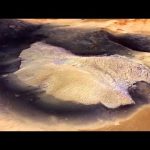
Becquerel crater is 167 km in diameter and lies in the Arabia Terra region on Mars, on the boundary between the southern highlands and northern lowlands. This movie shows the location of Becquerel crater on Mars and then provides a flyover of a mound of layered, sulphate-bearing deposits on the crater floor, thought to have formed under the influence of water. The darker material surrounding the mound is wind-blown dust from a source to the north, and provides evidence for effects of wind in eroding the sedimentary deposits.
The movie was made from a mosaic of four individual images acquired by the High Resolution Stereo Camera on ESA’s Mars Express during orbits 3253/1, 5332, 5350 and 5368. The image is centred at about 22ºN / 352ºE. The average ground resolution is about 17 m per pixel.
Copyright Notice:
This work is licenced under the Creative Commons Attribution-ShareAlike 3.0 IGO (CC BY-SA 3.0 IGO) licence. The user is allowed to reproduce, distribute, adapt, translate and publicly perform this publication, without explicit permission, provided that the content is accompanied by an acknowledgement that the source is credited as ‘ESA/DLR/FU Berlin’, a direct link to the licence text is provided and that it is clearly indicated if changes were made to the original content. Adaptation/translation/derivatives must be distributed under the same licence terms as this publication. To view a copy of this license, please visit http://creativecommons.org/licenses/by-sa/3.0/igo/
Amuse the neighbors for hours as you make objects float in midair. Believe it or not, the secret to this mystery of levitation is right in front of your nose. All you’ll need is a hairdryer and a ping pong ball to experience the power of air.
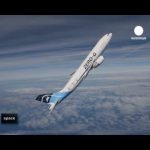
If you fly a plane in the right way at the right speed, you can be weightless for a few seconds. By throwing the aircraft into an orbit-like path within Earth’s atmosphere, you can enter the wonderful world of weightlessness.
It is one of the best ways to simulate the environment of space, and a valuable experimental tool for scientists with a special interest in microgravity. If they want to find out how the brain works, study the natural posture of humans in space, or how water boils in a weightless environment, this is the way to do it.
Take a journey into a free-floating world of the parabola in this edition of Space.
The Tea Bag Rocket is really an adaptation of a classic science demonstration called the Ditto Paper Rocket. If you’re old enough to have experienced Ditto paper, you’ll recall the bluish-purple ink and that unforgettable smell of freshly printed copies. (Come to find out… both the Ditto machine solvent and the ink were highly toxic, but no one seemed to care back then.) Each piece of Ditto paper had a sheet of tissue paper that separated the two-part form, and it was this discarded piece of paper that teachers and kids used to make Ditto paper “rockets.” Since Ditto paper is a thing of the past, science enthusiasts have found a simple replacement – a tea bag.
It’s not just a book, it’s an experience. Naked Eggs and Flying Potatoes is a hands-on science book using household materials. The Scientifically Enhanced eBook is available on Apple’s iBookstore for iPad and iPhone 4. It includes 37 instructional videos and over 200 stunning photographs.
Naked Eggs and Flying Potatoes: Unforgettable Experiences That Make Science Fun is the latest book from Steve Spangler. This is not your ordinary book of science experiments. It’s a geek-chic look at Steve Spangler’s latest collection of tricks and try-it-at-home activities that reveal the secrets of science in unexpected ways. What makes this book different from other science experiment books is the amazing photography. Over 245 color photographs accompany the step-by-step instructions, and simple explanations uncover the how-to and why for each activity. Make potatoes fly, cornstarch turn into quicksand, and 2-liter bottles of soda explode on command.
About Steve Spangler Science…
Steve Spangler is a celebrity teacher, science toy designer, speaker, author and an Emmy award-winning television personality. Spangler is probably best known for his Mentos and Diet Coke geyser experiment that went viral in 2005 and prompted more than 1,000 related YouTube videos. Spangler is the founder of www.SteveSpanglerScience.com, a Denver-based company specializing in the creation of science toys, classroom science demonstrations, teacher resources and home for Spangler’s popular science experiment archive and video collection. Spangler is a frequent guest on the Ellen DeGeneres Show where he takes classroom science experiments to the extreme. Check out his pool filled with 2,500 boxes of cornstarch!
On the education side, Spangler started his career as a science teacher in the Cherry Creek School district for 12 years. Today, Steve travels extensively training teachers in ways to make learning more engaging and fun. His hands-on science boot camps and summer institutes for teachers inspire and teach teachers how to prepare a new generation for an ever-changing work force. Over the last 15 years, he has also made more than 500 television appearances as an authority on hands-on science and inquiry-based learning.
On the business side, Spangler is the founder and CEO of Steve Spangler Science, a Denver-based company specializing in the creation of educational toys and kits and hands-on science training services for teachers. The companys unique business strategies and viral creations have been featured in the Wall Street Journal, Inc. Magazine, Wired and TIME Magazine where online readers voted Steve Spangler #18 in the Top 100 Most Influential People of the Year for 2006 (what were they thinking?). You’ll find more than 140 Spangler created products available online at SteveSpanglerScience.com and distributed to toy stores and mass-market retailers worldwide.
Spangler joined NBC affiliate 9News in 2001 as the science education specialist. His weekly experiments and science segments are designed to teach viewers creative ways to make learning fun. His now famous Mentos Geyser experiment, turning 2-liter bottles of soda into erupting fountains, became an Internet sensation in September 2005 when thousands of people started posting their own Mentos explosions on YouTube.com.
As founder of SteveSpanglerScience.com, Spangler and his design team have developed more than 140 educational toys and science-related products featured by mass-market retailers like Target, Wal-Mart, Toys R’ Us, Discovery Channel Stores and over 1,400 independent specialty toy stores. His educational science catalog and on-line business offers more than a thousand science toys and unique learning resources. Recently, Spangler has been featured in the Wall Street Journal, Inc. Magazine, WIRED, the History Channel, Food Network and TIME Magazine where on-line readers voted Steve Spangler #18 in the Top 100 Most Influential People of the Year for 2006.
His recent appearances on the Ellen DeGeneres Show have taught viewers how to blow up their food, shock their friends, create mountains of foam, play on a bed of nails, vanish in a cloud of smoke and how to turn 2,500 boxes of cornstarch and a garden hose into a swimming pool of fun.
Check out this and other cool science experiments at http://www.stevespanglerscience.com/experiments/ This experiment answers the age-old question, “Which came first, the rubber egg or the rubber chicken?” It’s easy to make a rubber egg if you understand the chemistry of removing the eggshell with vinegar. What you’re left with is a totally embarrassed naked egg and a cool piece of science.
About Steve Spangler Science…
Steve Spangler is a celebrity teacher, science toy designer, speaker, author and an Emmy award-winning television personality. Spangler is probably best known for his Mentos and Diet Coke geyser experiment that went viral in 2005 and prompted more than 1,000 related YouTube videos. Spangler is the founder of www.SteveSpanglerScience.com, a Denver-based company specializing in the creation of science toys, classroom science demonstrations, teacher resources and home for Spangler’s popular science experiment archive and video collection. Spangler is a frequent guest on the Ellen DeGeneres Show where he takes classroom science experiments to the extreme. Check out his pool filled with 2,500 boxes of cornstarch!
On the education side, Spangler started his career as a science teacher in the Cherry Creek School district for 12 years. Today, Steve travels extensively training teachers in ways to make learning more engaging and fun. His hands-on science boot camps and summer institutes for teachers inspire and teach teachers how to prepare a new generation for an ever-changing work force. Over the last 15 years, he has also made more than 500 television appearances as an authority on hands-on science and inquiry-based learning.
On the business side, Spangler is the founder and CEO of Steve Spangler Science, a Denver-based company specializing in the creation of educational toys and kits and hands-on science training services for teachers. The companys unique business strategies and viral creations have been featured in the Wall Street Journal, Inc. Magazine, Wired and TIME Magazine where online readers voted Steve Spangler #18 in the Top 100 Most Influential People of the Year for 2006 (what were they thinking?). You’ll find more than 140 Spangler created products available online at SteveSpanglerScience.com and distributed to toy stores and mass-market retailers worldwide.
Spangler joined NBC affiliate 9News in 2001 as the science education specialist. His weekly experiments and science segments are designed to teach viewers creative ways to make learning fun. His now famous Mentos Geyser experiment, turning 2-liter bottles of soda into erupting fountains, became an Internet sensation in September 2005 when thousands of people started posting their own Mentos explosions on YouTube.com.
As founder of SteveSpanglerScience.com, Spangler and his design team have developed more than 140 educational toys and science-related products featured by mass-market retailers like Target, Wal-Mart, Toys R’ Us, Discovery Channel Stores and over 1,400 independent specialty toy stores. His educational science catalog and on-line business offers more than a thousand science toys and unique learning resources. Recently, Spangler has been featured in the Wall Street Journal, Inc. Magazine, WIRED, the History Channel, Food Network and TIME Magazine where on-line readers voted Steve Spangler #18 in the Top 100 Most Influential People of the Year for 2006.
His recent appearances on the Ellen DeGeneres Show have taught viewers how to blow up their food, shock their friends, create mountains of foam, play on a bed of nails, vanish in a cloud of smoke and how to turn 2,500 boxes of cornstarch and a garden hose into a swimming pool of fun.
Check out this and other cool science experiments at http://www.stevespanglerscience.com/experiments/ 9News, the Colorado Rockies and Steve Spangler Science are gearing up for Weather and Science Day at Coors Field on May 7th. In preparation for the big day, Steve demonstrates some of the powerful principles of air with his amazing Potato Launcher!
About Steve Spangler Science…
Steve Spangler is a celebrity teacher, science toy designer, speaker, author and an Emmy award-winning television personality. Spangler is probably best known for his Mentos and Diet Coke geyser experiment that went viral in 2005 and prompted more than 1,000 related YouTube videos. Spangler is the founder of www.SteveSpanglerScience.com, a Denver-based company specializing in the creation of science toys, classroom science demonstrations, teacher resources and home for Spangler’s popular science experiment archive and video collection. Spangler is a frequent guest on the Ellen DeGeneres Show where he takes classroom science experiments to the extreme. Check out his pool filled with 2,500 boxes of cornstarch!
On the education side, Spangler started his career as a science teacher in the Cherry Creek School district for 12 years. Today, Steve travels extensively training teachers in ways to make learning more engaging and fun. His hands-on science boot camps and summer institutes for teachers inspire and teach teachers how to prepare a new generation for an ever-changing work force. Over the last 15 years, he has also made more than 500 television appearances as an authority on hands-on science and inquiry-based learning.
On the business side, Spangler is the founder and CEO of Steve Spangler Science, a Denver-based company specializing in the creation of educational toys and kits and hands-on science training services for teachers. The companys unique business strategies and viral creations have been featured in the Wall Street Journal, Inc. Magazine, Wired and TIME Magazine where online readers voted Steve Spangler #18 in the Top 100 Most Influential People of the Year for 2006 (what were they thinking?). You’ll find more than 140 Spangler created products available online at SteveSpanglerScience.com and distributed to toy stores and mass-market retailers worldwide.
Spangler joined NBC affiliate 9News in 2001 as the science education specialist. His weekly experiments and science segments are designed to teach viewers creative ways to make learning fun. His now famous Mentos Geyser experiment, turning 2-liter bottles of soda into erupting fountains, became an Internet sensation in September 2005 when thousands of people started posting their own Mentos explosions on YouTube.com.
As founder of SteveSpanglerScience.com, Spangler and his design team have developed more than 140 educational toys and science-related products featured by mass-market retailers like Target, Wal-Mart, Toys R’ Us, Discovery Channel Stores and over 1,400 independent specialty toy stores. His educational science catalog and on-line business offers more than a thousand science toys and unique learning resources. Recently, Spangler has been featured in the Wall Street Journal, Inc. Magazine, WIRED, the History Channel, Food Network and TIME Magazine where on-line readers voted Steve Spangler #18 in the Top 100 Most Influential People of the Year for 2006.
His recent appearances on the Ellen DeGeneres Show have taught viewers how to blow up their food, shock their friends, create mountains of foam, play on a bed of nails, vanish in a cloud of smoke and how to turn 2,500 boxes of cornstarch and a garden hose into a swimming pool of fun.
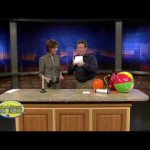
Check out this and other cool science experiments at http://www.stevespanglerscience.com/experiments/ I cant help but be amazed by the high-tech science that were seeing at this years Summer Olympics. The name of the game in so many of the sports is to reduce any opposing resistance. In some instances, the athlete can actually use other competitors to block the wind (drafting in cycling). What does any of this have to do with floating beach balls and flying toilet paper? That fast-moving air flowing around the object creates an area of lower pressure and gives the athlete an advantage. Thanks Bernoulli.
About Steve Spangler Science…
Steve Spangler is a celebrity teacher, science toy designer, speaker, author and an Emmy award-winning television personality. Spangler is probably best known for his Mentos and Diet Coke geyser experiment that went viral in 2005 and prompted more than 1,000 related YouTube videos. Spangler is the founder of www.SteveSpanglerScience.com, a Denver-based company specializing in the creation of science toys, classroom science demonstrations, teacher resources and home for Spangler’s popular science experiment archive and video collection. Spangler is a frequent guest on the Ellen DeGeneres Show where he takes classroom science experiments to the extreme. Check out his pool filled with 2,500 boxes of cornstarch!
On the education side, Spangler started his career as a science teacher in the Cherry Creek School district for 12 years. Today, Steve travels extensively training teachers in ways to make learning more engaging and fun. His hands-on science boot camps and summer institutes for teachers inspire and teach teachers how to prepare a new generation for an ever-changing work force. Over the last 15 years, he has also made more than 500 television appearances as an authority on hands-on science and inquiry-based learning.
On the business side, Spangler is the founder and CEO of Steve Spangler Science, a Denver-based company specializing in the creation of educational toys and kits and hands-on science training services for teachers. The companys unique business strategies and viral creations have been featured in the Wall Street Journal, Inc. Magazine, Wired and TIME Magazine where online readers voted Steve Spangler #18 in the Top 100 Most Influential People of the Year for 2006 (what were they thinking?). You’ll find more than 140 Spangler created products available online at SteveSpanglerScience.com and distributed to toy stores and mass-market retailers worldwide.
Spangler joined NBC affiliate 9News in 2001 as the science education specialist. His weekly experiments and science segments are designed to teach viewers creative ways to make learning fun. His now famous Mentos Geyser experiment, turning 2-liter bottles of soda into erupting fountains, became an Internet sensation in September 2005 when thousands of people started posting their own Mentos explosions on YouTube.com.
As founder of SteveSpanglerScience.com, Spangler and his design team have developed more than 140 educational toys and science-related products featured by mass-market retailers like Target, Wal-Mart, Toys R’ Us, Discovery Channel Stores and over 1,400 independent specialty toy stores. His educational science catalog and on-line business offers more than a thousand science toys and unique learning resources. Recently, Spangler has been featured in the Wall Street Journal, Inc. Magazine, WIRED, the History Channel, Food Network and TIME Magazine where on-line readers voted Steve Spangler #18 in the Top 100 Most Influential People of the Year for 2006.
His recent appearances on the Ellen DeGeneres Show have taught viewers how to blow up their food, shock their friends, create mountains of foam, play on a bed of nails, vanish in a cloud of smoke and how to turn 2,500 boxes of cornstarch and a garden hose into a swimming pool of fun.
Order now at http://www.stevespanglerscience.com/product/flying-film-canisters Everyone loves a film canister experiment… but in this digital-age, where can you find a film canister? Weve been asking ourselves the same thing for a long time, but now, we are bringing back film canister science. These super-sturdy film canisters are the best weve ever seen and were specially made for Steve Spangler Science to ensure the biggest pop. And, unlike regular film canisters, our Flying Film Canisters have gradations on the side for accurate scientific explorations.
About Steve Spangler Science…
Steve Spangler is a celebrity teacher, science toy designer, speaker, author and an Emmy award-winning television personality. Spangler is probably best known for his Mentos and Diet Coke geyser experiment that went viral in 2005 and prompted more than 1,000 related YouTube videos. Spangler is the founder of www.SteveSpanglerScience.com, a Denver-based company specializing in the creation of science toys, classroom science demonstrations, teacher resources and home for Spangler’s popular science experiment archive and video collection. Spangler is a frequent guest on the Ellen DeGeneres Show where he takes classroom science experiments to the extreme. Check out his pool filled with 2,500 boxes of cornstarch!
On the education side, Spangler started his career as a science teacher in the Cherry Creek School district for 12 years. Today, Steve travels extensively training teachers in ways to make learning more engaging and fun. His hands-on science boot camps and summer institutes for teachers inspire and teach teachers how to prepare a new generation for an ever-changing work force. Over the last 15 years, he has also made more than 500 television appearances as an authority on hands-on science and inquiry-based learning.
On the business side, Spangler is the founder and CEO of Steve Spangler Science, a Denver-based company specializing in the creation of educational toys and kits and hands-on science training services for teachers. The companys unique business strategies and viral creations have been featured in the Wall Street Journal, Inc. Magazine, Wired and TIME Magazine where online readers voted Steve Spangler #18 in the Top 100 Most Influential People of the Year for 2006 (what were they thinking?). You’ll find more than 140 Spangler created products available online at SteveSpanglerScience.com and distributed to toy stores and mass-market retailers worldwide.
Spangler joined NBC affiliate 9News in 2001 as the science education specialist. His weekly experiments and science segments are designed to teach viewers creative ways to make learning fun. His now famous Mentos Geyser experiment, turning 2-liter bottles of soda into erupting fountains, became an Internet sensation in September 2005 when thousands of people started posting their own Mentos explosions on YouTube.com.
As founder of SteveSpanglerScience.com, Spangler and his design team have developed more than 140 educational toys and science-related products featured by mass-market retailers like Target, Wal-Mart, Toys R’ Us, Discovery Channel Stores and over 1,400 independent specialty toy stores. His educational science catalog and on-line business offers more than a thousand science toys and unique learning resources. Recently, Spangler has been featured in the Wall Street Journal, Inc. Magazine, WIRED, the History Channel, Food Network and TIME Magazine where on-line readers voted Steve Spangler #18 in the Top 100 Most Influential People of the Year for 2006.
His recent appearances on the Ellen DeGeneres Show have taught viewers how to blow up their food, shock their friends, create mountains of foam, play on a bed of nails, vanish in a cloud of smoke and how to turn 2,500 boxes of cornstarch and a garden hose into a swimming pool of fun.
Check it out at http://www.stevespanglerscience.com/experiment/00000037 Amuse the neighbors for hours as you make objects float in mid-air. Believe it or not, the secret to this mystery of levitation is right in front of your nose.
Steve makes his fourth appearance on The Ellen DeGeneres Show having more fun with exploding “fire water,” gooey polymers, tricks to play at the restaurant and a studio filled with flying potatoes. This is not the normal science lesson that most kids get in school… and that’s part of Steve Spangler’s appeal to Ellen and her show producers.
About Steve Spangler Science…
Steve Spangler is a celebrity teacher, science toy designer, speaker, author and an Emmy award-winning television personality. Spangler is probably best known for his Mentos and Diet Coke geyser experiment that went viral in 2005 and prompted more than 1,000 related YouTube videos. Spangler is the founder of www.SteveSpanglerScience.com, a Denver-based company specializing in the creation of science toys, classroom science demonstrations, teacher resources and home for Spangler’s popular science experiment archive and video collection. Spangler is a frequent guest on the Ellen DeGeneres Show where he takes classroom science experiments to the extreme. Check out his pool filled with 2,500 boxes of cornstarch!
On the education side, Spangler started his career as a science teacher in the Cherry Creek School district for 12 years. Today, Steve travels extensively training teachers in ways to make learning more engaging and fun. His hands-on science boot camps and summer institutes for teachers inspire and teach teachers how to prepare a new generation for an ever-changing work force. Over the last 15 years, he has also made more than 500 television appearances as an authority on hands-on science and inquiry-based learning.
On the business side, Spangler is the founder and CEO of Steve Spangler Science, a Denver-based company specializing in the creation of educational toys and kits and hands-on science training services for teachers. The companys unique business strategies and viral creations have been featured in the Wall Street Journal, Inc. Magazine, Wired and TIME Magazine where online readers voted Steve Spangler #18 in the Top 100 Most Influential People of the Year for 2006 (what were they thinking?). You’ll find more than 140 Spangler created products available online at SteveSpanglerScience.com and distributed to toy stores and mass-market retailers worldwide.
Spangler joined NBC affiliate 9News in 2001 as the science education specialist. His weekly experiments and science segments are designed to teach viewers creative ways to make learning fun. His now famous Mentos Geyser experiment, turning 2-liter bottles of soda into erupting fountains, became an Internet sensation in September 2005 when thousands of people started posting their own Mentos explosions on YouTube.com.
As founder of SteveSpanglerScience.com, Spangler and his design team have developed more than 140 educational toys and science-related products featured by mass-market retailers like Target, Wal-Mart, Toys R’ Us, Discovery Channel Stores and over 1,400 independent specialty toy stores. His educational science catalog and on-line business offers more than a thousand science toys and unique learning resources. Recently, Spangler has been featured in the Wall Street Journal, Inc. Magazine, WIRED, the History Channel, Food Network and TIME Magazine where on-line readers voted Steve Spangler #18 in the Top 100 Most Influential People of the Year for 2006.
His recent appearances on the Ellen DeGeneres Show have taught viewers how to blow up their food, shock their friends, create mountains of foam, play on a bed of nails, vanish in a cloud of smoke and how to turn 2,500 boxes of cornstarch and a garden hose into a swimming pool of fun.