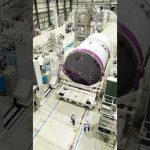
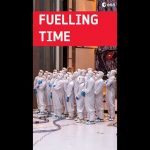
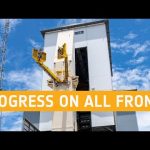
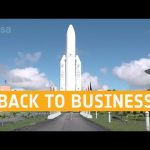
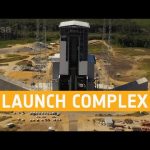
The two central stages for Ariane 6’s first flight are being assembled in the launcher assembly building (BAL) at Europe’s Spaceport. The core stage and the upper stage for Europe’s new rocket Ariane 6 are set to fly in the Summer of 2024. Once assembled, the stages will be transferred to the launch pad.
On the launch pad, the two stages will be raised into their vertical launch position inside the mobile assembly building. Here the two boosters for Ariane 6’s first flight will be added and then the payloads will be placed on top and be covered by the fairing – Ariane 6’s nose cone that splits vertically in two.
The stages arrived at Europe’s Spaceport on novel hybrid sail ship Canopée on 21 February after a two-week transatlantic crossing from mainland Europe.
Ariane 6 is an all-new design, created to succeed Ariane 5 as Europe’s heavy-lift launch system. With Ariane 6’s upper stage restart capability, Europe’s launch capability will be tailored to the needs of multiple payload missions, for example to orbit satellite constellations. This autonomous capability to reach Earth orbit and deep space supports Europe’s navigation, Earth observation, scientific and security programmes. Ongoing development of Europe’s space transportation capabilities is made possible by the sustained dedication of thousands of talented people working in ESA’s 22 Member States.
The largest components for the first flight model of Europe’s new rocket Ariane 6 arrived at the port of Pariacabo in Kourou, French Guiana on 21 February 2024 via the novel ship, Canopée (canopy in French).
The Ariane 6 stages and components are all manufactured across Europe. On this trip, Canopée brought the central core for Ariane 6’s first flight. The main engine and the main stage were integrated in Les Mureaux, France, while the upper stage and insulation for the rocket’s exterior were built up in Bremen, Germany.
The various Ariane 6 components are then offloaded and transported by road to the new Ariane 6 launch vehicle assembly building just a few kilometres away. Here, the launcher stages are unpacked and installed on the assembly line for integration, and finally, liftoff.
The Ariane 6 boosters are already in Europe’s Spaceport after their production in Italy, they are the same P120C solid propulsion boosters as used for Europe’s Vega-C rocket.
First the central core will be assembled horizontally after which it is transported to the launchpad. Here it will be lifted into the upright position after which Boosters and the upper stage will be added inside the mobile gantry.
This summer Flight Model-1 will be ready to let its engine rumble and fly.
Credits: ESA/CNES/Arianespace/Arianegroup
★ Subscribe: http://bit.ly/ESAsubscribe and click twice on the bell button to receive our notifications.
We are Europe’s gateway to space. Our mission is to shape the development of Europe’s space capability and ensure that investment in space continues to deliver benefits to the citizens of Europe and the world. Check out https://www.esa.int/ to get up to speed on everything space related.
The first Meteosat Third Generation Imager (MTG-I1) satellite lifted off on an Ariane 5 rocket from Europe’s Spaceport in French Guiana on 13 December at 21:30 CET.
From geostationary orbit, 36,000 km above the equator, this all-new weather satellite will provide state-of-the art observations of Earth’s atmosphere and realtime monitoring of lightning events, taking weather forecasting to the next level. The satellite carries two completely new instruments: Europe’s first Lightning Imager and a Flexible Combined Imager.
MTG-I1 is the first of six satellites that form the full MTG system, which will provide critical data for weather forecasting over the next 20 years. In full operations, the mission will comprise two MTG-I satellites and one MTG Sounding (MTG-S) satellites working in tandem.
★ Subscribe: http://bit.ly/ESAsubscribe and click twice on the bell button to receive our notifications.
We are Europe’s gateway to space. Our mission is to shape the development of Europe’s space capability and ensure that investment in space continues to deliver benefits to the citizens of Europe and the world. Check out https://www.esa.int/ to get up to speed on everything space related.
ESA’s new Vega-C rocket lifted off for its inaugural flight VV21 at 15:13 CEST/13:13 UTC/10:13 local time from Europe’s Spaceport in French Guiana. With new first and second stages and an uprated fourth stage, Vega-C increases performance to about 2.3 t in a reference 700 km polar orbit, from the 1.5 t capability of its predecessor, Vega. For flight VV21, Vega-C’s payload is LARES-2, a scientific mission of @AsiTVit and six research CubeSats from France, Italy and Slovenia.
We are Europe’s gateway to space. Our mission is to shape the development of Europe’s space capability and ensure that investment in space continues to deliver benefits to the citizens of Europe and the world. Check out https://www.esa.int/ to get up to speed on everything space related.
Enjoy the inaugural flight of ESA’s new Vega-C rocket. The principal payload of this flight is LARES-2, a scientific mission of @AsiTV. Also onboard are six European research CubeSats.
We are Europe’s gateway to space. Our mission is to shape the development of Europe’s space capability and ensure that investment in space continues to deliver benefits to the citizens of Europe and the world. Check out https://www.esa.int/ to get up to speed on everything space related.
Enjoy the inaugural flight of ESA’s new Vega-C rocket. The principal payload of this flight is LARES-2, a scientific mission of @AsiTV. Also onboard are six European research CubeSats.
We are Europe’s gateway to space. Our mission is to shape the development of Europe’s space capability and ensure that investment in space continues to deliver benefits to the citizens of Europe and the world. Check out https://www.esa.int/ to get up to speed on everything space related.
Enjoy the inaugural flight of ESA’s new Vega-C rocket. The principal payload of this flight is LARES-2, a scientific mission of the @AsiTV. Also onboard are six European research CubeSats.
We are Europe’s gateway to space. Our mission is to shape the development of Europe’s space capability and ensure that investment in space continues to deliver benefits to the citizens of Europe and the world. Check out https://www.esa.int/ to get up to speed on everything space related.
ESA’s newest launcher stands nearly 35m tall when its four stages and payload are fully stacked. For its inaugural flight, VV21, the main payload is LARES-2, a scientific mission of @AsiTV.
We are Europe’s gateway to space. Our mission is to shape the development of Europe’s space capability and ensure that investment in space continues to deliver benefits to the citizens of Europe and the world. Check out https://www.esa.int/ to get up to speed on everything space related.
This animated preview of flight VV21 illustrates gantry rollout and liftoff from Europe’s Spaceport in French Guiana, stage and fairing separations, and deployment of the Italian Space Agency’s LARES-2 scientific payload and six research CubeSats. Vega-C represents a dramatic capability boost compared to its predecessor, Vega, which has flown since 2012. With new first and second stages and an uprated fourth stage, Vega-C increases performance from Vega’s 1.5 t to about 2.2 t in a reference 700 km polar orbit and handles larger payloads.
We are Europe’s gateway to space. Our mission is to shape the development of Europe’s space capability and ensure that investment in space continues to deliver benefits to the citizens of Europe and the world. Check out https://www.esa.int/ to get up to speed on everything space related.
How long would it take us to reach our closest neighbour? How do astronomers know so much about the universe? Why is astronomy important for society? In this Meet the Experts episode, ESA research fellow Tereza Jerabkova discusses our place in the universe and takes us on a journey through space.
We are Europe’s gateway to space. Our mission is to shape the development of Europe’s space capability and ensure that investment in space continues to deliver benefits to the citizens of Europe and the world. Check out https://www.esa.int/ to get up to speed on everything space related.
Are you curious to know how a telescope works? Join ESA astronomer Giovanna Giardino as she gives an insight into the inner workings of the world’s largest telescope in space, the extraordinary James Webb Space Telescope.
We are Europe’s gateway to space. Our mission is to shape the development of Europe’s space capability and ensure that investment in space continues to deliver benefits to the citizens of Europe and the world. Check out https://www.esa.int/ to get up to speed on everything space related.
How did the universe go from a dark and cold place after the Big Bang, to the mesmerizing cosmos we see today? In this episode of Meet the Experts, ESA research fellow Rachana Bhatawdekar takes us on a tour of the early universe, to discover how the very first stars and galaxies were born after the Big Bang.
We are Europe’s gateway to space. Our mission is to shape the development of Europe’s space capability and ensure that investment in space continues to deliver benefits to the citizens of Europe and the world. Check out https://www.esa.int/ to get up to speed on everything space related.
Embark on a mission with ESA astronomers Mark McCaughrean and Giovanna Giardino to learn more about the James Webb Space Telescope and the early Universe. This programme is suitable for primary and secondary students. Join the quest!
We are Europe’s gateway to space. Our mission is to shape the development of Europe’s space capability and ensure that investment in space continues to deliver benefits to the citizens of Europe and the world. Check out https://www.esa.int/ to get up to speed on everything space related.
The James Webb Space Telescope lifted off on an Ariane 5 rocket from Europe’s Spaceport in French Guiana, at 13:20 CET on 25 December 2021 on its exciting mission to unlock the secrets of the Universe.
This timelapse shows highlights of the launch campaign from the arrival of Webb in French Guiana through to liftoff.
Every launch requires meticulous planning and preparation. For Webb, this process began about 15 years ago. Webb arrived from California on board the MN Colibri which sailed the Panama Canal to Pariacabo harbour in French Guiana. The shallow Kourou river was specially dredged to ensure a clear passage and the vessel followed high tide to safely reach port on 12 October 2021.
Though the telescope weighs only six tonnes, it was more than 10.5 m high and almost 4.5 m wide when folded. At Europe’s Spaceport it was unpacked inside a dedicated spacecraft preparation facility fitted with walls of air filters to protect the telescope from contamination during preparations for launch.
After its arrival in the final assembly building, Webb was lifted slowly about 40 m high and then carefully manoeuvred on top of Ariane 5 – one of the most delicate operations during the entire launch campaign. A ‘shower curtain’ about 12 m high and 8 m in diameter was installed in between two platforms, to create a closed-off space around Webb to avoid any contamination.
On the day of encapsulation, the fairing was lowered over the observatory and locked in place for liftoff. A laser guiding system assisted this particularly delicate operation for a perfect fit inside Ariane 5’s fairing.
Ariane 5 with Webb was rolled out from the final assembly building to the launch pad on 22 December. On 25 December, Ariane 5 performed the flawless launch of this once in a generation mission. Ariane 5’s highly precise launch meant that Webb saved its own fuel which can be used to significantly extend its expected lifetime of 10 years.
Webb is the largest, most powerful telescope ever launched into space. As part of an international collaboration agreement, ESA has provided the telescope’s launch service using the Ariane 5 launch vehicle. Working with partners, ESA was responsible for the development and qualification of Ariane 5 adaptations for the Webb mission and for the procurement of the launch service by @arianespace. ESA has also provided the workhorse spectrograph NIRSpec and 50% of the mid-infrared instrument MIRI, in collaboration with the University of Arizona. Webb is an international partnership between @NASA, ESA and the @Canadian Space Agency.
We are Europe’s gateway to space. Our mission is to shape the development of Europe’s space capability and ensure that investment in space continues to deliver benefits to the citizens of Europe and the world. Check out https://www.esa.int/ to get up to speed on everything space related.
This real-time video shows the separation of the James Webb Space Telescope from the Ariane 5 launch vehicle and the subsequent solar array deployment.
Webb’s launch on an ESA-provided Ariane 5 rocket was performed by @arianespace on behalf of ESA from Europe’s Spaceport in French Guiana, at 12:20:07 GMT (13:20:07 CET) on 25 December 2021.
Webb separation from the Ariane 5 occurred at 12:47:14 GMT (13:47:14 CET) with solar array deployment starting 69 seconds later.
Thanks to Ariane 5’s highly precise launch trajectory Webb’s solar array was able to deploy soon after separation from the Ariane 5, capturing sunlight to power the observatory.
This video shows the view from Ariane 5’s upper stage, taken by a camera manufactured by Irish company Réaltra Space Systems Engineering.
Webb is the next great space science observatory following Hubble, designed to answer outstanding questions about the Universe and to make breakthrough discoveries in all fields of astronomy. Webb will see farther into our origins: from the formation of stars and planets, to the birth of the first galaxies in the early Universe. Webb is an international partnership between @NASA, ESA and the @Canadian Space Agency.
We are Europe’s gateway to space. Our mission is to shape the development of Europe’s space capability and ensure that investment in space continues to deliver benefits to the citizens of Europe and the world. Check out https://www.esa.int/ to get up to speed on everything space related.
Highlights of the launch campaign for the James Webb Space Telescope, from its arrival at Europe’s Spaceport in Kourou, French Guiana, weeks of launch preparations, to launch on board an Ariane 5, and separation of the spacecraft and solar panel deployment.
Now in space and on its way to L2, Webb will undergo a complex unfolding sequence. In the months after, the instruments will be turned on and their capabilities tested. After half a year in space, Webb will start its routine science observations.
Webb will see farther into our origins: from the Universe’s first galaxies, to the birth of stars and planets, to exoplanets with the potential for life, and our own Solar System.
We are Europe’s gateway to space. Our mission is to shape the development of Europe’s space capability and ensure that investment in space continues to deliver benefits to the citizens of Europe and the world. Check out https://www.esa.int/ to get up to speed on everything space related.
From one space flier to another, ESA astronaut Matthias Maurer shares a message of support for the James Webb Space Telescope (Webb) launch, from ESA’s Columbus science laboratory on the International Space Station.
Matthias is currently living and working in space for his first mission known as Cosmic Kiss. He describes the mission of Webb as part of humankind’s biggest adventure, as we explore the cosmos to understand our place within it.
Webb is the next great space science observatory following Hubble, designed to answer outstanding questions about the Universe and to make breakthrough discoveries in all fields of astronomy. It is an international partnership between the European Space Agency ESA, US space agency @NASA, and the @Canadian Space Agency, and will be launched on an Ariane 5 rocket from Europe’s Spaceport in French Guiana.
Webb is designed to see farther into our origins: from the formation of stars and planets to the birth of the first galaxies in the early Universe, just as the International Space Station enables us to learn more about our home planet.
We are Europe’s gateway to space. Our mission is to shape the development of Europe’s space capability and ensure that investment in space continues to deliver benefits to the citizens of Europe and the world. Check out https://www.esa.int/ to get up to speed on everything space related.
The Copernicus Sentinel-2 takes us over Kourou – home to Europe’s Spaceport in French Guiana, where the James Webb Space Telescope is being prepared for its upcoming launch – in this edition of the Earth from Space programme.
We are Europe’s gateway to space. Our mission is to shape the development of Europe’s space capability and ensure that investment in space continues to deliver benefits to the citizens of Europe and the world. Check out https://www.esa.int/ to get up to speed on everything space related.
The world’s next generation cosmic observatory, the James Webb Space Telescope, is due for launch on an Ariane 5 from Europe’s Spaceport in French Guiana in late December.
Developed and constructed over more than 30 years, Webb is a remarkable feat of engineering and technology – with the largest astronomical mirror ever flown in space, sophisticated new scientific instruments, and a sunshield the size of a tennis court.
Webb is an international partnership between @NASA, ESA and the @Canadian Space Agency and will reveal the Universe in a whole new light. Optimised for infrared wavelengths, its detectors will be able to look back to shortly after the very dawn of time, revealing the formation of the first galaxies, as well as study stars and planets in our own Milky Way.
We are Europe’s gateway to space. Our mission is to shape the development of Europe’s space capability and ensure that investment in space continues to deliver benefits to the citizens of Europe and the world. Check out https://www.esa.int/ to get up to speed on everything space related.
The James Webb Space Telescope, configured for flight, was moved from the cleanroom to the payload preparation facility for fuelling at Europe’s Spaceport in French Guiana on 11–12 November 2021.
Webb will be loaded with propellants before being mounted on top of the rocket and then encapsulated by the Ariane 5 fairing.
Webb will be the largest, most powerful telescope ever launched into space. As part of an international collaboration agreement, ESA is providing the telescope’s launch service using the Ariane 5 launch vehicle. Working with partners, ESA was responsible for the development and qualification of Ariane 5 adaptations for the Webb mission and for the procurement of the launch service by Arianespace.
Webb is an international partnership between @NASA , ESA and the @Canadian Space Agency.
We are Europe’s gateway to space. Our mission is to shape the development of Europe’s space capability and ensure that investment in space continues to deliver benefits to the citizens of Europe and the world. Check out https://www.esa.int/ to get up to speed on everything space related.
ESA’s Ariane 6 will offer more performance and flexibility than its predecessor Ariane 5 and will be available in two versions, with either two or four boosters.
This new rocket will launch from Europe’s Spaceport in French Guiana and its home, the recently inaugurated launch complex, is a marvel of engineering. Take a tour with Tony Dos Santos, ESA’s Technical Manager there.
The main elements of the Ariane 6 launch complex include the mobile gantry, launch pad and launch vehicle assembly building.
See tests being carried out to qualify vital systems involved in a launch campaign and hear how they work. This includes raising a mockup Ariane 6 core stage vertical in the 90 m-high mobile gantry. Watch the deluge system gush water to absorb the roar of launch and capture the moment the fluidic systems detach from the rocket as it lifts off.
The Ariane 6 programme is funded and developed by ESA. These tests by @CNESand @ArianeGroup teams were jointly performed under the responsibility of ESA.
Ariane 6 opens new opportunities and guarantees continued access to space for ESA Member States.
★ Subscribe: http://bit.ly/ESAsubscribe and click twice on the bell button to receive our notifications.
We are Europe’s gateway to space. Our mission is to shape the development of Europe’s space capability and ensure that investment in space continues to deliver benefits to the citizens of Europe and the world. Check out https://www.esa.int/ to get up to speed on everything space related.
These are exciting days at Europe’s Spaceport in French Guiana and throughout several sites in ESA Member States as the development of Ariane 6 enters its final phase. Ariane 6 parts are being shipped from Europe for combined tests on the new Ariane 6 launch base. These tests rehearse all activities and systems involving the rocket and launch base on an Ariane 6 launch campaign. On the final test, the Ariane 6 core stage will perform a static hot firing while standing on its recently inaugurated launch pad. It will be from this new launch base that ESA’s Ariane 6 rocket will soon be launched for the first time.
Meanwhile in Europe, Ariane 6’s upper stage will experience the conditions of space at a new test bench at @DLR in Lampoldshausen. After this, all is ready for the much anticipated first flight of ESA’s new heavy-lift rocket from Europe’s Spaceport.
★ Subscribe: http://bit.ly/ESAsubscribe and click twice on the bell button to receive our notifications.
We are Europe’s gateway to space. Our mission is to shape the development of Europe’s space capability and ensure that investment in space continues to deliver benefits to the citizens of Europe and the world. Check out https://www.esa.int/ to get up to speed on everything space related.
Workers are returning to Europe’s Spaceport in Kourou, French Guiana to resume preparations for Vega and Ariane 5 launches. Construction of the new Ariane 6 launch pad has also restarted.
COVID-19 lockdown measures introduced in March meant that all but safety-critical operations were suspended at the Spaceport and the vast site had to be secured. Strict new safety and hygiene procedures have now been introduced. Launch teams returning from mainland Europe will spend two weeks in quarantine.
Vega is due to return to flight this summer on its first rideshare mission dedicated to small satellites and Vega’s new dispenser called the Small Spacecraft Mission Service.
★ Subscribe: http://bit.ly/ESAsubscribe and click twice on the bell button to receive our notifications.
We are Europe’s gateway to space. Our mission is to shape the development of Europe’s space capability and ensure that investment in space continues to deliver benefits to the citizens of Europe and the world. Check out http://www.esa.int/ESA to get up to speed on everything space related.
Take a tour of the Ariane 6 launch complex and its various facilities filmed on 1 March 2020 at Europe’s Spaceport in French Guiana.
The 8200 tonne 90 metre-high mobile gantry stands over the launch pad. Take a look at the bogies that moved it there. Inside stand two mock-ups of the P120C boosters flanked by work platforms that will enable engineers to access the launch vehicle.
Delve deep under the launch table structure to see engineers working on the launch support systems.
Outside, tour past the liquid hydrogen and oxygen stores and on up to the assembly building where a mock-up of the Ariane 6 core stage is waiting at the entrance. Close by are additional service facilities, and the pumping station that will provide the water to quell the exhaust from the motors at liftoff.
We are Europe’s gateway to space. Our mission is to shape the development of Europe’s space capability and ensure that investment in space continues to deliver benefits to the citizens of Europe and the world. Check out http://www.esa.int/ESA to get up to speed on everything space related.