Tag: Mars Mission

  • Why these volunteers are in bed for 60 days straight

    Why these volunteers are in bed for 60 days straight

    A group of volunteers is spending two months lying in bed—with their feet up and one shoulder always touching the mattress—even while eating, showering, and using the toilet. But why? This extreme bedrest study is helping scientists understand how space travel affects the human body and how to keep astronauts healthy on long missions.

    Microgravity causes muscle and bone loss, fluid shifts, and other physiological changes similar to those experienced by bedridden patients on Earth. By studying volunteers here on Earth, researchers can develop better countermeasures for astronauts and even improve treatments for medical conditions like osteoporosis.

    In this study, participants are divided into three groups: one stays in bed with no exercise, another cycles in bed to mimic astronaut workouts, and a third cycles while being spun in a centrifuge to simulate artificial gravity. Scientists hope artificial gravity could become a key tool in protecting astronauts during deep-space missions.

    Could you handle 60 days in bed for the sake of space exploration? Let us know in the comments!

    Credits: ESA – European Space Agency

    ★ Subscribe: http://bit.ly/ESAsubscribe and click twice on the bell button to receive our notifications.

    Check out our full video catalog: http://bit.ly/SpaceInVideos
    Follow us on Twitter: http://bit.ly/ESAonTwitter
    On Facebook: http://bit.ly/ESAonFacebook
    On Instagram: http://bit.ly/ESAonInstagram
    On LinkedIn: https://bit.ly/ESAonLinkedIn
    On Pinterest: https://bit.ly/ESAonPinterest
    On Flickr: http://bit.ly/ESAonFlickr

    We are Europe’s gateway to space. Our mission is to shape the development of Europe’s space capability and ensure that investment in space continues to deliver benefits to the citizens of Europe and the world. Check out https://www.esa.int/ to get up to speed on everything space related.

    Copyright information about our videos is available here: https://www.esa.int/ESA_Multimedia/Terms_and_Conditions

    #ESA #SpaceResearch #Astronaut
  • A mission for the Rosalind Franklin rover

    A mission for the Rosalind Franklin rover

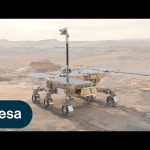
    Trailer of the ExoMars Rosalind Franklin mission.

    In 2028, ESA will launch its most ambitious exploration mission to search for past and present signs of life on Mars.

    Enjoy the ExoMars Rosalind Franklin mission in minute detail – everything down to the colour and size of the wires, sticky tape and scratches. The spacecraft, the rover and martian landscapes are as true to reality as possible for a simulation. The visuals show the spacecraft structural engineering with a faithful robotic appearance. The martian landscape has been simulated with meticulous realism.

    The story begins with the rover exploring the surface of the Red Planet. There is science to be done. Join the adventure.

    This trailer provides a first taste for the most accurate animation series made so far of a Mars mission.

    ESA’s Rosalind Franklin rover has unique scientific potential to search for evidence of past life on Mars thanks to its drill and scientific instruments. It will be the first rover to reach a depth of up to two metres deep below the surface, acquiring samples that have been protected from surface radiation and extreme temperatures. The drill will retrieve soils from ancient parts of Mars and analyse them in situ with its onboard laboratory.

    The mission will also serve to demonstrate key technologies that Europe needs to master for future planetary exploration missions. This includes the capability to land safely on a planet, to move autonomously on the surface, and to perform drilling and sample processing and analysis automatically. The rover will use novel driving techniques including wheel-walking to overcome difficult terrains, as well as autonomous navigation software.

    Check ESA’s ExoMars website [https://www.esa.int/Science_Exploration/Human_and_Robotic_Exploration/Exploration/ExoMars] and our frequently asked questions [https://www.esa.int/Science_Exploration/Human_and_Robotic_Exploration/Exploration/ExoMars/FAQ_The_rebirth_of_ESA_s_ExoMars_Rosalind_Franklin_mission] for the latest updates.

    Credits: ESA/Mlabspace

    ★ Subscribe: http://bit.ly/ESAsubscribe and click twice on the bell button to receive our notifications.

    Check out our full video catalog: http://bit.ly/SpaceInVideos
    Follow us on Twitter: http://bit.ly/ESAonTwitter
    On Facebook: http://bit.ly/ESAonFacebook
    On Instagram: http://bit.ly/ESAonInstagram
    On LinkedIn: https://bit.ly/ESAonLinkedIn
    On Pinterest: https://bit.ly/ESAonPinterest
    On Flickr: http://bit.ly/ESAonFlickr

    We are Europe’s gateway to space. Our mission is to shape the development of Europe’s space capability and ensure that investment in space continues to deliver benefits to the citizens of Europe and the world. Check out https://www.esa.int/ to get up to speed on everything space related.

    Copyright information about our videos is available here: https://www.esa.int/ESA_Multimedia/Terms_and_Conditions

    #ESA
    #Mars
    #Rover

  • Bringing Mars rock samples back to Earth 🌍 #shorts

    Bringing Mars rock samples back to Earth 🌍 #shorts

    Missions to Mars have made many exciting discoveries that have transformed our understanding of the planet, but the next step is to bring samples to Earth for detailed analysis in sophisticated laboratories.

    🎥 ESA – European Space Agency

    #ESA
    #Mars
    #MarsRover

  • Kombucha: Ally for Moon and Mars 🚀 #shorts

    Kombucha: Ally for Moon and Mars 🚀 #shorts

    ESA is testing kombucha cultures, famous for their fermentative properties and potential health benefits, to assess their resilience in space. These cultures hold great promise for supporting humans on the Moon and Mars.

    🎥 ESA – European Space Agency

    #ESA
    #Kombucha
    #SpaceExploration

  • Picking up lightsabres for Mars

    Picking up lightsabres for Mars

    Detect, fetch and collect. A seemingly easy task is being tested to find the best strategy to collect samples on the martian surface, some 290 000 million km away from home.

    Testing technologies for Mars exploration is part of the daily job of Laura Bielenberg, an ESA graduate trainee for the Mars Sample Return campaign.

    The test takes place at the rock-strewn recreation of the Red Planet at ESA’s ESTEC technical centre in Noordwijk, the Netherlands. The nickname of this test site is the ‘Mars Yard’ and is part of the Planetary Robotics Laboratory.

    The tube is a replica of the sample caches that NASA’s Perseverance rover is leaving on Mars hermetically sealed with precious martian samples inside. They are called RSTA, an acronym of Returnable Sample Tube Assembly, and to most people on Earth they look like lightsabers.
    Laura is investigating sample tube collection strategies, from autonomous detection to pose estimation of sample tubes on Mars, with a testbed called the RABBIT (RAS Bread Boarding In-house Testbed).

    The Sample Transfer Arm will need to load the tubes from the martian surface for delivery towards Earth. ESA’s robotic arm will collect them from the Perseverance rover, and possibly others dropped by sample recovery helicopters as a backup.

    Besides cameras and sensors, the team relies on neural networks to detect the tubes and estimate their pose. Inspired by the way the human brain works, neural networks mimic the way biological neurons signal to one another.

    More news about the Mars Sample Return campaign on ESA’s To Mars and Back blog: https://blogs.esa.int/to-mars-and-back/

    Credits: ESA/NASA/JPL-Caltech/GSFC/MSFC

    ★ Subscribe: http://bit.ly/ESAsubscribe and click twice on the bell button to receive our notifications.

    Check out our full video catalog: http://bit.ly/SpaceInVideos
    Follow us on Twitter: http://bit.ly/ESAonTwitter
    On Facebook: http://bit.ly/ESAonFacebook
    On Instagram: http://bit.ly/ESAonInstagram
    On LinkedIn: https://bit.ly/ESAonLinkedIn
    On Pinterest: https://bit.ly/ESAonPinterest
    On Flickr: http://bit.ly/ESAonFlickr

    We are Europe’s gateway to space. Our mission is to shape the development of Europe’s space capability and ensure that investment in space continues to deliver benefits to the citizens of Europe and the world. Check out https://www.esa.int/ to get up to speed on everything space related.

    Copyright information about our videos is available here: https://www.esa.int/ESA_Multimedia/Terms_and_Conditions

    #ESA
    #Mars
    #MarsRover

  • Terrae Novae | Earth orbit, Moon and Mars

    Terrae Novae | Earth orbit, Moon and Mars

    Terrae Novae is ESA’s exploration programme.

    Terrae Novae is not only literally about exploring new worlds, but by describing the limitless opportunities for discovery, economic growth and inspiration it also expresses our ambitions for Europe’s future innovators, scientists and explorers.

    This video shows the many exploration activities ESA is conducting or has planned in our Solar System, from the International Space Station to the Moon with the European Service Module and lunar Gateway modules for Artemis, and on to Mars with the Mars Sample Return campaign.

    For more on ESA’s human and robotic exploration strategy see: https://www.esa.int/terraenovae

    ★ Subscribe: http://bit.ly/ESAsubscribe and click twice on the bell button to receive our notifications.

    Check out our full video catalog: http://bit.ly/SpaceInVideos
    Follow us on Twitter: http://bit.ly/ESAonTwitter
    On Facebook: http://bit.ly/ESAonFacebook
    On Instagram: http://bit.ly/ESAonInstagram
    On LinkedIn: https://bit.ly/ESAonLinkedIn
    On Pinterest: https://bit.ly/ESAonPinterest
    On Flickr: http://bit.ly/ESAonFlickr

    We are Europe’s gateway to space. Our mission is to shape the development of Europe’s space capability and ensure that investment in space continues to deliver benefits to the citizens of Europe and the world. Check out https://www.esa.int/ to get up to speed on everything space related.

    Copyright information about our videos is available here: https://www.esa.int/ESA_Multimedia/Terms_and_Conditions

    #ESA
    #TerraeNovae
    #SpaceExploration

  • Bringing Mars rock samples back to Earth

    Bringing Mars rock samples back to Earth

    Short animation featuring key moments of the Mars Sample Return campaign: from landing on Mars and securing the sample tubes to launching them off the surface and ferrying them back to Earth.

    NASA and the European Space Agency (ESA) are developing plans for one of the most ambitious campaigns ever attempted in space: bringing the first samples of Mars material safely back to Earth for detailed study. European scientists are part of an international team giving advice on what samples to choose for return and the best analysis methods to use once they land on Earth.

    The diverse set of scientifically curated samples being collected by NASA’s Mars Perseverance rover could help scientists answer the question of whether ancient life ever arose on the Red Planet.

    Bringing samples of Mars to Earth for future study would happen in several steps with multiple spacecraft, and in close collaboration between ESA and NASA.

    The first step of the campaign began with the arrival of the Perseverance rover at Jezero Crater on 18 February 2021.

    ESA will give robotic assistance with the Sample Transfer Arm. The 2.5 m robotic arm will pick up the tubes filled with precious material from Mars and transfer them to a rocket for a launch into martian orbit.

    The European Earth Return Orbiter will then be the first interplanetary spacecraft to capture samples in orbit and make a return trip between Earth and Mars.

    This strategic partnership with NASA will be the first to return samples from another planet. The samples to be returned are thought to be the best opportunity to reveal the early evolution of Mars, including the potential for life.

    Credit: @NASA/ESA/@NASA Jet Propulsion Laboratory/@NASA Goddard/@NASA’s Marshall Space Flight Center

    ★ Subscribe: http://bit.ly/ESAsubscribe and click twice on the bell button to receive our notifications.

    Check out our full video catalog: http://bit.ly/SpaceInVideos
    Follow us on Twitter: http://bit.ly/ESAonTwitter
    On Facebook: http://bit.ly/ESAonFacebook
    On Instagram: http://bit.ly/ESAonInstagram
    On LinkedIn: https://bit.ly/ESAonLinkedIn
    On Pinterest: https://bit.ly/ESAonPinterest
    On Flickr: http://bit.ly/ESAonFlickr

    We are Europe’s gateway to space. Our mission is to shape the development of Europe’s space capability and ensure that investment in space continues to deliver benefits to the citizens of Europe and the world. Check out https://www.esa.int/ to get up to speed on everything space related.

    Copyright information about our videos is available here: https://www.esa.int/ESA_Multimedia/Terms_and_Conditions

    #ESA
    #Mars
    #SpaceScience

  • How Will NASA’s InSight Spacecraft Land on Mars?

    How Will NASA’s InSight Spacecraft Land on Mars?

    When NASA’s InSight descends to the Red Planet on Nov. 26, 2018, it’s guaranteed to be a white-knuckle event. Rob Manning, chief engineer at NASA’s Jet Propulsion Laboratory, explains the critical steps that must happen in perfect sequence to get the robotic lander safely to the surface.

    Download this video: https://images.nasa.gov/details-JPL-20181031-INSIGHf-0001-InSight%20Landing%20on%20Mars.html

  • InSight Mars Mission’s Road to Launch: Countdown to T-Zero

    InSight Mars Mission’s Road to Launch: Countdown to T-Zero

    On Monday, Nov. 26, 2018, our InSight spacecraft is set to land on Mars: https://go.nasa.gov/2Qcl8lq. This new documentary from NASA Launch Services follows InSight’s road to launch earlier this year & May 5, 2018 liftoff from Vandenberg Air Force Base, California.

  • Mars500 video diary 1 – Diego’s guided tour

    Mars500 video diary 1 – Diego’s guided tour

    Diego Urbina (@diegou) takes us on tour inside the Mars500 facilities – see how the crew are living and working for the next 17 months in isolation.

  • Interview with Romain Charles (ESA Mars500 participant)

    Interview with Romain Charles (ESA Mars500 participant)

    Romain Charles of the Mars500 crew talks about his motivation for taking part in this adventure and how he’ll cope with his 520-day ‘mission to Mars’ .