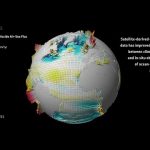
Earth’s oceans are huge heat stores, soaking up 93% of the excess heat from human activity over the past 70 years. Ocean currents redistribute heat around the planet, from the Equator to the poles. Where this ocean heat goes influences weather patterns and regional climate. As well as absorbing heat, oceans are a natural carbon sink, absorbing a quarter of carbon dioxide emissions from human activity. This has led to the acidification of ocean water, threatening marine life.
The amount of heat and carbon dioxide absorbed depends on a number of ocean variables, all of which can be measured from space.
We are Europe’s gateway to space. Our mission is to shape the development of Europe’s space capability and ensure that investment in space continues to deliver benefits to the citizens of Europe and the world. Check out https://www.esa.int/ to get up to speed on everything space related.
Are there oceans on other worlds? Yes! Earth is not alone. When you look deeper into our solar system, there are worlds we suspect have oceans hidden beneath their icy surfaces. NASA scientist Lucas Paganini is here to tell you more. Learn more about ocean worlds: https://go.nasa.gov/3rD0zlO
Producers: Jessica Wilde & Scott Bednar Editor: Matthew Schara
Listen to the full episode of this podcast and subscribe at: https://www.nasa.gov/gravityassist
For decades, moons of the outer solar system have proven fascinating subjects for scientists interested in the search for life. Forty years ago this year, NASA’s Voyager 1 spacecraft flew by Saturn’s moon Titan and took the first close images, revealing a thick orange-colored atmosphere that is the most Earth-like in the solar system. NASA’s Cassini probe then dropped off a lander at Titan called Huygens in 2004, and studied Titan in detail during its 13 years at Saturn. Now, NASA is preparing to launch the rotorcraft mission Dragonfly to Titan in the 2020s. But Titan is just one interesting moon. The European Space Agency’s upcoming JUpiter ICy moons Explorer (JUICE) mission will study Ganymede, Europa, and another moon of Jupiter called Callisto. Meanwhile, NASA’s Europa Clipper mission will provide complementary observations of Europa.
Earth observation satellites are guardians of our planet. Thanks to remote sensing technology and daily data collection, researchers are able to better monitor our planet’s oceans and rising sea levels from space. ESA senior advisor for Earth Observation programmes Jérôme Beneviste explains how ocean views from space play a role in climate change studies and natural catastrophe predictions.
We are Europe’s gateway to space. Our mission is to shape the development of Europe’s space capability and ensure that investment in space continues to deliver benefits to the citizens of Europe and the world. Check out http://www.esa.int/ESA to get up to speed on everything space related.
Experience magical moments from ESA astronaut Alexander Gerst’s Horizons mission in this time-lapse of highlights from space.
Combining thousands of images taken by Alexander over more than six months, this Ultra High Definition video provides a glimpse into spacecraft operations and the beauty of Earth as seen from the International Space Station.
Marvel at orbital sunrises, dancing auroras, city lights, oceans, clouds, the Milky Way, the release of cargo vehicles, a Soyuz launch and more against the thin band of atmosphere that surrounds our planet.
ESA is Europe’s gateway to space. Our mission is to shape the development of Europe’s space capability and ensure that investment in space continues to deliver benefits to the citizens of Europe and the world. Check out http://www.esa.int/ESA to get up to speed on everything space related.
Since the very first module Zarya launched from Baikonur Cosmodrome on 20 November 1998, the International Space Station has delivered a whole new perspective on this planet we call home. Join us as we celebrate 20 years of international collaboration and research for the benefit of Earth with ESA astronaut Alexander Gerst’s longest timelapse yet.
In just under 15 minutes, this clip takes you from Tunisia across Beijing and through Australia in two trips around the world. You can follow the Station’s location using the map at the top right-hand-side of the screen alongside annotations on the photos themselves.
This timelapse comprises approximately 21 375 images of Earth all captured by Alexander from the International Space Station and shown 12.5 times faster than actual speed.
Music is Orbital Horizons, an original composition by Los Angeles-based musician Matt Piper.
Participate in further Space Station celebrations via social media using hashtag #SpaceStation20th.
ESA is Europe’s gateway to space. Our mission is to shape the development of Europe’s space capability and ensure that investment in space continues to deliver benefits to the citizens of Europe and the world. Check out http://www.esa.int/ESA to get up to speed on everything space related.
Ever wondered what it feels like to fly from Alaska to the Andes in 260 seconds? ESA astronaut Alexander Gerst captured this timelapse footage of Alaska, the USA and South America while orbiting Earth on board the International Space Station.
This timelapse is made up of 6,375 images shown 12.5 times faster than actual speed. Music is Our Oasis by Miriam Speyer, sourced from Audio Network Limited.
Māori, as native New Zealanders, refer to their islands as “Aotearoa” or “the land of the long white cloud”. This timelapse from ESA astronaut Alexander Gerst shows Australia and New Zealand shrouded in cloud from the unique viewpoint of the International Space Station.
Comprised of 5,175 photos, this timelapse is 12.5 times faster than actual speed and is set to the soundtrack “Try or Die” sourced from Audio Network Limited.
Orbiting Earth once every 90 minutes, the International Space Station soars into 16 sunrises and sunsets every single day. Many of these sunrises occur while the crew is working or sleeping, but ESA astronaut Alexander Gerst captured this stunning timelapse of a sunrise to share with us here on Earth.
These photos were taken by Alexander at an interval of two per second and the video has been edited at 25 frames per second.
Music: First Survivors 4 by Los Angeles-based British composer, Luke Richards. Sourced from Audio Network Limited.
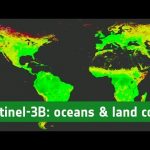
Following its launch in February 2016 and subsequent commissioning phase, the Copernicus Sentinel-3A satellite has been systematically measuring our oceans, land, ice and atmosphere. The information feeds a range of practical applications and is used for monitoring and understanding large-scale global dynamics. Sentinel-3A will soon be joined in orbit by its identical twin, Sentinel-3B. Both satellites carry a suite of cutting-edge instruments to supply a new generation of data products, which are particularly useful for marine applications. For example, they monitor ocean-surface temperatures for ocean and weather forecasting services, aquatic biological productivity, ocean pollution and sea-level change. The mission also delivers unique and timely information about changing land cover, vegetation, urban heat islands, and for tracking wildfires. With the two satellites in orbit, global coverage and data delivery will be optimised.
Atmospheric carbon dioxide is the most important human-made greenhouse gas responsible for global warming. Oceans assist in removing carbon dioxide from the atmosphere: phytoplankton accumulate carbon dioxide through photosynthesis and their chlorophyll colours the ocean’s waters. Satellites use this colour to measure chlorophyll, which helps scientists to calculate how much carbon dioxide is absorbed or emitted.
Two long-running NASA missions are providing new details about ocean bearing moons of Jupiter and Saturn – further heightening scientific interest in these and other “ocean worlds” in our solar system and beyond. The details – discussed during an April 13 NASA science briefing – include the announcement by the Cassini mission that a key ingredient for life has been found in the ocean on Saturn’s moon Enceladus. Meanwhile, researchers using the Hubble Space Telescope observed a probable plume erupting from the surface of Jupiter’s moon Europa, at the same location where Hubble saw evidence of a plume in 2014. Researchers say this could be circumstantial evidence of water erupting from the moon’s interior. Hubble’s monitoring of plume activity on Europa and Cassini’s long-term investigation of Enceladus are laying the groundwork for NASA’s Europa Clipper mission, which is being planned for launch in the 2020s. Also, Expedition 50 Returns Home Safely, Next Space Station Crew at Launch Site, Student Launch Event, Groundbreaking for New Lab, and Yuri’s Night, First Space Shuttle Mission Celebrated!
Sentinel-3A’s preparation is finished and the satellite will soon be shipped to the Russian Cosmodrome of Plesetsk, in Northern Russia for its launch on top of a Rockot planned end of this year. Carrying a suite of state-of-the-art instruments, Sentinel-3 is set to play a key role in Copernicus, the world’s largest environmental monitoring programme operated by the European Commission. It will provide highly accurate measurements on Earth’s oceans, land, ice and atmosphere.
Az Európai Űrügynökség hamarosan felbocsátja a Sentinel-3 műholdat, amelynek egyik fő feladata az lesz, hogy az óceánokról gyűjtsön adatokat.
Régóta tudjuk hogy az óceánok alapvető fontosságúak a földi élet szempontjából, és ezek szabályozzák az időkárást és a klímát. De most a műholdak segítségével ezt globális léptékben figyelhetjük meg. Egy műhold egy nap alatt annyi adatot szolgáltat az óceánokról, mint egy hajó egy év alatt. Ezeket az ismereteket azonban össze kell vetni a felszínen végzett mérésekkel.
Hogyan is történik mindez: például az űrből megfigyelhető az óceán színe, ami következtetni enged a fitoplankton, egy apró algaféle mennyiségére. Ezek az apró jószágok bocsátják ki a Föld oxigéntermelésének felét, ezek a tengeri ökoszisztéma alapvető építőkockái, ugyanakkor jelzőrendszerként is funkcionálnak, mert nagyon érzékenyen reagálnak a környezet változásaira. Ugyanakkor csak mintavétellel lehet megmondani, hogy mi is az, amit a műhold a a földkörüli pályáról lát.
Ezeknek a kutatásoknak köszönhetően tudjuk, hogyan változik a vízsszint, az óceánok hőmérséklete, az élővilág állapota: ha kellő mennyiségű adat gyűlik össze, abból sokkal inkább megérthetjük a Föld klimatikus viszonyait és folyamatait, mint bármi másból.
The annual gathering of Earth and space scientists in San Francisco at the American Geophysical Union meeting draws thousands of researchers from around the world, including many involved with NASA research. Galen McKinley of the University of Wisconsin-Madison talks about her work with carbon in the global oceans and the Great Lakes.