After lifting off from Baikonur Cosmodrome in Kazakhstan on Thursday, Sept. 11, a Roscosmos cargo spacecraft, delivering approximately three tons of food, fuel, and supplies, is scheduled to arrive at the International Space Station on Saturday, Sept. 13.
The unpiloted spacecraft will dock autonomously to the aft port of the orbiting laboratory’s Zvezda module at 1:27 p.m. EDT (1727 UTC) on Saturday, Sept. 13.
The Progress 93 spacecraft will remain docked to the space station for approximately six months. Then, it will depart for re-entry into Earth’s atmosphere, disposing of trash loaded by the crew.
After lifting off from Baikonur Cosmodrome in Kazakhstan on Thursday, July 3, a Roscosmos cargo spacecraft, delivering approximately three tons of food, fuel, and supplies, is scheduled to arrive at the International Space Station on Saturday, June 5.
The unpiloted spacecraft will dock autonomously to the space-facing port of the orbiting laboratory’s Poisk module at 5:27 p.m. EDT (2127 UTC) on Saturday, July 5.
The Progress 92 spacecraft will remain docked to the space station for approximately six months before departing for re-entry into Earth’s atmosphere to dispose of trash loaded by the crew.
A Roscosmos cargo spacecraft, delivering approximately three tons of food, fuel, and supplies to the Expedition 73 crew aboard the International Space Station, is launching on a Soyuz rocket from the Baikonur Cosmodrome in Kazakhstan on Thursday, July 3. Liftoff is scheduled for 3:32 p.m. EDT (1932 UTC).
After a two-day journey to the station, the unpiloted spacecraft will dock autonomously to the space-facing port of the orbiting laboratory’s Poisk module at 5:27 p.m. EDT (2127 UTC) on Saturday, July 5.
The Progress 92 spacecraft will remain docked to the space station for approximately six months before departing for re-entry into Earth’s atmosphere to dispose of trash loaded by the crew.
#stiinta #fizica #science #tehnologie #technology #cristianpresura algoritm:”DeepSeek, fondat în 2023, a început inițial prin dezvoltarea unui software pentru tranzacționarea pe piețele financiare, însă întâmpinând dificultăți financiare și tehnice. În ciuda unui embargou pe cipuri de inteligență artificială din partea Nvidia, compania chineză a reușit să se adapteze și să refacă sistemul, folosind o arhitectură mai puțin avansată pentru sarcini generale, cum este cazul ChatGPT. Rezultatele obținute au fost similare cu cele ale modelelor de la OpenAI, dar folosind cu mult mai puține resurse. Acest succes a provocat o scădere semnificativă a valorii altor companii tehnologice majore, inclusiv Microsoft și Alphabet, pe fondul temerii că investițiile în tehnologiile AI tradiționale sunt prea mari și că performanțele dorite pot fi atinse cu resurse mult mai reduse.
Surpriza nu a fost doar în lumea financiară, ci și în cercurile de cercetători, deoarece DeepSeek a demonstrat că nu este necesar hardware de ultimă generație pentru a obține rezultate remarcabile. Această realizare ridică întrebarea esențială: ce se va întâmpla cu viitorul inteligenței artificiale și al omenirii în ansamblu? Pe măsură ce tehnologia avansează, mulți se întreabă cum vor evolua gândirea și conștiința, atât pentru oameni, cât și pentru inteligențele artificiale.
Inteligența artificială generală (IAG) este o noțiune care se referă la dezvoltarea unui software capabil să egaleze sau să depășească inteligența umană, inclusiv să dezvolte conștiința de sine. Dacă până acum AI a fost folosită în scopuri specifice, precum procesarea informațiilor sau rezolvarea problemelor, IAG ar putea avea dorințe, opinii și o viziune proprie asupra existenței. Aceasta ar putea chiar să se reconfigureze, să dezvolte multiple forme de conștiință și să găsească soluții inovative la probleme fundamentale, cum ar fi descoperirea legilor fundamentale ale universului.
Cu toate acestea, trecerea la superinteligență ar însemna un salt rapid în evoluția tehnologică, iar IAG ar putea ajunge să se autoregleze și să-și modifice structura, ceea ce ar permite o dezvoltare exponențială a capacităților sale. Dacă oamenii ar avea nevoie de o viață întreagă pentru a înțelege un concept, IAG ar putea realiza același lucru în câteva microsecunde. Aceasta ar putea revoluționa domenii precum medicina, tehnologia sau fizica, iar în acest context, omenirii ar putea să-i rămână inaccesibile răspunsuri care, până acum, păreau imposibile.
În cele din urmă, evoluția inteligenței artificiale ar putea schimba radical fața lumii și a umanității. Într-o eră a superinteligenței, descoperirile științifice și tehnologiile inovative ar putea revoluționa viața pe Pământ, dar și concepțiile fundamentale despre existență. Totuși, oamenii ar trebui să învețe să se adapteze și să colaboreze cu aceste tehnologii pentru a menține un echilibru care să nu le subjuge, dar să le permită să atinga potențialul lor maxim. Istoria ne-a învățat că progresele majore sunt adesea însoțite de crize și renașteri, iar superinteligența ar putea deschide o nouă eră a abundenței materiale și cunoașterii profunde.”
These are exciting days at Europe’s Spaceport in French Guiana and throughout several sites in ESA Member States as the development of Ariane 6 enters its final phase. Ariane 6 parts are being shipped from Europe for combined tests on the new Ariane 6 launch base. These tests rehearse all activities and systems involving the rocket and launch base on an Ariane 6 launch campaign. On the final test, the Ariane 6 core stage will perform a static hot firing while standing on its recently inaugurated launch pad. It will be from this new launch base that ESA’s Ariane 6 rocket will soon be launched for the first time.
Meanwhile in Europe, Ariane 6’s upper stage will experience the conditions of space at a new test bench at @DLR in Lampoldshausen. After this, all is ready for the much anticipated first flight of ESA’s new heavy-lift rocket from Europe’s Spaceport.
★ Subscribe: http://bit.ly/ESAsubscribe and click twice on the bell button to receive our notifications.
We are Europe’s gateway to space. Our mission is to shape the development of Europe’s space capability and ensure that investment in space continues to deliver benefits to the citizens of Europe and the world. Check out https://www.esa.int/ to get up to speed on everything space related.
Making progress on our Artemis Moon rocket, images from a close encounter with a Jovian moon, and a ring of fire for our Moon … a few of the stories to tell you about – This Week at NASA!
Our Artemis program will return U.S. astronauts to the surface of the Moon, a goal announced by Vice President Mike Pence on March 26, 2019. Take a look at all we’ve accomplished since then, from testing our Orion spacecraft and building our Space Launch System rocket to graduating a new Artemis Generation class of astronauts and creating partnerships with private industry.
ExoMars 2020 has passed a number of milestones. The European carrier module was delivered in March. The European rover, which contains nine instruments, has been assembled by Airbus UK and is under environmental testing in Toulouse. It should be integrated with the spacecraft by the end of the year. The spacecraft is now in the Thales Alenia Space test facilities in Cannes to start the environmental and performance verification test campaign that will last until February 2020.
However, there remain some important challenges ahead for the parachute system of the descent module. Recent balloon high-altitude drop tests were unsuccessful. As a result, the next and final two drop tests, scheduled between January and March 2020, must be fully successful otherwise the mission cannot launch in 2020.
The joint ESA and Russian mission consists of four elements: a carrier module to propel the spacecraft to Mars, a descent module, a surface science platform and the Rosalind Franklin rover, which will use its drill up to depths of two meters to search for signs of life.
We are Europe’s gateway to space. Our mission is to shape the development of Europe’s space capability and ensure that investment in space continues to deliver benefits to the citizens of Europe and the world. Check out http://www.esa.int/ESA to get up to speed on everything space related.
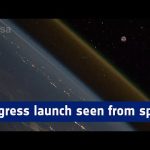
Timelapse of the Russian Progress MS-10 cargo spacecraft launched on 16 November 2018 at 18:14 GMT from Baikonur cosmodrome, Kazakhstan, taken by ESA astronaut Alexander Gerst from the International Space Station.
The spacecraft was launched atop a Soyuz rocket with 2564 kg of cargo and supplies. Flying at 28 800 km/h, 400 km high, the International Space Station requires regular supplies from Earth such as this Progress launch. Spacecraft are launched after the Space Station flies overhead so they catch up with the orbital outpost to dock, in this case two days later on 18 November 2018.
The images were taken from the European-built Cupola module with a camera set to take pictures at regular intervals. The pictures are then played quickly after each other at 8 to 16 times normal speed. The video shows around 15 minutes of the launch at normal speed.
The Progress spacecraft delivered food, fuel and supplies, including about 750 kg of propellant, 75 kg of oxygen and air and 440 l of water.
Some notable moments in this video are:
00:07 Soyuz-FG rocket booster separation.
00:19 Core stage separation.
00:34:05 Core stage starts burning in the atmosphere as it returns to Earth after having spent all its fuel.
00:34:19 Progress spacecraft separates from rocket and enters orbit to catch up with the International Space Station.
ESA is Europe’s gateway to space. Our mission is to shape the development of Europe’s space capability and ensure that investment in space continues to deliver benefits to the citizens of Europe and the world. Check out http://www.esa.int/ESA to get up to speed on everything space related.
NASA is on the hunt for an asteroid to capture with a robotic spacecraft, redirect to a stable orbit around the moon, and send astronauts to study in the 2020s — all on the agency’s human Path to Mars. Agency officials announced on Thursday recent progress to identify candidate asteroids for its Asteroid Redirect Mission (ARM), increase public participation in the search for asteroids, and advance the mission’s design.
NASA plans to launch the ARM robotic spacecraft in 2019 and will make a final choice of the asteroid for the mission about a year before the spacecraft launches. NASA is working on two concepts for the mission: the first is to fully capture a very small asteroid in open space, and the second is to collect a boulder-sized sample off of a much larger asteroid. The agency will choose between these two concepts in late 2014 and further refine the mission’s design.
NASA’s Spitzer Space Telescope made recent observations of an asteroid, designated 2011 MD, which bears the characteristics of a good candidate for the full capture concept. While NASA will continue to look for other candidate asteroids during the next few years as the mission develops, astronomers are making progress to find suitable candidate asteroids for humanity’s next destination into the solar system.
NASA Administrator Charlie Bolden, Senator Barbara Mikulski of Maryland and Goddard Center Director Chris Scolese congratulated the Goddard team recently for progress in development of the James Webb Space Telescope. The telescope’s flight instruments and primary mirrors are being integrated at Goddard. JWST is the agency’s flagship science project and the most powerful space telescope ever built. Scheduled to launch in 2018, it will study every phase in the history of our universe, including the first luminous glows after the big bang and the evolution of our own solar system. Also, Crawler-Transporter test drive, Adapter ring complete, Engine test, Progress up, Progress down and more!