Steve Spangler is a bestselling author, STEM educator and Emmy award-winning television personality with more than 2,100 television appearances to his credit. Steve appeared as a regular guest on the Ellen DeGeneres Show from 2007-2022 (27 appearances).
Steve Spangler is a bestselling author, STEM educator and Emmy award-winning television personality with more than 2,100 television appearances to his credit. Steve appeared as a regular guest on the Ellen DeGeneres Show from 2007-2022 (27 appearances).
Steve Spangler is a bestselling author, STEM educator and Emmy award-winning television personality with more than 2,100 television appearances to his credit. Steve appeared as a regular guest on the Ellen DeGeneres Show from 2007-2022 (27 appearances).
Just what you need for the holidays… the coziness of a crackling and roaring rocket engine!
Technically, this fireplace packs the heat of the SLS rocket’s four RS-25 engines and a pair of solid rocket boosters – just enough to get you to the Moon! (And get through the holidays with your in-laws.)
This glowing mood-setter is brought to you by the SLS (Space Launch System) rocket that launched Artemis I on its mission around the Moon and back on Nov. 16, 2022. 8.8 million pounds of total thrust – and a couple glasses of eggnog – might just be enough to make your holidays merry.
Video description: A stock fireplace illustration frames looping archival video of the blasting RS-25 engines that launched the Artemis I rocket to the Moon on Nov. 16, 2022 (source: https://go.nasa.gov/4g6LnWc ). The illustration includes stone tiling, a pillow, a basket of firewood, and contains elements generated with AI. NASA added two framed pictures to the illustration. One shows an archival image of the Orion capsule flying through space. The other shows the Artemis logo. The audio features the roar of the rockets at a low level, with the addition of the sounds of a crackling wood fire.
Credit: NASA Producers: Sami Aziz, John Sackman Designer: Chris Chamberland
Steve Spangler is a bestselling author, STEM educator and Emmy award-winning television personality with more than 2,100 television appearances to his credit. Steve appeared as a regular guest on the Ellen DeGeneres Show from 2007-2022. Learn more about Steve at https://stevespangler.com/about-steve-spangler/
It’s time to say goodbye to our rocket with its final liftoff.
On this last flight, it will carry the Copernicus Sentinel-2C, into orbit. Vega already delivered Sentinel-2A and 2B to space in 2015 and 2017 ensuring constant monitoring of our planet for precision farming, water quality monitoring, natural disaster management and detecting methane emissions.
Since its inaugural flight in 2012, Vega has launched over 20 times, serving Europe with precision and excellence. Now, Vega-C is ready to take the reins, bringing more power and capacity to future missions.
The first half of 2024 saw hundreds of people across Europe building, cajoling, shipping, lowering, integrating, securing and protecting the precious pieces and parts that came together to create Ariane 6 – Europe’s new heavy-lift rocket.
Huge engines, boosters and outer shells met tiny screws, electrical boards and masses of supercooled fuel. All this came together at Europe’s Spaceport in French Guiana, for the spectacular first launch of Ariane 6 on 9 July 2024, restoring Europe’s access to space.
Get a glimpse at the teamwork, skill and care that went into this moment over many months, in this montage of Ariane 6 images, videos and timelapse photography spanning 30 January to 9 July 2024.
★ Subscribe: http://bit.ly/ESAsubscribe and click twice on the bell button to receive our notifications.
We are Europe’s gateway to space. Our mission is to shape the development of Europe’s space capability and ensure that investment in space continues to deliver benefits to the citizens of Europe and the world. Check out https://www.esa.int/ to get up to speed on everything space related.
Europe’s new rocket Ariane 6 powered Europe into space taking with it a varied selection of experiments, satellites, payload deployers and reentry demonstrations that represent thousands across Europe, from students to industry and experienced space actors.
This inaugural flight, designated VA262, is a demonstration flight to show the capabilities and prowess of Ariane 6 in escaping Earth’s gravity and operating in space. Nevertheless, it had several passengers on board.
Ariane 6 was built by prime contractor and design authority ArianeGroup. In addition to the rocket, the liftoff demonstrated the functioning of the launch pad and operations on ground at Europe’s Spaceport. The new custom-built dedicated launch zone was built by France’s space agency CNES and allows for a faster turnover of Ariane launches.
Ariane 6 is Europe’s newest heavy-lift rocket, designed to provide great power and flexibility at a lower cost than its predecessors. The launcher’s configuration – with an upgraded main stage, a choice of either two or four powerful boosters and a new restartable upper stage – will provide Europe with greater efficiency and possibility as it can launch multiple missions into different orbits on a single flight, while its upper stage will deorbit itself at the end of mission.
ESA’s main roles in the Ariane 6 programme is as contracting authority – managing the budget from Member States participating in the Ariane 6 development programme; and as launch system architect – ensuring that the rocket and launch pad infrastructure work together.
Ariane 6 is the latest in Europe’s Ariane rocket series, taking over from Ariane 5 featuring a modular and versatile design that can launch missions from low-Earth orbit and farther out to deep space.
★ Subscribe: http://bit.ly/ESAsubscribe and click twice on the bell button to receive our notifications.
We are Europe’s gateway to space. Our mission is to shape the development of Europe’s space capability and ensure that investment in space continues to deliver benefits to the citizens of Europe and the world. Check out https://www.esa.int/ to get up to speed on everything space related.
Ariane 6 is the newest rocket in a series that has, for five decades, been launching Europe towards the stars. Building on all the knowledge, expertise and technology developed over the years, Ariane 6 will be versatile, modular, and European.
Guaranteeing Europe’s access to space for the next years, Ariane 6 in two versions, with either two or four boosters attached depending on the ‘oomph’ the mission requires. Versatile, its upper stage can reignite multiple times during a single flight, placing any spacecraft into any orbit – including constellations – saving a final boost to return and burn up in Earth’s atmosphere. Modular, it will be continuously adapted to the needs of the future space sector.
Four organisations take care of the Ariane 6 programme: ESA at the head, ArianeGroup as the main contractor, CNES who designed and built the launchpad and ArianeSpace who sell the launches.
13 countries contribute, thousands of Europeans have worked on it, and every one of us will benefit from the Earth observation, science, technologies and services it will make possible.
Credits: ESA – European Space Agency
★ Subscribe: http://bit.ly/ESAsubscribe and click twice on the bell button to receive our notifications.
We are Europe’s gateway to space. Our mission is to shape the development of Europe’s space capability and ensure that investment in space continues to deliver benefits to the citizens of Europe and the world. Check out https://www.esa.int/ to get up to speed on everything space related.
On 20 June 2024 the first Ariane 6 rocket to launch into space went through its last full ‘wet dress rehearsal’ at Europe’s Spaceport in French Guiana – it provided an exciting sneak peek of what’s to come, stopping just a few seconds before engine ignition and of course, liftoff.
One of the first steps was to roll back the colossal 90-m tall Ariane 6 mobile gantry building 120 m away from the launch pad – the first moment the complete rocket stood free.
The first parts of Ariane 6 began arriving in French Guiana from continental Europe in February 2024 via the Canopée ‘spaceship’. In March, the main stage and upper stage were assembled, followed by the transfer of the two powerful P120C boosters in April.
In May, Ariane 6’s first passengers also arrived in Kourou – a varied selection of experiments, satellites, payload deployers and reentry demonstrations that represent thousands across Europe, from students to industry and experienced space actors NASA and ArianeGroup.
The payloads were integrated onto the ‘ballast’ at the end of May, and just a few days ago the ballast was fitted onto the top of the rocket and the fairing closed around it – the last time Ariane 6’s cargo would see light. From Earth observation to technology demonstrations testing wildlife tracking, 3D printing in open space, open-source software and hardware and science missions looking for the most energetic explosions in the universe, the passengers on Ariane 6’s first flight are a testament to the rocket’s adaptability, complexity, and its role for the future – launching any mission, anywhere.
Credits: ESA – European Space Agency Footage: ESA/ArianeGroup/Arianespace/CNES
★ Subscribe: http://bit.ly/ESAsubscribe and click twice on the bell button to receive our notifications.
We are Europe’s gateway to space. Our mission is to shape the development of Europe’s space capability and ensure that investment in space continues to deliver benefits to the citizens of Europe and the world. Check out https://www.esa.int/ to get up to speed on everything space related.
🚀 Have you ever wondered how we transport rockets?
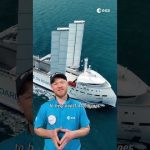
All the elements that make up Ariane 6 are manufactured in mainland Europe and then transported by this ship, named Canopée.
It is the first custom-built transporter to use sails, reducing emissions and saving on fuel by up to 30%, and on this trip, it travels for 10 days covering over 7000 km to reach Europe’s Spaceport in French Giuana.
The hybrid-propulsion vessel is 121 m long and has 37 m tall sails. Canopée rotates continuously between stop-offs to load each Ariane 6 stage and other parts and ship them across the Atlantic Ocean to Europe’s spaceport.
Europe’s new launcher, Ariane 6 uses liquid oxygen and hydrogen as fuel to lift it off the ground and into space. This fuel is chilled to -150°C which allows more propellant to be loaded into the rocket with more fuel from the engine.
But Ariane would not get far without the boosters that provide the most thrust by far.
In order to control the direction of Ariane 6 after launch, the nozzles on the boosters and main stage can swivel to keep it on course. This is no easy feat as Ariane 6 is 56 m tall and controlled at the bottom, so it is a careful balancing act.
Steve Spangler is a bestselling author, STEM educator and Emmy award-winning television personality with more than 2,100 television appearances to his credit. Steve appeared as a regular guest on the Ellen DeGeneres Show from 2007-2022. Learn more about Steve at https://stevespangler.com/about-steve-spangler/
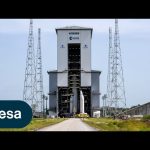
Last week, Ariane 6’s central core – the main body of the rocket – was stood tall at the launch zone and connected to its two solid-fuel boosters. This exciting moment means only one thing: it’s the start of the first launch campaign.
The main stage and upper stage make up the core stage, and they were autonomously driven at 3 km/h from the rocket assembly building to the launch pad, 800 m away. Then lifted by a crane, the Ariane 6 core was stood upright on the launch table.
The two boosters were transported to the launch pad on a specially designed truck and then configured with the rocket body, now holding it upright.
Ariane 6 is due to launch in summer 2024. The heavy-lift rocket will inaugurate a new era of autonomous European space transportation, powering Europe into space to realise its ambitions on the world stage. It will lift off from a modern launch complex at Europe’s Spaceport in French Guiana, carrying with it not just a variety of spacecraft, but also European goals for prosperity and autonomy.
Credits: ESA – European Space Agency
★ Subscribe: http://bit.ly/ESAsubscribe and click twice on the bell button to receive our notifications.
We are Europe’s gateway to space. Our mission is to shape the development of Europe’s space capability and ensure that investment in space continues to deliver benefits to the citizens of Europe and the world. Check out https://www.esa.int/ to get up to speed on everything space related.
Europe has a new rocket, and it’s set to launch soon 🚀
Europe’s next launch vehicle is the powerful Ariane 6. The rocket will be bigger, better, and more versatile than its predecessor.
Our daily life is becoming increasingly reliant on space to keep people and things connected for communication, banking, transport, weather forecasting and more!
Ariane 6 is ensuring Europe has continued independent and autonomous access to space.
Steve Spangler is a bestselling author, STEM educator and Emmy award-winning television personality with more than 2,100 television appearances to his credit. Steve appeared as a regular guest on the Ellen DeGeneres Show from 2007-2022. Learn more about Steve at https://stevespangler.com/about-steve-spangler/
Steve Spangler is a bestselling author, STEM educator and Emmy award-winning television personality with more than 2,100 television appearances to his credit. Steve appeared as a regular guest on the Ellen DeGeneres Show from 2007-2022. Learn more about Steve at https://stevespangler.com/about-steve-spangler/
On 22 June 2023 at Europe’s Spaceport in French Guiana, engineers rolled back the mobile gantry protecting Ariane 6 on its launch pad. The exercise helped validate ground systems and prepare for a series of engine fire tests.
Credits: ESA ; S. Corvaja, ESA/M. Pédoussaut, Zetapress
★ Subscribe: http://bit.ly/ESAsubscribe and click twice on the bell button to receive our notifications.
We are Europe’s gateway to space. Our mission is to shape the development of Europe’s space capability and ensure that investment in space continues to deliver benefits to the citizens of Europe and the world. Check out https://www.esa.int/ to get up to speed on everything space related.
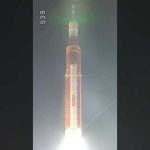
On Nov. 16, 2022, the Orion spacecraft launched aboard the Space Launch System (SLS) rocket from NASA’s Kennedy Space Center and embarked on the #Artemis I mission to the Moon and back. Orion orbited the Moon, getting as close as 79 miles to the lunar surface, and successfully splashed back down to Earth 25.5 days later on Dec. 11.
Four RS-25 engines and two five-segment solid rocket boosters provided more than 8.8 million pounds of thrust for SLS during liftoff and flight. Thanks in part to development of a new RS-25 engine controller that checks engine health 50 times per second, engineers were able to collect more than 100 measurements on pressures, temperatures, flows, speeds, and vibrations on the four RS-25 engines that helped power Artemis I. The preliminary post-flight data indicates that all SLS systems performed exceptionally and that the designs are ready to support a crewed flight on Artemis II.
The Artemis II mission will bring us closer to establishing a sustained human presence on the lunar surface and landing the first woman and first person of color on the Moon.
This video was captured from the Launch Pad 39B perimeter and was used by engineers to monitor and track the rocket during flight.
Video credit: NASA Music credit: Universal Production Music
Joining @NASA’s Orion spacecraft on the powerful Space Launch System rocket are ten CubeSats that will help prepare for the return of astronauts to our lunar companion. Our deep space antennas, along with the Goonhilly Earth Station in the UK, are tracking six of the small satellites, ensuring they arrive where they need to be, and their data gets back home.
We are Europe’s gateway to space. Our mission is to shape the development of Europe’s space capability and ensure that investment in space continues to deliver benefits to the citizens of Europe and the world. Check out https://www.esa.int/ to get up to speed on everything space related.
Raw NASA camera footage, taken from the Space Launch System’s (SLS) core stage, shows the SLS separation of the solid rocket boosters two minutes and 11 seconds after liftoff.
At 1:47 am EST (6:47 UTC) on November 16, NASA’s Orion spacecraft launched aboard the SLS rocket from historic Launch Complex 39B at NASA’s Kennedy Space Center on a path to the Moon, officially beginning the Artemis I mission.
This mission is the first integrated test of NASA’s deep space exploration systems: the Orion spacecraft, the SLS rocket, and Kennedy Space Center ground systems.
NASA’s Artemis I mission lifted off on Nov. 16, 2022, from Kennedy Space Center’s Launch Complex 39B. This video includes highlights from the event.
With 8.8 million pounds of thrust, the Space Launch System (SLS), is NASA’s most powerful rocket. It will send the uncrewed Orion spacecraft beyond the Moon, 280,000 miles from Earth, farther than any human-rated spacecraft has ever flown.
After 26 days and a total distance of over a million miles, Orion will return home faster and hotter than any spacecraft has before.
The primary goals for Artemis I are to demonstrate Orion’s systems in a spaceflight environment and ensure a safe re-entry, descent, splashdown, and recovery prior to the first flight with crew on Artemis II.
The first in a series of increasingly complex missions, Artemis I will demonstrate our commitment and capability to build a long-term human presence at the Moon for decades to come.
Space Rider is an uncrewed robotic laboratory about the size of two minivans. After launch on Vega-C, this reusable spacecraft will stay in low orbit for about two months, conducting research in microgravity or observing the Earth or deep space. At the end of its mission, Space Rider will return to Earth with its payloads to be unloaded and refurbished for another flight.
Credit: ESA/Frame by Frame
★ Subscribe: http://bit.ly/ESAsubscribe and click twice on the bell button to receive our notifications.
We are Europe’s gateway to space. Our mission is to shape the development of Europe’s space capability and ensure that investment in space continues to deliver benefits to the citizens of Europe and the world. Check out https://www.esa.int/ to get up to speed on everything space related.
This Ariane 6 combined tests model will be used to validate the entire launch system during its ground phase in readiness for the inaugural launch of the first Ariane 6 rocket.
We are Europe’s gateway to space. Our mission is to shape the development of Europe’s space capability and ensure that investment in space continues to deliver benefits to the citizens of Europe and the world. Check out https://www.esa.int/ to get up to speed on everything space related.
At Europe’s Spaceport in French Guiana, a test model of the Ariane 6’s central core has been assembled for the first time. Ariane 6 is the first Ariane rocket to be assembled horizontally, which is simpler and less costly than more traditional vertical assembly. One of the P120C boosters can be seen from different angles during installation, before the rocket’s central core is moved to its launchpad and placed upright in its mobile gantry. With the central core and boosters in place, combined tests validate compatibility between all components of the complete launch system.
★ Subscribe: http://bit.ly/ESAsubscribe and click twice on the bell button to receive our notifications.
We are Europe’s gateway to space. Our mission is to shape the development of Europe’s space capability and ensure that investment in space continues to deliver benefits to the citizens of Europe and the world. Check out https://www.esa.int/ to get up to speed on everything space related.
It has been an exciting and busy summer for the European Space Agency, with development and testing of its new Ariane 6 launcher. At Europe’s spaceport in, French Guiana, a test model of the launcher’s central core was assembled for the first time. Ariane 6 is the first Ariane rocket to be assembled horizontally, which is simpler and less costly than more traditional vertical assembly. Then, the rocket was moved to its launchpad and placed upright in the massive mobile gantry for combined tests, to validate the compatibility between all components of the complete launch system. Soon more testing will be done on Ariane 6’s upper stage at a purpose-built @DLRde facility in Lampoldshausen, Germany.
★ Subscribe: http://bit.ly/ESAsubscribe and click twice on the bell button to receive our notifications.
We are Europe’s gateway to space. Our mission is to shape the development of Europe’s space capability and ensure that investment in space continues to deliver benefits to the citizens of Europe and the world. Check out https://www.esa.int/ to get up to speed on everything space related.
ESA’s new Vega-C rocket lifted off for its inaugural flight VV21 at 15:13 CEST/13:13 UTC/10:13 local time from Europe’s Spaceport in French Guiana. With new first and second stages and an uprated fourth stage, Vega-C increases performance to about 2.3 t in a reference 700 km polar orbit, from the 1.5 t capability of its predecessor, Vega. For flight VV21, Vega-C’s payload is LARES-2, a scientific mission of @AsiTVit and six research CubeSats from France, Italy and Slovenia.
We are Europe’s gateway to space. Our mission is to shape the development of Europe’s space capability and ensure that investment in space continues to deliver benefits to the citizens of Europe and the world. Check out https://www.esa.int/ to get up to speed on everything space related.
ESA’s new Vega-C rocket lifted off for its inaugural flight VV21 on 13 July 2022 at 15:13 CEST/13:13 UTC/10:13 local time from Europe’s Spaceport in French Guiana. This video features shots of the launch from different angles.
With new first and second stages and an uprated fourth stage, Vega-C increases performance to about 2.3 t in a reference 700 km polar orbit, from the 1.5 t capability of its predecessor, Vega.
For flight VV21, Vega-C’s payload is LARES-2, a scientific mission of the Italian space agency ASI and six research CubeSats from France, Italy and Slovenia.
We are Europe’s gateway to space. Our mission is to shape the development of Europe’s space capability and ensure that investment in space continues to deliver benefits to the citizens of Europe and the world. Check out https://www.esa.int/ to get up to speed on everything space related.
Enjoy the inaugural flight of ESA’s new Vega-C rocket. The principal payload of this flight is LARES-2, a scientific mission of @AsiTV. Also onboard are six European research CubeSats.
We are Europe’s gateway to space. Our mission is to shape the development of Europe’s space capability and ensure that investment in space continues to deliver benefits to the citizens of Europe and the world. Check out https://www.esa.int/ to get up to speed on everything space related.
Enjoy the inaugural flight of ESA’s new Vega-C rocket. The principal payload of this flight is LARES-2, a scientific mission of @AsiTV. Also onboard are six European research CubeSats.
We are Europe’s gateway to space. Our mission is to shape the development of Europe’s space capability and ensure that investment in space continues to deliver benefits to the citizens of Europe and the world. Check out https://www.esa.int/ to get up to speed on everything space related.
Enjoy the inaugural flight of ESA’s new Vega-C rocket. The principal payload of this flight is LARES-2, a scientific mission of the @AsiTV. Also onboard are six European research CubeSats.
We are Europe’s gateway to space. Our mission is to shape the development of Europe’s space capability and ensure that investment in space continues to deliver benefits to the citizens of Europe and the world. Check out https://www.esa.int/ to get up to speed on everything space related.
ESA’s newest launcher stands nearly 35m tall when its four stages and payload are fully stacked. For its inaugural flight, VV21, the main payload is LARES-2, a scientific mission of @AsiTV.
We are Europe’s gateway to space. Our mission is to shape the development of Europe’s space capability and ensure that investment in space continues to deliver benefits to the citizens of Europe and the world. Check out https://www.esa.int/ to get up to speed on everything space related.
This animated preview of flight VV21 illustrates gantry rollout and liftoff from Europe’s Spaceport in French Guiana, stage and fairing separations, and deployment of the Italian Space Agency’s LARES-2 scientific payload and six research CubeSats. Vega-C represents a dramatic capability boost compared to its predecessor, Vega, which has flown since 2012. With new first and second stages and an uprated fourth stage, Vega-C increases performance from Vega’s 1.5 t to about 2.2 t in a reference 700 km polar orbit and handles larger payloads.
We are Europe’s gateway to space. Our mission is to shape the development of Europe’s space capability and ensure that investment in space continues to deliver benefits to the citizens of Europe and the world. Check out https://www.esa.int/ to get up to speed on everything space related.
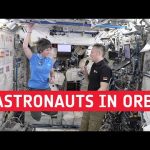
For the first time since mid 2011, ESA has two astronauts living and working together aboard the International Space Station. Watch a conversation between Samantha Cristoforetti and Matthias Maurer in this rare moment for Europe in space.
The astronauts’ meeting marks a brief crossover between the start of Samantha’s second space mission, Minerva, and Matthias’s final days in orbit for his first mission, Cosmic Kiss.
Samantha arrived with Crew-4 on 28 April in @SpaceX Crew Dragon Freedom, while Matthias will depart with Crew-3 in SpaceX Crew Dragon Endurance in May after almost six months on the Station.
In this video Matthias is impressed by Samantha’s floating ability and says it’s like she never left. Samantha confirms weightless was the thing she missed the most on Earth and talks about the differences on Station since her Italian Space Agency ASI-sponsored Futura mission in 2014-15.
Matthias is pleased with what he’s achieved in his time on Station, including the science he’s supported and the spacewalk he performed. He wishes Samantha all the best for her mission as she wishes him a safe return to Earth.
We are Europe’s gateway to space. Our mission is to shape the development of Europe’s space capability and ensure that investment in space continues to deliver benefits to the citizens of Europe and the world. Check out https://www.esa.int/ to get up to speed on everything space related.
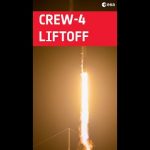
Crew Dragon Freedom is launched to the International Space Station, carrying ESA astronaut Samantha Cristoforetti and @NASA astronauts Kjell Lindgren, Robert “Bob” Hines and Jessica Watkins.
Collectively known as Crew-4, the four astronauts were launched from @NASA’s Kennedy Space Center in Florida, USA.
Samantha is the third ESA astronaut to travel to the orbital outpost in a @SpaceX Crew Dragon. During the journey she and Jessica will serve as Mission Specialists. Kjell is Crew-4 Commander and Bob is Crew-4 Pilot.
Upon arrival, Crew-4 will be greeted by the Space Station’s current crew – including ESA astronaut Matthias Maurer. Samantha and Matthias will enjoy a brief handover in orbit before he returns to Earth with Crew-3.
Samantha first flew to space in 2014 for her @AsiTV-sponsored mission Futura. Her ESA space mission, known as Minerva, will officially begin once she reaches the Station.
Throughout her mission, Samantha will hold the role of US Orbital Segment (USOS) lead, taking responsibility for all operations within the US, European, Japanese and Canadian modules and components of the Space Station. She will support around 35 European and many more international experiments in orbit.
We are Europe’s gateway to space. Our mission is to shape the development of Europe’s space capability and ensure that investment in space continues to deliver benefits to the citizens of Europe and the world. Check out https://www.esa.int/ to get up to speed on everything space related.
How long would it take us to reach our closest neighbour? How do astronomers know so much about the universe? Why is astronomy important for society? In this Meet the Experts episode, ESA research fellow Tereza Jerabkova discusses our place in the universe and takes us on a journey through space.
We are Europe’s gateway to space. Our mission is to shape the development of Europe’s space capability and ensure that investment in space continues to deliver benefits to the citizens of Europe and the world. Check out https://www.esa.int/ to get up to speed on everything space related.
Are you curious to know how a telescope works? Join ESA astronomer Giovanna Giardino as she gives an insight into the inner workings of the world’s largest telescope in space, the extraordinary James Webb Space Telescope.
We are Europe’s gateway to space. Our mission is to shape the development of Europe’s space capability and ensure that investment in space continues to deliver benefits to the citizens of Europe and the world. Check out https://www.esa.int/ to get up to speed on everything space related.
How did the universe go from a dark and cold place after the Big Bang, to the mesmerizing cosmos we see today? In this episode of Meet the Experts, ESA research fellow Rachana Bhatawdekar takes us on a tour of the early universe, to discover how the very first stars and galaxies were born after the Big Bang.
We are Europe’s gateway to space. Our mission is to shape the development of Europe’s space capability and ensure that investment in space continues to deliver benefits to the citizens of Europe and the world. Check out https://www.esa.int/ to get up to speed on everything space related.