Jupiter has super strong winds and massive storms, including the iconic Great Red Spot, a storm bigger than Earth! At the poles, winds can reach up to 1440 km/h.
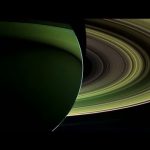
Saturn is even windier! It has some of the fastest, but not the fastest winds in our Solar System blow. Winds here can reach 1800 km/h.
Venus has super-rotating winds that race around the planet up to 60x faster than Venus itself spins. That’s way faster than Earth’s winds, which top out at 10–20% of our planet’s rotation speed.
Mars has a thin atmosphere, so winds are usually gentle. But during dust storms, they can kick up to around 100 km/h.
Neptune holds the record for the fastest winds in the Solar System, blowing at over 2000 km/h!
For context: the fastest wind ever recorded on Earth? 408 km/h—during a massive tornado in Australia.
📹 European Space Agency (ESA) 📸 ESA/Voyager 2, NASA, NSSDC Photo Gallery ID P-34709C
Ai întrebări de știință și vrei răspunsuri personale? Intră acum pe Patreon și eu își voi răspunde direct pe whatsapp ►https://patreon.com/cristianpresura
algoritm:”În contextul recentelor discuții mediatică privind presupusa aliniere perfectă a planetelor, prezentul articol își propune să clarifice realitatea astronomică a acestor evenimente și să evidențieze diferența fundamentală dintre percepția vizuală și configurația spațială a sistemului solar.
Metodologie și observații Analiza se bazează pe compararea imaginilor populare cu datele reale obținute din simulări digitale (ex. Stellarium). Studiul evidențiază două perspective de observare: direcția 1, orientată spre răsărit, unde se regăsesc Marte, Jupiter și Uranus, și direcția 2, către apus, unde sunt vizibile Mercur, Venus, Saturn și Neptun. Deși aceste planete se află în aceeași jumătate a sistemului solar, ele nu formează o linie perfectă, ci sunt dispuse conform pozițiilor lor orbitale. Proiecția boltei cerești asupra unui suport bidimensional conduce la apariția unui arc de cerc, iluzie rezultată din metoda de reprezentare a planurilor tridimensionale pe suprafețe plane.
Discuții Rezultatele simulărilor indică faptul că, din perspectiva unui observator de pe Pământ, planetele par a fi aliniate doar parțial. Imaginea populară a unei aliniamente perfecte este, de fapt, o interpretare eronată a proiecției optice, dat fiind că planul ecliptic intersectează sfera cerească într-o curbă, nu într-o linie dreaptă. Această constatare contrazice reprezentările simplificate adesea promovate de mass-media.
În a doua parte a analizei, se compară efectele gravitaționale exercitate de Lună și Jupiter asupra obiectelor de pe Pământ, utilizând un model simplificat pentru un obiect de 1 kg. Calculul indică că diferența de forță mareică generată de Lună este de ordinul 10⁻⁶ newtoni, în timp ce efectul lui Jupiter, din cauza distanței mari, se reduce la aproximativ 10⁻¹¹ newtoni. Această discrepanță subliniază faptul că influențele gravitaționale ale planetelor asupra Pământului sunt nesemnificative din punct de vedere al efectelor dinamice majore, infirmând astfel predicțiile catastrofale din literatura de specialitate, precum cele din „The Jupiter Effect”.
Concluzii Studiul evidențiază că, deși planetele se află în aceeași jumătate a sistemului solar și pot fi observate simultan pe cer, nu există o aliniere perfectă în spațiu. Percepția unui arc de cerc este rezultatul proiecției bolții cerești pe o suprafață plană. Astfel, explicațiile astronomice riguroase se distanțează de interpretările astrologice, demonstrând importanța abordării științifice în analiza fenomenelor cosmice.”
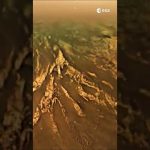
19 years ago, on 25 December 2004, ESA’s Huygens probe was released from the Cassini spacecraft. Huygens continued on to Titan, Saturn’s largest and most interesting moon, descending via parachute and touching-down at 11:30 UTC, 14 January 2005. The descent phase lasted around 2 hours, 27 minutes, with a further 1 hour and 10 minutes of operation on the surface.
This video has been accelerated to 200% speed, showing the descent from an altitude of 62 km at 9:41 UTC to the touchdown.
#stiinta #fizica #science #tehnologie #technology #cristianpresura Measured Paces de la Kevin MacLeod este licențiată în baza unei licențe Creative Commons Attribution 4.0. https://creativecommons.org/licenses/by/4.0/
Is there life beyond Earth? How did life get started on Earth anyway? This season of NASA’s Gravity Assist podcast is about the origins of life on Earth and the search for life elsewhere. Subscribe at https://www.nasa.gov/gravityassist. See all NASA podcasts: www.nasa.gov/podcasts
Hosted by NASA’s Chief Scientist Jim Green, each episode features a conversation with a scientist who has researched some aspect of these questions. We’ll talk about the search for life on Mars, what kind of life might survive on Saturn’s moon Titan, and much more.
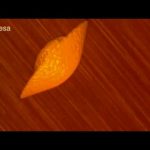
These observations of Phobos and Saturn were taken by the Super Resolution Channel of the High Resolution Stereo Camera on Mars Express. The video comprises 30 separate images acquired during Mars Express orbit 16 346 on 26 November 2016. The slight up and down movement of Saturn and Phobos in these images is caused by the oscillation of the spacecraft’s orientation after completing the turn towards the moon. Phobos can be seen in the foreground, partially illuminated, with Saturn visible as a small ringed dot in the distance. For more information go tohttp://www.esa.int/Our_Activities/Space_Science/Mars_Express/Mars_Express_views_moons_set_against_Saturn_s_rings
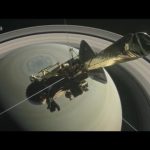
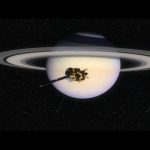
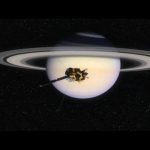
On Sept. 15, our Cassini spacecraft concluded its remarkable mission with a plunge into Saturn’s atmosphere. This was the last of 22 close orbits Cassini made between Saturn and its rings as part of the mission’s Grand Finale. No other spacecraft has ever explored this unique region. Although the spacecraft may be gone after the finale, the enormous amount of data collected about Saturn, its magnetosphere, rings and moons during this last dive is expected to yield new discoveries for decades. Also, Recovering from Irma, New Crew Launches to the Space Station, Successful Orion Chute Test and Shane Kimbrough in Washington!
On Sept. 13, NASA held a news conference from the agency’s Jet Propulsion Laboratory, in Pasadena, California to discuss details of final mission activities for the agency’s Cassini mission to Saturn. On Sept. 15, the Cassini spacecraft will complete its remarkable story of exploration with an intentional plunge into Saturn’s atmosphere, ending its mission after nearly 20 years in space.
Following over a decade of ground-breaking discoveries, Cassini is now approaching its mission end.
With little fuel left to correct the NASA’s spacecraft trajectory, it has been decided to end the mission by plunging it into Saturn’s atmosphere on 15 September 2017. In the process, Cassini will burn up, satisfying planetary protection requirements to avoid possible contamination of any moons of Saturn that could have conditions suitable for life. These include Saturn’s largest moon Titan and Enceladus, which has a liquid ocean under its icy crust.
The grand finale is not only a spectacular way to complete this extraordinary mission, but will also return a bounty of unique scientific data that was not possible to collect during the previous phases of the mission. Cassini has never ventured into the area between Saturn and its rings before, so the new set of orbits is almost like a whole new mission.
These close orbits will provide the highest resolution observations ever achieved of the inner rings and the planet’s clouds. The orbits will also give the chance to examine in situ the material in the rings and plasma environment of Saturn. It will also probe the planet’s magnetic field at close distances.
This video explains Cassini ‘s final operations, what the Cassini-Huygens mission has taught us about Saturn, the potential for life on its moons and the promise of more science to come.
Cassini-Huygens was launched on 15 October 1997 from Cape Canaveral, Florida.After nearly 13 years in orbit around Saturn, the international Cassini-Huygens mission is going through its final chapter: NASA’s Cassini spacecraft is performing a series of daring dives between the planet and its rings, leading to a dramatic final plunge into Saturn’s atmosphere on 15 September.
On 14 January 2005, ESA’s Huygens probe, which hitched a ride to the Saturn system attached to Cassini during the seven-year voyage, entered the history books by descending to the surface of Titan, Saturn’s largest moon. This was humanity’s first successful attempt to land a probe on another world in the outer Solar System.
Huygens made a 21-day solo cruise toward the haze-shrouded moon. Plunging into Titan’s atmosphere, the probe touched down safely on Titan’s frozen surface.
Huygens provided a stream of data representing a unique treasure trove of in situ measurements from the planet-sized satellite which scientists are still mining today.
This video recalls the ‘one of a kind’ journey of Huygens.
Right now the Cassini spacecraft is flying between the rings of Saturn and the planet itself, a daring trajectory chosen to conclude a unique exploration mission.
To find out what that orbit means, and to look back at some of Cassini-Huygens finest moments, we met up with key members of the science team in the UK for this edition of Space.
Die Cassini-Huygens-Mission am Saturn startete vor zwanzig Jahren, 2004 schwenkte die Doppel-Sonde in ihre Umlaufbahn um den Saturn ein. Im Dezember 2004 koppelte der Lander Huygens von der Cassini-Sonde ab und setzte im Januar 2005 auf dem Titan auf. Die Mission entdeckte unter anderem ein Eismeer auf dem Saturn-Mond Enceladus und fliegt jetzt zwischen den Ringen des Saturn und dem Planeten selbst. Im September soll Cassini mangels Treibstoffvorräten in der Saturn-Atmosphäre verglühen.
Die Saturn-Spezialisten des Mullard Space Science Laboratory (MSSL) in Südengland verfolgen die Mission und erforschen das Sonnensystem des pittoresken Planeten. Die Cassini-Sonde wird gerade auf ihre finale Umlaufbahn gebracht, um nächstmögliche Eindrücke vom Saturn zu gewinnen.
During a NASA science briefing on April 13, representatives from the agency discussed new results about ocean worlds in our solar system based on data gathered by NASA’s Cassini spacecraft and the Hubble Space Telescope.
The two veteran missions are providing tantalizing new details about icy, ocean-bearing moons of Jupiter and Saturn, further enhancing the scientific interest of these and other “ocean worlds” in our solar system and beyond.
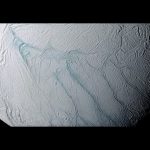
New research from Cassini indicates that hydrogen gas, which could potentially provide a chemical energy source for life, is pouring into the ocean of Saturn’s icy moon Enceladus from hydrothermal vents in the seafloor. The Cassini spacecraft detected the hydrogen in the plume of gas and icy material spraying from Enceladus during its deepest dive through the plume on Oct. 28, 2015.This means that ocean microbes — if any exist there — could use the hydrogen to produce energy
NASA’s Hubble Space Telescope saw a probable plume of material erupting from the moon’s surface on 2016, at the same location where Hubble saw evidence of a plume in 2014. These images bolster evidence that the Europa plumes could be a real phenomenon, flaring up intermittently in the same region on the moon’s surface.
Both Cassini and Hubble investigations are laying the groundwork for NASA’s Europa Clipper mission, which is being planned for launch in the 2020s.
NASA held a news conference April 4 at the Jet Propulsion Laboratory, with participation from NASA headquarters, to preview the final phase of the Cassini spacecraft’s mission to Saturn. On April 26, Cassini will begin its “Grand Finale” – a series of deep dives between the planet and its rings. No other mission has ever explored this unique region that is so close to the planet. Cassini will make 22 orbits that swoop between the rings and the planet before ending its 20-year mission on Sept. 15, with a final plunge into Saturn. The mission team hopes to gain powerful insights into the planet’s internal structure and the origins of the rings, obtain the first-ever sampling of Saturn’s atmosphere and particles coming from the main rings, and capture the closest-ever views of Saturn’s clouds and inner rings. Also, Next Space Station Crew Travels to Launch Site, New Target Launch Date for Orbital ATK Mission to ISS, Lightfoot Visits Industry Partners, Human Exploration Rover Challenge, and John Glenn Interred at Arlington National Cemetery.
NASA’s Orbiting Carbon Observatory-2 mission is underway. Launched from California’s Vandenberg Air Force Base, OCO-2 will help track our impact on the amount of carbon dioxide in the atmosphere and help us better understand the various human-made and natural sources of CO-2. This is one of five Earth-observing missions scheduled in 2014 — the most Earth-focused missions launched in a single year, in more than a decade. Also, Saucer-shaped vehicle tested, Cygnus Orb-2 launch update, Space Launch System model tests and 10 years exploring Saturn.
Há algumas décadas, para observar Saturno, os cientistas recorriam a telescópios. Hoje em dia, os segredos de Saturno e da sua misteriosa lua Titã são revelados graças aos dados e imagens enviados pela missão Cassini-Huygens. Saturno nunca antes visto, é o tema de Space esta semana.
Hasta hace algunas décadas para ver Saturno la ciencia tenía que mirar a través de telescópios. Hoy Saturno y su misteriosa luna Titán son nuevos conocidos gracias a la misión Cassini-Huygens que desde 2004 envía imágenes y datos. Una aventura que está cambiando la percepción que hasta ahora teníamos de nuestro Sistema Solar.
Noch vor einigen Jahrzehnten konnte man den Saturn nur mit dem Teleskop beobachten. Heute lüftet die Cassini-Huygens-Mission mit ihren Bildern die Geheimnisse des Saturnsystems und liefert Antworten auf entscheidende wissenschaftliche Fragen.
After an epic space journey, the European Huygens probe landed on Saturn’s moon Titan, a mysterious satellite that has perplexed astronomers for decades. On 14 January 2005, Huygens made the farthest touchdown of any human-built object sent to land on another world.