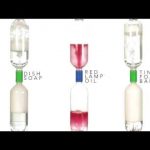
Our science guy, Steve Spangler, is an expert at making science fun, but you get an extra dose of fun when the science is ooey, gooey and slimy. Steve is with Kim today to uncover the real science behind making the perfect batch of slime.
Steve Spangler is a celebrity teacher, science toy designer, speaker, author and an Emmy award-winning television personality. Spangler is probably best known for his Mentos and Diet Coke geyser experiment that went viral in. Spangler is the founder of www.SteveSpanglerScience.com, a Denver-based company specializing in the creation of science toys, classroom science demonstrations, teacher resources and home for Spangler’s popular science experiment archive and video collection. Spangler is a frequent guest on the Ellen DeGeneres Show and Denver 9 News where he takes classroom science experiments to the extreme. For teachers, parents or DIY Science ideas – check out other sources of learning:
M&Ms have the slogan of melting in your mouth, but not in your hands. You wanna know something cool? The special melting property is totally scientific. The results are an amazing phenomenon that we call Floating Letters.
Hard candies are known for their bright colors, delicious tastes, and, well, having a ton of sugar. While having a handful of candy every once in a while is definitely a good thing, we like conducting experiments with them! We especially love Gobstoppers. They have layers of colors that, when they dissolve into water, do something very peculiar…
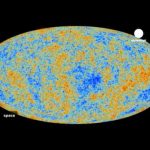
Scientists have traced a unique new map of the first light of the universe, and raised profound questions about the Big Bang.The image of the cosmic microwave background they have released was taken by ESA’s Planck satellite, and its results could have a significant impact on the field of cosmology.
“It turns that most of this image, most of this map, fits beautifully our very simple model. At the same time we find some strange things, and this is where it starts to get interesting, because we see some signs of things that do not fit,” explains ESA’s Planck Project Scientist Jan Tauber.
“Roughly speaking the things that we are finding that are not as we expect are features that are across the whole sky. When you look only at the large features on this map you find that that our best fitting model, our best theory has a problem fitting the data, there is a lack of signal that we would expect to see,” he says.
The news that the early universe is not quite as was thought has left the greatest minds in cosmology spinning with excitement.
George Efstathiou, Professor of Astrophysics, University of Cambridge, is a key member of the Planck Science Team.
“The idea that you can actually experimentally test what happened at the Big Bang still amazes me,” he says.
The Big Bang theory remains intact of course, but the concept of inflation could be put to test by the Planck data.
“We see these strange patterns that are not expected in inflationary theory, the simplest inflationary theories,” explains Efstathiou.
“So there’s a real possibility that we have an incomplete picture. It may be that we have been fooled, that inflation didn’t happen. It’s perfectly possible that there was some phase of the universe before the Big Bang actually happened where you can track the history of the universe to a pre-Big Bang period.”
The Planck mission could test ideas about how the early universe was formed.The puzzle is that at small scales the data fits the theoretical model very nicely, but at larger scales the signal from the cosmic microwave background is much weaker than expected.
Efstathiou is looking for answers: “Can we find a theoretical explanation that links together the different phenomena that we have seen, the different little discrepancies, with inflationary theory? That’s where there’s the potential for a paradigm shift, because at the moment there’s no obvious theoretical explanation that links together these anomalies that we have seen. But if you found a theory that links phenomena that were previously unrelated, then that’s a pointer to new physics.”
It appears that the audacious Planck mission really will shed new light on the dawn of time.
What a great start to 2013! From Pop Rocks, mystery liquids, folding eggs and even a VIRAL video showing how to remove iron from your breakfast cereal, to newspaper trees, dirty cell phones, and instantly freezing water. Hope you enjoyed this month as much as we did!
Don’t miss the season two premier of The Spangler Effect on March 6, 2013!
NASA’s newest Mars rover has found evidence that a stream once ran vigorously across the area on the Red Planet where the rover is now driving. The finding is a different type of evidence for water on Mars than ever found before. Scientists are studying Curiosity’s images of rocks containing ancient streambed gravels. The sizes and shapes of stones cemented into a layer of conglomerate rock are clues to the speed and distance of a long-ago stream’s flow.
A breathtaking collection of photos taken by ESA Astronaut Paolo Nespoli during his 6-month MagISStra mission on the International Space Station 25 December 2010 – 24 May 2011.
Music: Dream Elements by Green Sun licensed by Ambient Music Garden.
Video produced for Lufthansa inflight entertainment (released June 2011).
An early look at artificial Intelligence. Guests includes Edward Feigenbaum of Stanford University, Nils Nilsson of the AI Center at SRI International, Tom Kehler of Intellegenetics, Herb Lechner of SRI, and John McCarthy of Stanford. Featured demonstrations include Inferential Knowledge Engineering and the programming language LISP. Originally broadcast in 1984.
Q. What is artificial intelligence?
A. It is the science and engineering of making intelligent machines, especially intelligent computer programs. It is related to the similar task of using computers to understand human intelligence, but AI does not have to confine itself to methods that are biologically observable.
Q. Yes, but what is intelligence?
A. Intelligence is the computational part of the ability to achieve goals in the world. Varying kinds and degrees of intelligence occur in people, many animals and some machines.
Q. Isn’t there a solid definition of intelligence that doesn’t depend on relating it to human intelligence?
A. Not yet. The problem is that we cannot yet characterize in general what kinds of computational procedures we want to call intelligent. We understand some of the mechanisms of intelligence and not others.
Q. Is intelligence a single thing so that one can ask a yes or no question “Is this machine intelligent or not?”?
A. No. Intelligence involves mechanisms, and AI research has discovered how to make computers carry out some of them and not others. If doing a task requires only mechanisms that are well understood today, computer programs can give very impressive performances on these tasks. Such programs should be considered “somewhat intelligent”.
Q. Isn’t AI about simulating human intelligence?
A. Sometimes but not always or even usually. On the one hand, we can learn something about how to make machines solve problems by observing other people or just by observing our own methods. On the other hand, most work in AI involves studying the problems the world presents to intelligence rather than studying people or animals. AI researchers are free to use methods that are not observed in people or that involve much more computing than people can do.
Q. What about IQ? Do computer programs have IQs?
A. No. IQ is based on the rates at which intelligence develops in children. It is the ratio of the age at which a child normally makes a certain score to the child’s age. The scale is extended to adults in a suitable way. IQ correlates well with various measures of success or failure in life, but making computers that can score high on IQ tests would be weakly correlated with their usefulness. For example, the ability of a child to repeat back a long sequence of digits correlates well with other intellectual abilities, perhaps because it measures how much information the child can compute with at once. However, “digit span” is trivial for even extremely limited computers.
Hosted by Stewart Cheifet, Computer Chronicles was the world’s most popular television program on personal technology during the height of the personal computer revolution. It was broadcast for twenty years from 1983 – 2002. The program was seen on more than 300 television stations in the United States and in over 100 countries worldwide, with translations into French, Spanish, Chinese, and Arabic. The series had a weekly television broadcast audience of over two million viewers.
Many of the series programs are distributed on video to corporations and educational institutions for use in computer training. Computer Chronicles program segments have also been bundled with various computer text books by major publishers.
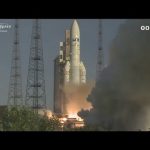
Thursday 2 August 2012 marked the 50th successful Ariane flight in a row: an Ariane 5 was launched from Europe’s Spaceport in French Guiana to perform a dual deployment of two telecommunications satellites, Intelsat 20 and Hylas-2, into their planned transfer orbits.
Lift off of flight VA208 took place at 22:54 CEST; 17:54 French Guiana time. This was Ariane 5’s fourth launch of 2012, continuing a line of launch successes unbroken since 2003.
The Mars Science Laboratory, the hardest mission ever attempted in planetary robotic exploration is about to prove its mettle with the landing of its Curiosity rover on the Red Planet. Live coverage begins at 11:30 p.m. Eastern on NASA TV.
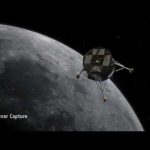
Lunar Lander mission, from launch to landing and exploring the Moon.
Lunar Lander is a robotic explorer that will demonstrate key European technologies and conduct science experiments.
The mission is a forerunner to future human and robotic exploration of the Moon and Mars. It will establish European expertise to allow strong international partnerships in exploration.
This movie shows a sequence of images taken as ESA’s Rosetta spacecraft flew past the main-belt asteroid (21) Lutetia, during the spacecraft’s 10-year journey towards comet 67P/Churyumov-Gerasimenko.
The flyby took place on 10 July 2010, when Rosetta flew past the asteroid at a distance of 3168.2 km and at a relative speed of 15 km/s. The first image shown in the sequence was taken nine and a half hours before closest approach, from a distance of 500 000 km to Lutetia; the last image was taken six minutes after closest approach, at 6300 km from the asteroid.
The OSIRIS camera on board Rosetta has surveyed the part of Lutetia that was visible during the flyby – about half of its entire surface, mostly coinciding with the asteroid’s northern hemisphere. These unique, close-up images have allowed scientists to study the asteroid’s surface morphology, composition and other properties in unprecedented detail.
During a NASA Television Science briefing, scientists discussed the findings of the first global analysis of the giant asteroid Vesta by NASA’s Dawn spacecraft. The Dawn mission has confirmed Vesta’s status as a special fossil of the early solar system and revealed a more varied, diverse world than originally thought. Dawn has shown Vesta is the only known intact, layered planetary building block with an iron core surviving from the earliest days of the solar system. It therefore more closely resembles a small planet or Earth’s moon, not another asteroid.
Read the full experiment at http://www.stevespanglerscience.com/content/experiment/squeeze-bottle-rocket It’s easy to turn a juice bottle into a rocket launcher. How? Grab a few straws of different sizes, some modeling clay, and an empty juice bottle to make a launcher that will send the straw rocket soaring across the room. Don’t worry, you aren’t just playing. You’ll learn something about Newton’s Third Law of Motion at the same time.
On this episode of The Spangler Effect, Steve shares a few of his favorite science pranks to pull on April Fools Day! With a magnet, baby diaper, spray can and a Starbucks cup, you too can have your own fun on April 1st!
Read the full experiment at http://www.stevespanglerscience.com/content/experiment/build-a-light-bulb-circuit-science When you are conducting experiments and demonstrations using electricity, you’ll use the science of circuits. Amazing things are possible with circuits including alarms, radios, and lights. In the Build a Light Bulb experiment, you’ll use household items to construct a complete circuit that results in a homemade light bulb.
Read the full experiment at http://www.stevespanglerscience.com/experiment/microwave-lightbulb
We love to see what microwaves do to common household items. We’ve shrunk potato chip bags and turned Ivory Soap into a fluffy soap souffle. What more could we want to do? We heard that it’s possible to actually make a lightbulb light-up if you do it right. And sure enough, we figured it out.
Learn more at http://www.stevespanglerscience.com/experiment/tornado-in-a-bottle How long does it take to empty a soda bottle full of water? You’ll amaze your dinner guests and explore some of the scientific properties of air and water when you learn how to empty a full bottle of water in just a few seconds!
Learn more at http://www.stevespanglerscience.com/experiment/cloud-in-a-bottle-experiment Have you ever wondered how clouds form? Moist air rises in the atmosphere, cools, and water droplets form into clouds. Making your own cloud is a popular experiment in many science books, but it can be a little tricky. Sometimes the results are a little hard to see, but practice always makes perfect.
Learn more at http://www.stevespanglerscience.com/content/experiment/colorful-convection-currents
Convection is one of those words that we often hear used, but we may not completely understand its meaning. Weather forecasters show how convection currents are formed when warm and cold air masses meet in the atmosphere. Convection currents are responsible for warm water currents that occur in oceans. This activity demonstrates convection currents in a very colorful fashion.
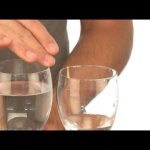
Water in rivers, in a glass, or falling from clouds obeys gravity. It’s going to fall towards the ground because of the physical pull of the earth. But, what if we told you that you could turn a glass of water completely upside down and the water wouldn’t fall to the floor? That’s what happens in the Anti-Gravity Water demonstration. It’s a simple experiment that dramatically demonstrates the amazing physical properties of water.
Steve Spangler is a celebrity teacher, science toy designer, speaker, author and an Emmy award-winning television personality. Spangler is probably best known for his Mentos and Diet Coke geyser experiment that went viral in. Spangler is the founder of www.SteveSpanglerScience.com, a Denver-based company specializing in the creation of science toys, classroom science demonstrations, teacher resources and home for Spangler’s popular science experiment archive and video collection. Spangler is a frequent guest on the Ellen DeGeneres Show and Denver 9 News where he takes classroom science experiments to the extreme. For teachers, parents or DIY Science ideas – check out other sources of learning:
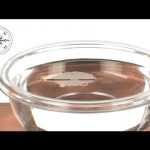
Learn more at http://www.stevespanglerscience.com/experiment/homemade-compass There is one tool that is sure to give you guidance if you get lost, a compass. But what could you do if you forgot to pack this useful tool in your survival kit? Easy! Float a needle on top of a standing pool of water. Well, there’s a bit more to creating a compass out of a needle and some water, but you can do it right at home with just a few tools.
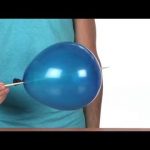
Learn more at http://www.stevespanglerscience.com/experiment/skewer-through-balloon Some things in this world just don’t mix – dogs and cats, oil and water, needles and balloons. Everyone knows that a balloon’s worst fear is a sharp object…even a sharpened, wooden cooking skewer. With a little scientific knowledge about polymers you’ll be able to perform a seemingly impossible task… pierce a balloon with a wooden skewer without popping it. Suddenly piercing takes on a whole new meaning!
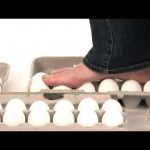
Learn more at http://www.stevespanglerscience.com/experiment/walking-on-eggshells
The phrase “walking on eggshells” is an idiom that is often used to describe a situation in which people must tread lightly around a sensitive topic for fear of offending someone or creating a volatile situation. Literally walking on eggshells would require exceptional caution, incredible skill, and a sense of self-control that would be nothing short of amazing. But what if eggs were really much stronger than most of us imagine? What if nature’s design of the incredible edible egg was so perfect that the thin, white outer coating of an egg was strong enough to withstand the weight of your body? Wake the kids! Phone the neighbors! It’s time for the Walking on Eggshells challenge.
Learn more at http://www.stevespanglerscience.com/experiment/how-to-make-a-newspaper-tree Newspapers are made from trees and trees grow… so it only makes sense that you should be able to grow a newspaper tree, right? What? You have doubts? Roll several sheets of newspaper into a tube, tear the tube in a few spots, and an eight foot tall tree suddenly appears!
Learn more at http://www.stevespanglerscience.com/experiment/secret-message-heat-friction-ink Give that special someone a note that requires the heat of a romantic candle to decode the message. You won’t believe what the ink in this pen will do. Your message can appear or vanish on command… and most people don’t even know that the ink works this way.
ESA has updated its application for iPhone and iPad.
With the launch of the ESA App V2, users can see ESA’s latest satellite imagery from Envisat in near-real time, complementing the latest news and discoveries in space exploration and Earth observation.
Making full use of the iPhone and iPad touch features, ESA App V2 puts videos, images, facts and figures, ESA’s Twitter feeds, YouTube links and other information in a convenient mobile package.
Download ESA App V2 here: http://itunes.apple.com/us/app/esa-european-space-agency/id441518639?mt=8
Learn more at http://www.stevespanglerscience.com/content/experiment/magic-crystal-snowflake
Bringing real snowflakes inside individually is next to impossible. So, to work around this conundrum, we’ve come up with the Magic Crystal Snowflake. This special snowflake is just a beautiful and unique as a snowflake from the sky, but it won’t melt! The Magic Crystal Snowflake uses some fun hands-on chemistry and makes a perfect holiday experiment.
Learn more at http://www.stevespanglerscience.com/lab/experiments/magic-crystal-tree/ Impress your friends by creating a colorful Christmas tree out of salt crystals, cardboard, and a few other household items. Within a day, you’ll have a colorful snow-covered tree that seemed to magically sprout from nothing!
Learn more at http://www.stevespanglerscience.com/experiment/pressure-cooker-shrinking-cup The pressure cooker is Mom’s secret weapon when it comes to making that savory stew in less than an hour. This amazing device is also the kitchen scientist’s favorite tool for subjecting ordinary things to high pressure to see what happens. For this experiment, our subject is a Styrofoam cup. Under extremely high pressure, will the cup expand, contract, melt or turn into a cute little puppy?
Cause a packet of ketchup to rise and fall on command in a bottle of water. People will think that you have the ability to move objects with your mind! Telekinesis? No, just cool science!
Steve Spangler is a celebrity teacher, science toy designer, speaker, author and an Emmy award-winning television personality. Spangler is probably best known for his Mentos and Diet Coke geyser experiment that went viral in. Spangler is the founder of www.SteveSpanglerScience.com, a Denver-based company specializing in the creation of science toys, classroom science demonstrations, teacher resources and home for Spangler’s popular science experiment archive and video collection. Spangler is a frequent guest on the Ellen DeGeneres Show and Denver 9 News where he takes classroom science experiments to the extreme. For teachers, parents or DIY Science ideas – check out other sources of learning:
Learn more at http://www.stevespanglerscience.com/lab/experiments/straw-through-a-potato/ Sometimes you have to stop and ask yourself, “Who comes up with this stuff?” No one ever uses a straw to eat a potato, but science nerds seem to like to find ways to poke straws through potatoes. There must be a deeper meaning… and there is!
Learn more at http://www.stevespanglerscience.com/experiment/move-a-match-with-your-mind The ability to move an object with your mind is called telekinesis. Magicians and psychics claim to have this amazing ability… and you will too once you’ve learned the science secret behind the Sympathetic Match trick. If you like to annoy all of your dinner guests by running your finger along the rim of a wine glass to make it sing, you’ll soon have your friends convinced that you can move objects with your mind!
This is a kid-safe version of the popular Elephant’s Toothpaste demonstration using common household materials. A child with a great adult helper can safely do this activity and the results are wonderful.
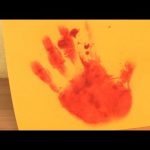
The term goldenrod is typically used to describe a color of paper – golden yellow. However, our goldenrod paper contains a special dye that turns bright red when exposed to solutions that are basic, like ammonia water or washing soda. We’ll show you how to use this special color-changing paper to develop a hidden message and make dripping, bleeding paper… complete with your own handprint marked in “blood.” It’s a great acid/base lesson for the Halloween season.
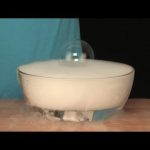
Exploration into the fascinating world of dry ice is never boring, and the same goes when you add in some bubbles! We’ve filled bubbles with dry ice smoke in our Boo Bubbles experiment, but did you know that bubbles will float on dry ice smoke like it was water? We’ll show you how to do it and, of course, teach you the amazing science behind this very cool trick.
For years, Steve has taught people how to shrink and grow heads without actually, you know, permanently changing the size of their head. In addition to being temporary, it’s also an extremely fun optical illusion. In mere moments, you’ll go from staring at a black and white spiral, to a state of shock with this stunning illusion.