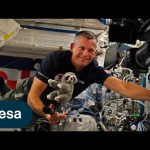
As we look ahead to long-term space missions, one of the big challenges is figuring out how to provide healthy and sustainable food for astronauts. To tackle this, ESA supported two research teams to investigate the possibility of cultivating meat in space.
An enormous burst of gamma rays was detected by our Integral space telescope, in October 2022. Such disturbances are usually associated with energetic particle events on the Sun but this one was the result of an exploding star almost two billion light-years away.
The blast caused a significant disturbance to our planet’s outer layer, the ionosphere. During the 800 seconds that the gamma rays were impacting, the burst delivered enough energy to activate lightning detectors in India. Instruments in Germany picked up signs that Earth’s ionosphere was disturbed for several hours by the blast.
The blast even triggered instruments generally reserved for studying the immense explosions in the Sun’s atmosphere known as solar flares.
Such an effect has been speculated to be a possible cause of some of the mass extinction events known to have taken place on Earth in the past. But to investigate the idea, we will need a lot more data.
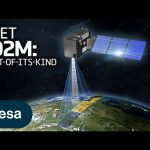
The Copernicus Anthropogenic Carbon Dioxide Monitoring (CO2M) mission will be the first satellite mission to measure how much carbon dioxide is released into the atmosphere through human activity.
CO2M isn’t just a mission; it’s a crucial step in our commitment to understanding and mitigating climate change. It will offer unprecedented precision in monitoring carbon dioxide emissions from the combustion of fossil fuel at national and regional scales.
Its data will provide the EU with a unique and independent source of information to assess the effectiveness of policy measures and to track their impact towards decarbonising Europe ahead of the next Global Stocktake set to place in 2028.
The video features interviews with Valerie Fernandez, CO2M Mission Project Manager, Yannig Durand, CO2M Payload Manager and Yasjka Meijer, CO2M Mission Scientist.
We are Europe’s gateway to space. Our mission is to shape the development of Europe’s space capability and ensure that investment in space continues to deliver benefits to the citizens of Europe and the world. Check out https://www.esa.int/ to get up to speed on everything space related.
Don’t miss the live conversation between ESA astronaut and commander of the International Space Station (ISS) Andreas Mogensen and the 2023 Nobel Prize laureates Ferenc Krausz (in physics) and Moungi Bawendi (in chemistry). The event will take place at the Nobel Prize Museum in Oslo which will be connected to the ISS. Andreas will show a Nobel Prize he brought with him to the Space Station.
★ Subscribe: http://bit.ly/ESAsubscribe and click twice on the bell button to receive our notifications.
We are Europe’s gateway to space. Our mission is to shape the development of Europe’s space capability and ensure that investment in space continues to deliver benefits to the citizens of Europe and the world. Check out https://www.esa.int/ to get up to speed on everything space related.
An educational in-flight call with ESA astronaut Andreas Mogensen on board the International Space Station for teachers and students in Europe, connecting live with local events organised by ESERO Denmark, ESERO Finland, ESERO Sweden and ESERO Norway.
★ Subscribe: http://bit.ly/ESAsubscribe and click twice on the bell button to receive our notifications.
We are Europe’s gateway to space. Our mission is to shape the development of Europe’s space capability and ensure that investment in space continues to deliver benefits to the citizens of Europe and the world. Check out https://www.esa.int/ to get up to speed on everything space related.
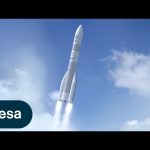
Animation of the first launch of the Ariane 6 rocket with two boosters.
Ariane 6 is an all-new design, created to succeed Ariane 5 as Europe’s heavy-lift launch system. With Ariane 6’s upper stage and its reignitable Vinci engine, Europe’s launch capability will be tailored to the needs of multiple payloads, for example to orbit satellite constellations. This autonomous capability to reach Earth orbit and deep space supports Europe’s navigation, Earth observation, scientific and security programmes. Ongoing development of Europe’s space transportation capabilities is made possible by the sustained dedication of thousands of talented people working in ESA’s 22 Member States.
At over 60 metres tall, Ariane 6 will weigh almost 900 tonnes when launched with a full payload – roughly equivalent to one and a half Airbus A380 passenger aircraft.
Vinci, the upper stage engine of Ariane 6 fed by liquid hydrogen and oxygen, can be stopped and restarted multiple times – to place satellites into different orbits and then de-orbit the upper stage, so it is not left behind as hazardous debris in space.
For the development of Ariane 6, ESA is working with an industrial network of several hundred companies in 13 European countries, led by prime contractor ArianeGroup.
France’s space agency, CNES, is preparing the Ariane 6 launch facilities at Europe’s Spaceport in French Guiana.
Credits: ESA – European Space Agency
★ Subscribe: http://bit.ly/ESAsubscribe and click twice on the bell button to receive our notifications.
We are Europe’s gateway to space. Our mission is to shape the development of Europe’s space capability and ensure that investment in space continues to deliver benefits to the citizens of Europe and the world. Check out https://www.esa.int/ to get up to speed on everything space related.
On 17 November 2023, our Juice spacecraft carried out one of the largest and most important manoeuvres in its eight-year journey to Jupiter.
Why does it take so long? Well, the short answer is that its less to do with the distance between Earth and Jupiter and more to do with fighting the Sun’s massive gravitational pull as you venture to the outer Solar System.
If spacecraft like Juice had to carry all the fuel needed to battle the Sun’s gravity alone, they’d be nothing more than colossal tanks. Instead, they use ‘gravity-assist’ tricks – they swing by planets to receive a boost on the way.
Using its main engine, Juice changed its orbit around the Sun to put itself on the correct trajectory for next summer’s Earth-Moon double gravity assist – the first of its kind.
The manoeuvre lasted 43 minutes and burned almost 10% of the spacecraft’s entire fuel reserve. It’s the first part of a two-part manoeuvre that could mark the final time that Juice’s main engine is used until its arrival in the Jupiter system in 2031.
On 28 November 1983, the first European-built Spacelab was launched from @NASAKennedy aboard Space Shuttle Columbia.
Also on board was Ulf Merbold, who became our first astronaut in space. The 10-day Spacelab-1 mission marked our entry into human spaceflight activities.
Under a cooperation agreement with @NASA, we were to build a modular research laboratory that would fit inside the Shuttle’s cargo bay.
In 17 years, European Spacelab equipment flew on 36 missions. The two Spacelab modules eventually made 16 flights with five different Shuttle Orbiters.
Many of Spacelab’s features live on in space hardware that is flying today. Europe’s Columbus laboratory on the Station evolved from Spacelab.
★ Subscribe: http://bit.ly/ESAsubscribe and click twice on the bell button to receive our notifications.
We are Europe’s gateway to space. Our mission is to shape the development of Europe’s space capability and ensure that investment in space continues to deliver benefits to the citizens of Europe and the world. Check out https://www.esa.int/ to get up to speed on everything space related.
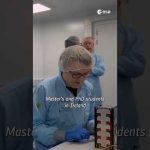
Have you ever dreamt of flying your own satellite?
A team of university students from @universitycollegedublin have done just that!
Meet EIRSAT-1, the Educational Irish Research Satellite, Ireland’s first ever satellite to go to space.
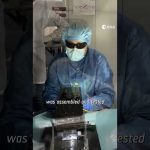
The journey wasn’t easy, but over six years, the students worked with our experts and in our state-of-the-art labs as part of our Academy’s Fly Your Satellite! programme to overcome challenges. They even set up their own clean room and mission control at the University.
EIRSAT-1 is scheduled to launch at the end of November. Stay tuned to learn more about Ireland’s historic space moment!
🎥 ESA – European Space Agency
★ Subscribe: http://bit.ly/ESAsubscribe and click twice on the bell button to receive our notifications.
We are Europe’s gateway to space. Our mission is to shape the development of Europe’s space capability and ensure that investment in space continues to deliver benefits to the citizens of Europe and the world. Check out https://www.esa.int/ to get up to speed on everything space related.
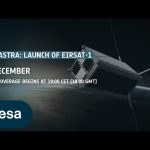
Watch live as Ireland goes to space, for the first time, with the launch of EIRSAT-1. Built by students at @universitycollegedublin under the guidance of ESA’s Education Office, EIRSAT-1 is a 2-unit CubeSat carrying three experiments, including a novel gamma ray detector that will study some of the most luminous explosions in the universe. Irish broadcaster Rick O’Shea, with guests from ESA and the EIRSAT-1 team, will take viewers through the mission’s development and major launch milestones including liftoff, separation and acquisition of signal, from outside the EIRSAT-1 Mission Control Room in Dublin. Níl aon satailít mar do shatailít féin! [There’s no satellite like your own satellite!]
We are Europe’s gateway to space. Our mission is to shape the development of Europe’s space capability and ensure that investment in space continues to deliver benefits to the citizens of Europe and the world. Check out https://www.esa.int/ to get up to speed on everything space related.
Have you ever dreamt of flying your own satellite?
A team of university students from @universitycollegedublin have done just that!
Meet EIRSAT-1, the Educational Irish Research Satellite, Ireland’s first ever satellite to go to space.
The journey wasn’t easy, but over six years, the students worked with our experts and in our state-of-the-art labs as part of our Academy’s Fly Your Satellite! programme to overcome challenges. They even set up their own clean room and mission control at the University.
EIRSAT-1 is scheduled to launch at the end of November. Stay tuned to learn more about Ireland’s historic space moment!
🎥 ESA – European Space Agency
★ Subscribe: http://bit.ly/ESAsubscribe and click twice on the bell button to receive our notifications.
We are Europe’s gateway to space. Our mission is to shape the development of Europe’s space capability and ensure that investment in space continues to deliver benefits to the citizens of Europe and the world. Check out https://www.esa.int/ to get up to speed on everything space related.
Missions to Mars have made many exciting discoveries that have transformed our understanding of the planet, but the next step is to bring samples to Earth for detailed analysis in sophisticated laboratories.
Methane is the second most important greenhouse gas contributor to climate change after carbon dioxide. Curbing methane emissions could deliver immediate and long-lasting benefits for the climate, seeing as the gas only lingers in the atmosphere for a relatively short time. Satellites have a really important role to play in reducing greenhouse gas emissions. The Tropomi instrument onboard the Copernicus Sentinel-5P satellite is the only instrument that maps global methane concentrations every single day. This lets scientists detect hotspots for large methane sources around the world – allowing us to address the consequences of methane emissions on our climate and environment.
Credits: ESA – European Space Agency
★ Subscribe: http://bit.ly/ESAsubscribe and click twice on the bell button to receive our notifications.
We are Europe’s gateway to space. Our mission is to shape the development of Europe’s space capability and ensure that investment in space continues to deliver benefits to the citizens of Europe and the world. Check out https://www.esa.int/ to get up to speed on everything space related.
ESA is releasing the first full-colour images of the cosmos captured by its recently launched space telescope Euclid. Follow live a broadcast of the reveal on Tuesday 7 November at 13:15 GMT / 14:15 CET.
Never before has a telescope been able to create such razor-sharp astronomical images across such a large patch of the sky. Five images show that the telescope is ready for its mission to create the most extensive 3D map of the Universe yet and uncover some of its hidden secrets.
Credits: ESA – European Space Agency
★ Subscribe: http://bit.ly/ESAsubscribe and click twice on the bell button to receive our notifications.
We are Europe’s gateway to space. Our mission is to shape the development of Europe’s space capability and ensure that investment in space continues to deliver benefits to the citizens of Europe and the world. Check out https://www.esa.int/ to get up to speed on everything space related.
Today, ESA’s Euclid space mission reveals its first full-colour images of the cosmos. Never before has a telescope been able to create such razor-sharp astronomical images across such a large patch of the sky, and looking so far into the distant Universe. These five images illustrate Euclid’s full potential; they show that the telescope is ready to create the most extensive 3D map of the Universe yet, to uncover some of its hidden secrets.
Credits: ESA/Euclid/Euclid Consortium/NASA, image processing by J.-C. Cuillandre (CEA Paris-Saclay), G. Anselmi, CC BY-SA 3.0 IGO
★ Subscribe: http://bit.ly/ESAsubscribe and click twice on the bell button to receive our notifications.
We are Europe’s gateway to space. Our mission is to shape the development of Europe’s space capability and ensure that investment in space continues to deliver benefits to the citizens of Europe and the world. Check out https://www.esa.int/ to get up to speed on everything space related.
There is no point in sending human explorers on long voyages around the solar system if they arrive at their destination in poor physical shape. Long stays in zero gravity are not good for the human body.
We already know that astronauts lose bone mass at around 1% for every month they are in space; muscles – including heart muscles – atrophy despite hours of exercise; and there are a host of other problems.
Never before has a telescope been able to create such razor-sharp astronomical images across such a large patch of the sky.
On Tuesday 7 November, ESA will release the first full-colour images captured by its recently launched Euclid space telescope. These images form part of the mission’s ‘Early Release Observations’ – where Euclid was tasked with scrutinising a set of celestial targets chosen for their public appeal and scientific value.
The five images are full of cosmic secrets waiting to be revealed. And this is just the beginning. During its six-year mission, Euclid will generate the equivalent of a million DVDs of data. These data will be used to create the biggest ever 3D map of the Universe and uncover the secrets of dark matter and dark energy.
In this video, hear from the experts about how Euclid has reached this milestone. Discover how they felt when they saw the first images, and find out what these images will reveal about the cosmos.
Watch the reveal of the images live through ESA Web TV or YouTube on 7 November, 13:15 GMT / 14:15 CET. At the same time, an ESA press release including all images will be published at esa.int/euclid.
Credits: ESA – European Space Agency Music: Carollyn Eden – 2 Million stars
★ Subscribe: http://bit.ly/ESAsubscribe and click twice on the bell button to receive our notifications.
We are Europe’s gateway to space. Our mission is to shape the development of Europe’s space capability and ensure that investment in space continues to deliver benefits to the citizens of Europe and the world. Check out https://www.esa.int/ to get up to speed on everything space related.
ESA’s Euclid mission is on a quest to unveil the nature of two elusive ‘dark’ entities. As the renowned theoretical physicist Stephen Hawking remarked in 2013, “The missing link in cosmology is the nature of dark matter and dark energy”.
During the last 70 years, scientists have made enormous progress in understanding the very initial phases of the Universe and its evolution to the present day. Thanks to advances in observations and theoretical modelling, a clear picture has emerged of how stars form, and how galaxies grow and interact with each other, coming together to form groups and clusters.
Yet, fundamental mysteries remain. 95% of the Universe appears to be made up of unknown ‘dark’ matter and energy. Dark matter and energy affect the motion and distribution of visible sources but do not emit, reflect or absorb any light. And scientists do not know what these dark entities actually are.
To address this question, Euclid will create a great map of the large-scale structure of the Universe across space and time by observing with unprecedented accuracy billions of galaxies out to 10 billion light-years. This is not easy, and making sure that Euclid is up to the task has required the expertise and dedication of many people over several years of work.
This video captures the journey behind the Euclid mission, from a human and intensely visual perspective. It shows tiny screws, winding cables and shiny surfaces in a whole new light, revealing how each piece comes together to form the space telescope. Be drawn in by awe-inspiring photos of the cosmos, and stay for the seemingly choreographed ballet of teamwork necessary to assemble and test the spacecraft, before being swept away by the emotion of the launch into space.
Euclid’s adventure has begun. With its observations during the coming years, it will help us uncover the missing link in cosmology and open the gate to the ‘dark’ side of the Universe.
Credit: ESA/Studio Redgrove CC BY-SA 3.0 IGO
★ Subscribe: http://bit.ly/ESAsubscribe and click twice on the bell button to receive our notifications.
We are Europe’s gateway to space. Our mission is to shape the development of Europe’s space capability and ensure that investment in space continues to deliver benefits to the citizens of Europe and the world. Check out https://www.esa.int/ to get up to speed on everything space related.
The giant planet shines bright in the night sky this week as it reaches opposition on Thursday (2 November.)
This means it is at its biggest when seen from Earth, and spends much of the night above the horizon – so it’s the perfect time to observe Jupiter yourself!
If you don’t have a telescope handy, don’t worry. You will be able to spot the planet with just your eyes. Look for a bright orange star-like dot just above the eastern horizon that is not twinkling. This is our big friendly giant! You can also use a stargazing app to help you find the planet.
Through a pair of binoculars, Jupiter will look like a white disk. Peer closely and you will see a line of three or four tiny white dots. These dots are Jupiter’s largest moons: Ganymede, Callisto, Io and Europa. These will soon be visited by our Jupiter Icy Moons Explorer, or Juice for short.
Use a telescope if you’re curious to see Jupiter’s famous red spot and brown bands.
Try to find a clear sky this week and say… hello Jupiter!
Humans are adaptable beings. Wear glasses that turn your view of the world upside-down and within two weeks your brain will have adapted to the topsy-turvy world.
Researchers suspect that astronauts’ brains adapt to living in weightlessness by using previously untapped links between neurons. As the astronauts learn to float around in their spacecraft, left–right and up–down become second nature as these neuronal connections are activated.
To confirm this theory, up to 16 astronauts will be put through advanced Magnetic Resonance Imaging (MRI) scanners before and after their flights to study any changes in their brain structure. A control group on ground will undergo the same scans for further comparison.
The research is providing scientists on Earth clues where to look in the brains of people who suffer from disorders based on previous traumatic experiences such as vertigo.
On Saturday 7 and Sunday 8 October 2023, the European Space Agency opened the doors to the European Space Research and Technology Centre, ESTEC, in the Netherlands. Where science meets science fiction, the theme of this year’s open day was ‘Science Fiction Gets Real’, highlighting how science fiction has inspired scientists and engineers to join ESA, and turn once imaginary concepts into science fact. The single largest ESA establishment invited the public to meet astronauts, view spacecraft – including a rare chance to view ESA’s asteroid mission Hera as it undergoes testing – and peer behind the scenes of Europe’s space adventure, along with a full schedule of events and talks from Space Rocks, celebrating the art and culture of science and space.
0:30 – NL Space Tent, showcasing the Netherlands in space, organised by the Netherlands Space Office, NSO 1:00 – ESA Earth Observation Stand in the Rainbow Corridor 1:08 – Dutch ESA astronaut André Kuipers takes to the Space Rocks stage to announce that the annual Association of Space Explorers ASC Planetary Congress will take place at ESTEC in 2024 1:21 – Spanish ESA astronaut Pedro Duque joins the Mayor of Noordwijk Wendy Verkeij; ESA Director of Technology, Engineering and Quality and Head of ESTEC Dietmar Pilz; ESA Director General Josef Aschbacher; NSO Director Harm van de Wetering; a Moonshots NL 24 student, André Kuipers on a panel discussing the ASE Planetary Congress in 2024 1:24 – John McFall, member of ESA’s Astronaut Reserve 1:46 – The ESTEC Test Centre, Europe’s largest satellite testing facility 1:51 – ESTEC’s Erasmus Innovation Centre, including a showcase on human spaceflight 2:00 – The formal opening of the new Earth to Space exhibit at ESTEC’s visitor centre Space Expo wth Dietmar Pilz; Space Expo Director Barbara Hoppel and Josef Aschbacher
Credits: ESA – European Space Agency
★ Subscribe: http://bit.ly/ESAsubscribe and click twice on the bell button to receive our notifications.
We are Europe’s gateway to space. Our mission is to shape the development of Europe’s space capability and ensure that investment in space continues to deliver benefits to the citizens of Europe and the world. Check out https://www.esa.int/ to get up to speed on everything space related.
When astronauts return to the lunar surface they are probably going to be doing more driving than walking – but to keep billowing moondust at bay they are going to need roads. An ESA project reported in today’s Nature Scientific Reports tested the creation of roadworthy surfaces by melting simulated moondust with a powerful laser.
Like every other living creature we know of, humans evolved at the bottom of a gravity well. We take the Earth’s tug for granted, and so do our bodies. So it’s not surprising that our bodies behave oddly in orbit. What is surprising is that humans turn out to adapt remarkably well to zero-g (more precisely, microgravity).
At some point, statistically speaking, a large asteroid will impact Earth. Whether that’s tomorrow, in ten years, or a problem for our descendants, ESA is getting prepared.
As part of the world’s first test of asteroid deflection, ESA’s Hera mission will perform a detailed post-impact survey of Dimorphos – the 160-metre asteroid struck, and successfully deflected, by NASA’s DART spacecraft.
Hera will soon study the aftermath. Launching in October 2024, Hera will turn this grand-scale experiment into a well-understood and hopefully repeatable planetary defence technique.
But before Hera and its two CubeSats fly, they’re rigorously tested at ESA’s ESTEC test centre in Noordwijk, the Netherlands. From the force and noise of the rocket take-off to the sustained vacuum and temperature extremes of deep space, all aspects of Hera’s functioning are checked before they begin their journey, alone in space.
Credits: ESA – European Space Agency
★ Subscribe: http://bit.ly/ESAsubscribe and click twice on the bell button to receive our notifications.
We are Europe’s gateway to space. Our mission is to shape the development of Europe’s space capability and ensure that investment in space continues to deliver benefits to the citizens of Europe and the world. Check out https://www.esa.int/ to get up to speed on everything space related.
ESA is testing kombucha cultures, famous for their fermentative properties and potential health benefits, to assess their resilience in space. These cultures hold great promise for supporting humans on the Moon and Mars.
The Minerva mission is ESA astronaut Samantha Cristoforetti’s second expedition to the International Space Station. The name of the mission takes inspiration from the Roman goddess of wisdom.
2409 new objects were launched into space in 2022, that’s more than ever before.
Last year though, also saw a record number of satellites reenter Earth’s atmosphere.
The rising number of reentries is not necessarily a bad thing. Disposing of satellites efficiently is one of the most important things for keeping low-Earth orbits safe.
However, most objects reenter in an uncontrolled manner: they are switched off at the end of their mission and left to fall and burn up in Earth’s atmosphere.
There is good news though. Advancing technology has seen a recent increase in “controlled reentries” for rocket bodies. A controlled reentry allows operators to remove their hardware from protected regions more quickly and with greater control over where, when and how it reenters – and even lands – at the cost of allocating some fuel to do so.
By the way, just because an older satellite wasn’t designed to be controlled during its descent doesn’t mean it’s impossible to do so. In July 2023, our teams guided the Aeolus satellite to burn up over uninhabited regions in the Atlantic and Antarctica, even though the satellite was designed in the late 1990s with no intention to control it in this way.
Nestled between the colossal martian ‘Grand Canyon’ (Valles Marineris) and the tallest volcanoes in the Solar System (the Tharsis region) lies Noctis Labyrinthus – a vast system of deep and steep valleys that stretches out for around 1190 km (roughly the length of Italy here on Earth).
This video visualises a flight over the eastern part of Noctis Labyrinthus as seen by Mars Express’s High Resolution Stereo Camera (HRSC). It presents a perspective view down and across this fascinating landscape, showing distinctive ‘graben’ – parts of the crust that have subsided in relation to their surroundings. The intense volcanism in the nearby Tharsis region is to blame for the formation of these features; this volcanism caused large areas of martian crust to arch upwards and become stretched and tectonically stressed, leading to it thinning out, faulting and subsiding.
The highest plateaus seen here represent the original surface level before chunks of surface fell away. The intersecting canyons and valleys are up to 30 km wide and six km deep. In many places, gigantic landslides can be seen covering the valley slopes and floors, while other valley slopes show large dune fields created by sands blown both down and upslope by martian winds.
ESA has highlighted Mars Express images of Noctis Labyrinthus before, in 2006 and 2015. Mars Express has orbited the Red Planet since 2003, imaging Mars’s surface, mapping its minerals, studying its tenuous atmosphere, probing beneath its crust, and exploring how various phenomena interact in the martian environment. For more from the mission and HRSC, see ESA’s Mars Express releases.
Processing notes: The video was created using an image mosaic built over eight orbits (0442, 1085, 1944, 1977, 1988, 10497, 14632 and 16684) by ESA’s Mars Express and its HRSC. This mosaic is combined with topographic information from a digital terrain model to generate a three-dimensional landscape, with every second of the video comprising 50 separate frames rendered according to a pre-defined camera path. The opening credits (Mars globe, first 24 seconds) were created using the recent 20-year Mars global colour mosaic; this opening sequence has a three-fold vertical exaggeration, while the subsequent flight animation has a 1.5-fold exaggeration. Haze has been added to conceal the limits of the terrain model, and starts building up at distance of between 150 and 200 km. The video is centred at the martian coordinates of 7°S, 265°E.
Alt-text: The video begins on a rotating full-globe of Mars, with white polar caps and mottled tan surface visible. It then zooms in on the westernmost part of the large Valles Marineris canyon system, a region highlighted by a white box, and swaps to a new Mars Express visualisation of Noctis Labyrinthus. The camera then flies slowly across a landscape that is broken apart by deep intersecting valleys and canyons.
Credit: ESA/DLR/FU Berlin & NASA/JPL-Caltech/MSSS, CC BY-SA 3.0 IGO
★ Subscribe: http://bit.ly/ESAsubscribe and click twice on the bell button to receive our notifications.
We are Europe’s gateway to space. Our mission is to shape the development of Europe’s space capability and ensure that investment in space continues to deliver benefits to the citizens of Europe and the world. Check out https://www.esa.int/ to get up to speed on everything space related.
Today, our Gaia mission releases a goldmine of knowledge about our galaxy and beyond. Among other findings, the star surveyor surpasses its planned potential to reveal half a million new and faint stars in a massive cluster, identify over 380 possible cosmic lenses, and pinpoint the positions of more than 150 000 asteroids within the Solar System.
Astronauts on the International Space Station do a full circle of Earth every 90 minutes and experience 16 sunsets and sunrises every day.
With this unearthly routine, astronauts can struggle to find a natural daily rhythm in space.
The Space Station follows Greenwich Mean Time (GMT), which helps keep a consistent schedule, along with regular wake-up and bedtime routines.
During his Huginn mission, our astronaut Andreas Mogensen will run two experiments focusing on sleeping in space with real world applications: Circadian Light and Sleep in Orbit.
📹 ESA – European Space Agency 📸 SAGA Space Architects
1. Mars has two moons, Phobos and Deimos. They are both too light for gravity to make them spherical.
2. It has the highest volcano in the Solar System, the Olympus Mons. It rises 25 kilometres above the surrounding plain: Mount Everest is only one third as high.
3. The air is 100 times thinner than on Earth, and mostly made up of carbon dioxide. Human explorers will have to wear oxygen masks and special suits every time they step outside their sealed homes.
4. Like Earth, the Red Planet has two large ice caps at its north and south poles.
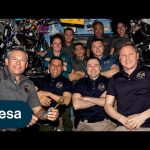
ESA astronaut Andreas Mogensen became commander of the International Space Station (ISS) on September 26, 2023, in a traditional ceremony in which the departing commander, Sergey Prokopyev, handed over the symbolic key of the Space Station. Mogensen is the sixth European to take on the role of ISS commander.
Mogensen will serve as commander for the rest of his Huginn mission until early 2024. During his command, he will be responsible for overseeing the crew’s activities and ensuring the safety and operation of the Space Station.
Credits: ESA/NASA
★ Subscribe: http://bit.ly/ESAsubscribe and click twice on the bell button to receive our notifications.
We are Europe’s gateway to space. Our mission is to shape the development of Europe’s space capability and ensure that investment in space continues to deliver benefits to the citizens of Europe and the world. Check out https://www.esa.int/ to get up to speed on everything space related.
ESA astronaut Andreas Mogensen has begun his Huginn mission, turning the International Space Station into his home and workplace. After piloting on Crew Dragon Endurance as the first non-US pilot, Andreas has started performing European experiments and technology demonstrations with many more to come throughout the mission.
Credits: ESA – European Space Agency
★ Subscribe: http://bit.ly/ESAsubscribe and click twice on the bell button to receive our notifications.
We are Europe’s gateway to space. Our mission is to shape the development of Europe’s space capability and ensure that investment in space continues to deliver benefits to the citizens of Europe and the world. Check out https://www.esa.int/ to get up to speed on everything space related.
Did you know, the Northern lights or Aurora Borealis are created when the mythical Finnish ‘Firefox’ runs so quickly across the snow that its tail causes sparks to fly into the night sky? At least, that’s one of the stories that has been told in Finland about this beautiful phenomenon. Another that we love comes from the Sámi people of Finnish Lapland (among others), who describe them as plumes of water ejected by whales.
Today’s scientific explanation for the origin of the Aurora wasn’t thought up until the 20th Century, by the Norwegian scientist Kristian Birkeland. Charged particles, electrons and protons, are constantly emitted by the Sun, making up the solar wind. This wind slams into Earth’s ionosphere – sometimes sped up to vast speeds by solar storms – and the charged particles are deflected towards the poles by the magnetosphere.
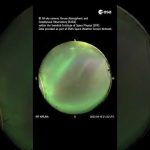
Molecules in our atmosphere then absorb energy from these charged particles from the Sun, and re-release it in their own unique set of colours. Oxygen produces green, but at high altitudes can create red, nitrogen creates blues, and colours can overlap creating purple. Waves, twists and streams are caused by variations in Earth’s magnetic fields. This striking video shows the Aurora over Kiruna, the northernmost city in Sweden. It’s composed of images taken by the Kiruna all-sky camera every minute for about ten hours over 18-19 September 2023.
The all-sky auroral camera is operated by the Kiruna Atmospheric and Geophysical Observatory (KAGO) within the Swedish Institute of Space Physics (IRF), and data from here is provided as part of ESA’s network of space weather services within the Agency’s Space Safety Programme. A sequence of multiple coronal mass ejections – large, sudden ejections of plasma and magnetic field from the Sun – recently struck Earth, and we are still recovering from the passage of the last of them. The fastest was travelling at around 700 km/s, which is considered a small event.
Solar storms are causing an increase in geomagnetic activity; temporary disturbances in Earth’s magnetosphere, which has led to increased light shows at Earth’s poles.
Credits: All-sky camera, Kiruna Atmospheric and Geophysical Observatory (KAGO) within the Swedish Institute of Space Physics (IRF). Data provided as part of ESA’s Space Weather Service Network.
Coronal Mass Ejections or CMEs, are an eruption of around a billion tonnes of particles that comes from the solar atmosphere, the corona, and travels through the solar system. CMEs are an important part of ‘space weather’. The particles spark aurorae on planets with atmospheres, and can cause malfunctions in some technology. They can also be harmful to unprotected astronauts. So it is important to understand CMEs, and be able to track their progress.
Credits: ESA – European Space Agency
★ Subscribe: http://bit.ly/ESAsubscribe and click twice on the bell button to receive our notifications.
We are Europe’s gateway to space. Our mission is to shape the development of Europe’s space capability and ensure that investment in space continues to deliver benefits to the citizens of Europe and the world. Check out https://www.esa.int/ to get up to speed on everything space related.
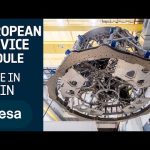
Artemis in Europe: the structure and radiators for the European Service Modules that fly NASA’s Orion spacecraft to the Moon are built in Turin, Italy.
Thales Alenia Space produces the structure that acts like a chassis on a car providing the solid foundations for all other elements to be attached to and also absorbs the forces that the Artemis spacecraft will endure during launch into Earth orbit and onto the Moon.
Technicians assemble the primary structure that is made from a core of Composite Fibre Reinforced Polymer sandwich panels and aluminium alloy elements for the secondary structures. This technology keeps the European Service Module light enough to fly farther and longer but strong enough to keep its shape.
Thales Alenia Space also supplies the radiators for the European Service Modules that consist of six elements forming two independent systems. Like a car’s radiator system the European Service Module radiators are designed to expel excess heat and keep the computers and other components inside from overheating.
The structures are trucked from Turin to Bremen, Germany, where the rest of the hardware that makes a spacecraft can be installed. The first step in their voyage to the Moon.
Credits: ESA – European Space Agency
★ Subscribe: http://bit.ly/ESAsubscribe and click twice on the bell button to receive our notifications.
We are Europe’s gateway to space. Our mission is to shape the development of Europe’s space capability and ensure that investment in space continues to deliver benefits to the citizens of Europe and the world. Check out https://www.esa.int/ to get up to speed on everything space related.
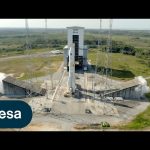
On 5 September 2023, teams from France’s space agency CNES and Arianegroup under the lead of ESA carried out a complete Ariane 6 launch sequence on its launch pad at Europe’s spaceport in French Guiana. The test ended with a hot-fire of the launcher’s core stage and startup of the Vulcain 2.1 engine.
This is a key step in the test campaign. It follows from initial integration of the Ariane 6 launcher on its launch pad, electrical and fluid system tests and the first launch sequence test run on 18 July 2023.
This test involved a launch sequence and final countdown representative of a launch, including removal of the Ariane 6 mobile gantry and filling the launcher’s upper and core stage tanks with liquid hydrogen and liquid oxygen. The test ended with the ignition and the startup of the core stage’s Vulcain 2.1 engine, followed by four seconds of firing.
The next milestone is to complete a core stage long hot-fire test, where the Vulcain 2.1 engine will operate for about 8 minutes.
Ariane 6 is an all-new design, created to succeed Ariane 5 as Europe’s heavy-lift launch system. With Ariane 6’s upper stage and its reignitable Vinci engine, Europe’s launch capability will be tailored to the needs of multiple payloads, for example to orbit satellite constellations. This autonomous capability to reach Earth orbit and deep space supports Europe’s navigation, Earth observation, scientific and security programmes. Ongoing development of Europe’s space transportation capabilities is made possible by the sustained dedication of thousands of talented people working in ESA’s 22 Member States.
www.esa.int/ariane
Credits: ESA/ARIANEGROUP/CNES – Optique vidéo du CSG
★ Subscribe: http://bit.ly/ESAsubscribe and click twice on the bell button to receive our notifications.
We are Europe’s gateway to space. Our mission is to shape the development of Europe’s space capability and ensure that investment in space continues to deliver benefits to the citizens of Europe and the world. Check out https://www.esa.int/ to get up to speed on everything space related.